

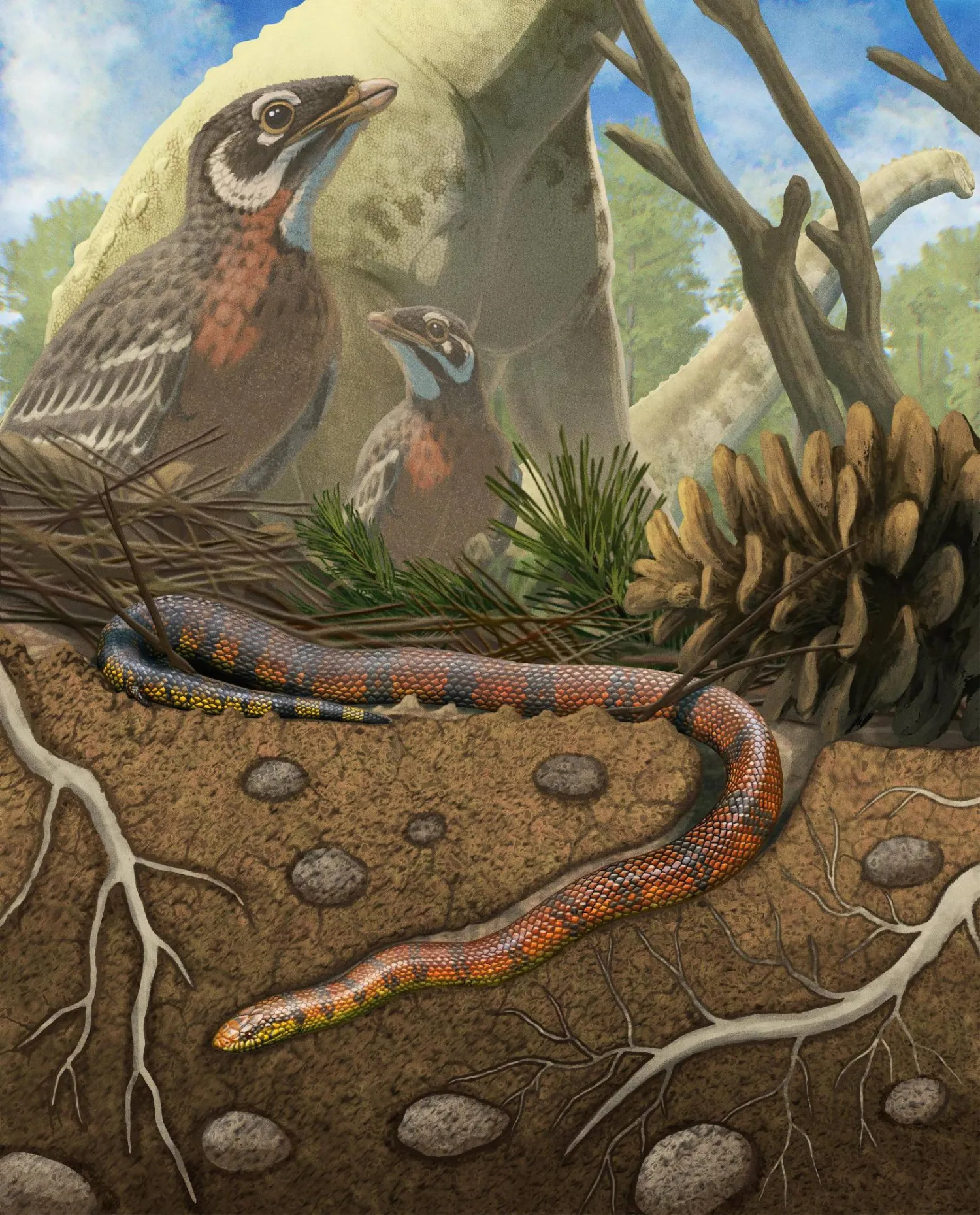

Dinosaur-era Fossil Provides Insight Into Snake Evolution

Life reconstruction of the Cretaceous Period burrowing snake Tametara mirim, shown against a background of long-necked sauropod dinosaurs and the bird Navaornis from the same locality in Brazil. The image was released on July 22, 2026. Gabriel Ugueto/Handout via REUTERS
TT

Dinosaur-era Fossil Provides Insight Into Snake Evolution

Life reconstruction of the Cretaceous Period burrowing snake Tametara mirim, shown against a background of long-necked sauropod dinosaurs and the bird Navaornis from the same locality in Brazil. The image was released on July 22, 2026. Gabriel Ugueto/Handout via REUTERS

Snakes first appeared during the age of dinosaurs, but fossils of many early species are so fragmentary that scientists have had difficulty deciphering their evolution as a group. Now, a well-preserved fossil from southeastern Brazil is offering fresh insight into the history of these slithering reptiles.

The fossil is of a snake called Tametara mirim that lived between 75 and 85 million years ago during the Cretaceous Period and measured about 17 inches (42 cm) long. It inhabited a lush ecosystem alongside animals including enormous long-necked, plant-eating dinosaurs, crocodiles and birds.

While the fossil does not retain all of Tametara's anatomy, a portion of the skull was so well preserved that it enabled researchers to reconstruct the snake's brain anatomy. It was the brain shape and skull bone microstructure that showed that this species lived a burrowing — known as fossorial — lifestyle, as do many present-day species such as coral snakes.

Snakes evolved from lizard ancestors, and are thought to have first appeared roughly 170 million years ago during the Jurassic ⁠Period. But there ⁠are no well-preserved snake fossils from the Jurassic and only a handful from the subsequent Cretaceous, the final chapter in the age of dinosaurs.

"Snakes represent one of the most extreme body plans among all vertebrates — animals with a backbone. Understanding the origin of this peculiar and yet highly diverse group remains one of the biggest mysteries in vertebrate evolution," said Tiago Simões, an evolutionary biology professor at Princeton University in New Jersey and lead author of the study published this week in the journal Nature.

Simões said approximately 60% of the skull and 70% of the vertebral column are preserved in the fossil, which was found in the municipality of Presidente Prudente ⁠in the Brazilian state of Sao Paulo. Most of the cranial region that was preserved was formed by the braincase and skull roof bones, with the back part of the lower jaw positioned as it would have been in life.

"Tametara enters a highly selective hall of spectacularly preserved Cretaceous snakes, with only four species in total with similar preservation. It tells us something we never thought we could learn from fossils until recently: the early evolution of their central nervous system," Reuters quoted Simões as saying.

"This reveals a more complex history of early snake evolution: a larger early diversity of neurosensory adaptations in snake evolution and an evolutionary trajectory of adaptations towards different environments that was not quick or linear. It involved multiple and independent incursions of snakes across different environments during their long evolutionary history," Simões said.

Fossils have shown that Cretaceous snakes adapted to burrowing, ground-dwelling and marine lifestyles.

"We predict the ancestral condition for all snakes was not one strongly adapted to a single habitat. Rather, it was a transitional one, lying in ⁠the interface of fossorial and ground-dwelling ⁠environments," Simões said.

Simões said Tametara most likely preyed on insects but there was no direct evidence of diet. Because the fossil lacked teeth, it was unclear whether Tametara was venomous, as coral snakes are.

While all extant snakes are limbless, fossils show that early snakes retained back legs. The hip area of the Tametara fossil was not preserved, but Simões said the snake almost certainly had robust hindlimbs, like its sister Cretaceous species Najash rionegrina.

Tametara has no direct descendants alive today, Simões said.

Based on cranial fossils, the researchers reconstructed the brain anatomy not only of Tametara but of a second Cretaceous snake, the ambush predator Dinilysia patagonica, which reached about 7 feet (2 meters) long.

"Their brain shapes substantially departed from each other and from most modern lineages of lizards and snakes. This means they had substantial neuroanatomical diversity, and likely sensorial functions, early on in snake evolutionary history," Simões said.

Knowing the brain of any organism is fundamental to understanding its basic functioning and how it interacts with the world, Simões said.

"Tametara's brain had comparatively smaller cerebral hemispheres, the brain's cognitive part, and also a smaller optic tectum, one of the brain parts responsible for vision, than many modern snakes. Some of these differences reflect its burrowing behavior, as burrowers have less requirements for visual acuity than animals living above ground," Simões said.

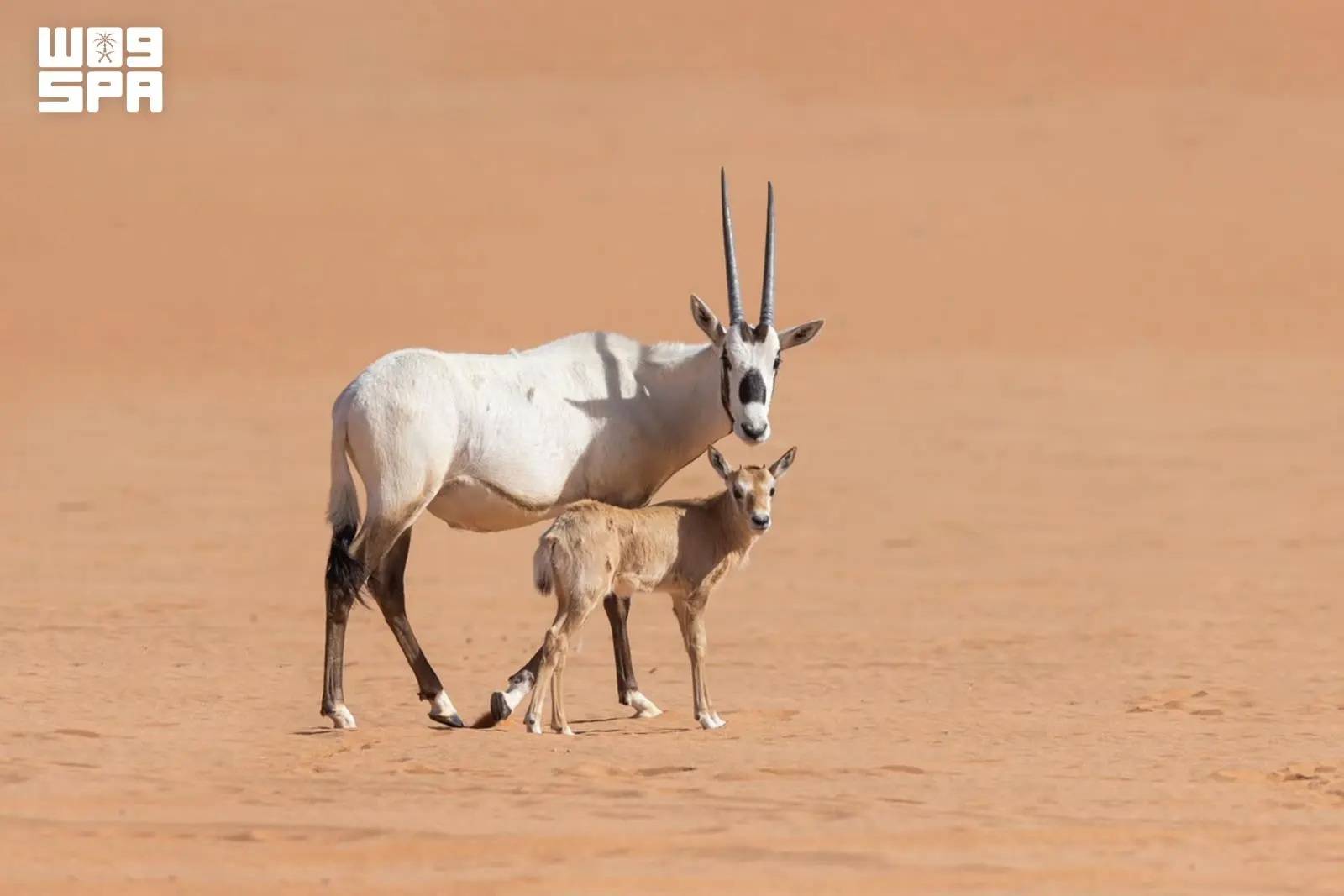

NCW, NEOM Celebrate First Striped Hyena Birth

Striped hyenas play an important ecological role by feeding on carcasses and carrion - SPA
TT

NCW, NEOM Celebrate First Striped Hyena Birth

Striped hyenas play an important ecological role by feeding on carcasses and carrion - SPA

The National Center for Wildlife (NCW), in collaboration with NEOM, has documented the first birth of a striped hyena following the reintroduction of two breeding pairs into NEOM Nature Reserve. The birth is a positive indication of the hyenas’ successful adaptation to the reserve and their ability to reproduce in the wild.

According to a press release issued by the NCW, the birth marks another milestone in NCW’s wildlife breeding and reintroduction programs, which include dedicated efforts for predator species aimed at restoring their natural roles within ecosystems.

Prior to the release, two pairs of striped hyenas were selected and underwent a rehabilitation program at one of NCW’s wildlife care facilities, SPA reported.

The program included veterinary examinations, health monitoring, and preparation for their transition into the wild. A specialized NCW team also conducted a field assessment of the reintroduction site to verify its readiness and ecological suitability for the hyenas.

NCW CEO Dr. Mohammed Qurban said: "This is the first striped hyena birth following their reintroduction, and it marks an important milestone in the center’s wildlife breeding and reintroduction programs.”

He emphasized that reintroducing species into their natural habitats represents an advanced stage in establishing populations capable of surviving and reproducing in the wild and restoring their ecological roles.

Striped hyenas play an important ecological role by feeding on carcasses and carrion. Their populations have declined in parts of their natural range due to several threats, particularly hunting and poisoning.


Chile-led Team Maps Antarctic Plant Genome in Step Towards Climate-resilient Crops

FILE PHOTO: A frozen section of the Ross Sea at the Scott Base in Antarctica on November 12, 2016. REUTERS/Mark Ralston/Pool/File Photo
TT

Chile-led Team Maps Antarctic Plant Genome in Step Towards Climate-resilient Crops

FILE PHOTO: A frozen section of the Ross Sea at the Scott Base in Antarctica on November 12, 2016. REUTERS/Mark Ralston/Pool/File Photo

A team led by Chilean researchers has produced the most complete genetic map yet of one of only two flowering plants that grow naturally in Antarctica, potentially helping the development of crops resistant to extreme weather.

Colobanthus quitensis has long attracted scientific interest because it can survive the freezing temperatures, lack of water and high levels of ultraviolet radiation in Antarctica, one of the planet's coldest and driest environments.

As record heat and extensive drought have increased the urgency of ⁠debate in many ⁠parts of the world over how to adapt agriculture, the scientists said they are now equipped to start assessing whether the plant's traits could be transferred to agricultural crops through gene-editing techniques.

The study, published in Oxford University Press journal "Genome Biology and Evolution," ⁠assembled all 40 chromosome-scale scaffolds that make up the plant's genetic blueprint under a project known as Polarix.

"We were able to sequence and assemble the entire genome," said Eduardo Castro, an associate researcher at Chile's Cape Horn International Center and lead author of the study alongside Claudio Meneses of Chile's Pontifical Catholic University.

"The idea is not to create transgenic plants. The idea is to edit the genome of a plant with ⁠nutritional ⁠value," Reuters quoted Castro as saying.

Identifying individual genes is easier once a genome has been mapped, but it can still take time. When that has been done, Castro said that scientists could need between five and 10 years to develop commercial applications.

A team in California supported the Chilean scientists, who said their work built on previous efforts by the Korea Polar Research Institute. That work produced only a partial version of the genome and was not published.


Stubborn Vulture Reportedly Plucked from Plane's Wing before Greece Flight

A vulture flies over the Iraty mountains, southwestern France on July 2, 2026. (Photo by Gaizka IROZ / AFP)
TT

Stubborn Vulture Reportedly Plucked from Plane's Wing before Greece Flight

A vulture flies over the Iraty mountains, southwestern France on July 2, 2026. (Photo by Gaizka IROZ / AFP)

A vulture who refused to budge had to be removed from the wing of a flight awaiting takeoff on the Greek island of Crete, in order to avoid potential damage to the plane, a local newspaper reported Monday.

The Patris daily said the incident occurred late Sunday at the island's Iraklio airport, when the fire service was called in to remove the large scavenger.

It pictured the bird tucked inside a jacket held by a firefighter. The report did not specify where the flight was headed.

Birds are routinely sucked into aircraft engines, occasionally causing serious accidents.

Last week, the US National Transportation Safety Board said bird remains had been found in the engine of a Ryanair plane that saw a blade break off on July 10, shattering a cabin window and partially sucking a passenger outside.

Four suspected bird strikes to the plane's engine had been reported by flight crews in the 12 months preceding the accident, but no damage was found in subsequent maintenance, the report said.
