Saudi-Bahraini Committee Reviews Joint Security Cooperation

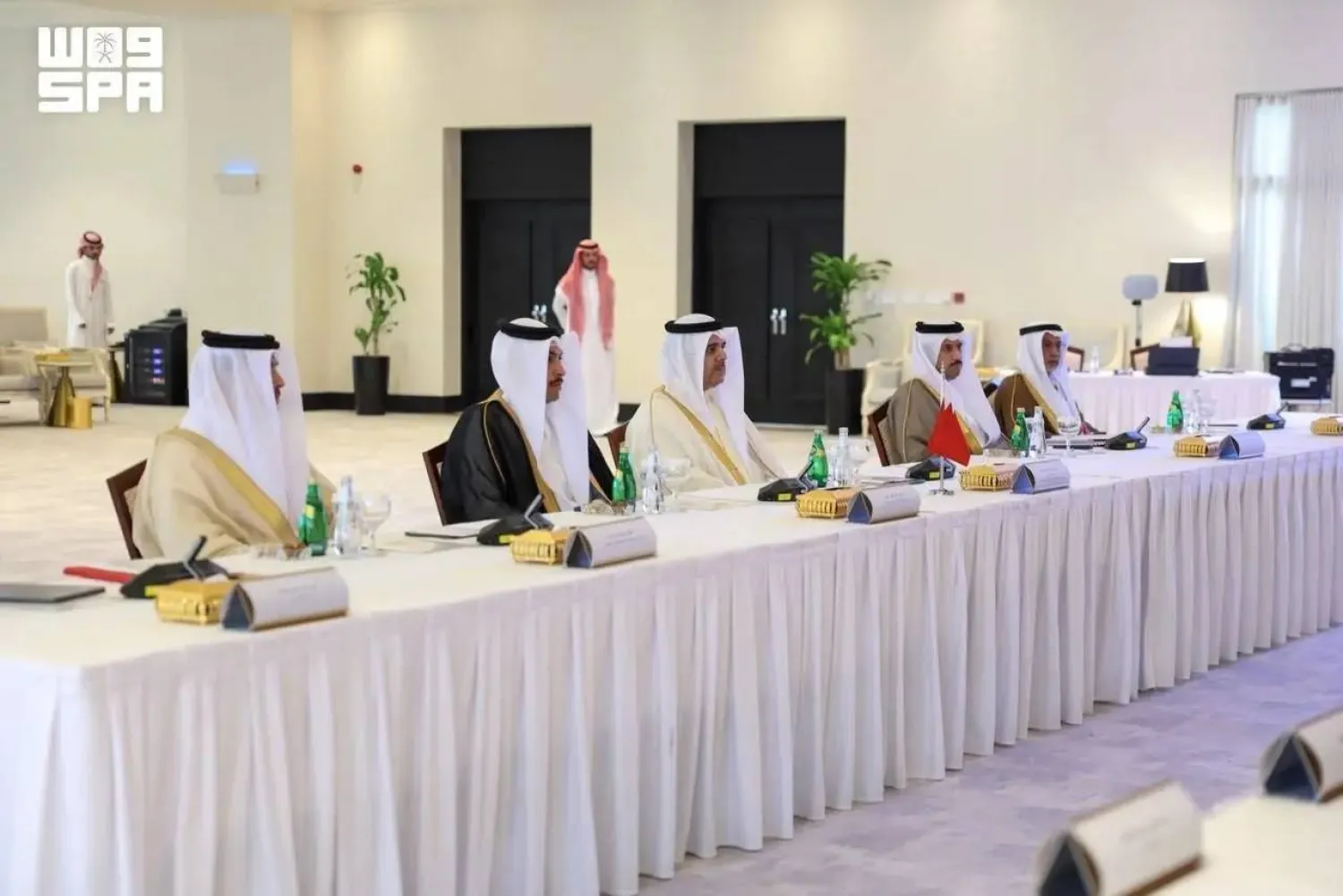
The seventh meeting of the Security Committee Working Group. (SPA)
TT

Saudi-Bahraini Committee Reviews Joint Security Cooperation

The seventh meeting of the Security Committee Working Group. (SPA)

Ahmed bin Sulaiman Al-Issa, director general of legal affairs and international cooperation at Saudi Arabia's Interior Ministry, and Bahrain's Deputy Police Chief Sheikh Hamad bin Mohammed Al Khalifa co-chaired the seventh meeting of the Security Committee Working Group under the Saudi-Bahraini Coordination Council in Riyadh on Thursday, the Saudi Press Agency reported Friday.

The officials reviewed bilateral security cooperation and coordination and discussed ways to strengthen collaboration, according to a Saudi government statement.


Senior Officials, Business Leaders to Attend French-Saudi Roundtable on Monday

Saudi Crown Prince during a previous meeting with the French president at the Élysée Palace in Paris (SPA).
TT

Senior Officials, Business Leaders to Attend French-Saudi Roundtable on Monday

Saudi Crown Prince during a previous meeting with the French president at the Élysée Palace in Paris (SPA).

As part of the official visit of Prince Mohammed bin Salman bin Abdulaziz Al Saud, Crown Prince and Prime Minister, to France, Paris will host the French-Saudi Investment Roundtable Meeting on Monday.

Organized by the Ministry of Investment, the roundtable will bring together senior government officials, business leaders, and CEOs of major companies from both countries.

The roundtable will feature strategic discussions among business leaders on industrial partnerships, transportation and logistics, artificial intelligence, and digital infrastructure. Several agreements and memoranda of understanding covering a range of sectors are also expected to be signed.

The meeting builds on the growing economic and investment ties between Saudi Arabia and France.

It supports joint efforts to expand cooperation, strengthen partnerships between the two countries’ business communities, and translate promising opportunities into high-quality investments and projects that advance their shared interests.


Saudi Arabia Condemns Terrorist Attack on Syria Internal Security Bus

This handout picture released by the Syrian Arab News Agency (SANA) shows a badly damaged bus at the side of a road following a blast in the countryside near the capital Damascus on August 22, 2026. (Photo by SANA / AFP)
TT

Saudi Arabia Condemns Terrorist Attack on Syria Internal Security Bus

This handout picture released by the Syrian Arab News Agency (SANA) shows a badly damaged bus at the side of a road following a blast in the countryside near the capital Damascus on August 22, 2026. (Photo by SANA / AFP)

The Saudi Ministry of Foreign Affairs has condemned the terrorist attack targeting a bus belonging to the Internal Security Command (ISC) in Rif Dimashq Governorate, Syria, which injured a number of ISC personnel.

In a statement issued Saturday, the ministry affirmed Saudi Arabia's solidarity with and full support for all measures taken by the Syrian government to combat all forms of extremism and terrorism.

It also wished Syria and its people lasting security and peace, and a swift recovery for the injured.


From Understanding to Implementation: Riyadh and Paris Redraw their Partnership

French President Emmanuel Macron welcomes Prince Mohammed bin Salman, Saudi Crown Prince and Prime Minister, at the Elysee Palace in Paris on June 16, 2023. (SPA)
TT

From Understanding to Implementation: Riyadh and Paris Redraw their Partnership

French President Emmanuel Macron welcomes Prince Mohammed bin Salman, Saudi Crown Prince and Prime Minister, at the Elysee Palace in Paris on June 16, 2023. (SPA)

Saudi-French relations enter a distinct phase with the visit by Prince Mohammed bin Salman, Saudi Crown Prince and Prime Minister, to Paris. The partnership between the two nations is no longer governed solely by the traditional files that have long formed the relationship's foundation. Instead, it is moving across a broader scope that brings together the economy, technology, energy, defense, and culture, placing project implementation at the forefront of the upcoming period.

The state visit carries a significance that transcends its protocol dimension, coming at a time when both countries are testing the ability of the partnership built over recent years to transition from understandings and agreements into projects with a direct impact. This is taking place as Saudi economic transformations redraw its requirements from international partners, while France is seeking a more firmly established position within the ongoing transformation taking place in the Kingdom.

The holding of the Saudi-French Strategic Partnership Council for the first time during the visit reflects this transformation in the nature of the relationship. The council, established following President Emmanuel Macron's visit to Saudi Arabia in late 2024, was designed to serve as an overarching framework for relations in political, economic, cultural, defense, and other fields, thereby providing cooperation between Riyadh and Paris with an institutional channel at the leadership level of both nations.

A partnership in search of ‘the project’

In previous years, it was easy to list the fields of Saudi-French cooperation: energy, defense, aviation, transport, culture, and tourism. The new phase, however, appears more closely linked to a different question: what can the two countries build together?

Here, the priorities of Saudi Vision 2030 intersect with French industrial and technological capabilities. Saudi Arabia is expanding its economy outside traditional sectors, searching for advanced technologies, industrial expertise, and investment models capable of supporting sectors such as artificial intelligence, advanced industries, health, tourism, hospitality, and new energy.

Conversely, French companies view the Saudi market as one of the world's major new growth arenas, rather than merely a market for products and services. The scale and diversity of Saudi projects grant French firms the opportunity to participate across different phases of the project lifecycle - from design and engineering to operations, localization, and knowledge transfer.

Figures demonstrate the expanding economic base of the relationship. The volume of trade exchange between the two nations reached approximately $11.79 billion (44.2 billion riyals) in 2025. Meanwhile, the stock of direct French investments in Saudi Arabia rose to around $18.52 billion (69.45 billion riyals) in 2024, compared to roughly $7.49 billion (28.09 billion riyals) in 2015, according to data from recent studies on economic relations between the two countries.

Over a single decade, total Saudi-French trade reached around $93.04 billion (348.9 billion riyals), indicating that the economic relationship has become more deeply established than being the product of an individual deal or an isolated project.

Energy: The changing yet continuous relationship

For many years, energy has formed one of the sturdiest bridges in the relationship. However, the nature of this cooperation is shifting with the transformation of the energy sector itself. Moving beyond major partnerships in refining and petrochemicals, most notably "SATORP" between Saudi Aramco and TotalEnergies, the cooperation agenda is heading toward broader fields that include renewable energy, hydrogen, energy storage, smart grids, and carbon capture, utilization, and storage (CCUS), alongside critical minerals.

This transformation aligns with Riyadh's efforts to build a more diversified energy system, and with Paris's desire to expand the presence of its companies in industrial transformation and low-emission energy projects.

Consequently, energy in the Saudi-French relationship is no longer an isolated file, but has instead become part of reshaping the economy, supply chains, and technologies that will serve both economies during the coming decades.

From supplier to partner

The same transformation applies to defense cooperation. The relationship, which has historically been built on training, armaments, and the development of military capabilities, is gradually moving toward fields more closely tied to localization, technology transfer, maintenance, training, and the development of domestic capabilities.

The Kingdom's direction toward localizing a larger share of its defense industries gives international partnerships a different meaning. The requirement is no longer merely acquiring a military system or platform, but building a sustainable domestic capability around it.

This opens an avenue for French companies to participate in a broader ecosystem that encompasses manufacturing, engineering services, training, and research and development.

Paris as a European gateway... and Riyadh as a regional hub

The economic agenda is inseparable from political developments. Saudi Arabia possesses growing political and economic weight in the Middle East and the Arab and Islamic worlds, while France enjoys permanent membership in the UN Security Council, an influential presence within the European Union, and the ability to maneuver regarding regional files.

Coordination between Riyadh and Paris, therefore, has gained importance that transcends bilateral relations, particularly regarding regional security, the Palestinian cause, Lebanon, Syria, and maritime security.

Amid the disruption of trade and energy routes in the region, the importance of seeking more diversified and resilient pathways to transport energy and goods between the Middle East and Europe also emerges - a file where the economic intersects with the strategic.

Saudi-French diplomatic relations date back to 1926, while France opened its diplomatic mission in Jeddah in 1932. However, King Faisal bin Abdulaziz’s stop in Paris in 1967 and his meeting with President Charles de Gaulle represented a significant turning point in building a deeper political relationship.

Since that time, visits and agreements have continued, leading to a phase in which relations experienced accelerated expansion concurrently with Saudi Vision 2030.

The importance of Crown Prince Mohammed’s current visit lies in the fact that it comes after a long accumulation of agreements and understandings, and in the presence of a new institutional framework for the partnership.

Therefore, the essential task ahead for Riyadh and Paris today appears less connected to proving the strength of the relationship, and more to demonstrating what this relationship can produce.

The equation taking shape between the two countries is no longer: what does France sell to Saudi Arabia, and what does Saudi Arabia buy from France? Rather, it is how both parties can invest the major transformations in their economies and global standings to build shared interests that extend for years to come.

This is precisely what makes the state visit to Paris a milestone in the trajectory of the relationship, rather than merely another routine stop within it.