


US Sends More Weaponry to Middle East, Giving it More Military Options against Iran

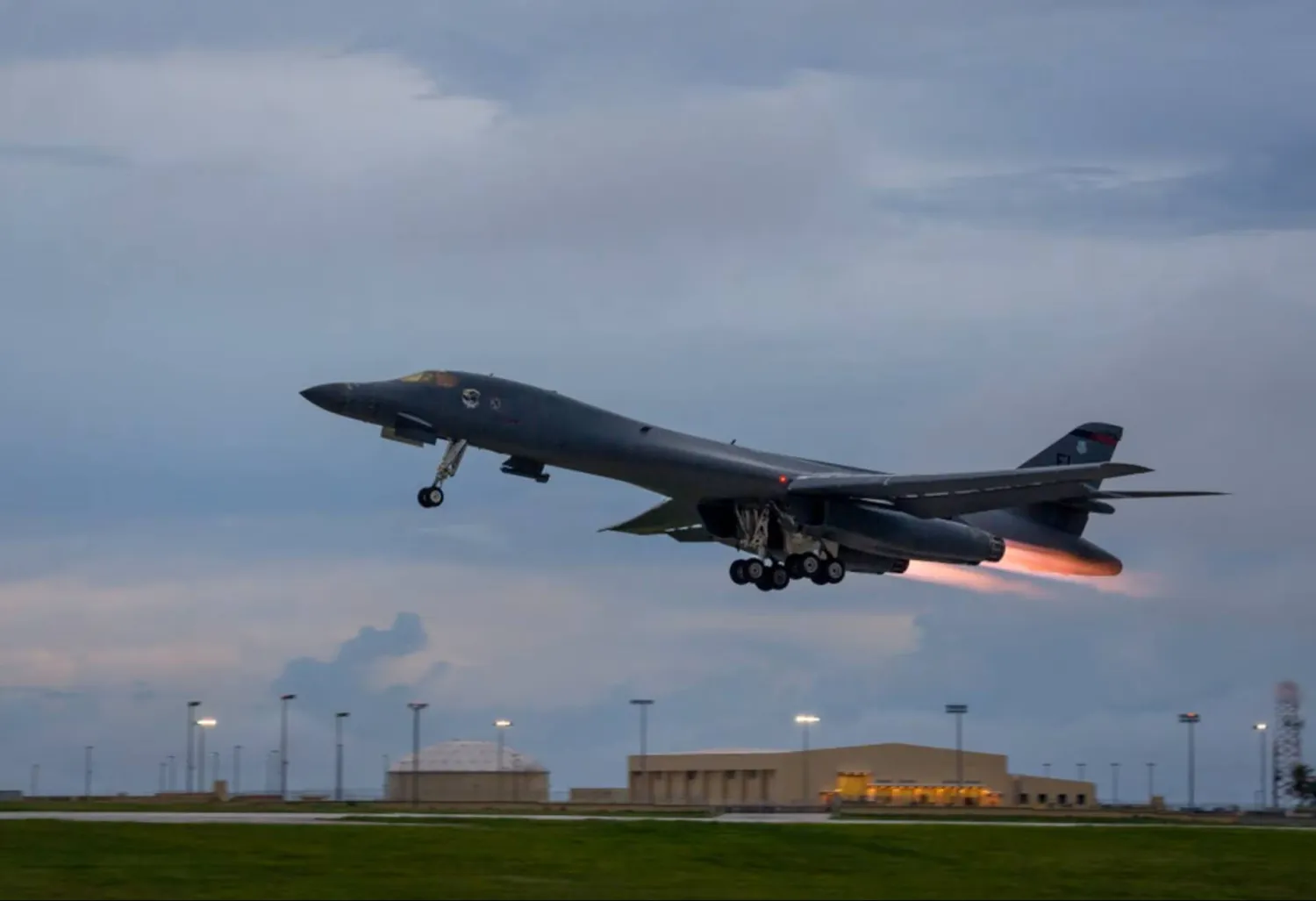
A US Air Force B-1B Lancer assigned to the 37th Expeditionary Bomb Squadron, takes-off to fly a bilateral mission with Japanese and South Korea Air Force jets in the vicinity of the Sea of Japan, from Andersen Air Force Base, Guam, October 10, 2017. (Staff Sgt. Joshua Smoot/US Air Force/Handout via Reuters)
TT

US Sends More Weaponry to Middle East, Giving it More Military Options against Iran

A US Air Force B-1B Lancer assigned to the 37th Expeditionary Bomb Squadron, takes-off to fly a bilateral mission with Japanese and South Korea Air Force jets in the vicinity of the Sea of Japan, from Andersen Air Force Base, Guam, October 10, 2017. (Staff Sgt. Joshua Smoot/US Air Force/Handout via Reuters)

The US is surging forces, medics and weaponry to the Middle East to give President Donald Trump more military options as he considers expanding the conflict against Iran, according to people familiar with the matter, reported the Wall Street Journal on Wednesday.

In the past week, special-operations forces have deployed to the region from their US bases, according to flight-tracking data and US officials. Squadrons of jet fighters have been staged across the Middle East, and bomber aircraft at bases in the US and UK are on high alert to ramp up operations, according to one of the officials.

The preparations are the latest indication that Trump is considering escalating the conflict after three American soldiers were killed in an Iranian attack in Jordan over the weekend. A fourth servicemember was killed in Iraq during a controlled detonation of an Iranian drone.

Additionally, more than 150 medics have arrived at the Landstuhl Regional Medical Center in Germany in recent days, another official said. The hospital is the primary location for treating troops injured in combat in the Middle East.

A spokesman for the Pentagon referred questions about the troop movements to the US Central Command, which declined to discuss details, citing operational security. In a statement, the White House said Trump “always has all options at his disposal.”

Retired Gen. Joseph Votel, the former commander of CENTCOM and of US Special Operations Command, said the surge itself doesn’t necessarily mean major military operations are inevitable.

“The big idea here is to give the president and the secretary [of defense] the most flexibility, and the force the most options to present to them,” Votel said, according to the Journal.

Trump has ramped up his rhetoric against Iran, threatening to punish the country for the deaths of Americans and saying on Tuesday that he might order an assault on Pickaxe Mountain, where Iran is suspected to have buried nuclear-enrichment centrifuges.

The US military used a B-1 long-range bomber on Tuesday to strike Iranian Revolutionary Guard Corps targets in Iran, US officials said, according to Axios.

It was the first time the US conducted a B-1 mission since fighting with Iran resumed.

Using B-1 bombers, which can carry two dozen 2,000-pound bombs or dozens of cruise missiles, signaled a significant escalation and expansion of the US military campaign. The B-1 can fly faster than the speed of sound at low altitudes while carrying the largest bomb load of any type of bomber.

The B-1 launched its mission from an airbase in the UK and was spotted on online plane tracking websites.

CENTCOM did not announce the B-1 mission in its statement on Tuesday about the strikes that day.

It is unclear what the B-1 attacked and whether the massive mission was more effective than other strikes over the last few days, said Axios.

The US conducted several B-1 missions during Operation Epic Fury, hitting missile bases, command centers, weapons storage facilities and air defense systems.

The US military also has sent aerial tankers, F-16 jet fighters from Spangdahlem Air Base in Germany and F-35s from the air base at Lakenheath, England, to the region, the Journal previously reported.



Pentagon Signs Deals with Boeing, RTX to Boost Missile Interceptor Component Production

Pete Hegseth, Pentagon'da düzenlediği basın toplantısı sırasında (Reuters)
TT

Pentagon Signs Deals with Boeing, RTX to Boost Missile Interceptor Component Production

Pete Hegseth, Pentagon'da düzenlediği basın toplantısı sırasında (Reuters)

The Pentagon on Friday announced framework agreements with Boeing and RTX to increase production of components of SM-3 Block IIA and SM-3 Block IB munitions, Reuters reported.

Both agreements will strengthen production of a series of critical ship-fired surface-to-air interceptors that underpin the Aegis Ballistic Missile Defense System, the Pentagon said in a statement.


China Calls Taiwan's Annual Military Drills a 'Wasteful Charade'

A Taiwanese military member fires ammunition aboard an armoured vehicle during a drill as part of the annual Han Kuang military exercises in Taipei, Taiwan, August 13, 2026. REUTERS/Ann Wang
TT

China Calls Taiwan's Annual Military Drills a 'Wasteful Charade'

A Taiwanese military member fires ammunition aboard an armoured vehicle during a drill as part of the annual Han Kuang military exercises in Taipei, Taiwan, August 13, 2026. REUTERS/Ann Wang

China's defense ministry on Friday dismissed Taiwan's annual Han Kuang military drills as a "wasteful charade" that "stoked war panic", in the Chinese government's first official comment on the 10 days of war games since they began last week.

Taiwan, a democratically governed island that rejects Beijing's sovereignty claims, began the exercise last week, as China ramps up its military presence around the island. The exercises rehearsed various scenarios should China ever make good on threats to try to seize the island by force, including how to break a maritime blockade and, for the first time, slowing mobile internet.

"The so-called 'Han Kuang exercise' has always been a posturing, wasteful charade," Chinese defense ministry spokesperson Chen Xi said in a statement, Reuters reported.

"The Democratic Progressive Party authorities have also recklessly stoked war panic, accelerating efforts to turn cities into battlefields and push ordinary people to the front lines," he added, referring to Taiwan's ruling party.

The People's Liberation Army remains on high alert and is fully prepared, continuously enhancing its real-combat capabilities to "counter separatism and external interference", Chen said.

"This remains the solid trump card for safeguarding national sovereignty and territorial integrity, and for maintaining peace and stability across the Taiwan Strait."

Writing on his Facebook page, Taiwan President Lai Ching-te said while the drills has come to a close, government efforts to strengthen defense and enhance the resilience of society as a whole will not cease.

"The government, together with the national military and all citizens, will make every necessary preparation to safeguard our democratic and free way of life through our strength, and maintain peace and stability across the Taiwan Strait," he added. While China has never renounced the use of force to bring Taiwan under its control, it says it would prefer "peaceful reunification".

Taiwan's government says only the island's people can decide their future, and regularly criticises China's pressure campaign.

The Chinese military operates almost daily in the skies and waters around Taiwan.


US Deportees Face Escalating Police Violence, Intimidation in Eq.Guinea

Handout picture released by Guatemalan Migration Institute shows Guatemalan migrants descending from an US military plane after being deported from US at the Guatemalan Air Force Base in Guatemala City on January 24, 2025. Guatemalan Migration Institute via AFP
TT

US Deportees Face Escalating Police Violence, Intimidation in Eq.Guinea

Handout picture released by Guatemalan Migration Institute shows Guatemalan migrants descending from an US military plane after being deported from US at the Guatemalan Air Force Base in Guatemala City on January 24, 2025. Guatemalan Migration Institute via AFP

The masked police officers burst into Ahmed Soliman's hotel room in Equatorial Guinea and dragged him and two dozen other US deportees outside, guns drawn, to deliver a message: go home.

"I have police officers yanking on my neck, trying to throw me on the ground, I have officers elbowing me in my back," Soliman, 30, told AFP of the incident, which occurred two weeks ago.

"Machine guns pointed at our faces, all this just so that they can tell us they're tired of us here in this country," he recalled, saying he and four others were handcuffed and hit by police, in an incident confirmed by two other deportees.

Authorities are ratcheting up pressure on deportees held at the hotel, which has become a dumping ground for expelled US immigrants, including Soliman, who arrived in April, said AFP.

The deportees say they're facing verbal and physical abuse from police, meagre rations and constantly being pushed to return home.

The authoritarian petro-state in central Africa has become a key transit point in President Donald Trump's immigration crackdown, which involves shipping people that the United States can't legally send home to "third countries" like Equatorial Guinea instead.

As their stay at the hotel, under watch from armed guards, drags on for months, authorities are getting impatient, deportees told AFP. A local lawyer also confirmed that deportees are facing pressure to return to their home countries.

"Anytime a problem happens, anytime we're asking for our rights for something, they say, 'Hey, if you don't like it, go back to your country,'" Soliman, who had lived in the United States since he was three and fears returning to his native Egypt because he is gay, told AFP.

The deportees cannot claim asylum in Equatorial Guinea.

But they say they can't leave, because they fear for their lives in their home countries -- and because they were deported without passports.

Soliman said authorities are pressuring him to accept a government-issued travel document instead.

Washington has expelled at least 50 people, mostly Africans, to Equatorial Guinea since November.

Twenty-seven remain in the hotel as Equatorial Guinea has deported people to their home countries, or onward to "fourth" countries.

- 'They're trying to intimidate you' -

At the hotel, the deportees are held on the premises by armed guards.

"They threaten you each and every day," said another deportee, who gave her first name, Petagaye, and has been held in the hotel since June.

"They tell you, 'oh, you need to go back to your country'. Or they tell you, 'oh, just kill yourself, because America don't care'," the 35-year-old said.

Deportees used to be able to walk around the hotel grounds, and sometimes get a police escort to a nearby corner store -- often in exchange for a few dollars -- but that too has seen a crackdown, a deportee who gave the name Him, a pseudonym, told AFP.

"They're trying to intimidate you," said Him, who fled what is now Eritrea during that country's war for independence from Ethiopia, and arrived in the United States as a refugee when he was 13.

"Even though you know you could go back and get killed, even though you ran away from a country and proved it in a federal court of law that we can't go back," said Him, 47.

Neither the US State Department nor Equatorial Guinea's national security minister responded to a request for comment.

- Ebola scare -

In July, deportees were sent into a panic when a guard told them an Ebola patient was being housed in the hotel.

Videos shared with AFP showed men in hazmat suits walking through the building.

Authorities have not commented on the incident and Equatorial Guinea has not reported any Ebola cases.

The three deportees interviewed by AFP had been in the United States since they were children, and spoke with American accents.

All three had won deportation protections preventing them from being sent to their home countries after judges found their lives would be in danger.

Under previous administrations, people with such protections, though legally weaker than asylum, have been allowed to legally work and live in the United States.

The Trump administration has argued that it can still deport people with such protections, as long as it doesn't send them to their home country.

A lawsuit was filed in June at the African Commission on Human and Peoples' Rights, the continent's top human rights body, to try to halt US deportations to Equatorial Guinea.

For now, the deportations continue: 10 more people arrived on July 30, US and local lawyers said.