

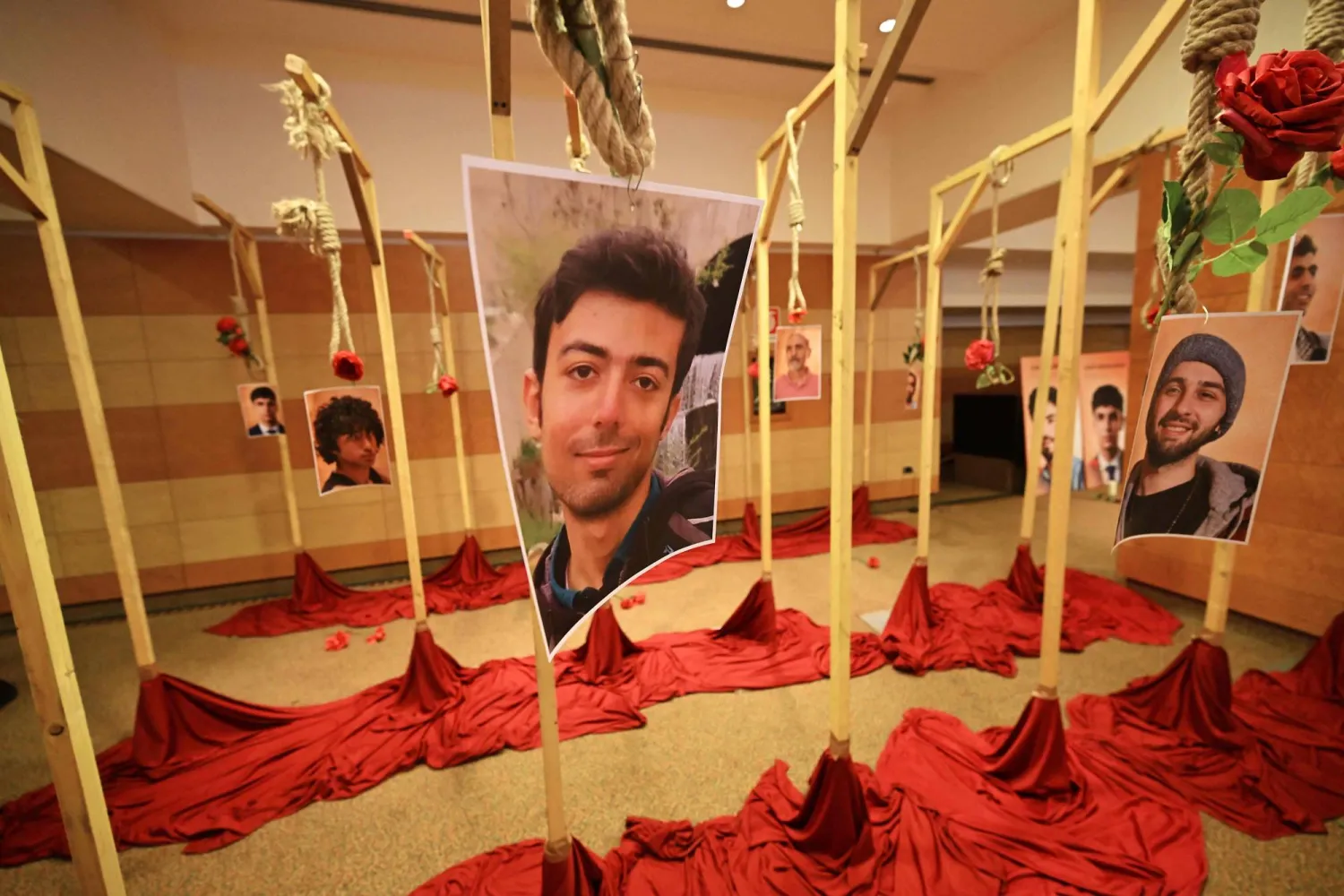

Iran Ramps up Executions Under Shadow of War

This photograph shows portraits of Iranian protesters allegedly executed by the Iranian regime during protests in Iran are displayed during a demonstration at the Ergife Palace Hotel to condemn the silence of Western governments in the face of the growing wave of Iranian political executions, in Rome on July 16, 2026. (AFP)
TT

Iran Ramps up Executions Under Shadow of War

This photograph shows portraits of Iranian protesters allegedly executed by the Iranian regime during protests in Iran are displayed during a demonstration at the Ergife Palace Hotel to condemn the silence of Western governments in the face of the growing wave of Iranian political executions, in Rome on July 16, 2026. (AFP)

Vahid Baniamerian's family only found out he was going to be executed when Iranian state media reports flashed on their phones, saying the supreme court would review his death sentence.

"They did not give any warning. Even the lawyer didn't know," a close relative of Baniamerian, based outside of Iran, told AFP, asking not to be identified.

"It was completely illegal, even based on their own oppressive laws."

Baniamerian, a 34-year-old academic who taught physics, was sentenced to death along with five other defendants on charges of membership of the outlawed People's Mujahedin (MEK) organization. All six men have now been hanged.

He is one of dozens of people that rights groups say are political prisoners Iran has executed since the war with the United States and Israel started, from protesters to alleged members of banned groups and people convicted of spying.

Iran has pressed ahead with executions since the earliest phase of the war finished in March, in what activists see as an attempt to instill fear in society and prevent a repeat of the protests that shook the leadership earlier this year.

The political situation is now all the more febrile after the killing of longstanding supreme leader Ali Khamenei on the first day of the war and his replacement by his son Mojtaba, who has yet to appear in public.

- 'Where else in the world?' -

Now that a shaky ceasefire has ruptured, rights groups fear Iran will further ramp up executions to intimidate people into silence.

"With the breakdown of the ceasefire and the resumption of the war, we are deeply concerned that the authorities will exploit the situation to intensify the execution of political prisoners," said Mahmood Amiry-Moghaddam, the director of the Iran Human Rights (IHR) NGO, which tracks executions.

IHR warns "hundreds of political prisoners and protesters are currently facing capital charges" with around 100 already sentenced to death.

This includes over 70 people awaiting the gallows in a single prison -- Dastgerd in the central city of Isfahan.

IHR has repeatedly called for what it terms Iran's "killing machine" to be a central part of any dialogue with the Iranian regime.

"The international community -- and the European Union in particular -- must make an immediate moratorium on executions a central issue" in any negotiations, said Amiry-Moghaddam.

According to IHR, since the start of the war, 24 people have been hanged over the January protests and another two over a previous protest movement that shook Iran between 2022 and 2023.

Authorities say those convicted carried out deadly attacks against security forces or targeted public buildings, but rights groups say they were tortured and convicted after grossly unfair fast-track trials.

Another 13 men have been executed for alleged links to the MEK and other banned groups, while 10 people have been hanged on accusations of espionage.

But with over 400 people executed so far in this year alone, according to IHR, such high-profile cases do not form the bulk of capital punishment in the country.

Most people are hanged on drugs-related charges or for murder.

To protest the high levels of hangings at their prison, inmates at Ghezel Hesar prison in Karaj outside Tehran have staged a sit-in protest since July 13 after fellow prisoners were taken to solitary confinement ahead of hanging on drugs charges.

Footage shared by rights groups on social media showed inmates sitting outside their cells chanting "no to execution".

"These are prisoners who committed errors simply to afford the basic necessities of life, and they deeply regret their actions. Where else in the world is a human life taken for a first mistake?" the prisoners said in a statement seen by AFP.

- 'Do not cry' -

Last year, Iran put to death over 2,150 people, according to Amnesty International, making it again by a wide margin the world's most prolific executioner after China.

Baniamerian was from childhood "a kind and humble person", his relative said.

"He had a sense of responsibility. He always wanted to help," they added.

"Even in his darkest moments, he chose to encourage others instead of giving in to fear," the relative said.

In his last days in prison he tried to keep up the spirits of his fellow inmates and managed to have smuggled out an audio message to his mother.

"I said goodbye to you and did not know what lay ahead," he said referring to their final meeting.

A video also smuggled out of prison showed him singing a patriotic song in the prison yard ahead of execution.

"The day they took them to solitary, Vahid told them 'do not cry in front of the enemy. We are proud of what we are doing'," his relative said.



Kremlin Says It Does Not Rule Out Restart of Peace Talks with Ukraine and US

In this handout photograph taken and released by the Ukrainian Presidential Press Service on September 6, 2026, US Special Envoy Steve Witkoff (R) and US President Donald Trump's son-in-law Jared Kushner (L) arrive for talks with Ukrainian president in Kyiv, amid the Russian invasion of Ukraine. (Handout / Ukrainian Presidential Press Service /AFP)
TT

Kremlin Says It Does Not Rule Out Restart of Peace Talks with Ukraine and US

In this handout photograph taken and released by the Ukrainian Presidential Press Service on September 6, 2026, US Special Envoy Steve Witkoff (R) and US President Donald Trump's son-in-law Jared Kushner (L) arrive for talks with Ukrainian president in Kyiv, amid the Russian invasion of Ukraine. (Handout / Ukrainian Presidential Press Service /AFP)

The Kremlin said on Monday that it did not rule out the resumption of peace talks between Russia, Ukraine and the United States, but said it was too early to say when ‌and where ‌such talks might ‌take ⁠place.

Kremlin spokesman Dmitry ⁠Peskov made the comments when asked about a weekend visit to Moscow and Kyiv by US envoys Steve Witkoff and ⁠Jared Kushner who ‌are ‌trying to breathe new life into ‌stalled talks designed to ‌find a way to end the war in Ukraine.

Peskov said the Kremlin did ‌not rule out a phone call between Russian President ⁠Vladimir ⁠Putin and US President Donald Trump to discuss the US envoys' trip.

Moscow has not yet received any information about contacts between the US envoys and Ukrainian officials in Kyiv on Sunday, Peskov said.


Majority of Spaniards Unhappy with Government's Handling of Ceuta Crisis, Poll Shows

Migrants rest along a street in the Spanish North African enclave of Ceuta, 04 September 2026. EPA/LAURA RINCON
TT

Majority of Spaniards Unhappy with Government's Handling of Ceuta Crisis, Poll Shows

Migrants rest along a street in the Spanish North African enclave of Ceuta, 04 September 2026. EPA/LAURA RINCON

Nearly nine in ‌10 Spaniards blame Morocco for the mass migrant crossings into Ceuta in late July, while a majority rate Prime Minister Pedro Sanchez's handling of the crisis as "bad" or "very bad", according to an opinion poll released on Monday that also showed a drop in support for Sanchez's party, Reuters said.

The 40dB poll of 2,000 people for El Pais newspaper and radio station SER also recorded an increase in voting ‌intentions for the ‌conservatives and the anti-immigration, far-right Vox party, ‌in ⁠line with several ⁠other polls conducted after the deadly border surge into Spain's North African enclave.

* For 89% of respondents, Morocco bore the most responsibility for the crisis, followed by human-trafficking groups (75%), the spread of disinformation on social media (74%), the migrants who decided ⁠to cross (73%) and the Spanish government (72%), the ‌40dB poll found.

* Only ‌14.2% rated Sanchez's handling of the crisis positively, with ‌two-thirds of those surveyed saying his response was too ‌slow.

* The combined voting intentions for the conservative People's Party and Vox hit 50.2%, leading their potential right-wing alliance to breach the 50% mark for the first ‌time in an opinion poll during this legislature. The center-left bloc fell to 36.1%.

* ⁠The ⁠PP rose to 32.4%, from 32% in the previous 40dB poll in July, and Vox to 17.8% from 17.2%, while Sanchez's Socialist Party dipped to 27.6% from 28%.

* About 27% of respondents named Vox as the most capable party on the issue of immigration, ahead of the Socialists at 18.4% and the PP at 13.9%.

* Seven out of 10 chose tighter border controls over protecting vulnerable migrants and 82% backed increasing fences and surveillance at Spain's borders.


Iran Says to Announce New Restricted Zone in the Gulf in the Coming Days

Vessels at the Strait of Hormuz, as seen from Musandam, Oman, September 6, 2026. REUTERS/Stringer
TT

Iran Says to Announce New Restricted Zone in the Gulf in the Coming Days

Vessels at the Strait of Hormuz, as seen from Musandam, Oman, September 6, 2026. REUTERS/Stringer

Iran said it will announce a new restricted zone in the Gulf in the coming days, along with maps of a new shipping corridor through the Strait of Hormuz, as a weekend exchange of strikes on shipping sent oil prices higher on Monday.

The new restricted zone will begin from where the US blockade of Iran begins and extend into areas of the Gulf, Mohsen Rezaei, the secretary of Iran's Supreme National Security Council, said on Sunday in an interview with state TV.

Few details were provided on the plan, but Rezaei said any ship entering the new zone would be added to a sanctions list, reported Reuters.

In addition, maps detailing passage routes for the Strait of Hormuz, a vital energy conduit largely closed to tanker traffic, would also be approved soon, Rezaei said.

"The maps of a new international corridor which lies in Iranian and Omani waters and in which Iran will have management have been agreed and should be signed in the coming days," he said.

"We will only commit to the Strait of Hormuz being ‌open when they (the Americans) ‌stop the sabotage, threats and attacks on Iran," Rezaei added.

Six months after US-Israeli strikes on Iran sparked ‌the war, the ⁠conflict appears to ⁠be at a stalemate. A preliminary ceasefire accord reached in June has unraveled, and little progress has been made in diplomatic efforts to get the peace process back on track.

After a pause in military action for much of August, tit-for-tat strikes have resumed. US forces struck three Iranian oil tankers on Saturday, US Central Command said, including one off Kharg Island, Iran's key oil export hub, following attacks by Iran's Revolutionary Guard Corps on US warships in the region.

Tehran has shown it retains the capability to attack US interests in neighboring countries and to shut down oil flows through the Strait of Hormuz, through which about a fifth of global oil supplies flowed prior to the conflict.

An average of 10 commodity ships transited the Strait per day in the past 10 days, the lowest since May, according to shipping ⁠data on Monday. That helped oil prices extend last week's big gains, with Brent crude up 0.8% ‌above $97 a barrel.

SANCTIONS, OIL BLOCKADE SQUEEZE ECONOMY 

Iran has said it will step up efforts to ‌tackle problems created by US sanctions that are crippling its economy. 

However, the US campaign to throttle Iran's economy by blockading its oil exports and stopping sanctions evasion is growing ‌increasingly difficult to withstand, three senior Iranian sources have said. 

Iran's Parliament Speaker Mohammad Baqer Qalibaf said on Sunday that the US should understand that the ‌rules of the game have changed "before it is too late". 

"From now on, any attack against Iran’s interests and security will receive a faster, heavier and more painful response,” he said in a speech published on his Telegram channel. 

Qalibaf said that alongside the military front, Iran’s main battle was now over production and people’s livelihoods. 

He cited sharp currency fluctuations, inflation, unemployment and market management as major challenges, adding Iranians could tolerate hardship but not mismanagement or inaction and expected the government to act quickly. 

Iran's Economy Minister Ali Madanizadeh said ‌Tehran planned to respond to US economic pressure with reforms and rejected the notion that sanctions would cause it to change course, according to state media on Sunday. 

“They speak of economic pressure and isolation, of ⁠breaking off financial ties and they think ⁠that by pressuring the economy of a country they can change the decisions of its people,” Madanizadeh said. 

“I have to clarify one point: The responsibility of reforming Iran’s economy is with its government and people, not with the US Treasury." 

KHARG ISLAND HIT 550 TIMES IN PRIOR MONTHS, IRAN SAYS 

Iran is the third-largest producer in the Organization of the Petroleum Exporting Countries and exported 90% of its crude via its Kharg Island export hub before the war. Flows have been disrupted since a US blockade of Iranian oil exports began in mid-April. 

US Central Command said on X that as of Sunday it had redirected 92 commercial vessels, disabled three and boarded two to ensure strict compliance with its blockade. 

On August 31, US President Donald Trump issued a one-line social media post accompanied by an AI-generated video depicting Kharg Island being "blown to smithereens." Iranian authorities have vowed a strong response if Kharg is attacked. 

In an interview aired on state TV on Sunday, Iran's Oil Minister Mohsen Paknejad said the island had been hit around 550 times in previous months but continued to operate. 

Iran's blockade of the Strait of Hormuz has pushed up fuel prices, weighing on Trump's popularity as his Republican Party heads into elections in November when control of Congress is at stake. 

However, US Energy Secretary Chris Wright said oil was getting through the waterway. 

"Our transits through the Strait are averaging over 9 million barrels a day now, and with the access pipelines that go around the strait, we're probably two-thirds or more of pre-conflict flows. So Iranians are still causing trouble, but the United States Navy is winning that battle," he told CNN.