Dollar Gets Yields Boost as Middle East and Trade Wars Raise Inflation Stakes

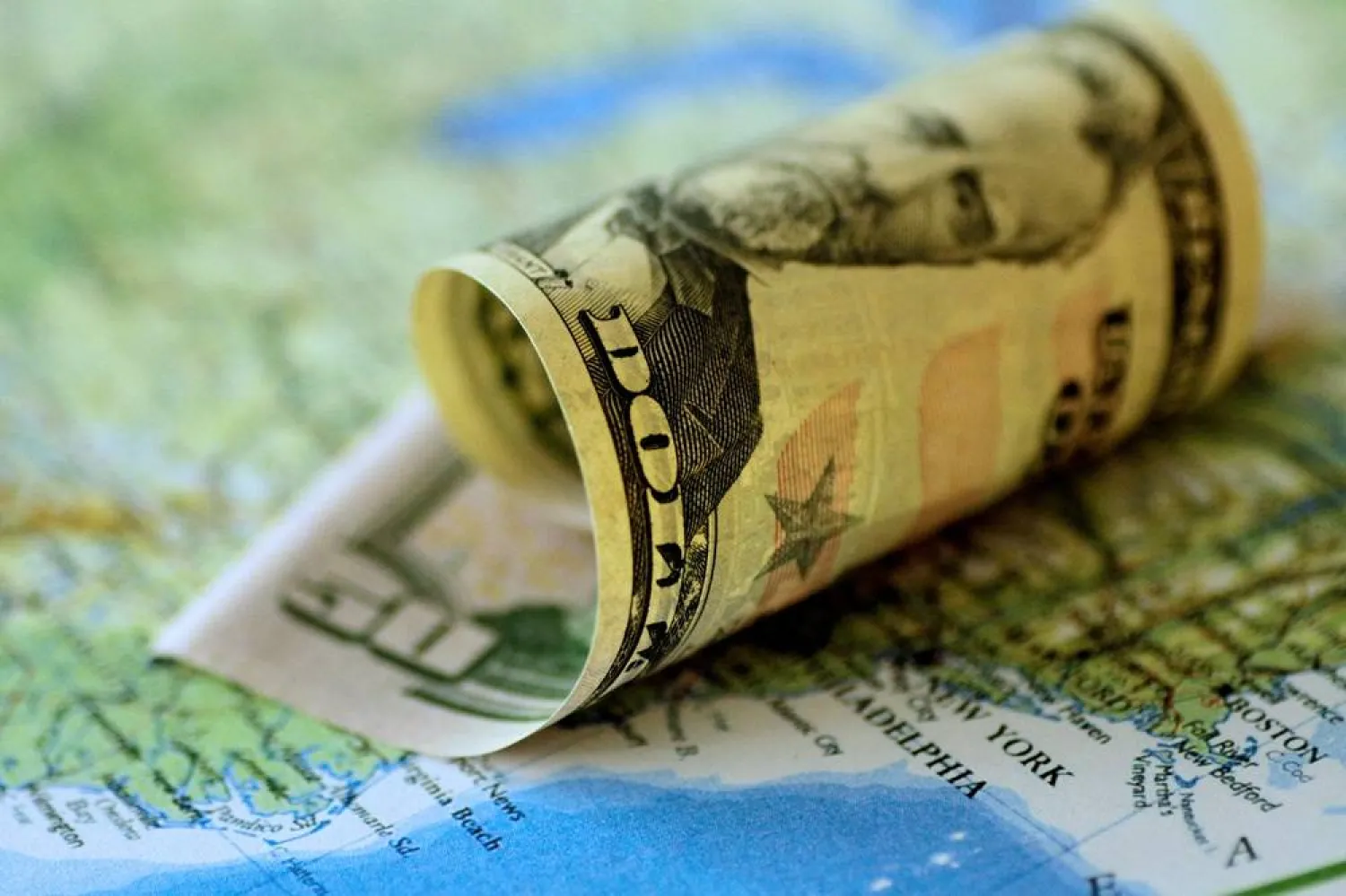
A US Dollar note is seen in this June 22, 2017 illustration photo. (Reuters)
TT

Dollar Gets Yields Boost as Middle East and Trade Wars Raise Inflation Stakes

A US Dollar note is seen in this June 22, 2017 illustration photo. (Reuters)

The dollar was underpinned by higher US Treasury yields on Friday and hovered near a 40-year peak against the yen, as a spike in oil prices and a renewed global trade war raised the stakes for inflation.

Sterling languished around a three-week low and bought $1.3310 in Asia trade, after sliding nearly 0.5% in the previous session against a resurgent dollar.

The euro was similarly nursing losses and wobbled at $1.1381, drawing little support from the prospect of imminent European Central Bank rate hikes, while the dollar held near a three-week top against a basket of currencies at 101.41.

The latest bout of dollar strength came as Brent oil prices climbed back above $100 a barrel after Yemen's Houthis struck two Saudi oil tankers in the ‌Red Sea, extending ‌the Middle East war to a second major shipping chokepoint.

US President Donald ‌Trump ⁠promised "major military punishment" for ⁠Iran and its Houthi allies.

Adding to the inflationary pulse, the Trump administration said it would impose new tariffs of 10% and 12.5% on goods from 60 trading partners over allegations of lax enforcement of forced labor bans, just as a temporary 10% global tariff expires.

"The world must be prepared for a double whammy of tariffs, because essentially oil is a tariff... and the independent supply disruptions... there is a certain actual quantity-determined disruption... then there's a price shock from the (trade) tariffs as well," said Vishnu Varathan, Mizuho's head of macro strategy for Asia-Pacific.

"I ⁠think the world pretty much is more comfortable guessing Trump's style with ‌tariffs, which is to say, big on upfront escalation and open ‌to beg and negotiation. Whereas with Iran and the Houthis, you can't undrop a bomb, can you?"

The fresh ‌turmoil in the Middle East and renewed trade tensions sent US Treasury yields higher on inflation ‌fears, with the benchmark 10-year yield rising to an over 18-month high above 4.7%.

The 30-year yield held well above the 5% level, while 2-year yields were at their highest since February 2025 and last stood at 4.3627%.

"I'm sure the question about whether 30-year yields will hit 6% is not far away, and your 10-year yield at 5% may be ‌now more a bet than a fear," said Varathan.

The strength in the dollar, meanwhile, spelled more pain for the yen, which remained pinned near ⁠a 40-year low at 163.80 ⁠per dollar.

The US Treasury Department on Thursday warned against excessive yen volatility and called for further interest rate hikes by the Bank of Japan.

In other currencies, the Australian dollar was up 0.14% at $0.6978, having fallen more than 0.4% in the previous session, while the New Zealand dollar edged 0.1% higher to $0.5778, after sliding 0.8% on Thursday.

Investors now head into next week facing a slew of major central bank decisions including from the Federal Reserve, where policymakers must contend with mounting inflationary pressures even as the Fed has pared back its forward guidance.

"Removing forward guidance or being less generous with forward guidance, our read on that is... (it's) an actual tightening of financial conditions without actually having to hike rates," said Leonard Kwan, a fixed-income portfolio manager at T. Rowe Price.

"Because what you are doing is you are introducing a little bit more uncertainty, you are retaining optionality within the Fed to be to move in any direction they want. So what that actually means for risk takers is that there's a potential for more volatility to come out from Fed events."


Türkiye Cuts Key Interest Rate to 36%, First Cut in Months

Central Bank of Türkiye (Official Website)
TT

Türkiye Cuts Key Interest Rate to 36%, First Cut in Months

Central Bank of Türkiye (Official Website)

Türkiye's central bank cut its key interest rate on Thursday to 36 percent in the first cut in nine months, pointing to a recent slowdown in inflation.

At a policy meeting, the bank "decided to reduce the policy interest rate ... from 37 percent to 36 percent," it said in a statement.

It was the first cut since January when the bank cut the key rate from 38 to 37 percent, a rate which it held until Thursday's meeting.

"Despite monthly fluctuations, recent inflation figures and leading indicators confirm the downward trend," a bank statement said.

"Data on economic activity and the limited impact of supply shocks on domestic prices suggest that the weak trend in domestic demand continues," it added.

However, ongoing geopolitical tensions were keeping energy prices high, which could push inflation higher, it warned, saying the effects of such geopolitical developments "are being closely monitored".

Türkiye's annual inflation rate eased to 29.7 percent in September from 31.5 percent in August - the first time it had fallen below 30 percent in nearly five years, official figures showed.

At the time, Finance Minister Mehmet Simsek said it was at its lowest level since November 2021. "Disinflation is spreading across the board, excluding transportation," he wrote on X.

The official figures are disputed by the ENAG group of independent economists that publishes its own data, which said its figures showed year-on-year inflation stood at 46.6 percent in September.


Saudi Stock Market Drops 2.3% to Lowest Close Since 2021

A person stands in front of a screen showing falling stock prices (Reuters)
TT

Saudi Stock Market Drops 2.3% to Lowest Close Since 2021

A person stands in front of a screen showing falling stock prices (Reuters)

Saudi Arabia's benchmark stock index ended Thursday's session down 2.3 percent, shedding 231 points to close at 9,696, its lowest closing level since 2021, with total trading turnover reaching approximately SAR 4.9 billion.

The Tadawul All Share Index (TASI) fluctuated between an intraday low of 9,640 points and a high of 9,888 points.

Thursday's decline brought the index's weekly losses to more than 400 points, or 4.1 percent, marking its eighth consecutive week of declines.

Most stocks fell during the session, led by Saudi National Bank, which dropped more than 5 percent to SAR 34.62, with approximately 9 million shares traded.

Saudi Aramco and Al Rajhi Bank each declined 1 percent, closing at SAR 25.40 and SAR 59.80, respectively, while Maaden fell 5 percent to SAR 55.90.

Shares of Retal, Al Yamamah Steel, East Pipes, Jahez, Gulf Training and Saudi Steel Pipe ended the session with losses ranging from 5 to 9 percent.

Meanwhile, Electrical Industries, Abo Moati, Umm Al-Qura Cement, Saleh Al-Rashed, Wafrah, Saudi Vitrified Clay Pipe and Watani Iron Steel each fell 10 percent.

On the upside, Al-Etihad rose 10 percent to SAR 6.16, followed by JAZADCO with gains exceeding 9 percent. Shares of Al Arabia, UCIC and Saudi Kayan advanced between 1 and 3 percent.


Barclays Bank to Cut about 5,000 Jobs amid AI Drive

Barclays says the job cuts are due to AI efficiencies. Paul ELLIS / AFP/File
TT

Barclays Bank to Cut about 5,000 Jobs amid AI Drive

Barclays says the job cuts are due to AI efficiencies. Paul ELLIS / AFP/File

British bank Barclays announced Thursday plans to cut around 5,000 jobs, or roughly five percent of its global workforce, by the end of 2026 in an AI efficiency drive.

The announcement came alongside an earnings update that showed Barclays' net profit grew 13 percent in the third quarter, fueled by surging income across its equities division, said AFP.

Barclays said in an earnings presentation that it was implementing "organizational simplification and technology change efficiency driven by AI".

"About 60 percent of the job losses relate to support functions, including fewer developers as AI makes our people more productive," it added.

The bank's profit after tax grew to £1.65 billion ($2.2 billion) in the third quarter from £1.46 billion in the July-September period a year earlier.

Barclays chief executive C. S. Venkatakrishnan noted "ongoing momentum of... operational and financial performance" and said the investment bank division "delivered strong equities performance".

Revenue from equities jumped 47 percent year-on-year, while total group income for the quarter climbed three percent to £7.37 billion.

Barclays' share price was up slightly following the news updates.

The AI "announcement comes as the company failed to match expectations with its third-quarter performance -- with the unveiling of a healthy share buyback failing to entirely ease investors' disappointment", noted AJ Bell investment director Russ Mould.

"Across the wider group, costs went up and Barclays shareholders are also having to contend with two major clouds over the business.

"The first being a widely expected increase in tax on the sector in next week's (UK) budget and the other being a reported probe into possible misrepresentation of risks in its private credit portfolio."