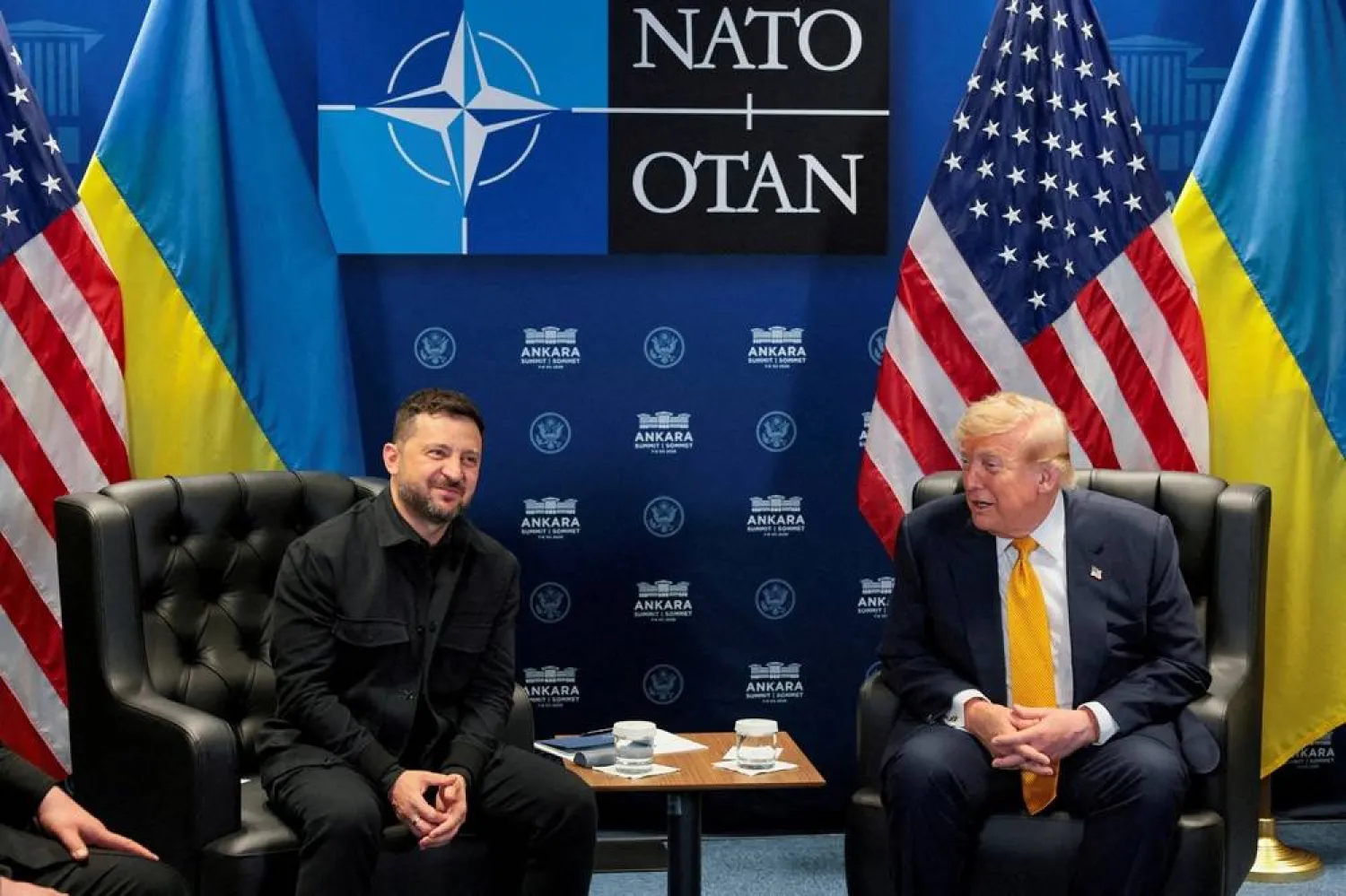
Zelensky to Meet Trump in Washington Next Week

 US President Donald Trump holds a bilateral meeting with Ukrainian President Volodymyr Zelensky alongside the NATO leaders summit at the Bestepe Presidential Compound in Ankara, Türkiye, July 8, 2026. (Reuters)
US President Donald Trump holds a bilateral meeting with Ukrainian President Volodymyr Zelensky alongside the NATO leaders summit at the Bestepe Presidential Compound in Ankara, Türkiye, July 8, 2026. (Reuters)
TT

Zelensky to Meet Trump in Washington Next Week

 US President Donald Trump holds a bilateral meeting with Ukrainian President Volodymyr Zelensky alongside the NATO leaders summit at the Bestepe Presidential Compound in Ankara, Türkiye, July 8, 2026. (Reuters)
US President Donald Trump holds a bilateral meeting with Ukrainian President Volodymyr Zelensky alongside the NATO leaders summit at the Bestepe Presidential Compound in Ankara, Türkiye, July 8, 2026. (Reuters)

Ukrainian President Volodymyr Zelensky will meet US President Donald Trump in Washington on Tuesday, a White House official said, amid a new push to end the war with Russia.

"President Zelensky is slated to meet with President Trump at the White House on Tuesday," the White House official told AFP on condition of anonymity on Friday.

Zelensky will meet Trump on the same day as a memorial service in Washington for US Senator Lindsey Graham, a supporter of Ukraine who died earlier this month aged 71.

Kyiv did not immediately confirm Zelensky's meeting with Trump or whether he would attend the service for Graham.

Zelensky said this week that he had spoken to Trump's envoy Steve Witkoff and son-in-law Jared Kushner in a bid to revive the stalled talks to end the four-year-old war.

The US-led negotiations on resolving the conflict have been stuck while Washington's attention has been diverted to the Iran war.

Trump is meeting Israeli Prime Minister Benjamin Netanyahu on the same day as Zelensky.

Trump and Zelensky have meanwhile had a fraught relationship that has veered from a shouting match in the Oval Office in February 2025 to warmer ties in recent months.


Immigration Judge Rules US Can Deport President of Wisconsin's Largest Mosque

FILE - This photo provided by Yaseen Jajeeb shows Islamic Society of Milwaukee President Salah Sarsour on June 18, 2026, shortly after his release from Clay County Jail in Brazil, Indiana, where he was detained after his arrest by US Immigration and Customs Enforcement agents in March. (Yaseen Najeeb via AP, File)
TT

Immigration Judge Rules US Can Deport President of Wisconsin's Largest Mosque

FILE - This photo provided by Yaseen Jajeeb shows Islamic Society of Milwaukee President Salah Sarsour on June 18, 2026, shortly after his release from Clay County Jail in Brazil, Indiana, where he was detained after his arrest by US Immigration and Customs Enforcement agents in March. (Yaseen Najeeb via AP, File)

An immigration judge ruled that the US government can deport Palestinian American Salah Sarsour, who is the president of Wisconsin's largest mosque and a US permanent resident, under a Cold War-era law.
Sarsour, who grew up in the Israeli-occupied West Bank, was detained by the Immigration and Customs Enforcement agency in late March and released in mid-June after a federal judge said he had raised a substantial free speech retaliation claim that would render his detention unlawful, reported Reuters.
Chicago Immigration ‌Court Judge Jayme ‌Salinardi sided late on Tuesday with the government's argument that ‌Sarsour ⁠posed a security and ⁠foreign policy threat under the Cold War-era Immigration and Nationality Act, while rejecting the government's allegation that he lied on his green card application.
The US Department of Homeland Security welcomed the ruling, saying the judge "sustained multiple grounds of removability" in the case.
Sarsour said his legal team will appeal the ruling, which he called "deeply disappointing."
"I will not stop standing up for what's right and for justice in Palestine," he said in a statement. Sarsour cannot ⁠be deported until all legal avenues available to him are ‌exhausted. He says his life will be at risk ‌if deported to the West Bank.
Islamic Society of Milwaukee, Wisconsin's largest mosque, says Sarsour has ‌lived in the US for over three decades.
The mosque has said Sarsour ‌was "being targeted on the basis of his Palestinian and Muslim background, and his advocacy for Palestinian rights."
He has type 2 diabetes and lost more than 30 pounds in ICE detention, his legal team said.
Sarsour has no criminal record in the US and was convicted as a teenager ‌in Israeli military court before he came to the United States, which the Trump administration noted to cast him as a ⁠threat. Sarsour says ⁠the government has known that information for decades.
Israeli rights group B'Tselem says military courts in the West Bank, where Palestinians are tried for alleged crimes, have a 96% conviction rate and a history of extracting confessions through torture.
President Donald Trump's administration says Sarsour was convicted of throwing Molotov cocktails at the homes of Israeli armed forces.
Sarsour denies committing such crimes and says he was tortured and coerced into past confessions.
Trump has attempted to deport foreign pro-Palestinian protesters, threatened funding freezes for universities where protests were held, enforced a social media screening of immigrants and sanctioned Israel's critics.
Trump alleges pro-Palestinian voices are antisemitic and support extremists. Advocates, including some Jewish groups, say their criticism of Israeli attacks on Gaza and of Israel's occupation of Palestinian territories does not amount to antisemitism, and their advocacy for Palestinian rights should not be conflated with supporting extremism.


Ukraine Urges US to Sanction Entities Supporting Russia's Starlink Rival

Plastic letters arranged to read "Sanctions" are placed in front of Ukraine's and Russia's flag colors in this illustration taken February 25, 2022. REUTERS/Dado Ruvic/Illustration/ File Photo
TT

Ukraine Urges US to Sanction Entities Supporting Russia's Starlink Rival

Plastic letters arranged to read "Sanctions" are placed in front of Ukraine's and Russia's flag colors in this illustration taken February 25, 2022. REUTERS/Dado Ruvic/Illustration/ File Photo

Ukraine is urging the United States to impose sanctions on several Russian entities that it says are helping develop Moscow's Rassvet satellite network as a domestic alternative to SpaceX's Starlink, its acting ambassador said on Wednesday.

Denys Sienik, deputy chief of mission at the Ukrainian embassy in Washington, told reporters Russia was rapidly expanding the Rassvet satellite network, saying its goal to start operations in 2027 would pose grave risks to Ukraine.

"If they launch Rassvet by the end of 2026, they will be able to target to hit Ukrainian targets real time on our territory," Sienik said, adding that he would share details with the US government and Congress about ‌the firms and ‌individuals that Kyiv accuses of aiding Rassvet.

"If these entities are not sanctioned, ‌it ⁠will actually make this ⁠program possible for Russia and that will be a game-changer," Sienik said. He also stressed Ukraine's urgent need for some 300 additional Patriot interceptors by winter, saying that Russia was producing more than 100 ballistic missiles per month.

The US Treasury Department had no immediate comment on Ukraine's push for new sanctions, Reuters said.

Russia plans to start operating Rassvet, a smaller version of Elon Musk's Starlink system, in 2027, Alexei Shelobkov, CEO of Iks Holding, the company developing the service, said in June. The company launched its first 16 low-orbit satellites in March ⁠and plans to reach 900 over several years.

SpaceX currently has more ‌than 10,000 satellites in orbit. Starlink is banned in Russia, ‌and the use of its equipment is subject to fines.

Western nations have targeted the infrastructure behind Russia's space-based communications ‌efforts, but gaps remain. Kyiv has been pressing Washington to expand sanctions against a broader group of ‌Russian companies and individuals.

Ukraine has been pressing for access to expanded Starlink satellite internet coverage so it can strike Russian ballistic missile launchers located inside Russian territory, a position backed by Finnish President Alexander Stubb last week.

SHORTAGE OF AIR DEFENSE

With winter looming, Ukraine has an acute shortage of air defenses to repel Russian ballistic missiles, ‌and Kyiv officials believe that turning on Starlink over Russian territory would help it target the Russian launchers that fire the missiles.

Sienik also questioned ⁠the lack of US ⁠response when Russian strikes hit American firms in Ukraine, saying US complaints about Ukrainian strikes that hit US assets in the Caspian Sea had resulted in closer cooperation and more precise targeting.

But Washington remained silent in terms of messaging to Moscow when US firms in Ukraine were struck, and officials were even reluctant to name the companies affected, he said.

Sienik last week posted details of US firms being hit by Russia missiles in Ukraine, including offices of Boeing, Flex and Bunge. A Coca-Cola facility in the Kyiv region was also hit in September, along with a logistics facility serving McDonald’s, he said in his message on X.

"It is not a coincidence, Russia knows what it is doing by attacking regular businesses operating in Ukraine, supported by American investment and serving civilian needs," he wrote.

"While Russia must be deprived of the possibility to cause more deaths and destruction by strong sanctions, Ukraine must have enough air defense capabilities to protect itself but also to ensure the security of the American businesses operating and investing in Ukraine."



South Korea's Lee Urges North Korea to Restore Dialogue, Pledges Military Buildup

South Korean President Lee Jae Myung delivers a speech during the Armed Forces Day at a military base in Gyeyong, South Korea, Thursday, Oct.  1, 2026. (Jeon Heon-kyun/Pool Photo via AP)
South Korean President Lee Jae Myung delivers a speech during the Armed Forces Day at a military base in Gyeyong, South Korea, Thursday, Oct. 1, 2026. (Jeon Heon-kyun/Pool Photo via AP)
TT

South Korea's Lee Urges North Korea to Restore Dialogue, Pledges Military Buildup

South Korean President Lee Jae Myung delivers a speech during the Armed Forces Day at a military base in Gyeyong, South Korea, Thursday, Oct.  1, 2026. (Jeon Heon-kyun/Pool Photo via AP)
South Korean President Lee Jae Myung delivers a speech during the Armed Forces Day at a military base in Gyeyong, South Korea, Thursday, Oct. 1, 2026. (Jeon Heon-kyun/Pool Photo via AP)

South Korean President Lee Jae Myung on Thursday called on North Korea to help restore trust and resume dialogue, a day after Seoul and Pyongyang traded barbs over a landmine incident that South Korea's military and the UN Command said amounted to an armistice violation.

"I hope that the North joins us now on the path of restoring trust and resuming dialogue, ‌following a ‌long interruption," Lee said in an address ‌marking ⁠the country's Armed ⁠Forces Day, adding that his administration would "consistently pursue practical measures to reduce military tensions between the two Koreas."

The comments came after Seoul's military and the UN Command said North Korea violated the Korean War armistice following a landmine blast last week that wounded ⁠three South Korean soldiers in the Demilitarized ‌Zone (DMZ).

Kim Yo Jong, the ‌influential sister of North Korean leader Kim Jong Un, rejected ‌the findings in a statement on Wednesday, accused ‌Seoul of fabricating the results and warned of retaliation.

Lee reaffirmed his goal of securing the transfer of wartime operational control from the United States to South Korea, calling it ‌part of a long-standing push for self-reliant national defense.

In a wide-ranging defense reform ⁠agenda, Lee ⁠also said in his speech that South Korea would build nuclear-powered submarines by the mid-2030s and upgrade missile defense capabilities, including AI-based command-and-control systems and high-energy laser interceptors.

He said the modernization drive would also involve expanding AI capabilities, restructuring the military for future warfare and strengthening the country's three-axis defense system for detecting and intercepting missile threats.

Lee's government has sought to reopen dialogue with North Korea, but Pyongyang has largely rejected Seoul's overtures while pressing ahead with border fortification work along the DMZ.