

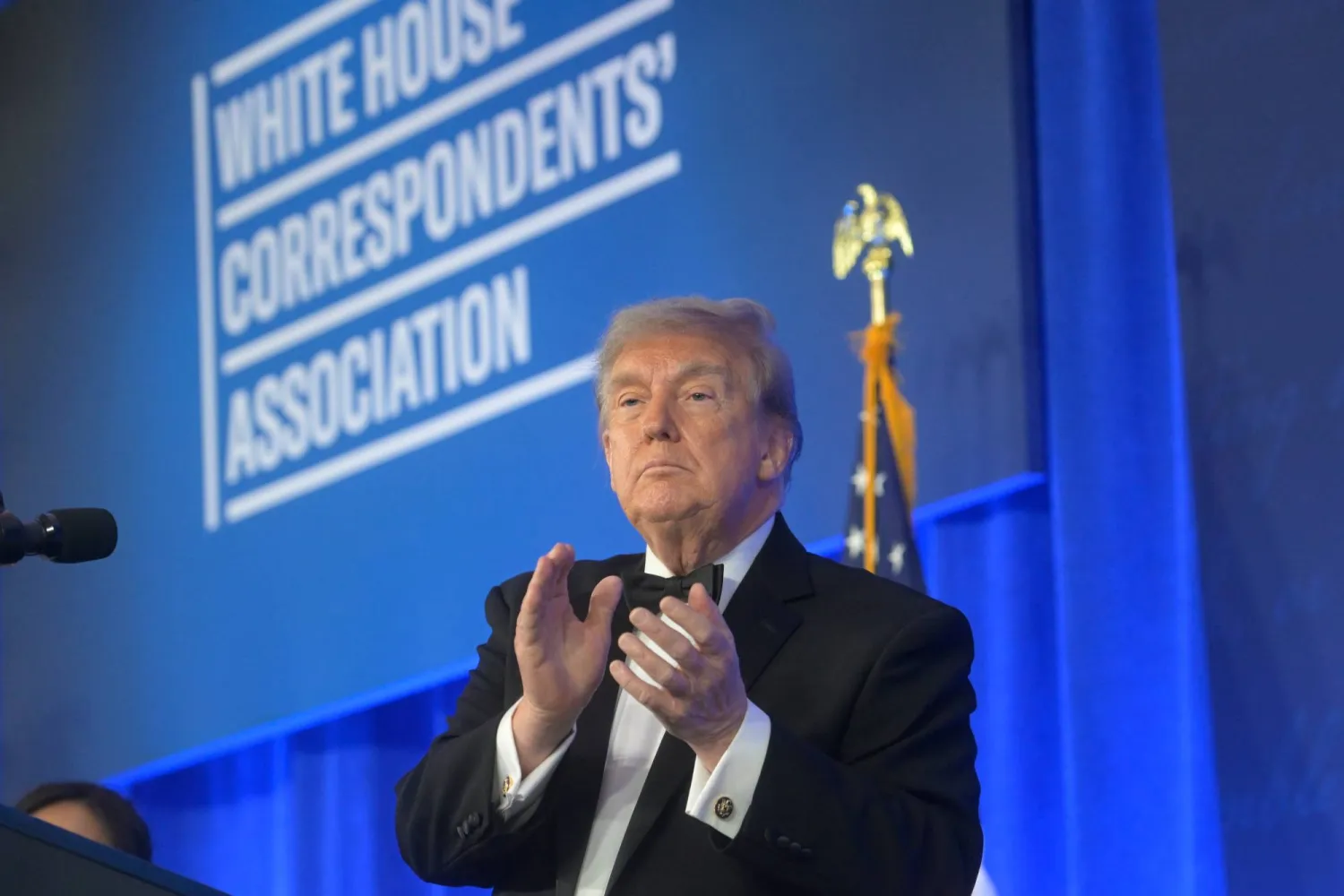

Trump Mixes Jokes with Barbs at Press Freedom Dinner

President Donald Trump speaks at the White House Correspondents' Association dinner at the Waldorf Astoria Washington DC, Friday, July 24, 2026, in Washington. (AP)
TT

Trump Mixes Jokes with Barbs at Press Freedom Dinner

President Donald Trump speaks at the White House Correspondents' Association dinner at the Waldorf Astoria Washington DC, Friday, July 24, 2026, in Washington. (AP)

US President Donald Trump took aim at the press with humor and barbs at the White House Correspondents' Association dinner on Friday, mixing in tropes typical of his political rallies at an event celebrating press freedom that was restarted anew after a shooting disrupted the original event in April.

Trump, whose administration has often been at odds with the press, started by mostly going along with the warm and relaxed tenor of the evening.

But much of the speech, which ran over an hour, veered into broadsides at his political adversaries, echoing oft-repeated themes and attack lines.

The black-tie gathering of journalists, politicians and administration officials, intended for April 25 at the Washington Hilton hotel, was called off that night after a man tried to force his way through a security checkpoint and fired a shotgun outside the ballroom where Trump and members of his cabinet were taking their seats. The suspect, Cole Allen, pleaded not guilty in May to charges including attempting to assassinate the president.

The correspondents' ‌gala has been ‌an annual fixture on Washington's calendar for more than a century and raises money for journalism scholarships ‌while ⁠celebrating press freedoms guaranteed ⁠by the First Amendment of the US Constitution.

Several hundred veteran journalists, along with eight professional journalism organizations, signed a letter urging the correspondents association to use the dinner to condemn what they called Trump’s attacks on the First Amendment. Regardless, the president was afforded typical honors, with only a few awkward moments when he shook hands with journalists winning awards for stories about the Trump administration.

"I hope all of you know that I believe in the free press more than anyone in this room does — maybe not quite. That's why I'm proud to be the most open and transparent president in history," Trump said. "They call me that."

Trump also spoke about the flip side of his attacks on the press: the unprecedented access he ⁠has provided by engaging in frequent question-and-answer sessions with reporters and personally taking phone calls from many ‌of them.

"I always find that when you don't speak to the press, you always ‌get a bad story," said Trump, whose relationship with the press goes back decades to his rise as a well-known New York real estate developer ‌in the 1980s. "When you do speak to the press, you have a shot at getting a good story."

As many of the ‌barbs on his teleprompter fell flat, he questioned the ability of his speechwriters, at one point asking, "Does anybody understand this?"

When one joke bombed, Trump remarked, "That was actually the only thing I thought was good in this whole freaking stupid speech."

Between jokes and insults, Trump returned to topics frequently aired at his political rallies, talking up what he views as his administration's accomplishments on issues such as Iran and crime in Washington.

He was occasionally self-reflective, for instance acknowledging his own ‌weight problem after making fun of others for their size.

This year's dual events marked Trump's first presidential appearance at the correspondents' dinner. He had boycotted the event in his previous years in office, ⁠though he promised to come back ⁠next year.

Press freedom advocates have criticized the Trump administration over lawsuits it has filed against media organizations, restrictions on some journalists' access, and threats of action against broadcasters. He rejects the criticism, saying his administration is promoting accountability and addressing bias.

Friday's event also honored Secret Service officer Victor Gonzales, who was shot at a security checkpoint outside the ballroom in April and is credited with stopping the attack, and the Washington Hilton staff who assisted guests. Gonzales survived wearing a protective vest.

The dinner was moved to a smaller venue at the Waldorf Astoria hotel under heightened security, and one of the first messages of the night was defiance in the face of the assault.

"We do not yield to political violence ... No deranged loser with a gun will ever change that," Trump said, embracing sentiments expressed by other speakers.

Still, he could not resist casting aspersions on his critics in the press and show business, singling out for attacks journalists such as Don Lemon and Lawrence O'Donnell, politicians like Chris Christie and Adam Schiff, and celebrities including Bruce Springsteen and Jane Fonda.

Typical of the competing messages, Trump thanked his hosts and said he made friends, but stopped short of a full embrace of his frequent antagonists.

“It’s been an interesting evening. I really didn't know what to expect," Trump said. "And it’s far worse than I actually thought."



Russia’s Lavrov, China’s Wang Discuss Cooperation, Ukraine, Iran at Asia Security Meeting

In this handout photograph taken and released by the Russian Foreign Ministry on October 14, 2026, Russia's Foreign Minister Sergei Lavrov and China's Foreign Minister Wang Yi hold a meeting on the sidelines of the Seventh Summit of the Conference on Interaction and Confidence Building Measures in Asia (CICA) in Baku. (Handout /Russian Foreign Ministry / AFP)
TT

Russia’s Lavrov, China’s Wang Discuss Cooperation, Ukraine, Iran at Asia Security Meeting

In this handout photograph taken and released by the Russian Foreign Ministry on October 14, 2026, Russia's Foreign Minister Sergei Lavrov and China's Foreign Minister Wang Yi hold a meeting on the sidelines of the Seventh Summit of the Conference on Interaction and Confidence Building Measures in Asia (CICA) in Baku. (Handout /Russian Foreign Ministry / AFP)

The Russian ‌and Chinese foreign ministers discussed the state of bilateral cooperation as well as the crises in Ukraine and Iran during an Asia security meeting, the Russian Foreign Ministry said on Wednesday.

Russian President Vladimir Putin and his Chinese counterpart Xi Jinping reaffirmed ‌their strategic ‌alliance at a ‌regional summit ⁠last August and ⁠both praised prospects for closer cooperation.

The statement on Wednesday said Russian Foreign Minister Sergei Lavrov and his Chinese counterpart Wang Yi met in Azerbaijan at ⁠a meeting of the ‌Conference on ‌Interaction and Confidence Building Measures in Asia.

It ‌said the two ministers "praised the ‌development dynamics of comprehensive partnership and strategic cooperation" and "synchronized watches on bilateral political dialogue".

It said discussions ‌also focused on "relations with the United States and the situation ⁠around ⁠the Ukrainian and Iranian crises".

Both Russia and China have called for an end to the Iran conflict, saying it could expand and threaten stability throughout the region.

China has affirmed its "no limits" partnership with Russia throughout the 4-1/2-year-long war in Ukraine, while calling for diplomatic efforts to end the conflict.


Netanyahu Says He Is Not Seeking to Attack Iran Again Before Israel Election

Israeli Prime Minister Benjamin Netanyahu (C) attends a ceremony marking the opening of Colombia's new embassy in Jerusalem, at the Ministry of Foreign Affairs in Jerusalem, Israel, 14 October 2026. (EPA)
TT

Netanyahu Says He Is Not Seeking to Attack Iran Again Before Israel Election

Israeli Prime Minister Benjamin Netanyahu (C) attends a ceremony marking the opening of Colombia's new embassy in Jerusalem, at the Ministry of Foreign Affairs in Jerusalem, Israel, 14 October 2026. (EPA)

Israeli Prime Minister Benjamin Netanyahu said on Wednesday that he was not in favor of a preemptive strike against Iran before Israel's October 27 election but also warned Tehran and its proxies against striking Israel.

"It is not convenient for us, it's no good," Netanyahu said in an interview on Israel's Army Radio, when asked about the possibility of a preemptive strike and allegations by his political rivals that he was seeking a military confrontation ahead of the election.

"Even if Iran fires missiles at us they will blame me," Netanyahu ‌said, though ‌he also repeated his previous warnings to Iran, saying ‌Israel ⁠would respond forcefully ⁠if attacked.

He would not elaborate on the possibility of a preemptive strike after the election or about his recent discussions with Washington about Iran.

The United States and Iran have been at war since February 28 when the US and Israel attacked Iran and Tehran responded with its own strikes on Israel and Gulf states.

Israel and Iran have not traded ⁠fire since June.

Netanyahu said that Iran's proxies were looking to launch attacks ‌on Israel before the election.

Defense Minister Israel Katz, speaking from the self-declared security zone Israeli forces are ⁠occupying in southern Lebanon, ⁠warned Iran-backed Lebanese group Hezbollah against attacking Israel.

"Hezbollah will suffer a severe blow and lose additional territories in southern Lebanon within the Nabatieh and Litani regions, which will become part of Israel's permanent security zone. The army is prepared to carry out the maneuver," Katz said.

Katz said that a million Shiites would be displaced and that Hezbollah's stronghold in Beirut would not be spared.

Israel launched air strikes and a ground invasion in southern Lebanon this year in parallel with the war in Iran, after Hezbollah fired into Israel in revenge for the attacks against Tehran.

Hundreds of thousands of people from Lebanon's Shiite community, from which Hezbollah draws its support, were uprooted by the fighting.


Israel Army Chief Says Reinforcing Troops on All Fronts

Israeli army chief Lieutenant General Eyal Zamir. (Reuters file)
TT

Israel Army Chief Says Reinforcing Troops on All Fronts

Israeli army chief Lieutenant General Eyal Zamir. (Reuters file)

Israel's army chief said on Wednesday that the military was reinforcing troop levels "across all fronts", citing an increased risk of escalation as the country heads into elections this later month.

On a visit to the occupied West Bank, Lieutenant General Eyal Zamir said the potential for incidents on Israel's borders had grown because of the election period, with Prime Minister Benjamin Netanyahu facing a tight race to stay in power in the October 27 poll.

"In light of the increased number of alerts across all fronts and the sensitivity of this period, the potential for escalation has grown," he said, according to an Israeli military statement.

"We have reinforced our forces across all areas."

He added that the military had raised its level of readiness as it prepares "for scenarios in which attempts may be made to catch us by surprise".

Israel recently marked the third anniversary of Hamas's surprise October 7 attack, in which the group's fighters stormed into Israel with pickup trucks and paragliders and opened fire at sites including a music festival.

Citing the need for "vigilance", Zamir said the military was "at a high level of readiness to launch extensive offensive operations against anyone who attempts to harm Israeli civilians".

In Gaza, a year after a US-brokered ceasefire agreement between Israel and Hamas took effect, the Israeli army now controls more than 60 percent of the devastated Palestinian territory and its strikes are ongoing.

In Lebanon, violence has decreased in the south since a framework agreement between the government and Israel, which includes the disarmament of Hezbollah. But the implementation of that deal has stalled.

Israel has also faced incoming fire from Iran during the Middle East war, which began in February with US-Israeli strikes on the country.