


Young Japanese Artists Turn School Blackboards into a Hit Medium for Creativity

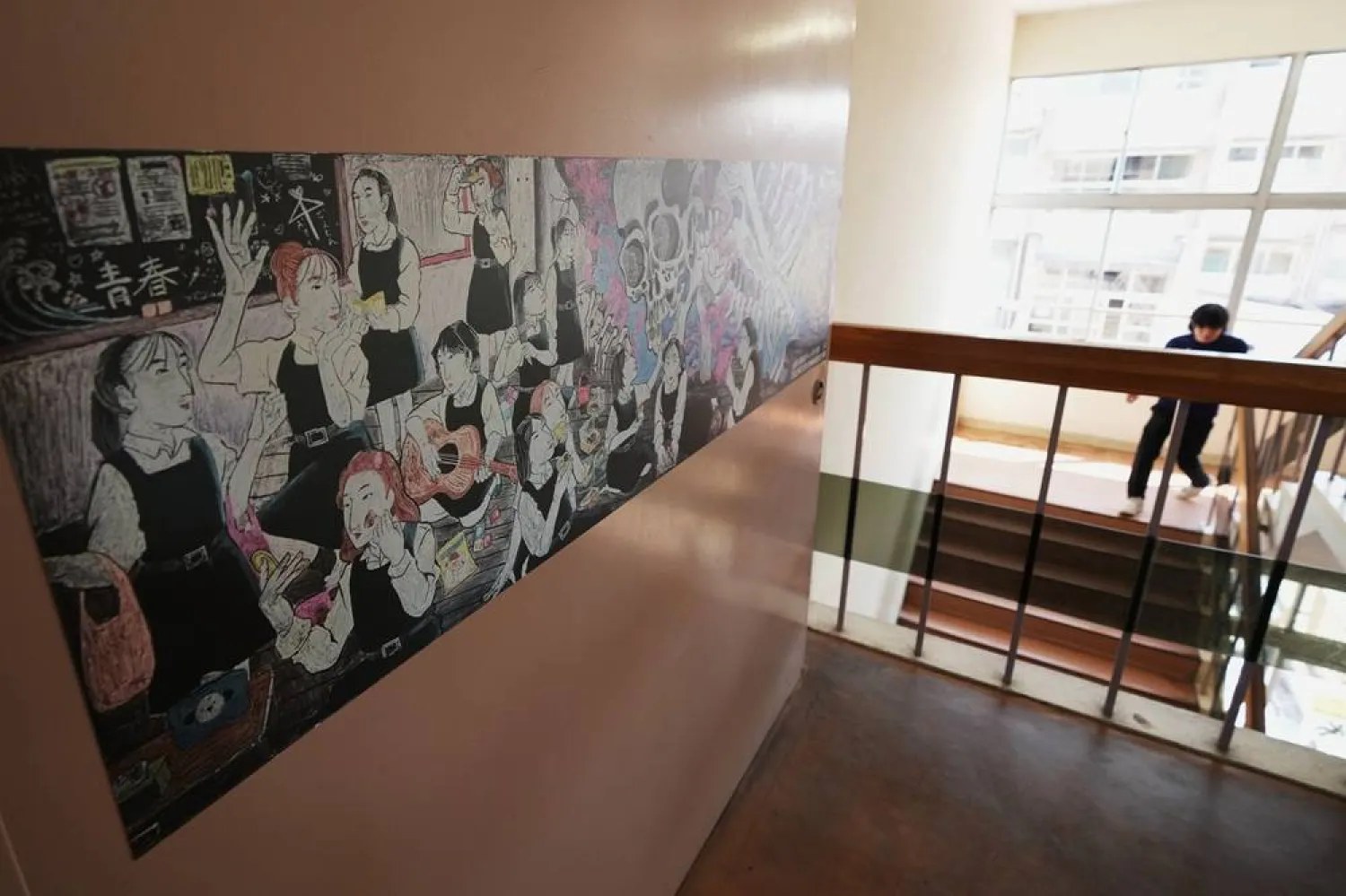
A teacher walks down stairs near a blackboard artwork displayed on the hallway at Kumagaya Girls High School in Kumagaya, northwest of Tokyo, Tuesday, July 21, 2026, after its art club members won the first prize in a national blackboard art contest in 2023. (AP)
TT

Young Japanese Artists Turn School Blackboards into a Hit Medium for Creativity

A teacher walks down stairs near a blackboard artwork displayed on the hallway at Kumagaya Girls High School in Kumagaya, northwest of Tokyo, Tuesday, July 21, 2026, after its art club members won the first prize in a national blackboard art contest in 2023. (AP)

The humble blackboard is serving as the canvas, and colorful chalk the paint, for young Japanese artists.

“Kokuban Art Koshien " is an annual national chalk art championship for high school students. Combining the word for “blackboard” ("kokuban") and the famous stadium where high school baseball is contested, the contest attracts artworks, all drawn on blackboards, usually over summer break, from about 300 high schools and junior high schools.

Each work — many dazzling in their artistry and often dreamlike themes — is a collaborative endeavor bringing together anywhere from one or two youngsters to dozens, all delivering a lesson in creativity and teamwork.

The images range from energetic depictions of dinosaurs, dogs and whales; popular manga scenes; Hokusai ’s Mount Fuji or the Mona Lisa, as well as slices of everyday life, except they aren’t all that everyday, such as an underwater classroom.

Some works even show a person writing on a blackboard.

Innovative and experimental art

Kazunari Minamishima, an art teacher at the Saitama Prefectural High School of the Arts, whose students have taken part in the contest, believes it appeals to students because it offers the chance to be more experimental than established forms of art, such as oil painting and sculpture.

“It’s still a work in progress,” he said.

The contest began in 2015 by Nichigaku Co., a Tokyo-based blackboard maker. The annual judging is done by examining the photos of the works, given that the medium, blackboards, can’t be moved easily. The winners will be announced in November.

The use of blackboards for creating artworks existed before in the Japanese school system. It was a stunning replica of Da Vinci’s “Last Supper” by an unknown artist on a school blackboard that caught Nichigaku’s eye.

“Back then, there was graffiti, but there was no genre called blackboard art,” said Nichigaku President Tomohiro Yoshida.
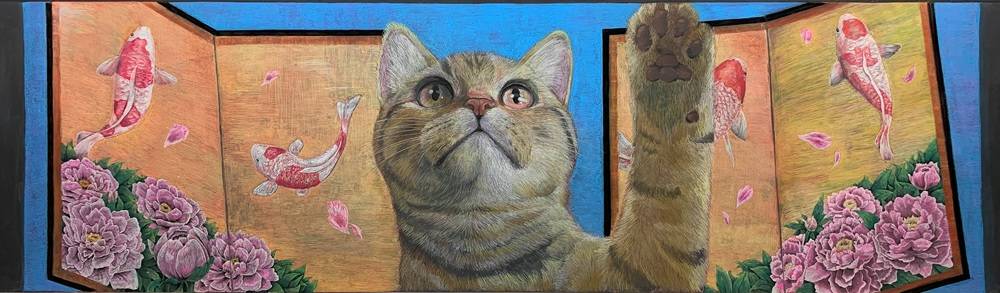
This undated image provided by Nichigaku Co., a Tokyo-based blackboard maker, shows the blackboard artwork by top winner in the main category in 2020, titled, "Grab It" by students at Fukushima Prefectural Aizu Gakuho High School. (Nichigaku Co., via AP)

The contest doesn’t really work as a direct marketing tool because schools already have blackboards. But some contestants become professional artists later, Yoshida added proudly.

Chalk powder gets scattered over the blackboard for an almost stardust effect. Smudging with fingers and tissue paper creates shadows and muted tones.

A skilled blackboard artist can depict the shiny translucence of a dragon’s eyeball. One award-winning work used chalk powder mixed in water sprayed a la Jackson Pollock.

‘Better friends while doing it’

All schools in Japan can enter the Kokuban Art Koshien contest, including international schools. Nichigaku hopes the contest can expand overseas some day.

But unlike the paint-on-walls graffiti of the West, blackboards can be erased. The students get permission from the schools to draw on the blackboards in advance, reflective of Japan’s conformist orderly culture.

“The challenge of trying to sort out the conflicting opinions of my two collaborators is the biggest memory about taking part in blackboard Koshien, as opposed to doing your own artwork,” said Kento Misumi, who took part in the contest as a high school student and now works at Nichigaku.

It’s harder than you think, and he and his friends devoted several days to one drawing, Misumi recalled, demonstrating how to draw an apple with chalk on a blackboard.

“I want young people today to go through the experience,” he said.

It was exactly the kind of brainstorming that was going on among a huddle of several students at the Kumagaya Girls' High School, north of Tokyo, in nearby Saitama Prefecture.

They were taking part in the contest for the first time, although their upper grade schoolmates have taken part and won prizes in the past.
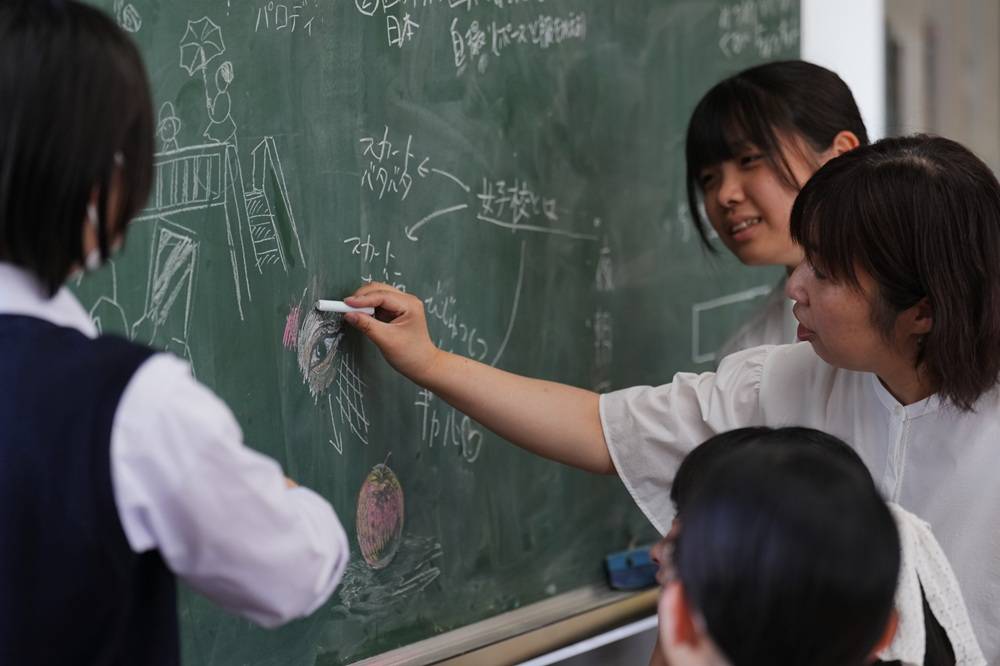
Art teacher Makiko Aoki, right, shows chalk drawing skills to freshman members of the art club at Kumagaya Girls High School in Kumagaya, northwest of Tokyo, on July 21, 2026. (AP)

“I see it as a chance to deepen my relationships with my schoolmates,” said Chiho Ninomiya, one of the students. “It's our first time so I'm not sure we will be able to do a good job. But even if we don't win, it'd have been worth it as long as we become better friends while doing it.”

Lesson on the impermanence of life

Among the ideas discussed for this year's entries were what they called parodies or spinoffs of well-known artworks like Renoir, juxtaposed with images of high school students in their uniforms, their skirts fluttering.

A blackboard may be a longtime familiar object in classrooms. But drawing art on them with chalk is different from using paints or pencils, Ninomiya said, so they are still learning, drawing, rubbing, and wiping.

It can be heartbreaking when the arduously created pieces get erased. But the artists are able to share that heartbreak with their collaborators.

Proponents say it’s a great educational tool to deliver the lesson on the impermanence of life, the fragility of creation and the courage to keep going. For when the work gets erased is the moment that the art is considered to be truly complete.



Food Industry Pushes Back on WHO Guidance for Products with Added Color, Sweeteners

Around 11 million deaths a year are linked to unhealthy diets, according to the agency, based on data from a global study. (Getty Images)
TT

Food Industry Pushes Back on WHO Guidance for Products with Added Color, Sweeteners

Around 11 million deaths a year are linked to unhealthy diets, according to the agency, based on data from a global study. (Getty Images)

Governments should consider regulating foods that include added colors, flavors or sweeteners designed to make the product more appealing to consumers, according to new draft World Health Organization guidance that has sparked swift pushback from the food industry.

The WHO draft aims to help governments identify which foods should be consumed in moderation as part of a healthy diet – and which products could be subject to measures like warning labels or taxes, depending on national priorities.

The new draft food-profiling model, published last week, marks the first time the UN health agency has included this type of ‌ingredient in its guidance, ‌previously only focused on nutritional content, including fat and salt.

“This draft ‌goes ⁠beyond traditional nutrient ⁠profiling by recognizing that foods may need to be considered not only for their nutrient content, but also for other aspects of their formulation” in order to prevent diet-related disease, said Katrin Engelhardt, technical officer at the WHO's department of nutrition and food safety.

Around 11 million deaths a year are linked to unhealthy diets, according to the agency, based on data from a global study.

The proposed new model is also the WHO’s attempt to guide member states through an increasingly polarized debate ⁠about ultra-processed foods (UPFs), a class of food or drink made using processing ‌techniques, additives and industrial ingredients, which often contain little ‌whole food. Examples include carbonated soft drinks or instant noodles.

BEYOND NUTRIENTS ALONE

Many food scientists say UPFs pose ‌numerous health risks but others – and the food industry – say they are defined too widely, ‌which risks demonizing healthy products.

The International Food and Beverage Alliance, an organization representing major multinational food and beverage companies, said it was concerned the proposed approach shifts attention away from nutritional quality and could capture more products for potential regulation.

"Of particular concern is the potential to undermine established nutrition priorities and reformulation ‌efforts,” said IFBA Secretary General Rocco Renaldi.

Other concerns for the food industry are higher costs from reformulating products or stringent labelling requirements, as well ⁠as the risk ⁠of class-action lawsuits as seen in the United States, and higher taxes for processed food companies.

Broadly, the WHO said the model covers “industrially-produced foods to be consumed in moderation” and is a bridge between its healthy diet recommendations and government policy on individual food products.

Lindsey Smith Taillie, co-director of the Global Food Research Program at the University of Chapel Hill, North Carolina, said the point of the model was to target unhealthy foods, combining both nutrients and UPFs.

“These two frameworks have never been mutually exclusive and can and should be used by policymakers as the starting place,” she said, adding that healthiness is measured by multiple criteria.

Kraft Heinz CEO Steve Cahillane last week told Reuters that industry players should have a say.

"We're in the food business and we care about consumers deeply," Cahillane said. "And so we ought to have a seat at the table as these discussions evolve."

The WHO proposal is out for consultation until November 27.


Pakistan Farmers in Long Fight to Make German Firms Pay for Flood Damage

Dozens of Pakistani farmers are suing German firms RWE and Heidelberg Materials in a rare bid to make big polluters pay damages for climate impacts. Aamir QURESHI / AFP
TT

Pakistan Farmers in Long Fight to Make German Firms Pay for Flood Damage

Dozens of Pakistani farmers are suing German firms RWE and Heidelberg Materials in a rare bid to make big polluters pay damages for climate impacts. Aamir QURESHI / AFP

In a Pakistani village nestled in rice fields, Abdul Hafeez Khoso remembers the vast industrial zones he saw in Germany when he visited to file a pioneering climate legal case.

"They're spreading pollution: up in the sky there are no borders, it can affect anywhere," the 43-year-old said, describing areas far larger than his village of 800 people.

"This is a problem for the whole world -- that is why it should be resolved at the global level."

Khoso and 38 other farmers from Pakistan's southern Sindh province who were devastated by "apocalyptic" flooding in 2022 are suing German energy firm RWE and cement maker Heidelberg Materials in a rare bid to make big polluters pay damages for climate impacts.

The companies are being targeted not over specific operations in Pakistan, but because of their climate-warming emissions. They are headquartered in Germany, where a recent legal case opened the door to such suits.

The litigation argues that the companies' emissions contributed to climate change and turbo-charged rain that wiped out their crops, livestock and homes.

"The year 2022 was an apocalyptic scene -- not even our elders had ever witnessed such weather," Khoso, who lives in the district of Jacobabad with his wife and toddler, told AFP.

"We had nothing left."

Both firms, which the plaintiffs estimate contributed 0.68 percent and 0.12 percent to global industrial emissions respectively, deny wrongdoing.

Khoso's case is backed by Pakistani and European organizations hoping to win compensation and build on nascent but vigorous international efforts to extract climate damages from corporations.

"We always blame natural disasters, and sometimes we blame God, but science tells us that climate change is increasing the risks and intensity of extreme weather events," said Mir Keerio, a development expert at Pakistan's HANDS Welfare Foundation, which mobilized communities for the lawsuit.

"Those who have contributed significantly to this crisis must be held accountable... we realized we must take our fight for climate justice to the major polluters."

- Debt and damages -

Climate litigation is a growing field globally, but action has so far largely targeted governments, with only a handful of firms such as Shell and cement maker Holcim facing suits for climate disaster compensations.

Lawyers say a ruling requiring a company to pay out compensation proportionate to its greenhouse gas emissions would mark a major breakthrough.

Germany's judiciary moved towards that principle last year in a case brought by a Peruvian farmer, also against RWE.

His compensation claim was rejected, but the courts left the door open to holding emitters liable.

Roda Verheyen, a German lawyer involved in both cases, told AFP the Pakistani farmers' lawsuit builds on that ruling and further accuses companies of "wrongful behavior".

"Large companies knew about the general impacts of climate change since the 1960s," said Verheyen.

"They should have exercised due diligence and actually at least tried to reduce emissions, which they didn't do enough."

The lawsuit also draws on research documenting farmers' losses in the floods, which hit a third of the country, killed 1,700 and affected 30 million Pakistanis.

Munawar Khatoon, a rare female landowner in a conservative area, said the floods struck just before the wheat harvest, submerging seeds and wiping out her family's main source of income.

"We worry about how the next generation will manage to live if this continues," the 43-year-old told AFP in her village Usman Samtio.

"Now when the rainy season comes, we feel fear."

In nearby Dadu district, litigant Abdul Khalique Laghari said the floods affected the region for years.

"To this day, we are unable to repay our debt," said the 55-year-old, who estimates he lost $14,000 in assets including his house, 40 acres (16 hectares) of crops and livestock.

"When we wake in the morning, we start getting calls from the people we owe money to," he said, pointing to crumbling walls and the remnants of flood-damaged houses.

"This has caused us serious mental harm."

- 'For justice' -

RWE and Heidelberg Materials both call the claims in the suit "unfounded".

Heidelberg Materials told AFP its operations were compliant with German laws and that firms could not be expected to retroactively face different standards.

RWE referred AFP to a statement describing the lawsuit as "yet another attempt to shift climate policy demands to German courtrooms".

"It would be a contradiction in terms if the state allowed CO2 emissions, regulated them by law and even demanded them in some cases, but at the same time allowed retroactive civil liability for them," it said.

Even if the case succeeds, an uphill battle remains for millions across Pakistan, ranked among the countries most affected by climate change despite contributing less than one percent of global emissions.

The case will be considered in a civil process likely to take years. But for the litigants, the attempt is worth it.

"This case is for justice," said Khatoon. "We hold these companies responsible for our destruction."


This Year Set to Be One of Four Hottest on Record, UN Report Says

A tourist holds an umbrella to shelter from the sun while walking on a hot day in Tokyo on July 15, 2026. (AFP)
TT

This Year Set to Be One of Four Hottest on Record, UN Report Says

A tourist holds an umbrella to shelter from the sun while walking on a hot day in Tokyo on July 15, 2026. (AFP)

This year is ‌on track to be one of the four hottest on record, driven by a powerful El Niño and perpetuating a warming streak of more than a decade, a UN report showed on Monday.

Countries are preparing to meet in Türkiye from November 9 to 20 for the next round of climate talks and the World Meteorological Organization "State of the Climate" report provides the latest available data ‌to inform ‌their discussions.

Between January and September ‌this ⁠year, the global average ⁠temperature was 1.47 degrees Celsius above the pre-industrial average and could rise further due to a major El Niño, the report showed.

The WMO report, which encompasses nine data sets, showed that each of the past 12 years, including 2026, ⁠was ranked among the 12 warmest ever ‌recorded since records began ‌in around 1850.

“Every indicator here is telling the ‌same story. We're seeing the heat trapped by greenhouse ‌gasses is showing up in the ocean, in the atmosphere, in the melting of ice and the rising of sea levels,” WMO Head of Climate Information John Kennedy ‌told reporters in Geneva ahead of the conference.

The EU's Copernicus climate ⁠service ⁠already said 2026 was all but certain to become the second calendar year after 2024 to exceed the threshold of 1.5 degrees Celsius above pre-industrial levels set in the 2015 Paris Agreement.

The planet is increasingly accumulating heat, the UN report said, with ocean temperatures continuing to rise this year from 2025 all-time highs.

Global mean sea levels have also reached a record this year as glaciers and ice sheets melt and seawater expands as it heats, the report said.