


Syrians Await Verdicts in Trials of Former Assad Officials

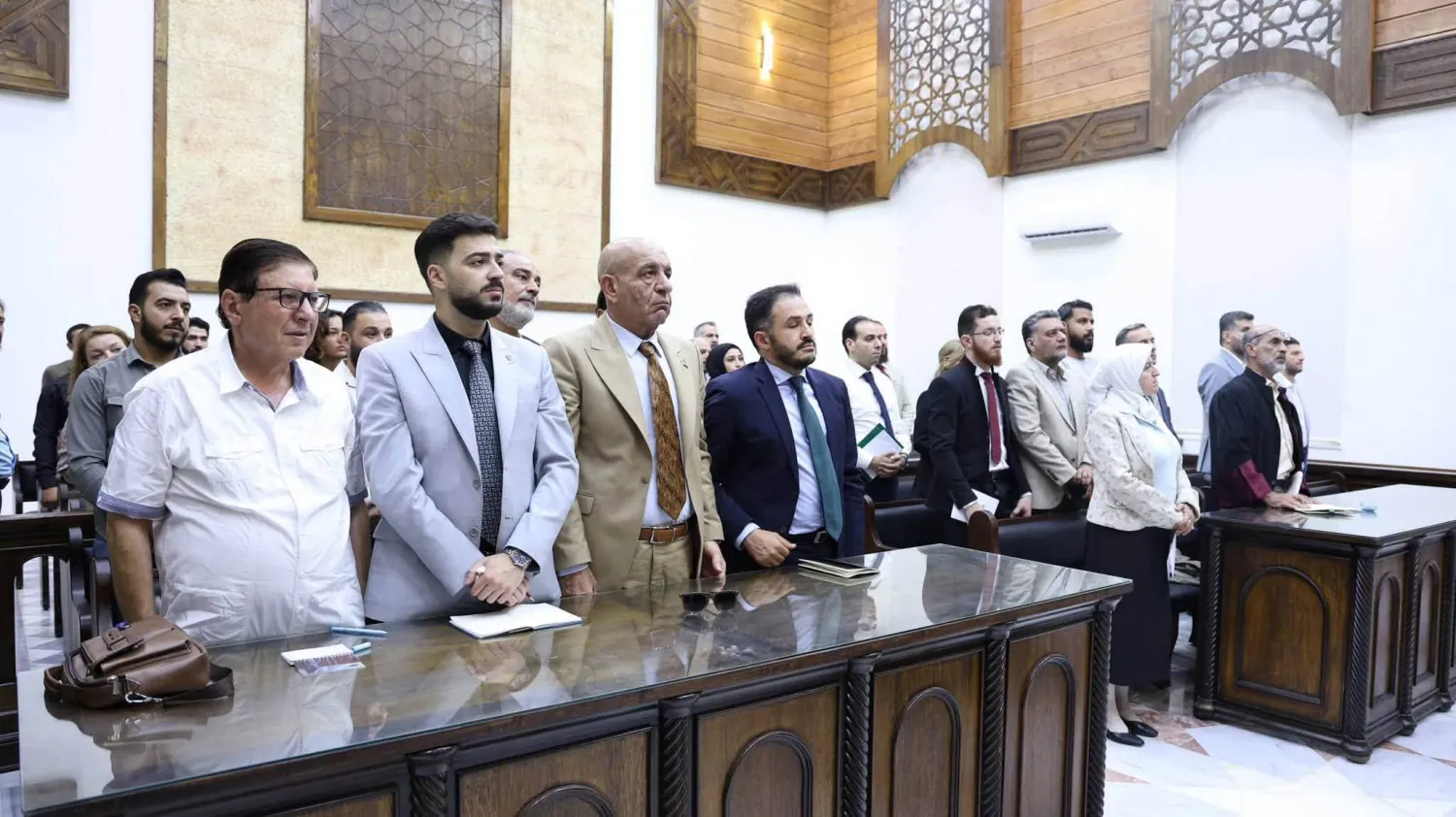
International and human rights organizations, and civil society attended the fifth session of Atef Najib's trial (Syrian Ministry of Justice)
TT

Syrians Await Verdicts in Trials of Former Assad Officials

International and human rights organizations, and civil society attended the fifth session of Atef Najib's trial (Syrian Ministry of Justice)

As public hearings gather pace in the trials of former officials from Syria’s ousted regime, families of victims and survivors of torture are anxiously awaiting the verdicts, with many calling for the defendants to receive the death penalty.

Proceedings before the Fourth Criminal Court at Damascus’ Palace of Justice have accelerated since April 25, when the court opened the in-absentia trial of deposed President Bashar al-Assad, his brother Maher al-Assad, and several senior figures from the former regime. Former security chief Atef Najib also appeared before the court in handcuffs.

The court has so far held six hearings for Najib and three for Wassim al-Assad, a cousin of the former president. According to the National Transitional Justice Commission, Wassim al-Assad’s next hearing, scheduled for July 29, is expected to move to deliberations and a verdict.

Three consecutive hearings have also been held for former Grand Mufti Ahmad Hassoun, who is charged with inciting violence and justifying killings during the rule of the former regime.

The trials are being closely followed in the southern province of Daraa, where Najib headed the Political Security branch. In February 2011, his branch arrested more than 20 schoolboys over anti-government graffiti, including the slogan, “It’s your turn, Doctor.” The case, later known as that of the “Children of Freedom,” helped ignite protests in Daraa on March 18, 2011, widely regarded as the start of the Syrian uprising.

Mohammad Abdul Rahman, a Daraa resident whose son died in Saydnaya prison after being arrested at the outset of the uprising, told Asharq Al-Awsat that residents were demanding “the execution of everyone whose hands are stained with the blood of hundreds of thousands of Syrians, not just Atef Najib.”

“There isn’t a single household in Daraa that hasn’t paid a price. Some lost one or more sons to the bullets of the former regime’s army and security services or in its prisons, while those who did not lose loved ones now live amid destruction,” he said. “The people want all of them executed.”

Youssef Sweidan, one of the children arrested in Daraa who remains unable to work because of the severe torture he endured in detention, also called for Najib to be sentenced to death.

“We want Atef Najib executed as a warning to others. Even execution is too lenient given the crimes he committed against the people of Daraa.”

The hearings have been held only days apart. Hassoun’s latest session took place on July 23, with the next set for July 30. Wassim al-Assad appeared on July 22, and prosecutors requested the death penalty, citing evidence and testimony linking him to premeditated murder as well as drug trafficking and distribution. His next hearing is scheduled for July 29. Najib’s latest hearing was held on July 21, with proceedings due to resume on July 28.

Lawyer Noha al-Masri, one of five attorneys serving on a prosecution team representing the plaintiffs in the cases against senior former regime officials, including Najib, dismissed suggestions that the trials were being rushed.

According to al-Masri, the cases reached public hearings only after progressing through the Public Prosecution, the investigating judge, the referral judge, and finally the Criminal Court. Those earlier stages received little public attention, creating the mistaken impression that proceedings had been expedited. In fact, the case against Najib has been underway since February 2025.

Al-Masri said the next hearing in Najib’s case would hear the defense’s arguments, after which the court would decide whether another procedural session was needed or whether the case was ready for deliberation and judgment.

She argued that the prosecution was seeking the death penalty under Syrian law, which provides that the alleged crimes are not subject to a statute of limitations because they were committed while the defendants represented a ruling regime that remained in power until its collapse. By contrast, she noted, international humanitarian law classifies such offenses as crimes against humanity but does not provide for capital punishment, making life imprisonment a possible sentence.

“We cannot prejudge the outcome, but we hope these killers and criminals receive death sentences. We have confidence in our judiciary and its justice.”

Syria’s new authorities have pledged to ensure justice and accountability for atrocities committed under Assad’s rule, while Syrian activists and the international community continue to stress the importance of transitional justice in the war-ravaged country.



Palestinian Authority: US Denial of Abbas Visa to Attend UN 'Unjustified'

FILE PHOTO: Palestinian President Mahmoud Abbas appears on a screen as he addresses delegates during a high-level meeting of heads of state on a two-state solution between Israel and the Palestinians at United Nations headquarters in New York City, US, September 22, 2025. REUTERS/Eduardo Munoz/File Photo
TT

Palestinian Authority: US Denial of Abbas Visa to Attend UN 'Unjustified'

FILE PHOTO: Palestinian President Mahmoud Abbas appears on a screen as he addresses delegates during a high-level meeting of heads of state on a two-state solution between Israel and the Palestinians at United Nations headquarters in New York City, US, September 22, 2025. REUTERS/Eduardo Munoz/File Photo

The Palestinian Authority on Thursday slammed a decision by the United States to refuse visas for its officials to attend the UN General Assembly in New York next week, a move which includes President Mahmoud Abbas.

In a statement, the Palestinian foreign ministry called it "an unjustified measure that runs counter to efforts to rebuild trust, develop Palestinian-US relations, and create the necessary political climate for implementing the two-state solution and achieving peace and stability.”

In a statement that did not mention Abbas by name, the State Department said Wednesday it would deny visas to members of the Palestine Liberation Organization (PLO) and officials with the Palestinian Authority (PA), "as a consequence of their failure to reform, contrary to their commitments to the United States, and their ongoing activities that undermine the prospects for peace."

The Trump administration took the same step last year, forcing the Palestinian leader, a regular at the UN General Assembly, to address the body of global leadership by video.


South Lebanon Blasts Threaten Landscape, Could Activate Fault Lines; Beirut to File UN Complaint

Smoke rises from the town of Halta following Israeli shelling (National News Agency)
TT

South Lebanon Blasts Threaten Landscape, Could Activate Fault Lines; Beirut to File UN Complaint

Smoke rises from the town of Halta following Israeli shelling (National News Agency)

Israeli forces pushed into the border town of Halta in South Lebanon on Wednesday before withdrawing to its outskirts after conducting searches and sweeps, amid reports that a local resident had been abducted.

The incursion came as Lebanese concern mounted over the scale of Israeli demolitions in the south, with Environment Minister Tamara El Zein warning that their repercussions could extend beyond direct destruction to geological risks affecting public safety.

Lebanon’s National News Agency reported that Israeli forces withdrew from Halta after entering the town Wednesday morning, amid reports that resident Fadi Abdel Aal had been abducted. Troops searched several homes and conducted sweeps with machine guns, while bulldozers razed olive groves.

Israeli forces also blew up several houses, while other homes were reportedly vandalized and solar panels on the ground and rooftops smashed. Three mortar shells struck the town, including one near homes. Powerful explosions heard across several villages in the Arqoub area were traced to demolitions carried out by Israeli forces inside Halta.

The operation followed previous Israeli incursions, searches, arrests and bulldozing in Halta and its surroundings. The town lies in the Arqoub area of Hasbaya district, near Kfar Shuba, the Kfar Shuba Hills and Shebaa Farms, in a geographically and militarily sensitive border area.

Israel says its operations in South Lebanon are intended to prevent Hezbollah from rebuilding its capabilities near the border.

Elsewhere, Israeli artillery struck the outskirts of Kfar Shuba and Kfar Tibnit in Nabatieh. In the western sector, Israeli forces carried out powerful demolitions in Mansouri, south of Tyre, following similar explosions targeting homes and valleys at dawn that caused strong tremors felt in neighboring villages.

Geological concerns

El Zein warned that the succession of massive Israeli explosions posed risks beyond the extensive destruction they caused, citing potential geological damage and ground disturbances.

She pointed to the demolition of the Ali al-Taher ridge two weeks ago using about 1,100 tons of explosives. According to data from Lebanon’s National Center for Geophysics, she noted, the blast generated seismic waves comparable to a magnitude 4.2 earthquake.

El Zein highlighted the site’s proximity to the Roum Fault, about one kilometer away, and the Yammouneh Fault, about seven kilometers away, arguing that the location and scale of the explosion raised additional concerns.

She also cited the demolition in Majdal Zoun using about 80 tons of explosives, which generated waves comparable to a magnitude 3.1 tremor and, according to her, physically split the town in two.

Another explosion near Beaufort Castle involved about 700 tons of explosives and generated waves comparable to a magnitude 3.8 tremor, with vibrations felt at considerable distances, she added.

The minister cautioned that massive underground explosions could, under certain geological conditions and particularly near existing faults, cause movement or reactivate faults, potentially increasing seismic risks.

She stressed that the inability to determine with certainty the future consequences of such effects did not mean the risks should be minimized or ignored.

‘Reshaping the geography’

El Zein argued that the scale of the explosions should not be measured solely by their immediate destruction, describing the operations as going beyond their direct military dimension to the “reshaping of geography.”

She warned that violent ground motion could damage the natural and built environment, infrastructure and homes across a wide area.

The minister linked the explosions to what she described as “ecocide,” stressing that the Lebanese state and government must respond to the scale of the damage and risks rather than merely document and catalogue what she called war crimes.

El Zein presented the findings and concerns to the Cabinet, which tasked her with preparing a detailed report on the repercussions of the explosions. The report will be submitted to the Foreign Ministry for referral to the UN Security Council and other relevant international bodies.


Sisi-Abbas Cairo Summit: Palestinian Reconciliation a Priority in Coming Period

Egyptian President Abdel Fattah al-Sisi assured his Palestinian counterpart on Wednesday of Egypt’s support for the Palestinian Authority (Egyptian Presidency)
TT

Sisi-Abbas Cairo Summit: Palestinian Reconciliation a Priority in Coming Period

Egyptian President Abdel Fattah al-Sisi assured his Palestinian counterpart on Wednesday of Egypt’s support for the Palestinian Authority (Egyptian Presidency)

Palestinian reconciliation featured prominently in talks between Egyptian President Abdel Fattah al-Sisi and Palestinian President Mahmoud Abbas, with Cairo reaffirming its support for “efforts to achieve consensus among Palestinian factions.”

A Palestinian official told Asharq Al-Awsat on Wednesday that the summit was part of longstanding Egyptian efforts to heal internal Palestinian divisions ahead of elections scheduled for November and could pave the way for an intra-Palestinian dialogue in Egypt.

The official expected reconciliation to become a priority in the coming period as Palestinians prepare for the phase following Israel’s elections in October.

During the summit, Cairo affirmed that it would continue working with mediators to implement the agreement to end the war in Gaza reached at the Sharm El-Sheikh Peace Summit in October 2025. It stressed the need for all parties to abide by its terms, including halting escalation, ensuring the flow of humanitarian aid and creating conditions for early recovery and reconstruction.

Al-Sisi affirmed “Egypt’s support for the Palestinian National Authority and for efforts to achieve consensus among the various Palestinian factions in a way that serves the interests of the Palestinian people,” according to a statement from the Egyptian presidency.

The two sides also agreed to intensify political coordination at all levels in the coming period.

According to the Palestinian news agency WAFA, Abbas told al-Sisi during their meeting at Cairo’s Al-Ittihadiya Palace on Wednesday that efforts would continue to renew national legitimacy through upcoming elections. He reiterated his rejection of any infringement on the unity of Palestinian territory or the sovereign institutions of the State of Palestine.

“Gaza is an integral part of our state, there is no alternative to Palestinian legitimacy, and we will not allow the separation of the Gaza Strip from the West Bank and East Jerusalem,” Abbas stressed.

PLO Executive Committee member Wasel Abu Youssef told Asharq Al-Awsat that the Abbas-Sisi summit was important given the circumstances facing the Palestinian cause, particularly because part of the talks concerned internal Palestinian arrangements, including national dialogue.

He noted that Egypt had consistently sought to ensure the success of such talks and had hosted numerous rounds aimed at healing divisions, ending internal rifts and achieving national unity before elections.

“National dialogue and ending the division are particularly important at this time,” Abu Youssef explained, noting that talks were underway among several factions with the aim of expanding them into a comprehensive national dialogue involving all factions.

He suggested this could take the form of a meeting of faction leaders, as held previously, or a broader call for dialogue, adding that “the most appropriate venue is Egypt.”

Abu Youssef expressed hope that a comprehensive national dialogue involving all sides could produce practical mechanisms to reorganize Palestinian internal affairs and end the division.

Such a process, he added, should affirm the unity of the Palestinian people in the West Bank, Gaza Strip and occupied East Jerusalem, as well as the responsibility of the Palestinian legitimate authority for all those territories, as preparations continue for upcoming elections.

He cited legislative elections scheduled for Nov. 28, provided the Israeli government does not obstruct them, particularly in Gaza.

Abu Youssef further maintained that it was in everyone’s interest to respond to Cairo’s efforts to heal the rift and for national dialogue to convene before the elections.

More importantly, he argued, the talks should produce results commensurate with current challenges and risks, reorganize Palestinian internal affairs on the basis of comprehensive national unity, uphold Palestinian rights and principles, and preserve representation through the Palestine Liberation Organization as the sole legitimate representative of the Palestinian people.

Over the years, numerous attempts have been made to unify the Palestinian ranks. Cairo has sponsored several rounds of talks, but none has produced a final agreement.