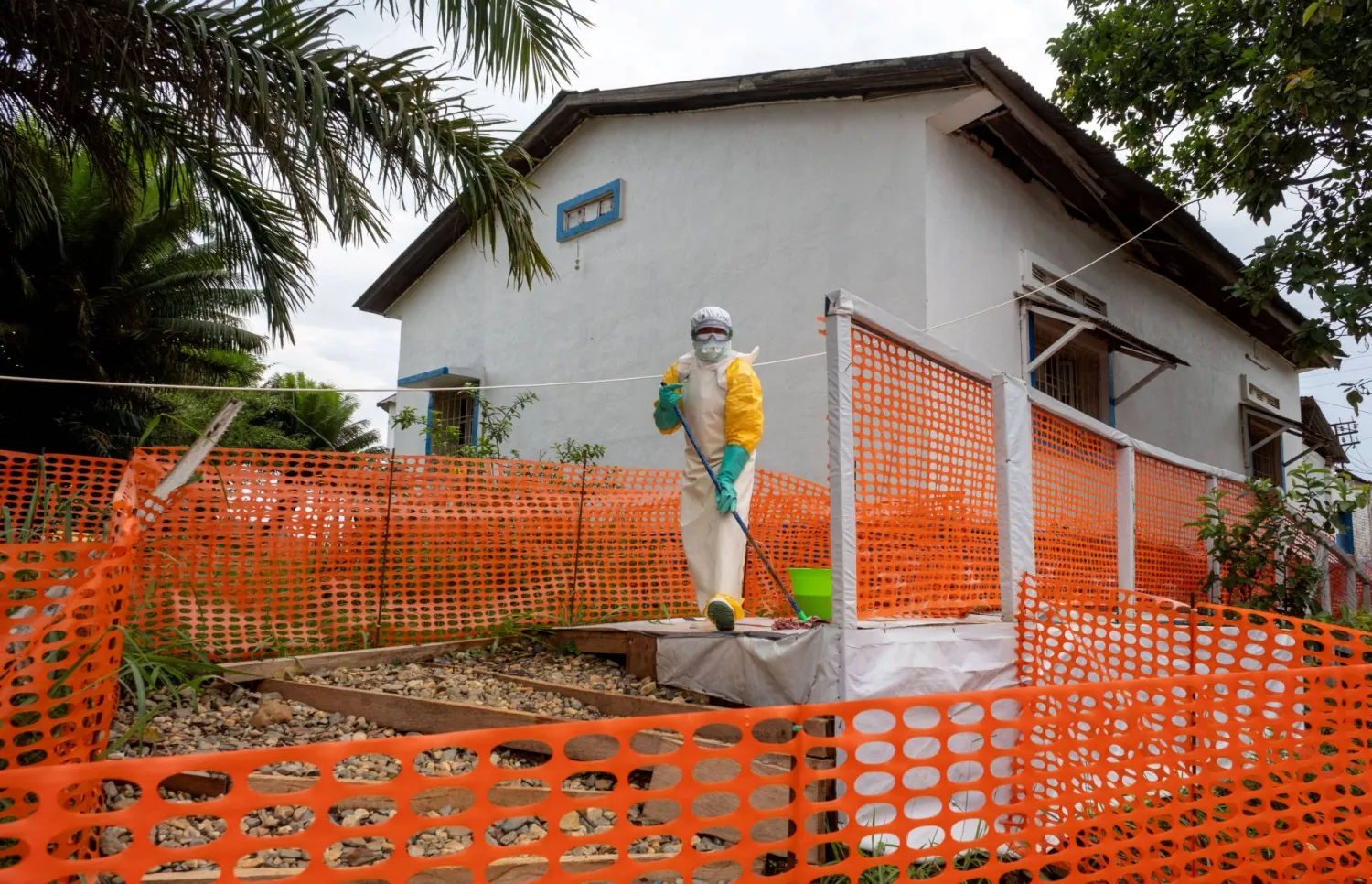
A Congolese health worker cleans outside her station during the tour by Democratic Republic of Congo Prime Minister Judith Suminwa Tuluka, at the Mongbwalu General Hospital in the Ebola-stricken town of Mongbwalu, as authorities intensify efforts to contain the Ebola outbreak involving the Bundibugyo strain on the outskirts of Mongbwalu, Djugu Territory of Ituri province, which is the epicenter of the Ebola epidemic, Democratic Republic of Congo, July 24, 2026. REUTERS/Gradel Muyisa Mumbere
A Congolese health worker cleans outside her station during the tour by Democratic Republic of Congo Prime Minister Judith Suminwa Tuluka, at the Mongbwalu General Hospital in the Ebola-stricken town of Mongbwalu, as authorities intensify efforts to contain the Ebola outbreak involving the Bundibugyo strain on the outskirts of Mongbwalu, Djugu Territory of Ituri province, which is the epicenter of the Ebola epidemic, Democratic Republic of Congo, July 24, 2026. REUTERS/Gradel Muyisa Mumbere
Medics have recorded more than 3,000 Ebola cases, including 1,354 deaths, in the Democratic Republic of Congo's 17th outbreak, officials said Sunday, after infections surged by around 1,000 in just 10 days.
The central African nation is battling its latest Ebola epidemic in the conflict-ridden east, a region scarred by decades of violence, said AFP.
A total of 3,075 cases have now been confirmed across five provinces, official figures showed, after the outbreak passed the 2,000-case mark on July 15.
Authorities said improved detection and testing had helped identify more infections.
The outbreak, declared on May 15, is caused by the Bundibugyo strain of the Ebola virus, for which there is no approved vaccine or treatment.
Nearly 90 percent of cases have been reported in the northeastern province of Ituri, which borders South Sudan and Uganda, according to the World Health Organization.
The outbreak could last several more months, while strikes by healthcare workers demanding unpaid wages have disrupted response efforts in some hospitals.
Ebola, which spreads through contact with bodily fluids and causes haemorrhagic fever, has killed more than 15,000 people across Africa over the past 50 years.
Scientists are racing to develop vaccines and treatments against the Bundibugyo strain. Oxford University said Friday that the first volunteer group had received an experimental vaccine specifically targeting the virus.
Several other candidate vaccines are being fast-tracked for clinical trials, while two potential treatments are also under development.
Brazil Heads to Polls in Runoff between Leftist Lula and Bolsonaro Jr.https://english.aawsat.com/world/5333322-brazil-heads-polls-runoff-between-leftist-lula-and-bolsonaro-jr
Brazil's incumbent leader Luiz Inacio Lula da Silva and his right-wing challenger Flavio Bolsonaro traded blows during a heated election debate. NELSON ALMEIDA / AFP
Brazil Heads to Polls in Runoff between Leftist Lula and Bolsonaro Jr.
Brazil's incumbent leader Luiz Inacio Lula da Silva and his right-wing challenger Flavio Bolsonaro traded blows during a heated election debate. NELSON ALMEIDA / AFP
Brazilians head to the polls on Sunday in a tight runoff vote that could shift Latin America's largest nation sharply rightward, bringing it closer to the United States as part of a broader conservative shift across the region.
The runoff pits leftist President Luiz Inacio Lula da Silva against right-wing Senator Flavio Bolsonaro, the son of convicted former President Jair Bolsonaro. Flavio scored a major upset at the start of the month by defying pollsters to lead voting in the first round, Reuters said.
A victory for Bolsonaro, 45, would extend a wave of right-wing victories for Latin American candidates friendly to US President Donald Trump, while a fourth mandate for Lula would be a disappointment in Washington, which has clashed with his government over trade and security.
The election race has been dominated by corruption scandals, economic anxiety and accusations of US meddling, which Washington denies. It has also been colored by fallout from Jair Bolsonaro's 2025 conviction for plotting a 2022 coup, with Flavio pledging to free his father if he is elected.
Trump has called the case a "witch hunt" and imposed a 50% tariff on Brazil in 2025, in a decision explicitly linked to Jair Bolsonaro’s trial. While many of those were later watered down, Trump unleashed new levies against Brazil this year, citing unfair trade practices.
Lula has cast the Trump administration’s proximity to the Bolsonaro clan as part of an attempt to sway the election, while labeling tariffs and other punitive measures as bullying.
On economic issues, despite falling inequality and unemployment, Lula has struggled to win over an electorate grappling with high living costs and heavy household debt. Endemic gang violence also weighs on voters’ minds.
Bolsonaro has sought to capitalize on cost-of-living concerns and has also promised a heavy-handed approach to fighting crime, pledging maximum-security jails and chemical castration for serious sexual offenses.
CANDIDATES ARE NECK AND NECK
Polls show the candidates are practically tied going into the runoff, as Lula has closed the gap in the final days.
Historical precedent favors Bolsonaro, however, as no candidate has ever won the presidency after coming second in the first-round vote.
Bolsonaro picked up 47% of ballots cast in the first round, while Lula trailed with 45%.
The senator's first-round win sent Brazil's markets and currency soaring on expectations of pro-business reforms.
His first-round success was mirrored in congressional elections for his Liberal Party and other right-wing politicians, which could pave a legislative path for him, or complicate governance for Lula.
More Than 400,000 Protest Across Francehttps://english.aawsat.com/world/5333204-more-400000-protest-across-france
Protesters light flares at the Porte de Vincennes during a demonstration in favor of purchasing power, the protection of public services, and fiscal and social justice, in Paris on October 24, 2026. (Photo by Dimitar DILKOFF / AFP)
Protesters light flares at the Porte de Vincennes during a demonstration in favor of purchasing power, the protection of public services, and fiscal and social justice, in Paris on October 24, 2026. (Photo by Dimitar DILKOFF / AFP)
Clashes erupted in Paris as a mass march drew to a close Saturday, with more than 400,000 people rallying across France over school funding and soaring living costs in a fresh challenge to President Emmanuel Macron’s government.
The Paris march began peacefully, a week after widespread rioting and looting during protests across the country. Near its endpoint at Porte de Vincennes, some protesters threw projectiles while police fired volleys of tear gas and used water cannons to disperse people.
The Interior Ministry put nationwide turnout at 410,000, while the CGT union estimated nearly 800,000. The ministry’s estimate included 110,000 in Paris, where authorities had confined the march to the city’s southeastern edge, away from the center.
Elsewhere in France, police used tear gas in Lyon, Clermont-Ferrand and Strasbourg and water cannons in Nice and Nantes, French media reported. In Marseille, officers fired tear gas during clashes with several dozen people near the march’s endpoint.
The Paris prosecutor’s office said 64 people had been arrested in connection with Saturday’s demonstration and 40 placed in police custody. Those arrested included six minors. Most arrests concerned suspected weapons offenses or participation in a group preparing violence or property damage, the office said.
The unrest is testing Macron's authority in the final months of his presidency before voters choose his successor in May. The stakes are high: the far-right National Rally has accused his government of failing to protect the public and urged people to channel their anger into votes for them.
Interior Minister Laurent Nuñez had announced a nationwide deployment of up to 70,000 officers, backed by helicopters, armored vehicles and water cannons.
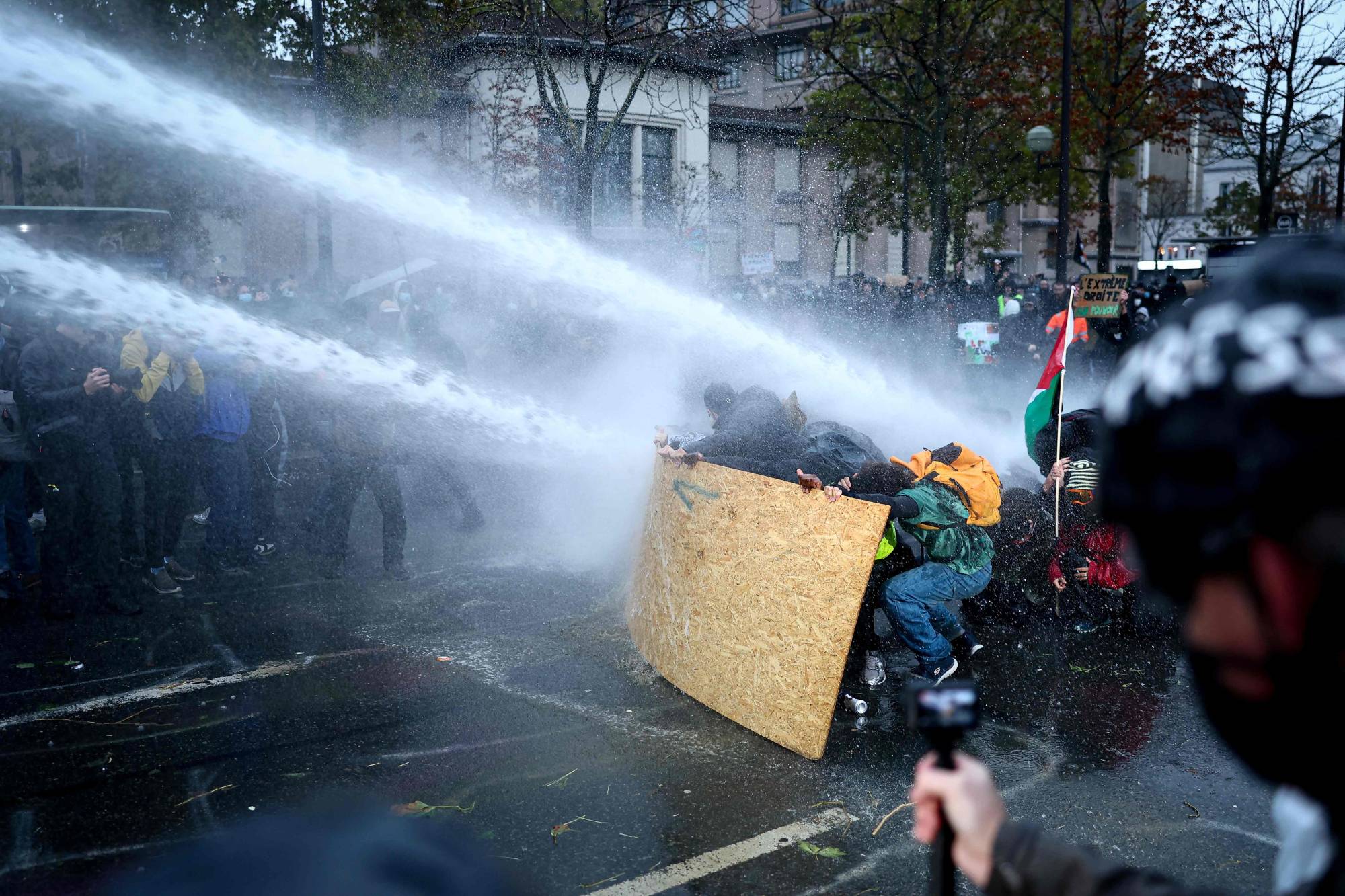
Protesters take cover behind a wooden panel as a water canon is launched during a demonstration in favor of purchasing power, the protection of public services, and fiscal and social justice, in Paris on October 24, 2026. (Photo by Sameer AL-DOUMY / AFP)
Trade unions led the procession, followed by protesters in raincoats carrying flags and handmade placards.
Camille Chesnier, 27, said she had been unable to find work despite having an engineering degree and a master’s degree.
“There are enormous numbers of people in the same situation as me but who aren’t privileged and who find themselves living on the streets and in squats and, frankly, it’s very tough,” she said.
A small protest became a national movement What began last month as a protest over staff shortages at one high school southeast of Paris has spread nationwide, drawing students demanding better schools and workers seeking higher wages and pensions.
In Paris, Bénédicte Pittion, a 46-year-old teacher, marched through steady rain with her 16-year-old daughter, Garance, a high school student. Both had supported the movement from the start, but this was their first protest together.
“The young people who have been demonstrating have not been heard, and as a parent and as a teacher, I stand with them,” The Associated Press quoted Pittion as saying.
Garance said she had been “really scared” to attend after seeing images of last weekend’s violence, but argued that staying away would hand the government a victory.
Public middle and high schools lost 15.4 million teaching hours in the 2024-25 school year because absent teachers were not replaced, according to Education Ministry figures. That amounted to 7.5% of scheduled teaching time.
Macron met high school representatives Friday. They said he had promised to overhaul university admissions, but called for protests to continue until concrete measures are announced.
Organizers from the “yellow vest” protest movement called for another day of rallies Oct. 31 to defend the right to demonstrate.
Some protests were banned Soumaya Abed, a 58-year-old nurse wearing a red CGT union vest, said she had been joining protests for more than 30 years, but had never seen one start at Porte d’Italie, on the capital's outskirts.
“They are using what happened last week as an excuse to quiet protesters,” she said. “But it won’t stop the movement. It won’t stop students from demanding better conditions in schools.”
In Marseille, police put attendance at 17,000, while the CGT union estimated 100,000. In the southwestern city of Toulouse, 26,500 people joined the protests, according to authorities. Authorities had banned rallies in cities including Lyon, Nice and Montpellier.
Trade unions have criticized the bans, calling them violations of freedom of expression, which is protected by the constitution.
Thousands also marched Saturday in Orléans, south of Paris, in a separate peaceful protest against the far right as Marine Le Pen’s National Rally held a two-day congress in the city.
Macron, a centrist, has entered the crisis in the final stretches of his term with his popularity at its lowest since he took office in 2017. He has said that the measures are needed to protect city centers, businesses and public buildings.
Nuñez acknowledged Monday that police had lost control in some cities during last weekend’s unrest, when more than half a million people took to the streets and some 3,000 shops across France were damaged or looted amid street violence not seen in years.
He offered to resign, but Macron refused the offer.
Shops board up and museums close Gendarmes stood guard Saturday beneath the Arc de Triomphe and shopkeepers boarded up storefronts across Paris. Near the Saint-Lazare train station Saturday, Akram Ahmed, a 34-year-old contractor, was boarding up an optician’s shop.
“I got the call last night,” he said. “The owner seemed desperate. He said I was saving his life.”
Major museums, including the Louvre, Orsay Museum, Picasso Museum and Grand Palais — where a major Cézanne exhibit is on display — were shuttered Saturday.
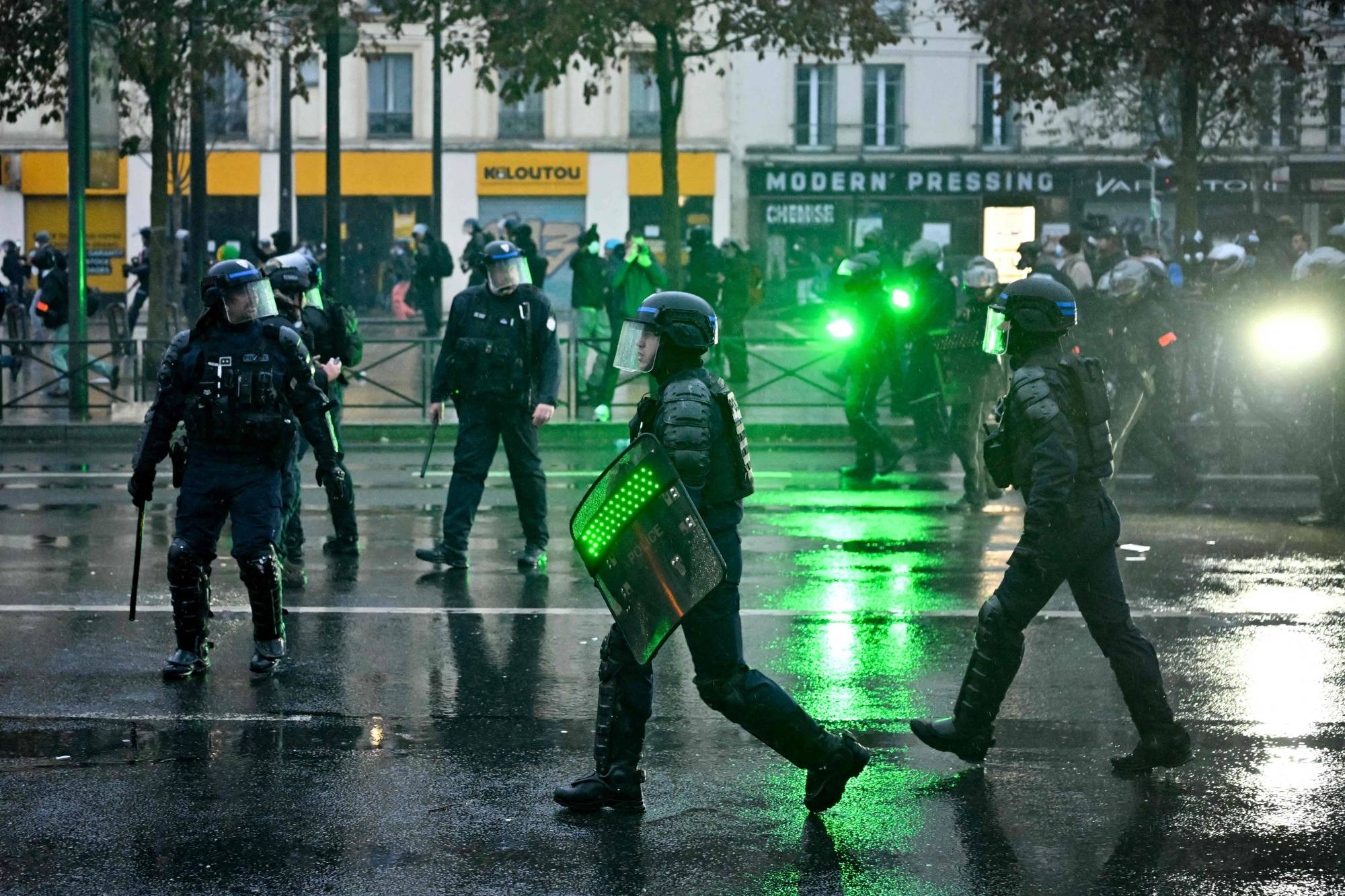
Police officers face protesters near Porte de Vincennes during a demonstration in favor of purchasing power, the protection of public services, and fiscal and social justice, in Paris on October 24, 2026. (Photo by NICOLAS TUCAT / AFP)
Art Basel, one of the world’s most prestigious contemporary art fairs, opened to the public Friday, but only for the day, with the threat of unrest prompting organizers to cancel the weekend program.
Students and workers are angry Student groups want 250,000 more places in higher education and an end to selection through Parcoursup, the national admissions system.
Their joint 10-point plan also calls for more teachers and repairs to schools and universities.
They are also seeking help with everyday costs: an extra 200 euros ($224) a month in student grants and a rent freeze in public student housing.
Energy prices in France were 21.3% higher in September than a year earlier, helping drive overall inflation to 3.1%, according to the national statistics agency, INSEE.
Paris protester Louis Ledoux--Xatard voiced frustration over inequality.
“Looking at countries like the United States, we don’t want to end up like them, where part of the population has everything and the others have nothing,” he said.
“I never imagined that I’d be taking to the streets so much before my thirties.”
North Korea's Kim Returns Home after Visit to Chinese Border Cityhttps://english.aawsat.com/world/5333158-north-koreas-kim-returns-home-after-visit-chinese-border-city
01 October 2026, North Korea, Pyongyang: FILE PHOTO - A photograph released by North Korea's official Korean Central News Agency (KCNA) on September 30, 2026, shows North Korean leader Kim Jong-un addressing a ceremony at Kim Il Sung University in Pyongyang marking the 80th anniversary of the country's top university. Photo: -/YNA/dpa
North Korea's Kim Returns Home after Visit to Chinese Border City
01 October 2026, North Korea, Pyongyang: FILE PHOTO - A photograph released by North Korea's official Korean Central News Agency (KCNA) on September 30, 2026, shows North Korean leader Kim Jong-un addressing a ceremony at Kim Il Sung University in Pyongyang marking the 80th anniversary of the country's top university. Photo: -/YNA/dpa
North Korean leader Kim Jong Un returned home on Saturday after making a day-long trip to the Chinese border city of Dandong, Beijing's state media reported, though the purpose of the unannounced visit was not immediately clear and there was no mention of talks with his counterpart Xi Jinping.
Kim is thought to have crossed into China via a major border bridge that officially opened last week, 12 years after its completion, deepening economic ties between China and diplomatically isolated North Korea.
Neither North Korea nor China disclosed Kim's visit in advance. South Korean lawmaker Youn Kun-young said Kim was "understood" to have met Chinese Premier Li Qiang on Saturday.
A readout from China's Xinhua news agency did not mention talks between Kim and Xi or Li. Instead, it said Wang Huning, Beijing's top political advisor, accompanied Kim in Dandong and "saw him off" at the bridge at the end of the trip.
The aims and outcomes of Kim's visit were murky, but China is North Korea's largest trading partner and a vital source of diplomatic, economic and political support for Pyongyang.
Xinhua quoted Wang as saying the visit was significant for "consolidating public goodwill towards the friendship... (and) deepening political mutual trust and jointly pursuing cooperation and development".
He also said China and North Korea should expand personnel exchanges, economic cooperation and strategic coordination, "to foster a peaceful and stable external environment for safeguarding their respective sovereignty, security and development interests", according to Xinhua.
Wang conveyed Xi's "cordial greetings and best wishes" to the North Korean leader.
The trip fell near the date both countries use to mark the entry of Chinese troops into the Korean War. Kim attended a memorial ceremony to fallen soldiers and visited an automobile factory, Xinhua said.
China's top diplomat, Wang Yi, also took part in the events, it added.
Youn, the South Korean lawmaker, said he had been briefed on Friday that a visit was likely.
The trip could send a "positive signal" about a possible US-North Korea summit, he said in a statement sent to AFP.
World leaders are preparing for November's APEC summit in China's Shenzhen, where it has been speculated that Kim may meet US President Donald Trump.
لم تشترك بعد
انشئ حساباً خاصاً بك لتحصل على أخبار مخصصة لك ولتتمتع بخاصية حفظ المقالات وتتلقى نشراتنا البريدية المتنوعة