

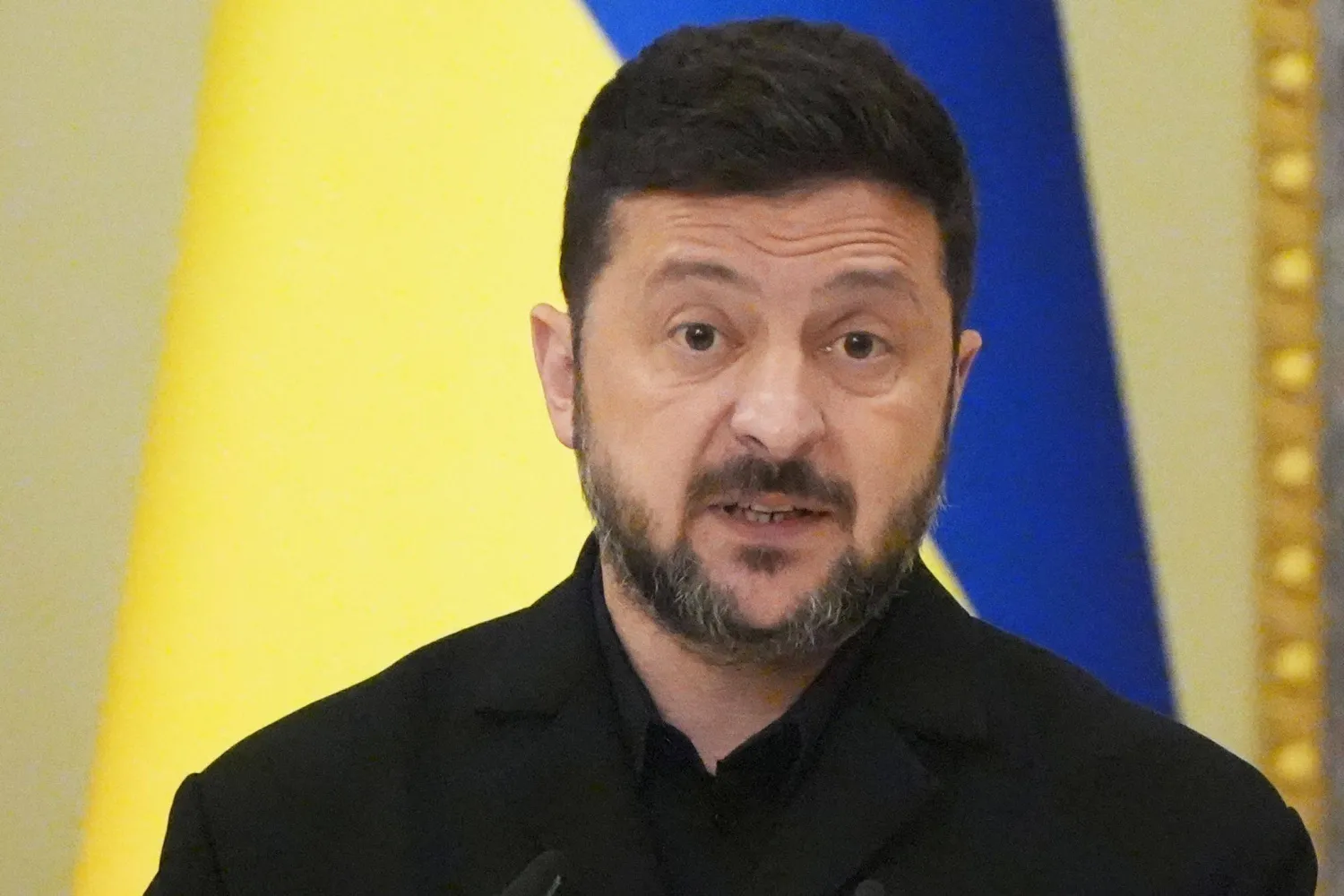

Zelensky in UK for First Meeting with Burnham

23 July 2026, Ukraine, Kiev: Ukrainian President Volodymyr Zelensky speaks during a press conference with Taoiseach Micheal Martin at the Presidential Palace in Kiev. Photo: Niall Carson/PA Wire/dpa
TT

Zelensky in UK for First Meeting with Burnham

23 July 2026, Ukraine, Kiev: Ukrainian President Volodymyr Zelensky speaks during a press conference with Taoiseach Micheal Martin at the Presidential Palace in Kiev. Photo: Niall Carson/PA Wire/dpa

Ukrainian President Volodymyr Zelensky arrived in Britain on Monday to meet Prime Minister Andy Burnham, who used his first bilateral with a foreign leader to underline London's "unwavering support" for Kyiv.

The visit came ahead of Zelensky's trip to Washington on Tuesday, as he makes a new bid to end the four-year war with Russia.

Zelensky is expected to renew calls to boost defense as both Moscow and Kyiv intensify drone and missile strikes, with US-led negotiations stuck while Washington's attention has been diverted to the Iran war.

Zelensky and Burnham were to visit a naval base in the southern city of Portsmouth to speak to armed forces personnel involved in training Ukrainian service members.

Downing Street said Burnham would vow "to continue the unbreakable bond between the two nations", echoing what he told Zelensky in a call last Monday within hours of replacing Keir Starmer.

"Britain stands with Ukraine, shoulder to shoulder, and our support remains unwavering," Burnham said in a statement.

"Russia should be in no doubt of our resolve, and we will not back down until we achieve long-lasting and just peace for Ukraine."

Landing in Britain, Zelensky hailed the alliance as "the strongest relationship in the entire history" of the two countries.

London also announced it will share with Kyiv information on a new battle-tested electronic jamming capability dubbed "Stone Cloak".

When attached to drones, the tablet-seized, military-grade jammers can hinder Russian air defense systems from tracking and targeting such weapons in-flight, Downing Street said.

Thousands of the jammers, developed under a 100-year partnership pact between the countries, have already been gifted to Kyiv, according to London.

Following their roll-out and potential mass production in Ukraine, Stone Cloak will be built into the next generation of UK deep-strike capabilities, it noted.

"Stone Cloak is the best of homegrown British innovation and proven on the frontline, and it will be vital to protecting our security in both our countries," Burnham said.

In another sign of Ukraine's deepening defense ties with Britain, Zelensky told broadcaster Sky News on Sunday he wanted to sign a strong "drone deal" to boost production and technology-sharing.

He admitted "we don't have enough missiles to defend", referring to Russia's ultra-fast ballistic missiles that have put Ukraine's air-defense system under strain in a recent spate of deadly attacks.

Moscow "can increase the production of ballistic missiles and that's why we need air defense as quick as possible," Zelensky said.

Burnham and Zelensky will meet some of the approximately 200 Ukrainian military personnel who have been in Britain for the past three weeks participating in a maritime security and counter-mine exercise.

It was held to prepare for future missions in the Black Sea.

Downing Street noted the UK's total support for Ukraine has reached 25 billion pounds ($33 billion) since Russia's full-scale invasion in February 2022, including 16 billion pounds in direct military assistance.

Zelensky is due in Washington on Tuesday for talks with US President Donald Trump, a White House official said last week.

The Ukrainian leader is also expected to attend the funeral of US senator Lindsey Graham, a supporter of Ukraine who died earlier this month.

Trump and Zelensky have had a fraught relationship that has veered from a shouting match in the Oval Office in February 2025 to warmer ties in recent months.

The US president told Zelensky on the sidelines of a NATO summit this month that he was giving Ukraine permission to build US-designed Patriot air defense systems capable of downing ballistic missiles.

Washington has also advanced bipartisan legislation targeting countries buying Russian energy -- potentially clearing the way for stronger pressure on Moscow.

Trump's support for Ukrainian defense comes as the president faces domestic pressure to end the Middle East war.

"I understand the United States is focusing on the Middle East," Zelensky told Sky News.

"I try to manage it now with some Europeans and with Americans and with some other countries.

"This, for me, it's a big challenge, a big challenge for Ukraine."


UK Says There are Strong Indications Iran Played a Part in a Security Incident at a US-run Air Base

Police officers guard an area as roadblocks remain in place near RAF Fairford airbase, after police declared a major incident at the base and arrested several men on suspicion of offences under the Explosives Act, who have since been released on bail, in Fairford, Gloucestershire, Britain, September 29, 2026. REUTERS/Toby Shepheard
TT

UK Says There are Strong Indications Iran Played a Part in a Security Incident at a US-run Air Base

Police officers guard an area as roadblocks remain in place near RAF Fairford airbase, after police declared a major incident at the base and arrested several men on suspicion of offences under the Explosives Act, who have since been released on bail, in Fairford, Gloucestershire, Britain, September 29, 2026. REUTERS/Toby Shepheard

The UK has “strong indications” that Iran played a part in the incident that saw five men arrested near a US-run military air base in England late at night, Prime Minister Andy Burnham said Wednesday.

Burnham said UK and US officials are carrying out a “complex and serious” investigation into how and why five men and three vans were near the perimeter of RAF Fairford, a base that has been used by American bombers striking Iran during this year's war.

Five British men in their 20s were arrested Sunday on suspicion of explosives offenses and planning an act of terror, before being released on bail a day later. Police say they found a quantity of an accelerant – gasoline – in the vans, but no explosives.

Burnham did not provide details about what the suspects were planning or why the UK thinks Iran was involved. He said he would “update people more in due course.”

“There are strong indications that Iran played a part in what happened over the weekend at RAF Fairford, but of course it remains an ongoing, complex, and serious police investigation,” Burnham told the BBC in one of a series of interviews with British broadcasters. “And of course, we are working closely with our colleagues in the United States of America.”

Iran has denied involvement in the incident. It has previously said that it considers any base used to attack its territory a legitimate target.

The base 100 miles (160 kilometers) west of London has been used by American bombers during decades of conflicts in the Middle East, including this year’s war with Iran.

Top US officials have criticized the decision to grant the suspects bail, with President Donald Trump saying “I wouldn’t have done that" and Secretary of State Marco Rubio saying a lot of people were “disturbed” by the move, The AP news reported.

Burnham said authorities have the investigation under “the strongest grip and the closest control,” and British officials had been “talking to counterparts in the United States all week to explain what is happening here, how things are being done.”

“I have complete confidence in the way British security services are handling this,” he told the BBC.

Laurence Taylor, the head of British counterterror policing, said Tuesday that the suspects remain under investigation and the decision to grant bail was grounded in “experience and strategy.”

He said a line of inquiry is whether the suspected offenses were committed by “proxies or individuals, either knowingly or unknowingly, working on behalf of a foreign state.”


Iran Says Received US Response to Its Proposal to End War

Vessels in the Strait of Hormuz near the beach of Bandar Abbas, Iran, September 28, 2026. Amirhosein Khorgooi/ISNA/via WANA (West Asia News Agency) via REUTERS
TT

Iran Says Received US Response to Its Proposal to End War

Vessels in the Strait of Hormuz near the beach of Bandar Abbas, Iran, September 28, 2026. Amirhosein Khorgooi/ISNA/via WANA (West Asia News Agency) via REUTERS

Iranian authorities said on Wednesday they received the official US response to their proposal to end the Middle East war, state media reported, days after US President Donald Trump rejected the plan. 

"At today's cabinet meeting, the American side's proposal was presented to President Masoud Pezeshkian by Foreign Minister Abbas Araghchi," government spokeswoman Fatemeh Mohajerani told the official IRNA news agency, without specifying the content of the reply. 

After seven months of conflict, indirect talks between the United States and Iran resumed last week on the sidelines of the UN General Assembly, said AFP. 

Iran said it has put forward seven conditions for ending hostilities and reopening the strategic Strait of Hormuz, a vital route for oil and gas exports. 

The strait lies at the heart of the conflict between the United States and Iran, which began with US-Israeli strikes on Iran in late February. 

Tehran imposed a blockade on Hormuz after the war started, prompting Washington to respond with its own blockade on Iranian ports. 

While not all conditions have been made public, Iran is notably demanding a ceasefire across the Middle East, including in Lebanon, where its ally Hezbollah has been battling Israeli forces. 

It is also demanding the unfreezing of Iranian assets abroad, the lifting of sanctions on its oil sector and an end to the US naval blockade. 

Trump rejected the proposal when speaking to the press on Saturday, but Tehran had been awaiting an official response via Qatari mediators. 

Fighting has subsided in recent weeks, though Tehran has continued to target ships in the strait. 

Iran's Revolutionary Guards, the ideological arm of the country's military, said on Wednesday that they have been striking small vessels that try to pass through the strait. 

"We have been striking ships for quite some time now -- specifically the small vessels I mentioned that attempt to pass. We block their passage, yet the US has not retaliated for a while," Guards spokesperson Hossein Mohebi told state TV. 

The US, meanwhile, has stepped up its economic warfare against Iran, imposing sanctions on Iranian airlines and vowing to take a hard stance against foreign companies that provide them with assistance. 


US Supreme Court Lifts Limits on Third-country Deportations

The United States has deported thousands of migrants to so-called third-countries, including Liberia, as part of US President Donald Trump's immigration crackdown. Matthew Jacobs / AFP
TT

US Supreme Court Lifts Limits on Third-country Deportations

The United States has deported thousands of migrants to so-called third-countries, including Liberia, as part of US President Donald Trump's immigration crackdown. Matthew Jacobs / AFP

The US Supreme Court on Tuesday lifted restrictions on the deportations of immigrants to countries that are not their own, while agreeing to hear the issue on its merits in December.

The conservative-dominated high court granted an emergency request by the Trump administration to suspend a lower court ruling that restricted, but did not outright ban, so-called "third-country removals."

The lower court had said people targeted with deportation must be given effective notice ahead of time about where they are being sent to allow them to raise concerns about potential persecution, said AFP.

The three liberal justices on the nine-member bench said they would not have granted the administration's request.

President Donald Trump campaigned on promises to expel millions of undocumented migrants from the United States and has taken several actions aimed at speeding up deportations since returning to the White House in 2025.

The Trump administration has defended third-country deportations as necessary since the home nations of some of those who are targeted for removal sometimes refuse to accept them.

In a brief to the Supreme Court, opponents of lifting the restrictions argued that the lower court ruling did not fully block all third-country deportations, "it simply requires them to do so lawfully."

Trump's solicitor general, John Sauer, meanwhile told the court that the rapid deportation to third countries was "an essential tool to remove certain aliens, including some of the worst criminal aliens."

The lower court ruling "created substantial logistical problems" with removals, he said.

- 'Indefensible' -

An AFP investigation found that the US has offered multimillion-dollar deals and threatened visa restrictions in a bid to get "third countries," especially in Africa, to take such deportees.

Once in these countries -- and outside US jurisdiction -- deportees have been subject to abuse by local guards, indefinite detention, or quickly re-deported to their home countries.

According to an investigation published last week, the United States has deported more than 25,000 people under secretive agreements with 35 countries to take migrants with no ties to those nations.

The investigation by Forbidden Stories found the administration has earmarked $410 million to be paid directly to the receiving countries, or to United Nations agencies to facilitate the returns.

The vast majority of the deportees -- around 20,000 -- were sent to Mexico, but the rest were dispersed to 27 other countries across Latin America, Africa, and the Pacific, and agreements have been finalized with seven more.

Congress has made it US policy not to deport people to countries where their lives would be in danger or they could be subject to torture.

After the high court's ruling, some Democratic lawmakers were calling for more formalized steps to prevent such deportations and uphold due process.

"Congress must step in. No one should be shipped off to a country that is not their own without basic due process and a meaningful opportunity to raise legitimate fears for their safety," House Democrat Lois Frankel said on X.

Rob Menendez, another congressional Democrat, called the Supreme Court's decision "indefensible."

"Taxpayers shouldn't fund tearing people from the only home they've ever known, nor should our legal system fast-track these unilateral deportations."
