


US Looks to Boost Anti-China Spending Worldwide by Hundreds of Millions

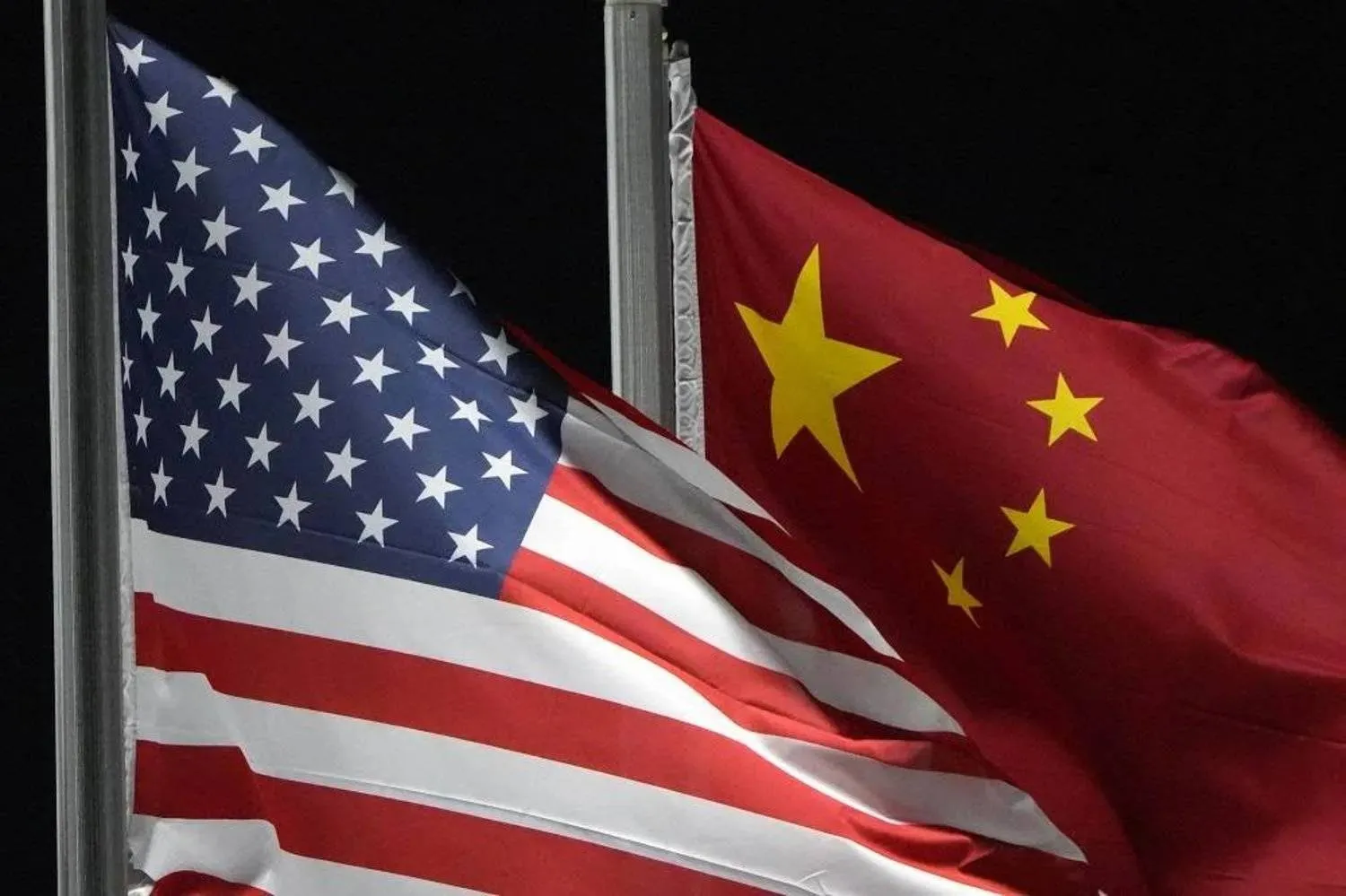
File photo: The American and Chinese flags wave at Genting Snow Park ahead of the 2022 Winter Olympics, in Zhangjiakou, China, on Feb. 2, 2022. (AP)
TT

US Looks to Boost Anti-China Spending Worldwide by Hundreds of Millions

File photo: The American and Chinese flags wave at Genting Snow Park ahead of the 2022 Winter Olympics, in Zhangjiakou, China, on Feb. 2, 2022. (AP)

The Trump administration is preparing to ramp up funding by hundreds of millions of dollars for programs designed to counter China’s growing influence around the world, after it had put a halt to many of those initiatives last year during a flurry of budget and personnel cuts.

The administration notified Congress late last week that it intends to spend $175.8 million to replace outdated and aging undersea telecommunications cables in the Caribbean and Central America to prevent China from moving in. The Associated Press obtained a copy of the notification on Monday.

The administration has expressed deep concern about China's activities in the Americas, pushing back on Chinese ownership of ports at either end of the Panama Canal, infrastructure projects funded by China's Belt and Road initiative in the region, and Chinese investment in the telecommunications sector.

A State Department official said China’s economic activities in the Western Hemisphere pose risks to US national security and prosperity. The official, who was not authorized to speak publicly to the subject and spoke on condition of anonymity, said China's offerings may seem cheaper but in the end wind up being more expensive due to cost overruns, hidden maintenance fees and poor performance.

The underseas cable funding appears to be part of a broader push to restore support for initiatives aimed at blunting Chinese influence globally that would cost many hundreds of millions of dollars more. That is even as President Donald Trump and Chinese leader Xi Jinping put on a show of cooperation and Xi prepares to visit the US this fall.

US weighs wider spending to counter China globally

The State Department is considering spending nearly half a billion dollars more on programs aimed at China throughout the Western Hemisphere, Africa and Asia, according to an internal State Department document obtained by AP.

“The United States must respond to the CCP’s growing economic, technological, and diplomatic leverage around the world which undermines our national interests,” the document says, using the acronym for the Chinese Communist Party.

Many of those proposed programs are designed to “reclaim diplomatic leverage” through investments in areas where the US had previously been spending money but stopped as the Elon Musk-led Department of Government Efficiency, or DOGE, carried out deep government budget and personnel cuts last year.

Those cuts, which dismantled the US Agency for International Development and eliminated several hundred diplomatic posts worldwide, also affected previously approved projects, including some aimed at countering China.

A senior US official, who spoke on condition of anonymity to discuss future administration plans, confirmed the Trump administration’s intent to boost funding on countering China but could not speak to specifics. The official acknowledged discussions of large-scale projects but said many were still in the discussion phase.

Congress told about undersea cable project to keep China away

The program described to Congress on Friday is called the “Countering CCP Control of Caribbean and Central America Undersea Cables project.”

It will “fund the installation of strategically-selected undersea cable infrastructure” and support foreign governments in partnering with private sector undersea cable installers, according to the notification. The money will “support replacement of outdated undersea telecommunications cables in the Caribbean and Central America region with secure, US and trusted alternatives,” it said.

Even as it pursues the war with Iran and peace efforts in Gaza and Lebanon, the Trump administration has put a focus on the Western Hemisphere, capturing Venezuelan leader Nicolás Maduro earlier this year, ramping up pressure on Cuba’s socialist government in the months since and imposing severe sanctions on the government in Nicaragua.

Under the new program, funding is anticipated to be given to or in support of undersea cable projects benefiting El Salvador, Guatemala, Honduras, Nicaragua and Haiti, the document said. The US has tenuous ties with Nicaragua and would not be working with the government there.

China's embassy in Washington did not immediately respond to requests for comment.

Other anti-China efforts could focus on cyber and critical minerals

At the same time, the administration has drawn up plans to spend more than $340 million for over 50 specific anti-China projects around the world, including many in the Western Hemisphere, according to the internal State Department document outlining various proposals.

The administration notified Congress in May that it had spent several hundred million dollars in counter-China funding from the 2024 budget that was approved by the Biden administration. However, many other projects funded for 2024 and 2025 had been put on hold.

Among the plans to be resurrected are the creation of security operations centers in Argentina and Belize to monitor Chinese threats to critical infrastructure and cyber platforms throughout the region. Also coming back would be initiatives to protect Ecuador, Jamaica, Mexico, Paraguay, Peru and Uruguay from alleged Chinese attempts to infiltrate port operations and illegally exploit offshore fishing and critical minerals extraction.

More broadly, the proposal, which is still under consideration, would work against Chinese influence in the selection of a successor to the Dalai Lama “by developing proprietary technology to ensure secure communications and information collection.” It also would go after international support for China’s space program and push back against Chinese firms seeking to export surveillance and censorship technology.

The document did not describe the initiatives in detail.

Trump is expected to meet with Xi in September around the time of the annual UN General Assembly gathering of world leaders in New York. To prepare for that meeting, Secretary of State Marco Rubio met with Chinese Foreign Minister Wang Yi last week at a regional security conference in the Philippines.

Trump has oscillated between anger and elation with Xi, whom the US leader has sought to cultivate as an ally even while China pursues goals antithetical to many of his administration's. The ultimate impact of the proposed new programs won't be known for many months or years.



UN Approves Resolution in Support of Map that Shows Africa's True Size

FILE PHOTO: A vendor sells a map of Africa along the streets of Bujumbura, Burundi April 24, 2015. REUTERS/Thomas Mukoya/File Photo
TT

UN Approves Resolution in Support of Map that Shows Africa's True Size

FILE PHOTO: A vendor sells a map of Africa along the streets of Bujumbura, Burundi April 24, 2015. REUTERS/Thomas Mukoya/File Photo

The United Nations on Friday voted for a shift away from the 16th-century Mercator global map towards one more accurately reflecting countries' true size, a resolution sponsored by African states to counter perceptions that the continent is peripheral.

Togo led the initiative to further the African Union campaign to limit use of the Mercator map, which distorts the relative size of land masses by expanding those nearer the poles. It makes Greenland appear roughly the same size ⁠as Africa, though Africa ⁠is about 14 times larger.

"A fair world begins with a fair map," Togo's Foreign Minister Robert Dussey told Reuters ahead of Friday's vote.

The resolution promotes the Equal Earth projection, which more accurately portrays the size of the continents.

It is not legally binding and it "in no way challenges the use of the Mercator projection for maritime and aerial navigation, for which it remains fully suited," the Togolese ministry ⁠said in a statement.

The resolution passed in the UN General Assembly by a vote of 164 to 1 with 6 abstentions.

The United States, the only country to vote against the resolution, said it promoted an "ideological agenda" and was a distraction from the "genuine problems of international peace, prosperity or good relations".

The Mercator map remains widely used in classrooms, but Togo hopes to change its school geography materials by the end of the year, Dussey told Reuters.

"Togo will be the first country to change our own geography books," Dussey said.

"In the classroom, we need to change it ⁠to give an ⁠example to all the countries in the world."

Togo will press other governments, schools, international organizations and technology companies to move away from the centuries-old Mercator projection, Dussey said, adding that Equal Earth offers "the best perception" of the world.

Togo plans to meet African Union member states and supporters from other regions within the next six months to agree on how to promote wider adoption, Dussey said.

Dussey said the discussion about next steps would need to include companies operating mapping, GPS and other location-based technologies.

Dussey linked the campaign to adopt the map to wider African efforts to confront colonial-era legacies, while saying it was not an attack on Europe or any other civilization.

The Mercator map's widespread use is a consequence of colonization, he said.

"The world is changing. Africa also is changing."


Philippine VP is Ordered Arrested for Threats Against the President

FILE -Philippine Vice President Sara Duterte gestures as she speaks during a press conference in Manila, Philippines on Friday, Feb. 7, 2025. (AP Photo/Basilio Sepe, File)
TT

Philippine VP is Ordered Arrested for Threats Against the President

FILE -Philippine Vice President Sara Duterte gestures as she speaks during a press conference in Manila, Philippines on Friday, Feb. 7, 2025. (AP Photo/Basilio Sepe, File)

A Philippine court ordered the arrest of Vice President Sara Duterte on Friday over charges that she publicly threatened to have the president and two other people assassinated.

Duterte was already impeached by the House of Representatives in May on the same charges as well as alleged financial anomalies, The Associated Press reported. Her troubles are part of a high-stakes political showdown pitting her against her rival, President Ferdinand Marcos Jr. A conviction could derail her plans to seek the presidency in 2028, when Marcos' six-year term ends.

A lawyer of the vice president, who has denied the charges, suggested she will post bail to avoid detention while facing trial by the Quezon City Regional Trial Court.

“She has no intention of evading the law and will continue to exercise all her legal remedies,” Paul Lawrence Lim said in a statement, without elaborating.

The charges stem from a threat made by Duterte in a 2024 online news conference to have Marcos, his wife and then-House of Representatives Speaker Martin Romualdez killed by an assassin if she herself was killed, as their political disputes escalated. The vice president then warned that her threat wasn’t a joke.

She later said she wasn’t threatening Marcos but was expressing concern for her own safety. Her remarks set off a criminal investigation and national security concerns.

Marcos and Duterte were running mates in the 2022 elections in a whirlwind alliance that combined the vote-getting power of two of the country’s most formidable political dynasties, but the union rapidly fell apart.

The vice president is the daughter of former President Rodrigo Duterte, Marcos’ predecessor. Rodrigo Duterte was arrested last year on orders of the International Criminal Court and detained in The Hague, where he is scheduled to face trial over alleged crimes against humanity on Nov. 30.

The charges are in connection with brutal anti-drugs crackdowns that left thousands of mostly poor suspects dead while Duterte was in power. He has denied authorizing extrajudicial killings but repeatedly threatened suspects with death while in office.

Last May, the House of Representatives, which is dominated by Marcos’ allies, voted overwhelmingly to impeach the vice president over alleged unexplained wealth, misuse of confidential state funds and her threats against Marcos, his wife and Romualdez.

The Philippine Senate, acting as an impeachment court, opened her televised trial in July.

If convicted of the charges, Duterte may be permanently disqualified from holding public office and will prohibit her from seeking the presidency in 2028.

Marcos and the Dutertes have contrasting geopolitical leanings. Marcos has expanded defense engagements with the United States, his country’s treaty ally, as his administration stood up to China’s increasingly aggressive actions in the disputed South China Sea.

Rodrigo Duterte had nurtured cozy ties with Chinese President Xi Jinping and Russian leader Vladimir Putin while threatening to sever ties with Washington. The vice president has come under fire for not condemning China’s assaults, including with the use of powerful water cannons, against Filipino forces and fishermen in the disputed waters.


US, Allies Want IAEA Board to Report Iran to UN Security Council

The logo of the International Atomic Energy Agency (IAEA) at the organization's headquarters in Vienna, Austria, March 6, 2023 (Reuters)
TT

US, Allies Want IAEA Board to Report Iran to UN Security Council

The logo of the International Atomic Energy Agency (IAEA) at the organization's headquarters in Vienna, Austria, March 6, 2023 (Reuters)

The US and its allies Britain, France and Germany are pushing other countries on the UN nuclear watchdog's board to pass a resolution next week reporting Iran to the UN Security Council for the first time in 20 years, diplomats said on Friday.

If passed, the resolution would follow up on one adopted on June 12 of last year declaring Iran in breach of its non-proliferation obligations for not fully cooperating with an investigation into uranium traces found at undeclared sites, Reuters reported.

Israel started bombing Iran's nuclear facilities the next day, soon joined by the United States, destroying or badly damaging Iran's uranium-enrichment plants.

Iran has not let International Atomic Energy Agency (IAEA) inspectors return to the bombed sites since then or verify what remains of its stocks of enriched uranium, some of which was enriched to up to 60% purity, a short step from weapons grade.

A resolution by the IAEA's 35-nation board reporting Iran to the Security Council would also be the culmination of a standoff over IAEA access to those sites, since the board has passed two resolutions in the past year demanding Iran declare its enriched uranium stocks and grant the IAEA full access to verify them.

A draft text for the resolution has yet to be formally submitted to the board and negotiations between countries over the exact wording are ongoing, diplomats said. A draft is usually formally submitted early in the week of a board meeting.

As a party to the nuclear Non-Proliferation Treaty (NPT), Iran has the right to develop nuclear technology, including enrichment, for peaceful purposes. Iran says it would never produce nuclear weapons.

It is, however, the only country to enrich to 60% without making a bomb. The amount it has enriched to that level is "a matter of serious concern" to the IAEA.

The IAEA believes well over 200 kg of that highly enriched uranium has survived the bombardments and is held in a tunnel complex at Isfahan and at the Natanz facility.