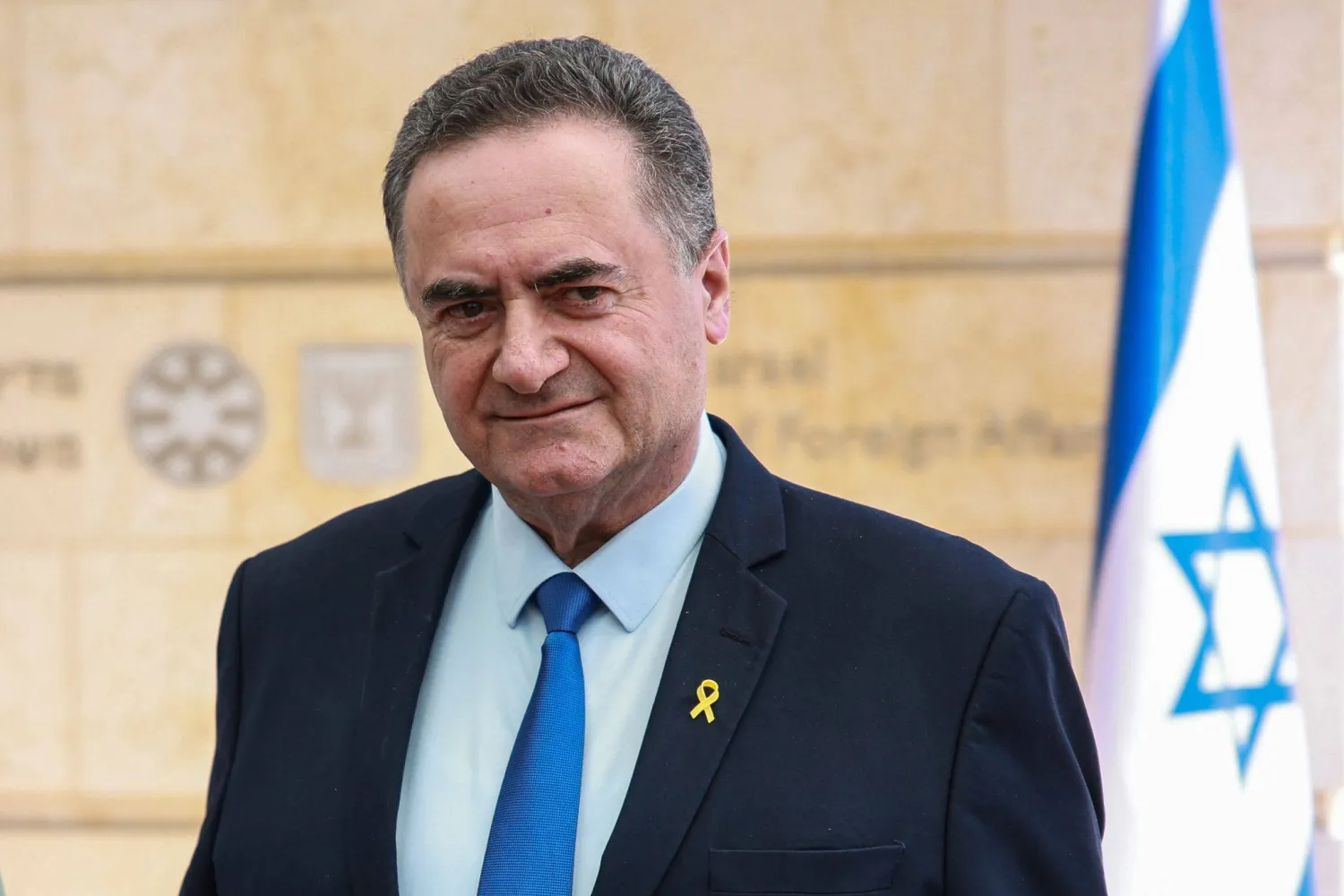
Katz: Israel Says US Bombers Used its Bases to Strike Iran

 Israeli Defense Minister Israel Katz is pictured in Jerusalem. Photo: Hannes P Albert/dpa
Israeli Defense Minister Israel Katz is pictured in Jerusalem. Photo: Hannes P Albert/dpa
TT

Katz: Israel Says US Bombers Used its Bases to Strike Iran

 Israeli Defense Minister Israel Katz is pictured in Jerusalem. Photo: Hannes P Albert/dpa
Israeli Defense Minister Israel Katz is pictured in Jerusalem. Photo: Hannes P Albert/dpa

Israeli defense minister Israel Katz on Tuesday said that American warplanes used Israeli bases during their attacks on Iran, reiterating that his country was prepared to retaliate if targeted.

Fighting between the US and Iran has been paused since Friday after 13 nights of US strikes on Iran after an April ceasefire collapsed.

Israel has not taken part in the latest round of hostilities in the war that began in late February with a wave of US-Israeli strikes on Iran.

"The fact is that, at the moment -- and this could change within an hour -- the Iranians are firing at everything in the region except one country: the State of Israel," Katz told Israel's right-wing Channel 14.

"They know that American aircraft are taking off from here to carry out strikes," he added.

"This does not mean we know what will happen tomorrow; it means we know what our response will be. I announced it, the Prime Minister announced it, and we made it absolutely clear: if Israel comes under fire, we will strike back with full force," Katz said.

US President Donald Trump on Monday voiced optimism at the prospects for a negotiated peace deal with Iran, as the two sides held their fire for a third consecutive day.


UN Aid Chief Warns Russian Drones Threaten Civilians and Aid Work in Ukraine

UN Under-Secretary-General for Humanitarian Affairs and Emergency Relief Coordinator Tom Fletcher briefs the media about the humanitarian crisis in the Gaza Strip during a press conference at the European headquarters of the United Nations (UNOG), Geneva, Switzerland, Aug. 22, 2025. (EPA)
TT

UN Aid Chief Warns Russian Drones Threaten Civilians and Aid Work in Ukraine

UN Under-Secretary-General for Humanitarian Affairs and Emergency Relief Coordinator Tom Fletcher briefs the media about the humanitarian crisis in the Gaza Strip during a press conference at the European headquarters of the United Nations (UNOG), Geneva, Switzerland, Aug. 22, 2025. (EPA)

The intensifying use of drones against civilians and humanitarian workers is a dangerous obstacle for aid operations in Ukraine, the UN's humanitarian chief, Tom Fletcher, said on Wednesday.

Fletcher spoke to The Associated Press in an interview after a visit to the southern city of Kherson, where he witnessed how communities there are coping while living under the constant threat of Russian drones. Fletcher described the visit to Kherson, split by the Dnipro River, which acts as an active front line, as “quite chilling."

Russian forces occupy the eastern bank, while Ukrainian forces hold the western bank. From across the water, kamikaze and surveillance drones routinely hunt and attack civilians, vehicles and public transit.

“It really gives us an insight into the dangers ahead of us,” he said.

The threat is also making it harder for humanitarian organizations to reach people who need assistance.

Fletcher spoke after attending a commemoration for two humanitarian workers who had died while doing their jobs.

“Drones are a real threat to not just civilians but the humanitarians who are here to protect them,” Fletcher said.

He said that aid workers are protected under international humanitarian law and yet marked humanitarian vehicles have still been hit. “So that does restrict what we can do," he said.

Local organizations are particularly exposed. More than two-thirds of operations funded through Ukraine's humanitarian fund are carried out by local organizations, according to Fletcher.

“They’re the ones who are saying most loudly to us, we’re not protected,” he said.

Fletcher said the UN needs more than $2 billion for its prioritized humanitarian response in Ukraine this year, with winter among his biggest concerns. Damage to civilian infrastructure, including electricity, water and gas systems, could once again leave millions vulnerable during the harsh winter months, raising fears of a repeat of last winter’s severe conditions.

The UN has sharply narrowed its humanitarian priorities all over the world as donor funding has fallen. Fletcher said the organization initially identified 87 million people facing the most severe humanitarian needs, but that figure has since risen to about 92 million with the onslaught of Ebola in Africa, the earthquake in Venezuela and other conflicts.

The UN is seeking $23 billion to provide life-saving assistance to those people and had raised about $11 billion, said Fletcher.

Ukraine is relatively well funded compared with many other crises, he added, with roughly 70–75% of its hyper-prioritized funding requirement covered. But even full funding of the humanitarian plan would address only part of Ukraine’s needs.

Fletcher also admitted that raising money for humanitarian operations has become more difficult as governments have increasingly redirected spending toward defense and domestic priorities.

“We’re in a more transactional world, I would say a more selfish world,” he said.

Fletcher said the UN now has to demonstrate that it is using limited taxpayer money efficiently and strategically.

“We have to show governments that we are spending their taxpayers’ money sensibly, wisely, in a prioritized way,” he said.

In a stark new assessment released on Wednesday, the UN warned that 907 aid workers were victims of violence last year and over 1,000 have been killed in three years. Fletcher said he could not reassure colleagues that those responsible would be held accountable based on how the international community has reacted.

He said accountability should extend beyond identifying the person who physically carried out an attack.

“I want to see investigations into the people who fired the weapon or flew the drone,” he said.


Seoul Detects North Korean Missile Launches after Trump Says to Meet Kim

People watch a news broadcast with file footage of a North Korean missile test, at a train station in Seoul. Jung Yeon-je / AFP
TT

Seoul Detects North Korean Missile Launches after Trump Says to Meet Kim

People watch a news broadcast with file footage of a North Korean missile test, at a train station in Seoul. Jung Yeon-je / AFP

North Korea has fired several short-range ballistic missiles, Seoul's military said on Thursday, hours after US President Donald Trump said he would meet Pyongyang's Kim Jong Un this year.

The latest launches from the nuclear-armed North come as South Korea and the United States hold a shorter edition of their annual Ulchi Freedom Shield military exercises, following an order from Trump to scale them back.

Pyongyang has long condemned US-South Korea joint exercises as rehearsals for invasion, often staging missile launches around the drills.

Trump, seeking to revive the bond he claims to have forged with Kim in his first term, told reporters at the White House on Wednesday he plans to meet the North Korean leader later this year.

The US president also said it was important to "get along" with Kim, adding that Pyongyang now had 57 "very powerful" nuclear weapons. Seoul says there are around 80-120.

Hours after Trump's remarks, an official from Seoul's Joint Chiefs of Staff told AFP that the North fired "around 10 short-range ballistic missiles" from the Pyongyang area.

Japan earlier said a suspected "ballistic missile launched by North Korea a short while ago has already fallen", according to an X post from the prime minister's office.

Trump's sudden focus on Kim and his scaling back of joint US-South Korean military drills have alarmed Asian allies, while sparking speculation that he was seeking a foreign policy win as the Iran war stalls.

Kim Yo Jong, the powerful sister of the North Korean leader, said on Wednesday that her brother had "good memories and feelings" about Trump and that the relationship between the two leaders remains "excellent".

She said, however, that she was unaware of any current communication between the two leaders.

Her statement came hours after Seoul announced the Ulchi Freedom Shield exercises would end on Friday -- about a week earlier than planned -- "at the suggestion of the US side".

The Pentagon said the reduced drills would cause "no degradation to US training objectives".

The exercises are designed to prepare for a possible attack by North Korea.

The United States stations about 28,500 troops in South Korea to bolster the country's defenses, a legacy of the 1950-53 Korean War that ended with an armistice rather than a peace treaty.

South Korea's Defense Minister Ahn Gyu-back said Seoul remained opposed to officially recognizing the North as a nuclear-weapon state.

Asked whether Washington had "given up" on North Korea's denuclearization, Ahn said he did not believe so.

President Lee Jae Myung - who has long pushed for stronger homegrown defenses to reduce South Korea's reliance on the United States -- said on Wednesday he would "do his utmost" to support Trump's peacemaking efforts with the North.


Japan Train Hits Station Workers, 4 Killed

A man takes photographs of a Japanese government sign reading "Day of the Return of the Northern Territories, Day of Peace. The Northern Territories are an inherent part of Japan's territory." (Photo by Yuichi YAMAZAKI / AFP)
TT

Japan Train Hits Station Workers, 4 Killed

A man takes photographs of a Japanese government sign reading "Day of the Return of the Northern Territories, Day of Peace. The Northern Territories are an inherent part of Japan's territory." (Photo by Yuichi YAMAZAKI / AFP)

A train hit and killed four workers in Japan on Thursday, authorities said, a rare incident in a country renowned for its normally excellent rail safety record.

Local media reported that the four workers were removing weeds from the train tracks at Shin-Kanuma Station in Kanuma city north of Tokyo when the express train struck them.

"The four were confirmed dead," a fire department official told AFP.

Another official said that when emergency services arrived, three workers were trapped under the train, while one was on the platform.

The workers, all men, were in their 50s and 60s, Jiji Press reported. None of the roughly 50 passengers on the train suffered injuries.

The six-car train was the Spacia X express on the Tobu Nikko Line, connecting Greater Tokyo with popular tourist destination Nikko in the Tochigi region, media reports said.

The Tokyo-bound train was approaching its stop at Shin-Kanuma when the accident occurred, broadcaster NHK said, citing the operator.

"We heard this loud rumbling noise. Then the train came to an emergency stop with such sudden braking that it was impossible to stand," a 40-year-old man who was on the train told NHK.

"There was an announcement saying 'we will stop to identify where the noise came from', and then we were left unable to get off for a while," the man was quoted as saying.

Local media reported that the workers were part of a seven-person crew removing weeds from around the train tracks.

Japanese railways have one of the best safety records in the world.

Fatal accidents from malfunctioning trains are extremely rare in Japan due to high levels of maintenance and training, and use of advanced technology.

Japan's deadliest accident this century was in April 2005 when a rush-hour commuter train derailed and smashed into an apartment building in Amagasaki, in the country's west, killing 107 people and injured more than 500 others.

An accident involving a derailed cargo train and two passenger trains killed 161 people in 1963.

There has never been a passenger fatality from a derailment or a collision on Japan's network of "shinkansen" bullet trains since they entered service in 1964.