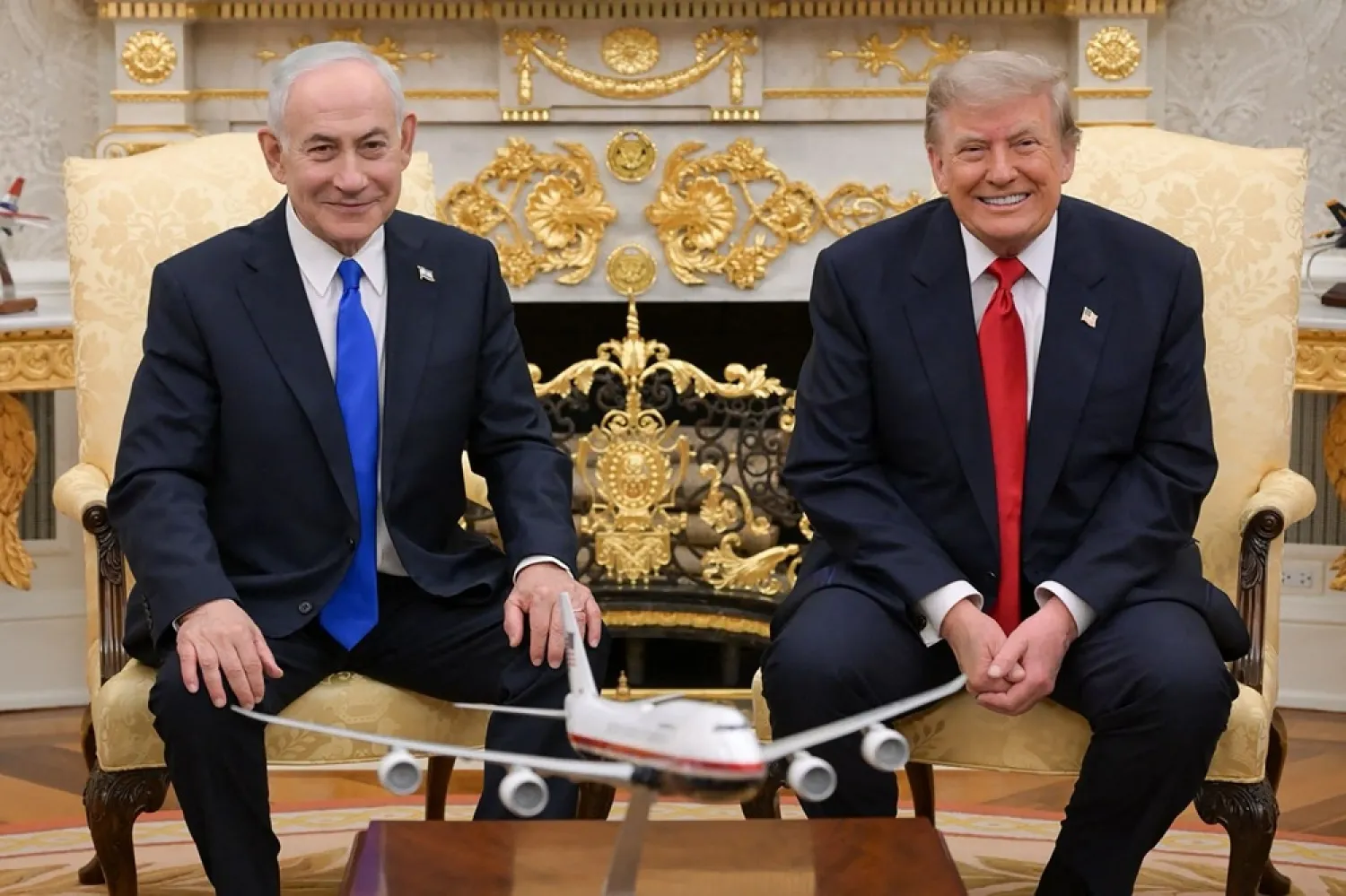
Netanyahu Praises First Meeting with Trump Since Launching the Iran War

This handout picture released by the Israeli Government Press Office (GPO) Shows Israel's Prime Minister Benjamin Netanyahu (L) posing for a picture with US President Donald Trump in the Oval Office of the White House in Washington DC, ahead of their meeting on July 28, 2026. (GPO/AFP)
TT

Netanyahu Praises First Meeting with Trump Since Launching the Iran War

This handout picture released by the Israeli Government Press Office (GPO) Shows Israel's Prime Minister Benjamin Netanyahu (L) posing for a picture with US President Donald Trump in the Oval Office of the White House in Washington DC, ahead of their meeting on July 28, 2026. (GPO/AFP)

Israeli Prime Minister Benjamin Netanyahu said he had an “excellent” meeting with President Donald Trump at the White House on Tuesday, their first sit-down since launching a joint war against Iran and it offered Netanyahu a chance to smooth out strains in their relationship. 

The closed-door meeting lasted nearly an hour and a half and was “positive and productive," White House press secretary Karoline Leavitt said. Trump, in a social media posting several hours after the talks, called it a “very good meeting” where “many important subjects were discussed” but offered no further details. 

The face-to-face talks come as both leaders face growing pressures at home. Netanyahu is up for reelection and is embattled in part because of his deteriorating relationship with Trump. Trump is under pressure to end an unpopular war that has wreaked economic havoc and driven prices higher ahead of midterm elections this November. 

Later on Tuesday, Iran shattered a brief period of calm in the war by launching multiple ballistic missiles at US forces in the Middle East, the US military said, adding that all of the Iranian missiles were successfully intercepted. 

An Israeli official briefed on the White House meeting said Netanyahu made it clear to Trump and his Cabinet that if Iran were to attack Israel, they would respond, but that beyond that, they would trust the judgment of the president regarding next steps. The official spoke on the condition of anonymity to share details of a private meeting. 

Despite signs of tension between the two before the meeting, Netanyahu was effusive afterward in a post on Instagram, noting that the meeting included Trump's “entire senior team.” 

Vice President JD Vance, who has had critical words for Israel and in June warned Israeli officials that Trump was their only friend among world leaders, was among those in the meeting. 

“When I say excellent, I don’t mean it in a superficial way,” Netanyahu said in Hebrew. “A conversation with full partnership, with mutual support, with an understanding of the common goal of ensuring that Iran does not have nuclear weapons, and other goals as well.” 

Netanyahu later joined Vance and Trump at a funeral for Sen. Lindsey Graham, where the Israeli leader was seen speaking to Ukrainian President Volodymyr Zelenskyy, who met with Trump earlier in the day. 

Trump expresses some frustration with Netanyahu before sitdown  

Trump revealed some tension with Netanyahu ahead of their meeting, complaining about reports that the Israeli leader planned to discuss intelligence on Iranian activities at Pickaxe Mountain, a potential nuclear site that the US president has threatened repeatedly to bomb. 

“I know exactly what’s going on at Pickaxe,” Trump told “Fox & Friends.” He insisted that whatever Iran is doing is “not a big problem” and that “Bibi’s telling me that because he wants me to stay involved.” 

“Why do you have to announce to the world?” Trump added, flashing his frustrations with his ally. 

The Israeli official said that Netanyahu reiterated to Trump during the meeting that Israel will always share its intelligence with the US but that it also understands that Washington has its own timeline and considerations to factor in, including other allied countries in the region that would be affected if Washington were to escalate militarily. 

Trump has had a hot-and-cold history with Netanyahu over the years, but upon his return to the White House last year, their alliance seemed stronger than ever. When they started the war together in February, it was with a united front, touting their respective militaries as acting in lockstep to take out Iran’s leadership and pave the way for a government more friendly to the West. 

But as Iran fought back — sending drones and missiles slamming into the Gulf, and choking off the Strait of Hormuz — Trump came under immense pressure both at home and by allies to end the conflict. 

Netanyahu has been deferential to Trump on next steps with Iran  

Since then, Netanyahu, who wanted to continue the fighting in Iran and against its ally, Hezbollah, in Lebanon, has been sidelined as Trump sought a deal with Tehran. Disagreements with Trump and Vance have burst into the open over the war in Iran and more. 

“The Americans are making it clear to the Israelis they are the ones who are running the war,” Israeli journalist and political analyst Amit Segal wrote Monday in the daily newspaper Israel Hayom. “It is clear to everyone that Israel has been put in the back seat.” 

Of Trump, Netanyahu said Sunday that “many ways, it’s his decision” on how to move forward. “If he can do so without returning to intense military fighting, that’s fine. Why not?” 

“But one way or the other, they have to end their nuclear program,” Netanyahu told Maria Bartiromo on Fox News Channel’s “Sunday Morning Futures” about Iran. 

The Israeli official said the two leaders also discussed the framework agreement that the US and Israel signed with Lebanon over the Israel-Hezbollah war. 

Steps to allow other forces in Gaza and in Lebanon  

Netanyahu also needed to persuade Trump that he won’t play spoiler to US diplomatic and reconstruction efforts in Gaza and Lebanon, where the president has previously complained that “too many people are being killed” by Israeli strikes. 

In Lebanon, where the Israeli military occupies much of the south, Israel agreed to allow the Lebanese army to deploy to some villages as part of a “pilot program” testing its ability to secure areas where Hezbollah once operated. The US State Department says the next round of talks between Israel and Lebanon will take place next week in Rome with a focus on expanding the program. 

On Gaza, Israel’s security cabinet green-lit on Sunday a measure that would, in theory, grant entry to the first members of an international stabilization force outlined last year in a US-backed ceasefire deal between Israel and Hamas. 

Few countries have pledged troops, however, and Israel would approve their entry into Gaza on a case-by-case basis. The troops, including from Morocco and Uganda, would only be allowed to operate in a small, desolate area in Rafah in the south, where the plan is to vet and house some displaced Palestinians. 

The Israeli military continues to carry out strikes it says target militants but that have also killed civilians. 

Israel has lost a significant amount of bipartisan support in the United States, particularly over Gaza. An AP-NORC poll published this month found a dramatic erosion of support among American adults for Israel. 

Near the White House, a small group of protesters chanted, “Netanyahu, you’re a tyrant” and “Bibi, you’re not welcome here,” referencing the prime minister’s nickname. 


France Wants Curfews in Some Areas after Weekend of Riots

A protester waving a French national flag walks past a fire during clashes prior to the start of a demonstration to protest against the "high cost of living", in Marseille, southern France, on October 17, 2026  (Photo by Thibaud MORITZ / AFP)
A protester waving a French national flag walks past a fire during clashes prior to the start of a demonstration to protest against the "high cost of living", in Marseille, southern France, on October 17, 2026 (Photo by Thibaud MORITZ / AFP)
TT

France Wants Curfews in Some Areas after Weekend of Riots

A protester waving a French national flag walks past a fire during clashes prior to the start of a demonstration to protest against the "high cost of living", in Marseille, southern France, on October 17, 2026  (Photo by Thibaud MORITZ / AFP)
A protester waving a French national flag walks past a fire during clashes prior to the start of a demonstration to protest against the "high cost of living", in Marseille, southern France, on October 17, 2026 (Photo by Thibaud MORITZ / AFP)

France's central government asked some local authorities to impose curfews and faced pressure over security failings on Monday after a weekend of riots and looting borne out of nationwide anti-government protests.

Prime Minister Sebastien Lecornu did not rule out declaring a state of emergency but said it was more appropriate for now to apply partial and localized curfews, without providing details of which cities would be affected.

"My determination to restore order is absolute," he said in a press conference, ruling out, however, a blanket curfew in Paris, Reuters reported.

The weekend of looting and violence between some protesters and police followed weeks of student demonstrations, rocking France six months ahead of its next presidential election and highlighting pressures from a weak economy and surging debt.

Lecornu blamed far-left groups for some of France's worst unrest in years. "There is, after all, a far-left movement that wants to cause — we can’t put it any more strongly — profound unrest in the country in the run-up to the presidential election," he said.

Hard-left presidential candidate Jean-Luc Melenchon urged him to provide evidence. "Otherwise, he should apologise, keep quiet and stop fanning the flames of unrest," he said on X.

The Federation of Trade and Retail said almost 3,000 shops had been affected over the weekend.

"Once again, the retail sector finds itself on the front line, at a time when it is already weakened by a succession of crises," it said.

"Behind every ransacked shop are business owners, employees and families who have seen years of work and effort wiped out in a matter of hours," it added, calling for relief from social security contributions and tax for those businesses affected.

Lecornu said the government would provide furlough measures from Tuesday.

Some 2,400 people were arrested and one protester died from a cardiac arrest on Saturday while nearly 1,000 officers were injured.

French assets were underperforming broader European markets on Monday, though moves were more contained than at some other moments of recent political friction.

Tensions in President Emmanuel Macron's fragile government over apparent security shortcomings — coming just as the government needs to pass a much-needed budget bill to rein in its finances — could further unsettle investors.

Macron's office said on Monday he had turned down his Interior Minister Laurent Nunez's offer to resign, telling him instead to put an end to barricades and looting and be transparent over what Macron called "intelligence and foresight failings".

Nunez told reporters that Tuesday evening's Champions League soccer match between Paris Saint-Germain and Barcelona would go ahead as planned, even though the capital was one of the worst-hit areas.

The mayors of Paris, Marseille and Lyon said in a joint op-ed published by the newspaper Liberation that they were used to demonstrations and protests.

"But on Saturday ... for the first time, we had the feeling that whole sections of our cities had been left without protection," the mayors — all from the centre-left — said. "We now need to patch the wounds of our cities and face up to the anger of our residents, aghast at this level of violence."

The start of school holidays on Monday may give the government some relief, but students were staging more gatherings and blockades in some places, including the Louvre gallery and Sciences Po university in central Paris.

Marseille, another city badly hit by the riots, banned gatherings and demonstrations. French unions meanwhile called for a new round of strikes and rallies on November 5.

INTELLIGENCE FAILURES

At the weekend, hundreds of thousands took to the streets to protest over what many say are declining and dysfunctional public services that leave citizens to fend for themselves amid cost-of-living pressures.

In Paris, at least 300 to 400 businesses were vandalised at the weekend, Dominique Restino, the head of the Paris chamber of commerce, told BFM television.

At the Place Vendome, home to luxury hotels and boutiques, most shops were shuttered and surrounded by security guards. The front door of a Dior boutique was smashed, while the windows were damaged in the stores of other luxury brands in central Paris, including Rolex, Louis Vuitton, Ralph Lauren and Gucci.

In Marseille, Ligue 1 club Olympique de Marseille said its official store on the city's historic main avenue had been looted, while a town hall in central France was torched.

France deployed 60,000 police and other security forces on Saturday, Nunez told France Inter radio, but he acknowledged that was not enough to control violent crowds.

European governments have advised citizens travelling to France to avoid large crowds and exercise caution.


Louvre Blocked as France Grapples with Unrest

TOPSHOT - A protester waving a French national flag walks past a fire during clashes prior to the start of a demonstration to protest against the "high cost of living", in Marseille, southern France, on October 17, 2026 as part of a nationwide call for mobilization bringing together various groups expressing their anger: former "Yellow Vests", secondary school and university students, climate activists and even farmers. (Photo by Thibaud MORITZ / AFP)
TT

Louvre Blocked as France Grapples with Unrest

TOPSHOT - A protester waving a French national flag walks past a fire during clashes prior to the start of a demonstration to protest against the "high cost of living", in Marseille, southern France, on October 17, 2026 as part of a nationwide call for mobilization bringing together various groups expressing their anger: former "Yellow Vests", secondary school and university students, climate activists and even farmers. (Photo by Thibaud MORITZ / AFP)

Protesters blocked the entrance to the Louvre in Paris on Monday, as French authorities scrambled to stem public discontent fueling mass cost-of-living demonstrations that over the weekend spilled over into some of the worst street violence in recent years.

President Emmanuel Macron ordered a security review as the country's interior minister admitted that the police "had lost control" during the weekend's unrest.

Undeterred, the Yellow Vests movement which organized the weekend's rallies called for a new round of protests Saturday, said AFP.

Italy, Spain and Portugal, where anger over rising prices has also led to protests, were keeping a nervous eye on the developments after smaller clashes broke out in Milan over the weekend and protests about housing costs persisted in Spanish cities.

Some half a million people turned out across France to protest the surging cost of living, a culmination of four weeks of protests that began with high school students demanding better conditions at their schools.

What started as peaceful demonstrations morphed into violence in some places, as masked groups on the sidelines of the protests attacked law enforcement, broke into town halls and other public buildings, setting many of them ablaze, looted shops, and set fire to cars, bicycles and scooters on the streets.

Interior Minister Laurent Nunez offered to resign on Monday after more than 2,500 people were arrested and nearly 1,000 members of the security forces injured. Protesters were also hurt, with one demonstrator's hand blown off by a police crowd-control grenade.

"On Saturday, in some major cities, you couldn't look shopkeepers in the eye after hundreds of shops had been looted and tell them we hadn't lost control," Nunez said.

Macron refused Nunez's resignation, even as he acknowledged security and intelligence failures in the government response, despite the some 60,000 law enforcement personnel deployed across the country on Saturday.

Nationwide, more than 2,330 people were taken into police custody over the weekend, 70 percent of whom were adults, Justice Minister Gerald Darmanin said Monday.

More than 2,000 shops were expected to have been affected by the weekend's violence across France, with damage running into "hundreds of millions of euros", according to chamber of commerce president Alain Di Crescenzo.

In an address to the nation Sunday evening, Macron slammed the "unbridled" violence and said local authorities would be able to ban -- "if necessary" -- certain rallies in coming days.

But he stopped short of announcing drastic measures, such as a state of emergency or curfew.

City authorities in Marseille said on Monday that public gatherings would be banned from noon to 08:00 pm (1000-1800 GMT).

- Louvre blocked -

The public discontent showed no signs of subsiding on Monday, with demonstrators blocking the entrance to Paris's iconic Louvre Museum, the most visited in the world.

"We are proud to announce that we are blocking the world's largest museum," read a leaflet posted outside the museum, as management and unions said the protest was led by students from Ecole du Louvre.

Rising prices have fueled anger in France, where diesel prices have jumped nearly 40 percent and petrol by 25 percent since March and where food prices have risen by 25 percent since 2021.

- Elections -

The unrest in France has flared just months before a key presidential election where centrist Macron cannot stand again and Marine Le Pen, the far-right presidential candidate for the National Rally party, is riding high in the polls.

Ministers have blamed "ultra-left" groups for the violence, while Le Pen claimed that the party of her far-left rival for the presidency, Jean-Luc Melenchon, had "legitimized the violence".

The left has accused Macron of ignoring protesters' demands, while the right is calling on him to take a firmer line.

- Europe -

With costs of living rising across Europe, smaller demonstrations have broken out in other countries.

During the weekend, clashes broke out on the sidelines of a cost-of-living demonstration in Milan, with Mayor Giuseppe Sala warning: "I'm very worried because it's a new phenomenon, which also originates from an international scenario and therefore feeds itself."

In Spain, hundreds of tents have occupied Madrid's central Puerta del Sol square since September, when the eviction of an 87-year-old woman from her lifelong flat sparked nationwide protests in a country with soaring housing costs.

Dozens of tents have also sprung up in Portugal's main cities of Lisbon and Porto, with protesters demanding action over rising costs of housing.


At Least Two Dead as Floods Hit Eastern Spain

Parked cars are half-submerged in a flooded park area after heavy rainfall that hit the area early in the morning, in the town of Algeciras, southern Spain, 18 October 2026. (EPA)
TT

At Least Two Dead as Floods Hit Eastern Spain

Parked cars are half-submerged in a flooded park area after heavy rainfall that hit the area early in the morning, in the town of Algeciras, southern Spain, 18 October 2026. (EPA)

At least two people have died after heavy rain triggered flooding in eastern Spain, authorities said Monday, as rescuers worked to evacuate stranded residents and officials urged people in the Valencia region to stay indoors.

Videos released by Valencia's regional meteorological agency showed streets turned into torrents, sweeping away vehicles in several towns in the provinces of Valencia and Alicante.

"Road travel is impossible, you must stay at home," Juan Carlos Valderrama, the Valencia region's emergency chief, said on Monday morning, warning that intense and persistent rainfall was causing severe flooding.

One person died in Sagunto, local authorities said overnight from Sunday to Monday, while firefighters in neighboring Catalonia reported the death of a woman who fell into a stream.

Emergency services and soldiers from Spain's military emergency response unit were working early on Monday to evacuate people whose homes had flooded, including residents who had taken refuge on rooftops.

"Rescue operations are continuing in areas that are difficult to access. People are urged to avoid all travel," Prime Minister Pedro Sanchez said on X, describing the situation in the Valencia region as "very difficult".

Scientists say human-driven climate change is intensifying the Mediterranean storms that typically hit eastern Spain in autumn as the sea absorbs heat during the summer, leading to increased evaporation and heavier rainfall.

National weather agency AEMET announced Friday that last month was mainland Spain's hottest September on record, after the country registered its warmest summer between June and August.