


Wildfires Are More Extreme in Europe and North America, but Global Burning Is Oddly Decreasing

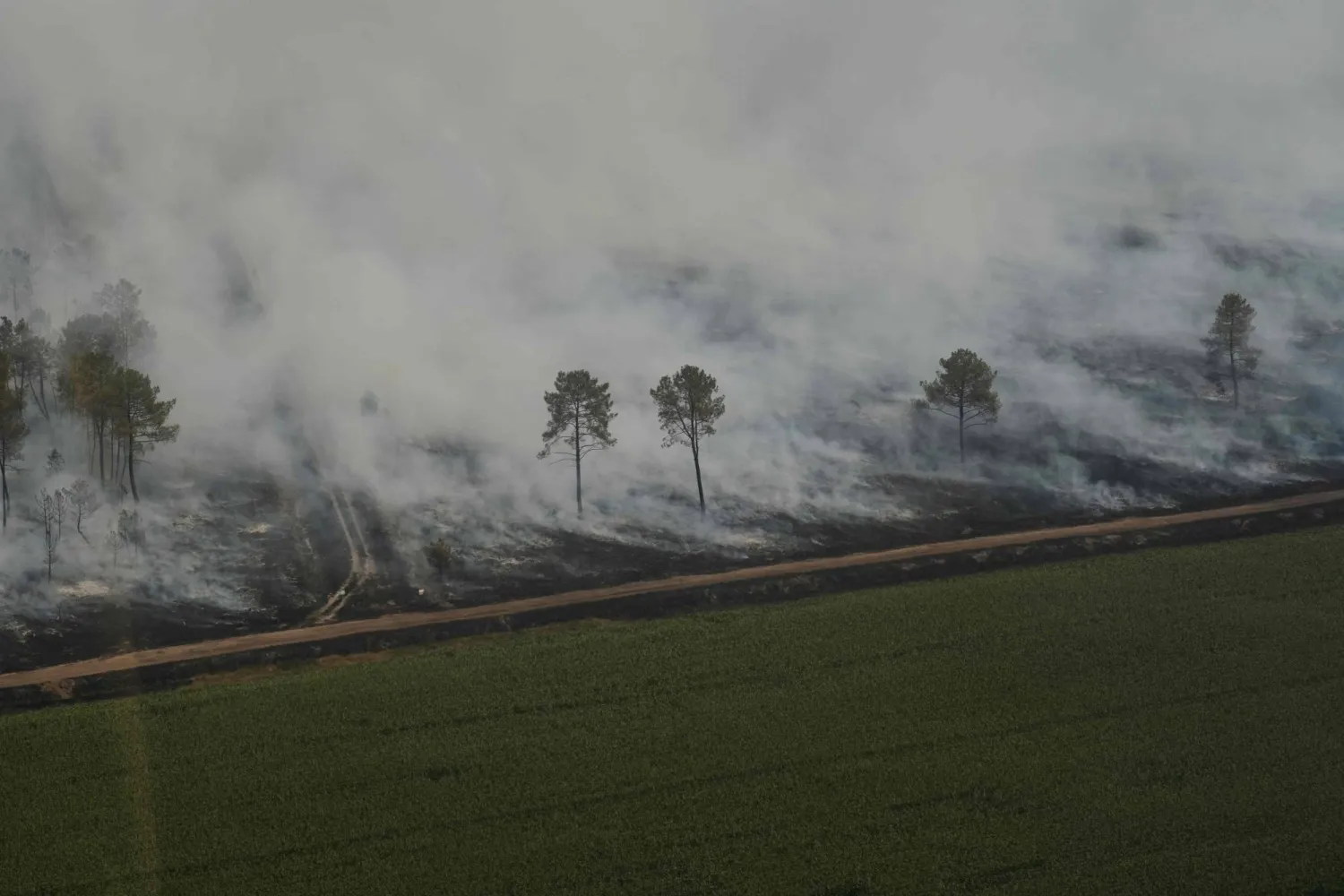
This aerial view taken from a Civil Security helicopter shows smoke billowing from a burning forested area next to a field near Ares, southwestern France, on July 28, 2026. (AFP)
TT

Wildfires Are More Extreme in Europe and North America, but Global Burning Is Oddly Decreasing

This aerial view taken from a Civil Security helicopter shows smoke billowing from a burning forested area next to a field near Ares, southwestern France, on July 28, 2026. (AFP)

It seems as if the world is afire this summer. But even as wildfires in Europe and North America grow more extreme, key worldwide burning statistics are at a record low largely because Africa and Asia are controlling fire more.

Experts say these seemingly opposite trends are happening at the same time because of what humanity is doing to the planet.

“It does seem like a paradox because we’re talking increases in fires, yet the global numbers have been going down and down. But they’re both true,” said fire scientist Mike Flannigan of Thompson Rivers University in Canada.

Spain's wildfire is that country's largest on record at more than 193 square miles (500 square kilometers) while wildfires in Europe have burned just a bit under 2025's all-time high. In Canada and the United States this summer, land burned by wildfires is at least 25% higher than the 10-year average and more than double what it was decades ago, according to national wildfire centers. Entire chunks of the continent were choked by smoke, causing unhealthy air quality.

Fires are worsening in terms of size, intensity, speed and frequency, especially in the US, Canada and Europe, said University of Colorado fire scientist Jennifer Balch.

“Extreme wildfires are on the rise globally in different parts of the world. And that’s the piece that you know has us shaking in our boots,'' Balch said.

Fires decrease in Africa, Asia

And yet the world went into July this year with record low global emissions from burning fires, a key measure of their prevalence, the European climate center Copernicus reported. That is because fires in Africa and Asia are way down due to changing agricultural practices, fire management and where people are moving to, said Mark Parrington, a senior scientist at Copernicus.

Copernicus calculated that this year's carbon emissions from burning are the lowest since satellites first measured nearly 25 years ago - about half what they were in the early 2000s.

“Africa dominates the global fire activity,” said UCLA water and fire scientist Park Williams. “So if there’s a trend in Africa, then that’s going to be the trend in the global fire activity. In sub-Saharan Africa, fire activity over the last 25 years has gone down pretty dramatically.”

On average, more than three-quarters of the global emissions from the burning of plant material comes from Africa and Asia, Copernicus statistics show. Less than one-eighth comes from North America and Europe.

Traditionally, huge grassland fires on the African savanna burned each year, compared to more intermittent forest fires in other regions, influencing worldwide fire totals, said John Abatzaglou, a fire scientist at the University of California Merced.

But with more land being used for housing and farming, humans are limiting savanna fires, while also creating barriers to prevent fires from spreading, he said.

In Asia and the Amazon, fires are often used to clear land for agriculture, experts said. So, Williams said, “it really is all driven by human demographic change.”
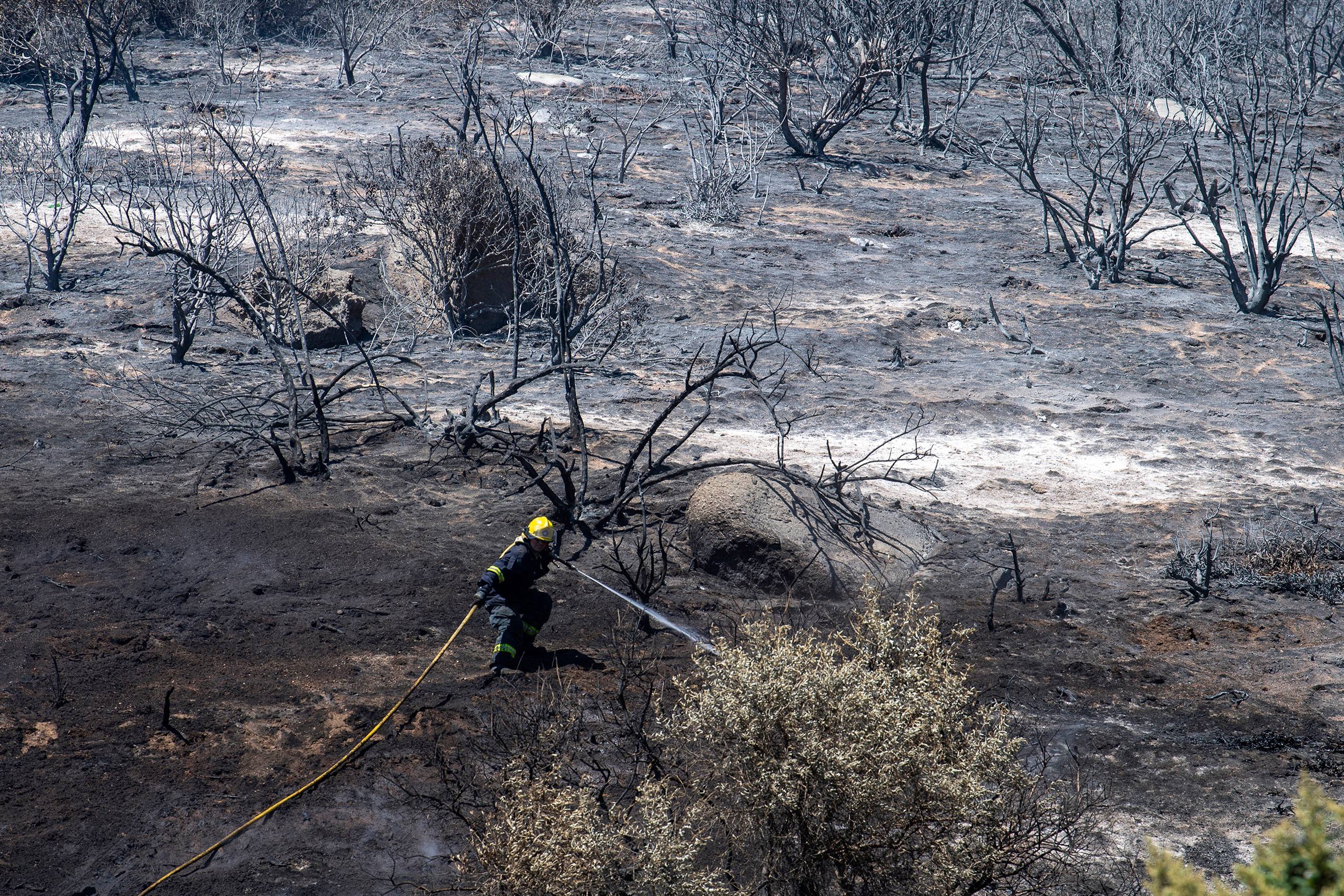
A firefighter battles a wildfire on the slopes above Simon's Town, South Africa, Dec. 19, 2023. (AP)

Human fingerprints on North American and European fire trends

In North America and Europe there are also “human fingerprints” on the more extreme fires dominating the news, but that is from climate change, Abatzaglou said. Climate change from the burning of coal, oil and gas is making it hotter and drier - ideal fire weather - five different experts told The Associated Press.

Hotter temperatures mean humans “have our foot on the gas pedal” for bigger fires, “but we also have lost the brakes on fire” because warmer and wetter nights don't give forests or firefighters time to recover during darkness like they used to, Balch said.

When it gets hotter, the atmosphere sucks more moisture out of the ground, making it drier and easier to burn, Flannigan said.

Climate change also increases the length of the burning season across North America and especially in northern forests where there used to be only a few days when the weather was conducive to wildfires, but now there are a lot more, he said.

And when climate change makes fire more extreme in places with larger populations, it tends to have a greater impact by burning more valuable property, Flannigan said.

Abatzaglou said that North America has long done a good job of fire suppression. But with climate change making fires more intense and frequent, “we're losing our ability to do that,” he said.

El Nino will add to fires

Fire activity is likely to get worse in the coming months because of the developing super strong El Nino. The weather pattern usually triggers more dangerous fires in the tropics, less so in the United States because of more rain, experts said. South American governments are already getting prepared.

“The most predictable outcome of El Nino is going to be more tropical fire, specifically tropical forests,” Williams said.

Williams said El Nino could increase fires in the Amazon region, Southeast Asia and the Western Pacific.

While El Nino means more rain and fewer forest fires in the US West, it can also mean more grass growth in deserts that adds fuel for eventual grass fires, Abatzaglou said. Examples of devastating grass fires include Los Angeles in 2025 and Hawaii in 2023,

Regardless of El Nino, scientists said areas in North America and Europe will have to improve planning and adaptation for worsening wildfires, including prescribed burns to thin excess trees and grasses.

“It’s not a question of whether our landscapes are going to burn, it’s the question of when they’re going to burn,” Balch said.

Cooking Was Already an Artform in Bronze Age Syria

What they once ate now tells the story of how they lived (SPA)
TT

Cooking Was Already an Artform in Bronze Age Syria

What they once ate now tells the story of how they lived (SPA)

While the folk of Bronze Age Europe were mostly making do with simple stews and bread, people in Syria were already importing ingredients and using pots of differing temperatures to support “sophisticated” cuisine, researchers said on Friday.

The evidence from Danish experts suggests people living in what is now the city of Hama 4,500 years ago were already enjoying dishes of simmered goat, gazelle and cereals, AFP reported.

The city’s cooks used pots with different heating properties depending on the type of meal they were about to prepare, much as we choose between cast-iron or non-stick frying pans today.

Mette Marie Hald, from the National Museum of Copenhagen, and her team reached the conclusion after examining animal bones, plant remains and fats from inside cooking pots found in the city.

“It feels a bit modern, actually, the way that you have different pots and you have different sort of serving wares,” the archaeobotanist told AFP.

Locally produced pots were made from clay and calcite, while others were made from clay mixed with basalt and were imported from as far away as China.

Meals could be prepared with imported ingredients such as gazelle, which itself came from much further east.

Hald said the evidence of “sophisticated cooking” they had uncovered in Hama was supported by recipes written down in much later periods.

Danish archaeologists started digging in Hama in the first half of the 20th century, she said, so there has been quite a lot of research on everyday life there.

But she added that they had not really focused on food culture before.

“This is a period of kingdoms, well-organised cities and stratified societies,” she said.

“In that way, it’s not surprising that they also knew sophisticated cooking. I think the surprising element is we can actually prove it.”


Lady Gaga Welcomes First Child

(FILES) US actress and singer Lady Gaga attends the US premiere of Warner's "Joker: Folie a Deux" at the TCL Chinese theater in Hollywood, California, September 30, 2024. (Photo by Chris DELMAS / AFP)
TT

Lady Gaga Welcomes First Child

(FILES) US actress and singer Lady Gaga attends the US premiere of Warner's "Joker: Folie a Deux" at the TCL Chinese theater in Hollywood, California, September 30, 2024. (Photo by Chris DELMAS / AFP)

Pop superstar Lady Gaga welcomed her first child with fiance Michael Polansky, US media reported Friday.

The 40-year-old "Bad Romance" singer, whose real name is Stefani Germanotta, began dating Polansky in 2020, and became engaged to the entrepreneur in 2024.

A source confirmed news of the child's birth to Page Six and People, but no additional details about the baby, including its name, sex or date of birth, were immediately available.

The musician affectionately referred to as "Mother Monster" by her fans has spoken in recent years about her desire to have a child.

She wrapped up her most recent world tour, the Mayhem Ball, in April, and her latest album "Mayhem" garnered multiple Grammy nominations, winning the award for "Best Pop Vocal Album" earlier this year.


Coastal Erosion Forces Cancellation of California Music Festival

MALIBU, CALIFORNIA - SEPTEMBER 10: People gather near erosion damage along a beach access road to Point Dume, which remains closed due to the erosion from powerful surf and high tides earlier this summer, on September 10, 2026 in Malibu, California. Mario Tama/Getty Images/AFP
TT

Coastal Erosion Forces Cancellation of California Music Festival

MALIBU, CALIFORNIA - SEPTEMBER 10: People gather near erosion damage along a beach access road to Point Dume, which remains closed due to the erosion from powerful surf and high tides earlier this summer, on September 10, 2026 in Malibu, California. Mario Tama/Getty Images/AFP

A music festival set to feature The Killers, Olivia Dean and Jack White was cancelled Friday because the California beach where it was to be held has been eaten away by coastal erosion.

The two-day Ocean Way Festival had been planned for later this month in Santa Monica, but waves up to 15 feet (4.5 meters) and storm runoff has left the beach in the city near Los Angeles badly degraded, forcing local officials to pull the plug.

"Storm surf generated by Hurricane Marie and runoff from a storm drain outfall eroded a large portion of the festival site," AFP quoted a statement from the city of Santa Monica as saying.

The storm, which churned the waters of the Pacific over the last week, stripped sand off the beach, making it no longer safe to hold the festival there, the city said.

"The surf took the beach we planned this on, and we cannot put tens of thousands of festival-goers on that sand until it's safe," said Mayor Caroline Torosis.

The coastal city of Santa Monica -- the official end point of Route 66 -- has a wide stretch of golden sand and a large wooden pier that features frequently in American television shows and movies.

News of the festival cancellation came days after the pounding surf opened a huge sinkhole on the driveway of a beachfront home belonging to Oscar-winning US actor Nicolas Cage.

Officials in Malibu, which sits just north of Santa Monica, have ordered the evacuation of 31 homes because of the danger posed by the hole.

Further south, at least seven homes in Dana Point were declared uninhabitable after the coast on which they sit rapidly eroded, with one house collapsing into the sea.

A similar problem has occurred in nearby Laguna Beach.

The waters of the Pacific Ocean have been unsettled in recent weeks by a series of tropical storms, with some of them developing into hurricanes.

Scientists say a near-record strength El Nino climate episode is warming the ocean's waters and creating extra volatility.

While the phenomenon is part of a natural cycle, human-caused climate change is thought to be super-charging the heating and exacerbating its effects.