Against the towering mountains of southwestern China, a crowd gathered as a young man prepared to bungee jump off the world’s highest bridge.
He stood above a vast canyon, the bridge’s roadway soaring nearly nine times higher above the water than San Francisco’s Golden Gate Bridge. Beyond him, the ancient peaks of Guizhou rolled toward the horizon. Around him, spectators edged closer, phones raised, eager to capture the moment.
First came the safety checks. Strapped into a harness, he stood on a platform beneath the roadway as staff inspected his equipment.
Then he stepped into the air.
For seven seconds, he plunged toward the canyon floor, hundreds of meters below.
Then the huge bungee cord bounced him back. Next came the applause.
It was an extraordinary spectacle, not least because of where it was happening: a towering suspension bridge in one of China’s most mountainous provinces, where an engineering marvel is now an unlikely playground for tourists and thrill-seekers, according to CNN.
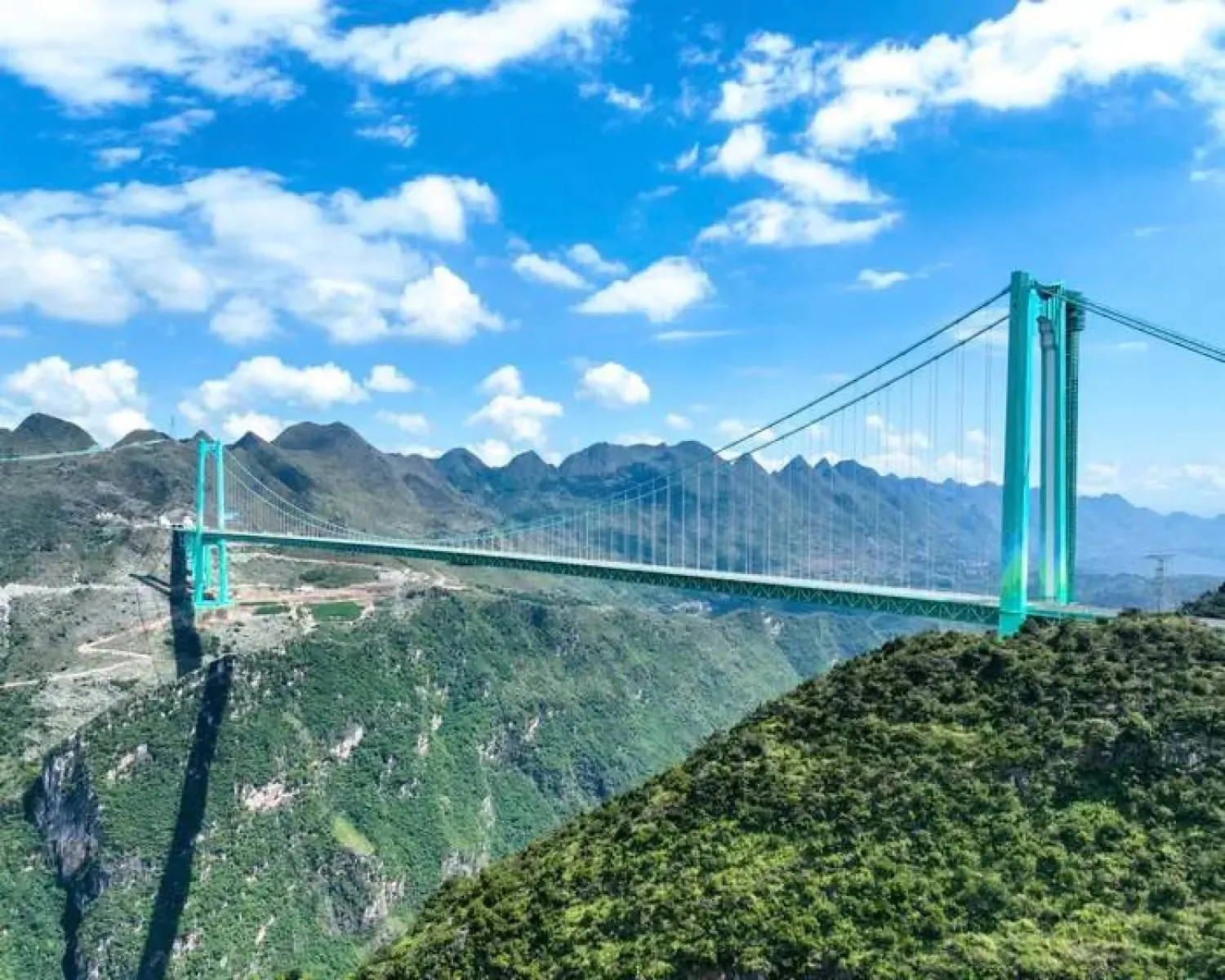
Opened in September 2025, the Huajiang Grand Canyon Bridge towers 625 meters above southwestern China’s Beipan River, making it the world’s highest, according to Guinness World Records.
Built to slash a once-arduous journey across the canyon from roughly two hours to just two minutes, the span connects rural mountain communities to China’s wider road network.
From its opening through August 2026, the bridge attracted approximately 3.3 million visitors, according to figures provided to CNN by local officials.
For decades, China has built bridges to conquer its difficult terrain. Huajiang raises a different question: What happens when the bridge itself becomes the vacation spot?
The Huajiang Grand Canyon Bridge stretches nearly 2.9 kilometers across the landscape, its two enormous teal towers rising above a gorge that seems to disappear into the mountains.
But the span’s most unusual feature may be what happens beneath its traffic.
Visitors can enter the structure itself, stepping onto glass observation platforms offering stomach-churning views of the canyon below.
For those seeking something more adventurous, there’s the bungee jump, along with an exposed walkway beneath the road.
For Lin Guoquan, the bridge opened possibilities he could scarcely have imagined for his family’s village.
After years working as a chef in Yunnan, Zhejiang and Guangdong provinces, Lin returned to Guizhou and began converting old houses, including his grandparents’ home, into guest accommodations. He was betting that the new bridge would bring visitors to a place few outsiders had reason to visit before.
The gamble appears to have paid off.
“When we first opened, we only had nine rooms. Now we have expanded to 52, and we still don’t have enough rooms for all our guests,” Lin told CNN.
His business has grown alongside an extraordinary surge in tourism. During the nine-day Chinese New Year holiday in February 2026, more than 300,000 visits were recorded at the bridge’s service area — greater than the population of Buffalo, New York.
For entrepreneurs like Lin, attracting visitors now depends on more than the roads leading into the canyon. It also depends on being able to reach potential guests online.
Mobile coverage in the area was once limited. State-owned telecom operator China Mobile, working with technology giant Huawei, has since expanded the network, adding base stations to handle growing numbers of visitors.
“What people see is this mighty physical bridge,” said Zhou Jianguo, a member of Huawei’s China strategy and business development division. “Yet a bridge in the digital world is equally necessary, and that is our communications network.”
Near the top of the canyon, tourists post from a perch at the other end of the hospitality spectrum.
Unlike Lin’s converted village homes, the 83-room luxury Onaemont Hotel was conceived as part of the larger development project to build a tourism industry around the new bridge.
For Cao Luyao, the hotel’s marketing communications manager, the bigger change isn’t simply how many people are visiting this remote corner of Guizhou—it’s how long they’re staying.
“Tourists no longer just come to see the bridge, they can stay overnight beside it,” Cao said. “This upgrades bridge-centered tourism from quick pass-through visits to immersive overnight stays.”