


US Launches Strikes on Iranian Targets a Day after It Foiled Missile Attack on American Forces

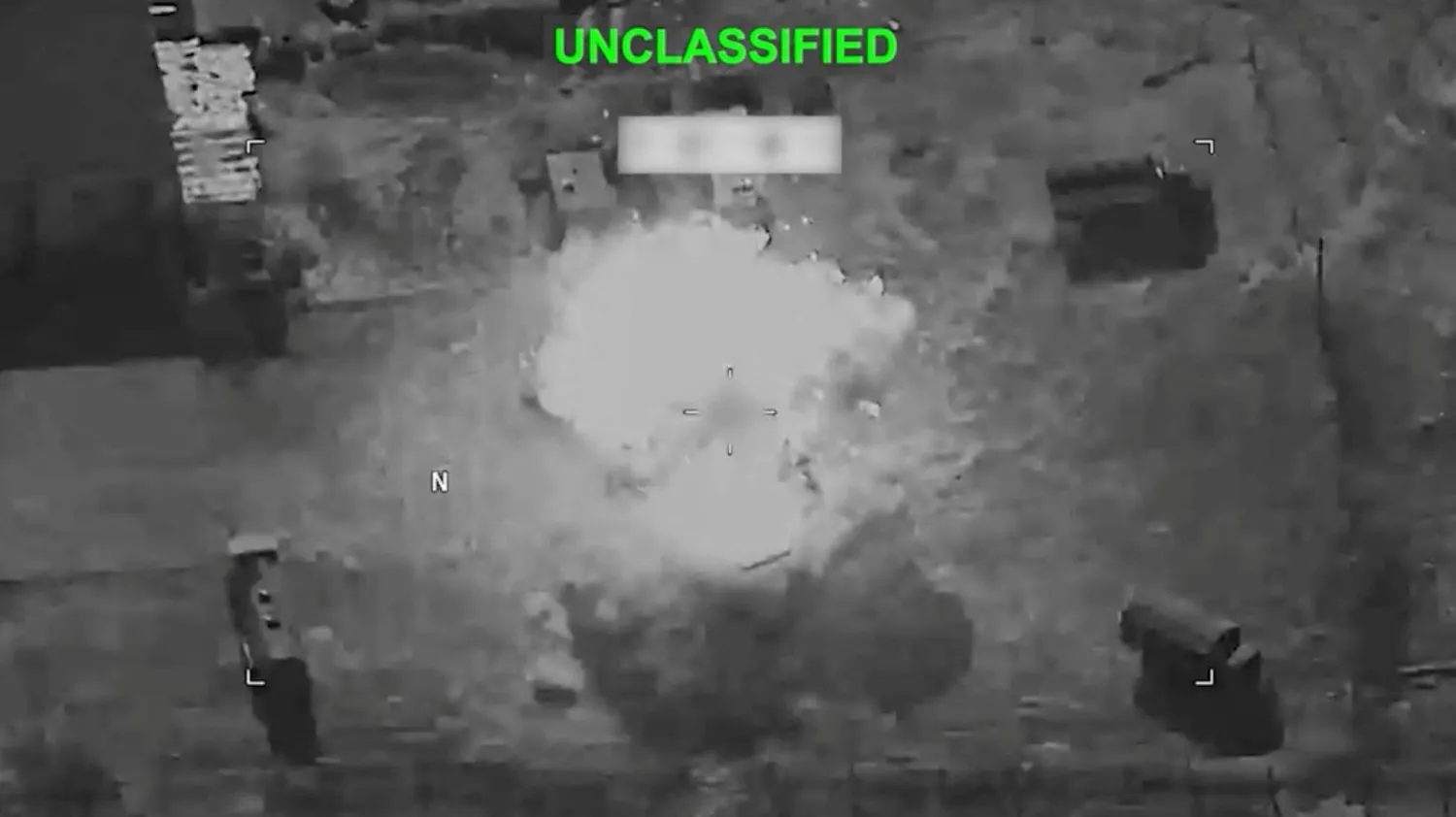
Smoke rises following explosion at an unknown location, during what US Central Command (CENTCOM) says are strikes on Iran, in this screengrab taken from a handout video released on July 29, 2026. US Central Command /Handout via REUTERS
TT

US Launches Strikes on Iranian Targets a Day after It Foiled Missile Attack on American Forces

Smoke rises following explosion at an unknown location, during what US Central Command (CENTCOM) says are strikes on Iran, in this screengrab taken from a handout video released on July 29, 2026. US Central Command /Handout via REUTERS

The US military said early Thursday it had completed “a heavy wave of strikes against Iran” conducted in response to an earlier Iranian missile attack on a US base in Jordan. The latest barrage came after the US partnered with Saudi Arabia to strike Iran-backed militias in neighboring Iraq, killing at least 20 fighters and six Iranian advisers.

Central Command said in a social media post that over two hours the US struck “dozens” of targets belonging to Iran’s Revolutionary Guard Corps, including military command centers as well as missile and drone facilities, and coastal surveillance and defense sites, The Associated Press said.

The new strikes came hours after US President Donald Trump vowed to hit Iran “very hard” after it targeted a base in Jordan that hosts US troops.

Iranian state media said two people were injured in attacks on the island of Qeshm in the Strait of Hormuz and that explosions were also reported in Khuzestan province to the northwest.

Elsewhere, drone strikes ignited fires on two natural gas vessels at the Egyptian port of Damietta, according to British maritime security firm Ambrey. It was not immediately clear who was responsible for the strikes on a US-owned floating storage facility and a Greek-owned tanker. No injuries were reported.

The flare-ups on multiple fronts after several days of relative calm raised the risk of a return to all-out war. It also underscored the difficulty of winding down a five-month conflict that has jolted the world economy and is unpopular among Americans. The fighting was also likely to add to concerns that the US is further drawing down already diminished stockpiles of sophisticated munitions needed to defend its bases and allies.

Egypt, a close US ally and regional mediator, is one of the only countries in the Middle East to have been spared direct military action during the war. A strike by Iran or its allies, if confirmed, would mark a significant widening of the conflict.

Asked during an Oval Office event if Iran was responsible for the strikes on the natural gas vessels, Trump responded: “It's a little more of the same.”

“In the meantime, we’re going to be hitting them very hard because it’s our turn to hit them," he added.

Saudi Arabia had accused the Iraqi militias of firing drones against its oil facilities over the past two days. An umbrella group of Iraqi militias initially denied the allegations, while another Iran-backed group — the Houthis in Yemen — said they had attacked Saudi energy facilities as part of a separate but related conflict.

Before the latest eruption, mediators had expressed optimism about bringing the US and Iran back to the negotiating table. An interim agreement collapsed in recent weeks over renewed fighting in the Strait of Hormuz, a crucial waterway for global energy supplies that Iranian attacks have again effectively closed.

A regional official said mediators are “still trying with both sides” to restore calm and get the ceasefire back on track. He gave no details on whether progress was being made and spoke on condition of anonymity to discuss the closed-door diplomacy.

The renewed hostilities sent oil prices spiking. Brent crude, the international standard, jumped 7.3% to $88.093 a barrel.

Jordan intercepts missiles and US strikes militias in Iraq Iran's paramilitary

Revolutionary Guard said it fired missiles Tuesday at Jordan's Muwaffaq Salti Air Base, a key US military hub for the region, in a statement carried by the state-run IRNA news agency.

Jordan’s military said five Iranian missiles had been intercepted and destroyed.

The US military later announced that American and Saudi fighter aircraft had struck multiple logistics and weapons sites in eastern Iraq in response to the drone attacks on Saudi Arabia.

The Popular Mobilization Forces, a coalition of primarily Shiite Iranian-backed armed groups that is officially under the command of the Iraqi military, said at least 20 fighters were killed and 32 wounded in the overnight strikes.

Six Iranian advisers were also killed, according to two Iraqi militia officials, who spoke to The Associated Press on condition of anonymity because they were not authorized to comment publicly. Iran's deputy governor for political, security and social affairs in Markazi province told Iranian state media that four advisers were killed.

The coalition joined the fight against the ISIS group after it seized large sections of Iraq in 2014. The Iraqi government later designated the coalition as an “independent military formation” within the armed forces, but the militias have significant autonomy and some have attacked US facilities.

On Monday, the Houthis said they had launched drones targeting oil facilities used to transport oil across Saudi Arabia to the Red Sea port city of Yanbu.



5 Killed in Russian Strikes on Ukraine as Putin Warns Europe Against Sending Troops

Ukrainian rescuers work amid the rubble at the site of a Russian strike on a multi-story residential building in Odesa, southern Ukraine, 12 September 2026, amid the ongoing Russian invasion. EPA/IGOR MASLOV
TT

5 Killed in Russian Strikes on Ukraine as Putin Warns Europe Against Sending Troops

Ukrainian rescuers work amid the rubble at the site of a Russian strike on a multi-story residential building in Odesa, southern Ukraine, 12 September 2026, amid the ongoing Russian invasion. EPA/IGOR MASLOV

Russian strikes killed five civilians and wounded dozens in Ukraine, local officials said Saturday, after Russian President Vladimir Putin warned that sending European troops into Ukraine would amount to direct conflict with Russia.

Ukraine is under mounting pressure from Russia’s intensifying air campaign that uses ballistic missiles and jet-powered drones to pierce defenses. Moscow’s attacks have targeted Ukraine’s power grid ahead of winter in what officials say is meant to demoralize civilians.

Two people were killed and one wounded when Russian drones struck a residential area overnight in the Ukrainian city of Zaporizhzhia, regional head Ivan Fedorov said Saturday.

One person died and three others were wounded in strikes on Kryvyi Rih, according to local officials.

In the Black Sea port of Odesa and the surrounding area, 35 people were wounded overnight in what regional head Oleh Kiper called a “massive attack.” Among the buildings hit was a residential high-rise, whose upper floors were completely destroyed.

Later on Saturday, two people were killed in a Russian attack on a grocery store in Ukraine's Zhytomyr region, local officials said.

Meanwhile, Ukrainian President Volodymyr Zelenskyy said Ukrainian forces struck two chemical industry facilities in Russia, one in Samara and one in Perm. The governors of the regions did not immediately comment, but Russian independent online news outlet Astra reported drone attacks on chemical plants in both regions.

Putin, speaking to reporters at a summit of the BRICS group of emerging economies in India on Friday, said that if European governments send troops into Ukraine, it will mean “a war with Russia.”

“Now they’re talking about how they’re considering sending troops into Ukraine. That means a war with Russia,” The Associated Press quoted him as saying.

Some European leaders have pledged their commitment to a potential peacekeeping force, a prospect that Moscow has repeatedly described as unacceptable.

Putin also denied Russia posed any threat to Europe, saying “there is no such threat and never has been.”

“We do not threaten, nor do we intend to threaten, European countries,” he said.

Polish Prime Minister Donald Tusk said Thursday that two incidents along Ukraine’s borders with Poland and Moldova this week were a preview of potential intensified Russian provocations at Ukraine’s border crossing points with Europe.

Two people died when Russian drones hit the Starokozache border crossing between Ukraine and Moldova on Tuesday night, while a “direct threat” to a Polish-Ukrainian crossing point on Wednesday night was only avoided thanks to cooperation between Warsaw and Kyiv, he said.

Meanwhile, Zelenskyy told Deutsche Welle, in an interview published Saturday, that he would meet Putin if both leaders were invited to the Group of 20 summit of rich and developing nations in December in Miami.

Putin’s foreign policy adviser, Yuri Ushakov, said Saturday that the possibility of Putin attending the summit had not yet been discussed.

The Kremlin in the past has said that Zelenskyy can come to Moscow if he wants a meeting with Putin, a proposal Kyiv has rejected.

“If he really wants to meet with Putin, Putin has already said that he could fly to Moscow,” Kremlin spokesman Dmitry Peskov said Saturday.

Russian Foreign Minister Sergey Lavrov affirmed Saturday that Russia is “ready for negotiations,” but that the so-called “special military operation,” as Moscow refers to its war in Ukraine, “will not be suspended during this period of negotiations.”


BRICS Nations Call for 'Maximum Restraint' in Middle East War

A handout photo made available by India’s Ministry of External Foreign Affairs shows BRICS leaders planting trees during the 18th BRICS Leaders' Summit in New Delhi, India, 12 September 2026. EPA/INDIAN MINISTRY OF EXTERNAL FOREIGN AFFAIRS/HANDOUT
TT

BRICS Nations Call for 'Maximum Restraint' in Middle East War

A handout photo made available by India’s Ministry of External Foreign Affairs shows BRICS leaders planting trees during the 18th BRICS Leaders' Summit in New Delhi, India, 12 September 2026. EPA/INDIAN MINISTRY OF EXTERNAL FOREIGN AFFAIRS/HANDOUT

Members of the 11-nation BRICS group including China, Russia, Iran and India called for calm in the Middle East at a summit in New Delhi on Saturday.

Chinese President Xi Jinping, who joined Russian, Iranian, Indian and other leaders in India's capital, told the summit that the Middle East war "does not serve the common interests of the international community.”

Leaders issued a statement on Saturday after intense diplomatic efforts by host India, as the bloc seeks to bolster its global influence and address conflict, trade turbulence and energy security.

"We express deep concern over the continued escalation of tensions in Middle East/West Asia," the joint statement said, according to AFP, adding the countries "call for exercising maximum restraint, as well as avoiding actions that could further aggravate the situation.”

BRICS was created in 2009 as a forum for major emerging economies seeking greater influence in institutions dominated by Western powers.

"We have to transform this pyramid of privilege into a platform of partnership," Indian Prime Minister Narendra Modi told Xi, Russian President Vladimir Putin, Iranian President Masoud Pezeshkian and other leaders as he opened the two-day summit.

Modi said BRICS nations "represent 50 percent of the world's population, 40 percent of global GDP and more than 25 percent of global trade.”

But finding balance in the bloc is a tough diplomatic task.

India maintains cordial relations with both Iran and US ally Israel, but is also careful to strike a delicate balance in its ties with Washington.

Iran's Pezeshkian attended the summit shortly after warning that the Middle East does not need the United States to be a "regional policeman,” with the two countries at war and tensions threatening the vital Strait of Hormuz.

India has navigated the energy crisis caused by the US-Iran war in part by turning to Russia, despite Moscow's war in Ukraine and pressure from Washington and other Western capitals.

Modi embraced Putin before talks on Friday. The Russian president, who last visited India in December 2025, is one of New Delhi's most important strategic partners.

Xi's participation is also being closely watched because it is his first visit to neighboring India since 2019, and the biggest step yet in a cautious thaw between the nuclear-armed rivals.

Xi was given a red-carpet welcome, with an honor guard of soldiers and traditional dancers in colorful dresses.

"Although our two countries are different in many respects, they are fully capable of complementing each other's strengths, supporting one another, achieving mutual success and advancing together," Xi said as he met Modi, in a video released from New Delhi.

His visit comes six years after a deadly military clash along the disputed Tibetan border between China and India, with ties gradually improving through restored flights, visas and high-level contacts.

The underlying territorial dispute remains unresolved, and both sides retain heavy military deployments along their roughly 3,500-kilometer high-altitude border.

India's foreign ministry said in a statement after the meeting that "the two leaders expressed commitment to a fair, reasonable, and mutually acceptable resolution of the boundary question.”

Modi "underlined the need for both sides to observe existing agreements and understandings on border related issues," the foreign ministry added.

Deep mistrust remains, with their contested Himalayan frontier, a widening trade deficit and strategic rivalry continuing to complicate ties.

"Both sides should... work hand-in-hand to promote high-quality major financial cooperation, advocate an equal and sustainable global order, and foster an economic globalization that is open and inclusive," Xi said.


Pezeshkian Says Middle East Has No Need for US 'Policeman'

Indian Prime Minister Narendra Modi, right, greets Iranian President Masoud Pezeshkian upon his arrival for the BRICS summit in New Delhi, India, Saturday, Sept. 12, 2026. (Indian Foreign Ministry via AP)
TT

Pezeshkian Says Middle East Has No Need for US 'Policeman'

Indian Prime Minister Narendra Modi, right, greets Iranian President Masoud Pezeshkian upon his arrival for the BRICS summit in New Delhi, India, Saturday, Sept. 12, 2026. (Indian Foreign Ministry via AP)

Iran's President Masoud Pezeshkian said on Saturday that the Middle East does not need the United States to be a "regional policeman,” with the two countries at war and vying for control of the Strait of Hormuz.

"We do not need a regional policeman," he said on the sidelines of a BRICS summit in India during a meeting with Malaysian Prime Minister Anwar Ibrahim.

"The territorial integrity and security of the region can only be guaranteed by its main players and the countries that comprise it," he added, according to the Iranian presidency.

Iran has been at war since February 28, when US-Israeli strikes killed its supreme leader.

Tehran retaliated with attacks across the region and blockaded the Strait of Hormuz, through which one-fifth of the world's oil previously flowed.

Iran and the US have since been vying for control of the strategic waterway.

The strait was free to transit before the war, but Iran now requires vessels to obtain permission and is considering a mechanism to impose service fees.

Ships that do not comply are regularly targeted by Iranian strikes, while the US periodically bombs the Iranian coastline to challenge the country's control of the strait.

More than six months into the Middle East war, the blockade continues to drive up oil prices, which soared past $100 a barrel this week.

"Despite all the injustices suffered by our people, we neither desire war nor its continuation. Peace remains our priority," Pezeshkian added.