Türkiye Confronts Growing Wildfires on Tourist Coasts

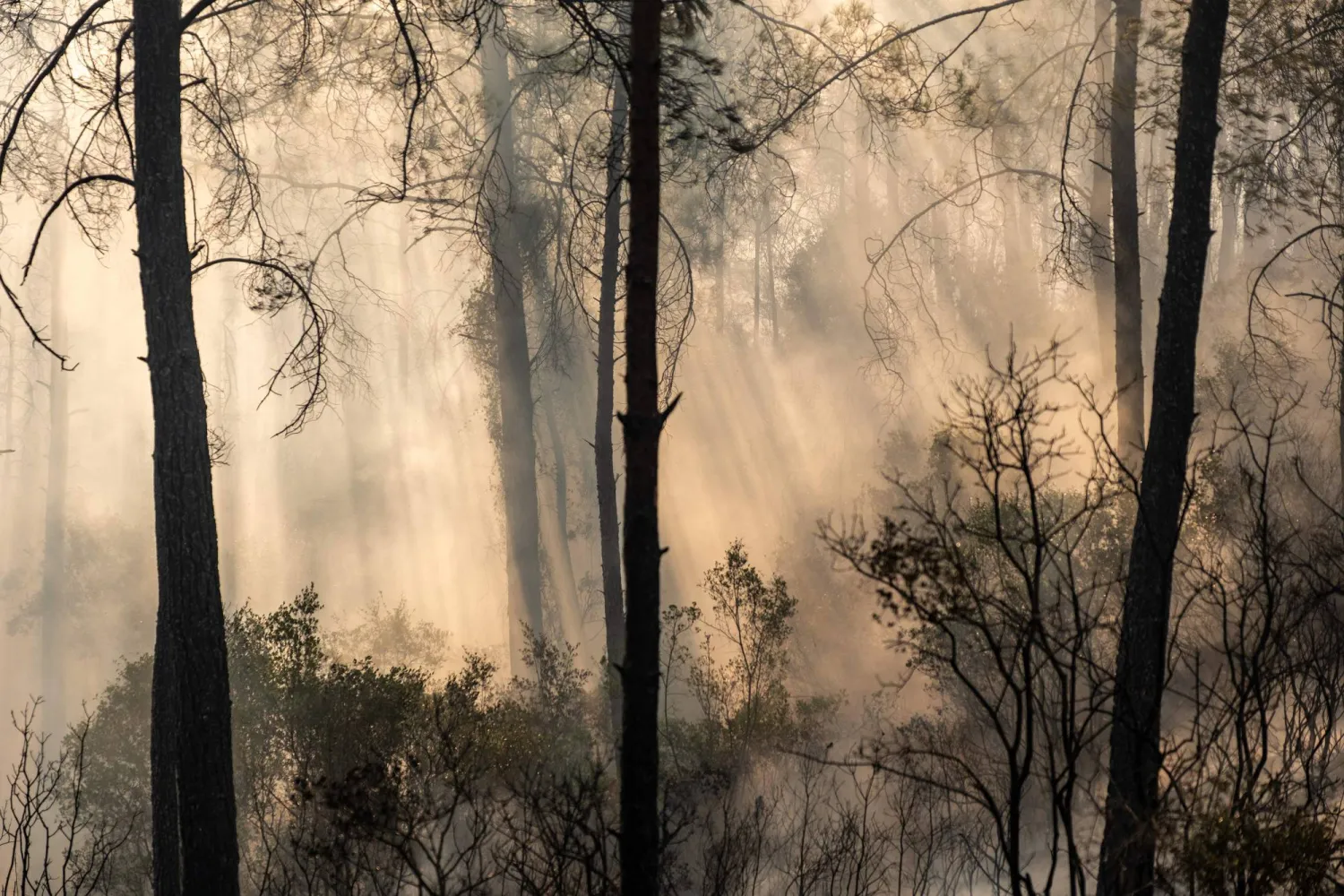
This photograph shows smoke rising from wildfires in Fethiye, in the province of Mugla, southwestern Türkiye on July 30, 2026. (AFP)
TT

Türkiye Confronts Growing Wildfires on Tourist Coasts

This photograph shows smoke rising from wildfires in Fethiye, in the province of Mugla, southwestern Türkiye on July 30, 2026. (AFP)

Hundreds of Turkish firefighters on Thursday battled to contain wildfires spreading near key tourist regions on the country's Mediterranean coast.

Authorities expressed particular concern over fires around the city of Antalya and the Aegean Sea resorts of Fethiye, where flames gathered new strength on Thursday, and Ayvalik.

TRT public television showed a man carrying his sheep on his shoulders away from one fire.

The national forestry office said firefighters had intensified the battle started Wednesday outside Fethiye where strong winds had reignited the flames.

Balikesir province governor Ismail Ustaoglu said 850 firefighters, five water-bombing planes and six helicopters were tackling a blaze at Ayvalik, opposite the Greek Aegean island of Lesbos.

Agriculture Minister Ibrahim Yumakli said earlier that 115 wildfires had been reported since Wednesday, with all but five brought under control.

Türkiye was hit by major forest fires in 2025 amid a prolonged drought. Access to forests and other high-risk areas has been closed since the start of the summer holiday season.


British Family to Return Home After 5 years At Sea

Andy Sheath and his family. (Andy Sheath)
TT

British Family to Return Home After 5 years At Sea

Andy Sheath and his family. (Andy Sheath)

A family from the Isle of Man is returning home after spending five years at sea aboard the world’s largest floating book fair, according to the BBC.

Andy Sheath, his wife Rebecca and daughters Elsie and Sofie have lived on the Logos Hope since 2021.

The vessel, which is due to dock in Douglas Harbor between November 6 and 22, is home to more than 300 people from 60 countries and travels the world as the largest floating book fair.

Sheath said he had always hoped the ship would visit the island and was looking forward to finally coming home.

‘Treasured memories’

Sheath first visited the ship as a university student in 2010 and said he was the only Manxman on board.

He said stepping on to the vessel for the first time felt like coming home.

Since 2021, the ship has been the family’s home and holds “precious, treasured memories”, he said.

“My oldest daughter Elsie is five. These corridors echo memories of her first steps. Our table and dining room is where we’ve eaten for five years. It’s where my daughters have grown from baby to toddler, to now,” he said.

The family returned to the island for Sofie’s birth, meaning Elsie remembers visits to the wildlife park, fish and chips on the beach with her grandparents and ice cream at Peel.

Sheath said his family is excited to return to the island to start a new life, calling it “a huge homecoming.”

Fellow crew members have shared in the family’s excitement about this stop on the boat’s tour.

“They have asked me ‘what can I do on the island’, ‘can we see the TT route?’ and many other questions,” Sheath said.

He hoped the visit would not be the last from the Logos Hope.

“On the next visit I would love to see another Manx person on board,” he added.

“I have proudly waved the three legs of Man at every port and I would love to see more Manx people waving the flag on board at different ports.”


UN Sees Higher Global Warming, Even in Best-case Scenario

FILE - The coal-fired Mountaineer Power Plant, near New Haven, W.Va., operates across the Ohio River from the Lock 24 RV Park and Campground in Racine, Ohio, March 13, 2026. (AP Photo/Carolyn Kaster, File)
TT

UN Sees Higher Global Warming, Even in Best-case Scenario

FILE - The coal-fired Mountaineer Power Plant, near New Haven, W.Va., operates across the Ohio River from the Lock 24 RV Park and Campground in Racine, Ohio, March 13, 2026. (AP Photo/Carolyn Kaster, File)

Global warming is now projected to exceed previous estimates, with even the most optimistic scenario seeing average temperatures rise to 1.7-1.8 degrees Celsius above pre-industrial levels by mid-century, a UN report showed on Wednesday.

Despite a rapid expansion of renewable energy and climate policies that are reducing emissions in many countries, the report said "urgent and stringent" cuts were still needed ‌to achieve that ‌best-case outcome.

The UN Environment Program's report said ‌greenhouse ⁠gas emissions would need ⁠to fall 18% from 2025 levels by 2030, 45% by 2035 and 69% by 2040. Current national plans would cut emissions by only 5-8% by 2030 and 11-15% by 2035.

The report projected global warming of 2.8 Celsius by 2100 under current policies, or 2.6 C if countries fully implement existing climate pledges. ⁠Both estimates are higher than last year's projections, ‌reflecting the US withdrawal from ‌the Paris Agreement and revised assessments of historical emissions.

As countries prepare for ‌the next round of climate talks in Turkey, COP31, UN ‌Secretary-General António Guterres said it was crucial not to give up on efforts to rein in the emissions that are fueling floods, fires and other natural disasters.

"Overshoot is not surrender. We can still ‌keep it as small and as short as possible – and bring temperatures back below 1.5 degrees by ⁠the end ⁠of the century," he said.

Under the 2015 Paris Agreement, countries agreed to try to keep the average temperature increase at well below 2 degrees and ideally 1.5 C.

As limiting warming to 1.5 C with no or limited overshoot was no longer considered possible, the UN Environment Program said its new "lowest possible" overshoot scenario gives roughly a 50% chance that temperatures could return to 1.5 C or below by 2100.

The report said climate plans submitted since last year had made virtually no difference to future warming projections, and that returning to 1.5 C would depend on large-scale carbon removal, the feasibility of which was uncertain.


Feared Extinct, Bangka Slow Loris Primate Rediscovered in Indonesia

A Bangka slow loris hangs from a tree on the Indonesian island of Bangka, east of Sumatra, in this undated photograph released on October 20, 2026. Andre Septian/Alobi Wildlife Rescue Center/Handout via REUTERS
TT

Feared Extinct, Bangka Slow Loris Primate Rediscovered in Indonesia

A Bangka slow loris hangs from a tree on the Indonesian island of Bangka, east of Sumatra, in this undated photograph released on October 20, 2026. Andre Septian/Alobi Wildlife Rescue Center/Handout via REUTERS

The Bangka slow loris is one of Earth's most exotic primates, a slow-moving tree dweller that happens to be venomous. It was listed as critically endangered and possibly extinct, last scientifically documented in the 1930s, but now has been rediscovered on the tropical Indonesian island of Bangka.

Scientists revealed in a new study that an animal rescue organization came across more than 90 Bangka slow loris individuals in recent years on Bangka, located off the southeastern coast of Sumatra. Most were returned to the wild.

"The Bangka slow loris is still alive," said Timon Glaw, a graduate student in nature conservation and biodiversity management at the Haus des Meeres Aqua Terra Zoo in Vienna, Austria, and one of the authors of the study published in the journal Spixiana.

The rescued animals came from different parts of Bangka, showing the species has survived in several areas despite extensive habitat destruction and decades of scientific neglect, Glaw said. Its habitat has been diminished due to tin mining and land clearing for oil palm plantations, Reuters quoted Glaw as saying.

"What I find particularly ⁠astonishing is ⁠that such a charismatic and distinctive primate has received so little scientific attention for nearly a century. Its rediscovery also offers hope that other species feared to be extinct may still survive in places where scientists have not looked for decades. After all, Bangka is just about an hour flight from Jakarta, one of the largest cities in the world," Glaw said.

The Bangka slow loris, whose scientific name is Nycticebus bancanus, is a relatively small, nocturnal primate, with reddish-brown fur, distinctive facial markings and large eyes. It moves slowly and deliberately in the trees, unlike other arboreal primates such as apes, monkeys and lemurs that can move quickly across branches.

In the primate evolutionary lineage, the ⁠Bangka slow loris is more closely related to the lemurs of Madagascar and the galagos of Africa than to monkeys or apes — or people.

"The last historical scientific records from Bangka discussed in our study date back to the early 1930s, more precisely to the period between 1930 and 1932. For decades, there was no reliable information on whether the species survived on the island," Glaw said.

In 2020, the International Union for Conservation of Nature, the organization that monitors the status of species, deemed the Bangka slow loris critically endangered and possibly extinct. The species also was listed as one of the "lost primates" by the conservation group Re:wild.

Like the world's other slow loris species, it is venomous — a rare trait among mammals. Slow lorises produce a secretion from specialized glands near their elbows, which they mix with saliva by raising their arms when threatened and then licking the glands before delivering the venom through a bite.

"The venom can cause severe allergic reactions in humans, potentially even life-threatening ones. Research on other slow loris species ⁠suggests that the venom is ⁠used primarily in conflicts with other lorises, although it may also serve defensive functions against predators and parasites," Glaw said.

Its diet is not well understood, but it likely feeds on insects, tree gums, nectar and other plant parts like other slow loris species, Glaw said.

It possesses a toothcomb formed by forward-projecting lower teeth, used mainly for grooming, gouging of tree bark for gum and delivering the venom during bites. It also has a specialized second tongue beneath the main tongue that helps clean the toothcomb.

Between 2015 and 2025, the Indonesian conservation organization Alobi Wildlife Rescue Center documented more than 90 Bangka slow lorises from different localities across the island, Glaw said.

Many were rescued from houses, gardens, plantations or roads, while others suffered severe injuries, particularly from electrical wires, with a few dying despite treatment, Glaw said. Following their recovery, 86 of them were released into suitable natural habitats, Glaw said.

"The most urgent priority is to protect the remaining natural forests on Bangka from further destruction, particularly through tin mining and the expansion of oil palm plantations. We also need systematic field surveys to determine where the species still survives and how large its populations are," Glaw said.

"Every species is the result of millions of years of evolution and part of a complex ecological network, and losing the Bangka slow loris would mean losing something truly irreplaceable," Glaw said.