


US Eyes European Gas Dominance through Balkans

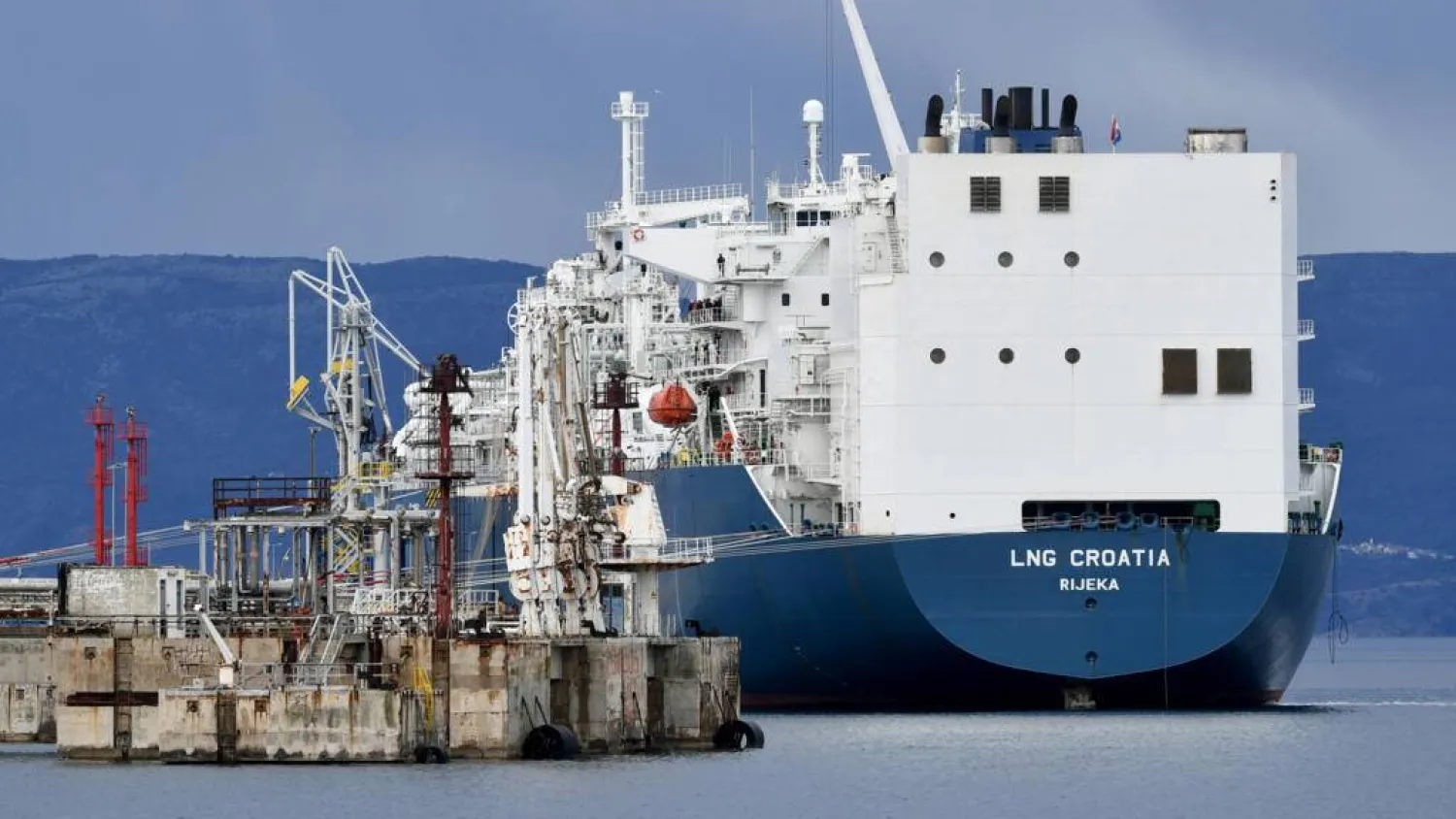
The new floating terminal for liquefied gas boosts Croatia's import capacity. DENIS LOVROVIC / AFP/File
TT

US Eyes European Gas Dominance through Balkans

The new floating terminal for liquefied gas boosts Croatia's import capacity. DENIS LOVROVIC / AFP/File

As Europe weans itself off Russian energy, Washington is fast emerging as its largest gas supplier, with experts suggesting Croatia's Adriatic gas terminal offers a pathway deeper into the continent.

Since Russia invaded Ukraine in 2022, gas supplies flowing from the east have become increasingly weaponized -- accelerating Brussels' plans to reduce its reliance on Moscow, said AFP.

Russia still supplies around 12 percent of the bloc's gas imports, according to the European Council, but by the end of 2027 it will ban them completely.

To meet this deadline, the European Union has spent billions of euros on infrastructure to be able to handle the needed volumes of liquefied natural gas (LNG), which will make the bloc the largest importer in the world.

- Balkan push -

One of the key sites is Croatia's floating LNG terminal off the island of Krk, which following a recent upgrade is now capable of handling around two percent of the EU's annual gas consumption at nearly 6.1 billion cubic meters.

Connecting pipelines link it to Hungary, allowing US gas to flow into central Europe.

But energy analyst Ivan Brodic said its future could be much bigger, as the terminal's largest supplier -- the United States -- looks to push Russia out of the market completely.

Already the EU's largest source of LNG, the US is forecasted to overtake Norway as bloc's largest natural gas supplier in 2026, according to the Institute for Energy Economics and Financial Analysis (IEEFA).

"Americans do not want Russian capital in the energy sector in this region anymore," Brodic told AFP.

"That is why they are pushing for the gas interconnection between Bosnia and Croatia."

The US-backed pipeline between the Balkan nations plans to link Bosnia to Krk, and loop it into Europe's gas network.

Some analysis suggests it could even offer the cheapest gas for a post-war Ukraine.

- 'Peace pipelines' -

Earlier this year, US Energy Secretary Chris Wright used a summit to promote the Trump Peace Pipelines Framework -- a plan to expand energy infrastructure across central and eastern Europe.

The US plan could turn Croatia into a major transit point for fuel imports, including oil, beyond the Balkans into other parts of Europe.

Alongside its LNG facility, Croatia also boasts oil pipelines connecting it to Bosnia, Hungary, Slovenia and Serbia -- capable of pumping nearly half a million barrels of crude per day.

"Energy dependence on Russia remains a strategic vulnerability in the region," said a State Department report submitted to Congress in May.

"Diversifying energy supplies, including with abundant US sources, enhances regional stability and prosperity."

- A Ukraine supply route -

For the EU and Croatia, the Krk terminal has already proven its value as its supply fully booked until 2036, according to LNG Croatia managing director Ivan Fugas.

"It was not only important for Croatia, but definitely also for the EU as it got an additional natural gas entry point," Fugas said.

The terminal, operating since 2021, was strongly supported by the US while Brussels funded nearly half of its more than 230 million euros cost.

The terminal's success has also been noticed in Kyiv.

Ukraine's underground storage operator, Ukrtransgaz, presented earlier this year an analysis showing that Croatia's LNG terminal could provide the cheapest route to supply the country.

Boasting one of Europe's largest underground gas storage networks, much of it dating back to the Soviet era, Ukraine could also solve a key problem of storing the large amounts of imported gas that could then also be sent elsewhere in Europe.

Ukrainian President Volodymyr Zelenskyy and Croatian Prime Minister Andrej Plenkovic met earlier this year to discuss energy supply and storage, but there have been no official announcements.

With major investments, it could become a shorter and cheaper route to Ukraine than existing options via Greece or Poland.

"But that does not mean anything if Croatia does not have the capacity," Fugas said, flagging the necessary pipeline upgrade for any new demand.



World Bank Projects Lebanon Economy to Contract by 6.4% Due to War

People inspect a damaged building after an Israeli airstrike on the village of Ansar, southern Lebanon, 15 August 2026. (EPA)
TT

World Bank Projects Lebanon Economy to Contract by 6.4% Due to War

People inspect a damaged building after an Israeli airstrike on the village of Ansar, southern Lebanon, 15 August 2026. (EPA)

The World Bank on Friday projected that Lebanon's economy would contract by 6.4 percent this year, as the latest Israel-Hezbollah war derailed the country's efforts at recovery.

Lebanon has been dealing with an unprecedented financial crisis since 2019 and was still reeling from the 2024 Israel-Hezbollah war when the Iran-backed group drew it into the Middle East conflict by attacking Israel in March.

Israel responded with a heavy air campaign and ground invasion that Lebanese authorities say have killed more than 4,300 people.

Due to the war, "real GDP is projected to contract by 6.4 percent in 2026, reflecting the collapse in tourism, weaker consumption, disrupted supply chains, heightened insecurity, and prolonged displacement," the World Bank said in a report.

Inflation is also expected to rise to 17.5 percent this year, according to the report.

The World Bank said Lebanon's economy had strengthened before the latest conflict, with an estimated real GDP growth of 4.2 percent in 2025, "the fastest since the onset of the 2019 financial crisis".

"Advancing reforms -- particularly on banking sector restructuring and fiscal management -- will be critical to restoring confidence, protecting stability, and mobilizing the financing needed for reconstruction and recovery," Dahlia Khalifa, the World Bank's Middle East director, said.

The international community has been demanding that Lebanese authorities enact financial reforms in order to secure much-needed economic aid.

Last week, parliament passed amendments to a bank resolution law aimed at restructuring troubled banks and addressing the country's banking crisis.

The International Monetary Fund welcomed the law, describing it as "a very good step that reflects Lebanon's commitment to aligning its legislation with the best international practices".

Lebanon has been in discussions with the IMF, which said it would resume its meetings in Beirut next month.


Tunisia Olive Oil Exports Surge 55%, Bringing in $1.6 billion

Tunisian olive oil producer, Mustapha Mtiraoui, displays olives to be pressed at his oil mill in Kairouan, Tunisia February 24, 2024. REUTERS/Jihed Abidellaoui
TT

Tunisia Olive Oil Exports Surge 55%, Bringing in $1.6 billion

Tunisian olive oil producer, Mustapha Mtiraoui, displays olives to be pressed at his oil mill in Kairouan, Tunisia February 24, 2024. REUTERS/Jihed Abidellaoui

Tunisia's olive oil exports surged 55.3% to a record 368,000 metric tons in the first nine months of the 2025/26 season, bringing in $1.6 billion in export revenue, up 44.4% from a year earlier, official data showed on Friday.

The surge in olive oil shipments, a vital source of foreign currency and Tunisia's top agricultural export, will provide a much-needed boost to the country's finances as the government grapples with persistent economic and fiscal pressure.

The jump in exports was driven by strong global demand during the first nine months of the season, which began in November.

Extra virgin olive oil accounted for 83.6% of total shipments, the National Observatory of Agriculture said, Reuters reported.

The European Union remained the biggest destination, taking 57.1% of Tunisian olive oil exports, while North America accounted for 24%. More than 70 countries imported Tunisian oil during the period.

Exports to other markets included Saudi Arabia, which took 4.6%, Jordan with 3.1% and African markets at 3.8%, with Egypt accounting for 3.3%.

Bottled olive oil exports rose 50.8% to 51,500 tons, but bulk oil still accounted for the vast majority of shipments, underscoring Tunisia's challenge in capturing more value from one of its most important export products.


South African Rand Hits Strongest Level since Start of Iran War

South African Rand coins are seen in this illustration picture taken October 28, 2020. REUTERS/Mike Hutchings/Illustration
TT

South African Rand Hits Strongest Level since Start of Iran War

South African Rand coins are seen in this illustration picture taken October 28, 2020. REUTERS/Mike Hutchings/Illustration

The South African rand strengthened on Friday to its strongest level since the United States and Israel launched attacks on Iran on February 28, as rising gold prices and a weaker dollar boosted the commodity-linked currency.

At 1229 GMT, the rand traded at 15.9925 against the dollar , about 0.8% stronger from its previous close.

Gold, one of South Africa's main exports, rose to a more than three-month high on Friday and was on track for a third straight weekly gain.

The precious metal was supported by a weaker dollar and the US Treasury's announcement that it would increase buybacks of longer-dated securities, Reuters reported.

US Treasury Secretary Scott Bessent said he may further increase the government's repurchases of Treasuries. That came after the Treasury said it would double the size of buybacks on longer-dated securities over the next quarter.

The US dollar was set to end a bumpy week lower, making greenback-priced bullion more affordable for buyers overseas.

Like other emerging market currencies, the rand has been at the mercy of global market sentiment, particularly since the start of the Iran war.

On the Johannesburg Stock Exchange, the Top-40 index was last up 2.2%.

South Africa's benchmark 2035 government bond was also firmer in early deals, as the yield fell 0.5 basis points to 8.56%.