Sources to Asharq Al-Awsat: Gaza Understandings Likely to Overcome Israeli, Islamic Jihad Objections

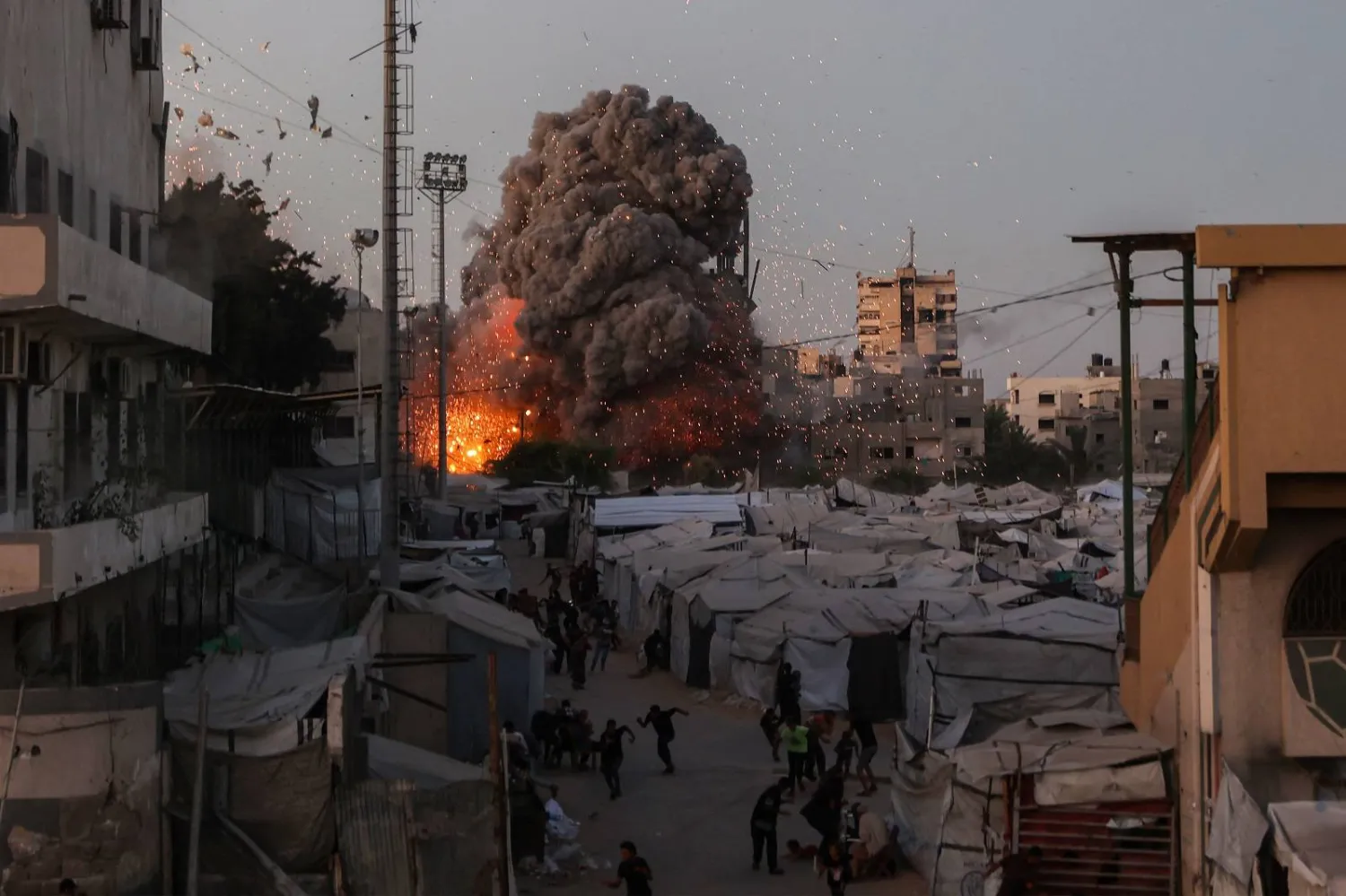
Palestinians rush to take cover as smoke and fire billow after an Israeli raid targeted Al-Muttaqin Mosque in Gaza City (AFP)
TT

Sources to Asharq Al-Awsat: Gaza Understandings Likely to Overcome Israeli, Islamic Jihad Objections

Palestinians rush to take cover as smoke and fire billow after an Israeli raid targeted Al-Muttaqin Mosque in Gaza City (AFP)

Two informed Palestinian sources said objections from Israel and the Iran-aligned Islamic Jihad could complicate efforts to implement the second phase of the Gaza ceasefire, particularly its disarmament provisions.

But the sources told Asharq Al-Awsat on Friday that pressure from the US and the mediators was likely to push the deal through.

The ceasefire entered a new phase overnight on Thursday after Egypt, Qatar, and Türkiye reached fresh understandings with Hamas and other Palestinian factions on arrangements for implementing the second phase.

The deal was reached nearly a year ago, but implementation stalled after the outbreak of the “Iran war” and Israeli violations.

Israeli resistance

The new understandings amount to a draft that will be presented to Israel for approval before the second-phase roadmap can begin, the two Palestinian sources said.

They expected Israel to resist any withdrawal from Gaza before elections. Islamic Jihad has also raised objections to the wording of the agreement and its disarmament provisions.

One source said Israel’s position would prove more consequential because it was likely to demand disarmament before withdrawing.

Islamic Jihad’s objections would be easier to resolve, the source said, because its military structure was neither large nor influential and did not compare with that of Hamas.

Another Palestinian expert said the mediators and factions had put the ball in Israel’s court, leaving Washington responsible for pressing it to implement the understandings.

Israel would probably be the only obstacle to advancing the ceasefire, he said, “but it will agree, even if only nominally.”

The Board of Peace said on X on Friday that the proposed mechanisms included setting a timetable and implementation procedures for the second phase of the Gaza peace plan, to be implemented within 14 days of approval by all parties.

The National Committee for the Administration of Gaza would then enter the enclave, take control of police weapons and assume governing responsibilities as Israel halted military operations and withdrew fully, the council said.

Factional weapons would be collected and stored under the committee’s authority according to an agreed timetable, alongside a gradual Israeli withdrawal.

Hamas sets conditions

Hamas said it and other Palestinian factions had dealt “responsibly and positively” with the negotiations and the mediators’ proposals for completing the second phase.

It said Israel must first stop the killings and attacks before the parties could begin implementing the deal and setting a framework and timetable for the agreed measures.

The second phase, Hamas said, remained conditional on Israel carrying out all provisions of the first.

The group said it had agreed to include heavy weapons in the agreement only on condition that all forms of aggression end and Israel withdraw from Gaza.

Its conditions also included early recovery efforts, the entry of the administrative committee, the deployment of international protection forces and the dismantling of armed gangs and militias established by Israel.

Hamas also called for reconstruction, guarantees of the right to self-determination, the establishment of an independent Palestinian state, and protection of citizens’ rights.

The National Committee for the Administration of Gaza welcomed the development and said it was fully prepared to assume its responsibilities.

It said it had spent recent months making extensive institutional and operational preparations to administer Gaza, restore essential public services, strengthen the rule of law, facilitate humanitarian aid, and lead recovery and reconstruction efforts.

Israel has yet to officially comment on the announcement, but a political source told AFP "that there will be no withdrawal whatsoever" from Israeli forces' current lines "unless Hamas undergoes a genuine disarmament.”

Nickolay Mladenov, the Board of Peace's high representative for Gaza, said Friday the deal "took months of very difficult negotiations.”

"What happens next matters even more. Implementation and verification have to be real," Mladenov wrote on X.

"Withdrawal must move in lockstep with decommissioning."

An informed Egyptian source said Cairo would soon host a meeting involving Egypt, the United States, Qatar, and Türkiye to reaffirm the parties’ commitment to the agreement.

Under the deal, the National Committee would oversee a gradual, sequential process for identifying and storing weapons, the source said.

That process would begin only after the committee entered Gaza and the International Stabilization Force was deployed, the source added.

Palestinian political analyst Ayman al-Raqab said the mediators and factions had completed their task, leaving Israel cornered and unable to reject the agreement openly while Washington was seeking to close the file.

He expected Israel to remain the main obstacle by raising objections over withdrawal and returning to political maneuvering.

Israel could offer conditional approval, he said, sending the parties back into the same cycle without producing progress.

“The devil is in the details and the implementation,” al-Raqab said.

He said the next Cairo meeting would be crucial in pressing for implementation, backed by strong US pressure on Israel to begin carrying out the roadmap and the new understandings.


Drone Strike in Disputed Sudan-South Sudan Area Kills Dozens, Minister Says

A person wounded in a drone strike on a market in the disputed Abyei region along the border between South Sudan and Sudan is carried to Ameth Bek hospital, October 20, 2026. (Reuters/Medecins Sans Frontieres/Handout)
TT

Drone Strike in Disputed Sudan-South Sudan Area Kills Dozens, Minister Says

A person wounded in a drone strike on a market in the disputed Abyei region along the border between South Sudan and Sudan is carried to Ameth Bek hospital, October 20, 2026. (Reuters/Medecins Sans Frontieres/Handout)

At least 73 people were killed when drones struck a market in the disputed Abyei region along the border of South Sudan and Sudan, the caretaker information minister for the jointly administered region said on Tuesday, accusing Sudan's army of carrying out the attack.

The minister did not provide evidence for his claim of who was responsible for Monday's attack.

Abyei is an oil-rich area that is jointly administered by South Sudan and Sudan, which have both staked claims to it. It experiences frequent bouts of ‌violence, with clashes ‌usually involving rival ethnic groups or armed militias.

"Around ‌73 ⁠people have been ⁠killed and 19 have been wounded ... a number of drones were shot yesterday by the Sudanese armed forces," Yohana Akol Ngor, the caretaker minister of information of the Abyei region, told Reuters on Tuesday.

Last year, at least six Bangladeshi peacekeepers were killed and eight wounded in a drone attack by separatist armed ⁠groups on a UN base in Abyei, Bangladesh's ‌armed forces said.

South Sudan's foreign ‌ministry said in a statement late Monday that drones struck a market ‌located north of Abyei town, but did not specify the ‌number of civilian casualties resulting from the attack.

The ministry said it had summoned the Sudanese ambassador to convey the government's "strong protest and deep concern regarding the attack and its implications for the security of civilians and ‌the stability of the Abyei Area."

The medical charity Médecins Sans Frontières (MSF) said in a statement that ⁠it was ⁠treating more than 20 wounded people at the nearby Ameth Bek Hospital.

"So far we received over 20 patients, including several critical cases. Patients with burns were also admitted. We are providing surgical services and wound dressing, along with other emergency care," said Christian Lindauer, MSF medical activities manager at Ameth Bek Hospital.

Sudan has been gripped by war since April 2023 between the Sudanese Armed Forces and the paramilitary Rapid Support Forces. The conflict has devastated large parts of the country and created what the United Nations has described as the world's worst humanitarian crisis.


Israeli Fire Kills Four People in Gaza, Medics Say

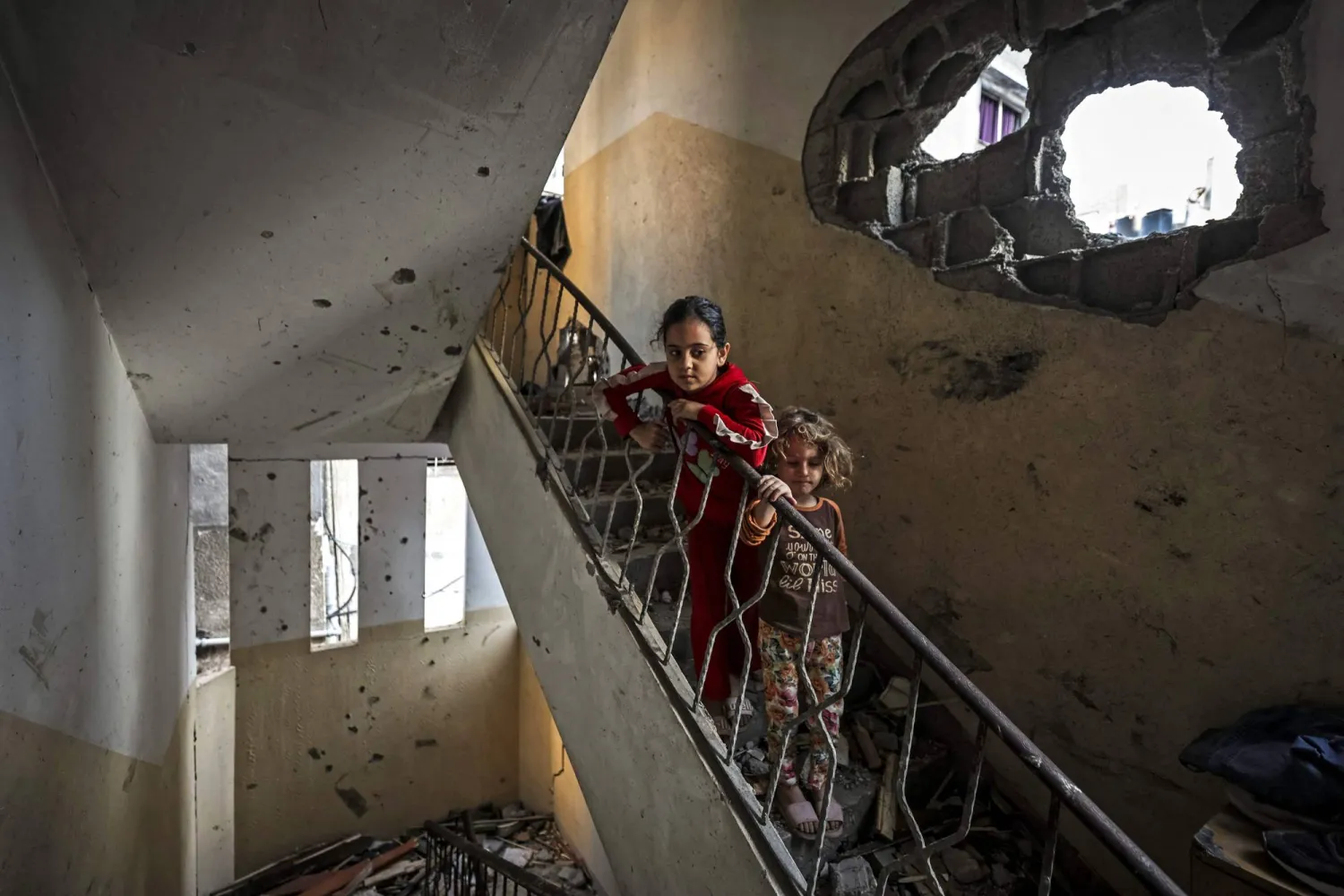
Children stand at the site of an Israeli strike on a residential building that killed two people in Gaza City on October 20, 2026. (AFP)
TT

Israeli Fire Kills Four People in Gaza, Medics Say

Children stand at the site of an Israeli strike on a residential building that killed two people in Gaza City on October 20, 2026. (AFP)

Israeli strikes and ‌gunfire killed at least four Palestinians, including a married couple and a 17-year-old, in separate incidents in the Gaza Strip on Tuesday, health officials said. 

Medics said an Israeli airstrike killed Akram Yassin and his wife Dina Abu Baker in an apartment in Gaza City. 

The Israeli military said it struck a fighter in the area, without giving further details. 

In Khan Younis, in the south, medics said a 17-year-old boy was killed by Israeli ‌gunfire near the ‌Qizan Al-Najar neighborhood, while another was ‌killed ⁠by Israeli gunfire ⁠in the Zeitoun suburb east of Gaza City, taking Tuesday's death toll to at least four. 

The Israeli military did not immediately comment on either of the two gunfire incidents. 

Palestinians inspected the aftermath of the strike on the apartment in Gaza City before gathering for the ⁠couple's funeral. 

"We’re supposed to be in a ceasefire ‌period, but honestly, we are ‌not seeing a ceasefire or anything. The war is ‌still going on, assassinations are continuing, and the shelling ‌has not stopped," said Mahmoud Yassin, whose brother was killed. 

Israel, which says the Hamas group has been rearming and launching attacks in violation of the ceasefire, has stepped up ‌strikes on the group in recent weeks. 

Hamas has denied trying to carry out ⁠attacks or ⁠rebuild its arsenal and accuses Israel of undermining the Gaza peace deal. 

The ceasefire, brokered by the US a year ago, calls for the eventual reconstruction of the territory. But little progress has been made towards implementing a deal to end the conflict that includes terms for Hamas to disarm and Israel to withdraw its troops. 

Gaza health officials have said at least 1,500 Palestinians have been killed by Israeli fire since the ceasefire. Israel says four of its soldiers have been killed by fighters in Gaza over the same period. 


Arab League Chief Pushes for Concrete Support for Lebanon

Lebanese President Joseph Aoun welcomes Arab League Secretary-General Nabil Fahmy (Lebanese Presidency)
TT

Arab League Chief Pushes for Concrete Support for Lebanon

Lebanese President Joseph Aoun welcomes Arab League Secretary-General Nabil Fahmy (Lebanese Presidency)

Arab League Secretary-General Nabil Fahmy has called for concrete political and financial support for Lebanon, as Lebanese leaders pressed for a diplomatic solution, Israel’s withdrawal and reconstruction.

“Lebanon is among the Arab League’s priorities, and among my own priorities as its secretary-general,” he said on Monday during a visit to Beirut that included meetings with President Joseph Aoun, Parliament Speaker Nabih Berri and Prime Minister Nawaf Salam.

Meeting the Arab League chief, Aoun accused Israel of failing to comply with the agreed framework and continuing its violations in South Lebanon, saying such actions only strengthened Lebanese determination to defend their land and rights.

He reaffirmed Lebanon’s commitment to diplomacy despite its difficulties, describing it as far less costly than a devastating war.

Declaring that it was time for Lebanon to enjoy some respite, Aoun welcomed Arab efforts to help the country overcome its challenges and stressed the importance of dialogue and negotiations.

The secretary-general said his visit followed a decision by Arab foreign ministers reaffirming support for Lebanon’s sovereignty, institutions and citizens.

He called for tangible financial and practical assistance that would strengthen state institutions and directly benefit the population, pledging to intensify contacts with Arab and Western governments.

Asked about the risk of a wider regional war, Fahmy denied conveying specific warnings to Aoun but acknowledged discussing the dangers posed by multiple conflicts and the possibility of a broader escalation.

He also reaffirmed the Arab League’s support for ending Israeli occupation and preserving Lebanon’s stability, stressing that each country had the right to determine its negotiating approach when asked about US-sponsored Lebanese-Israeli talks.

In talks with Berri, the Arab League chief reviewed regional developments and continued Israeli attacks, pledging to pursue diplomatic initiatives to secure assistance for Lebanese institutions and citizens.

The two also discussed the future of the United Nations Interim Force in Lebanon (UNIFIL), whose planned departure has raised concerns over a security vacuum.

The secretary-general said the Arab League opposed ending the mission, arguing that a continued UN presence offered the strongest framework for international oversight and accountability. Any alternative, he stressed, would require Lebanese agreement and a clear international legal mandate.

Salam urged continued Arab efforts to secure Israel’s complete withdrawal from Lebanese territory and extend state authority nationwide through its own forces.

He also urged support for recovery and reconstruction to help residents remain in their communities and strengthen state institutions.

The prime minister encouraged Arab investment in infrastructure and regional connectivity projects to stimulate growth and deepen Lebanon’s integration with its Arab neighbors.

Fahmy announced plans to visit South Lebanon to assess conditions firsthand and help shape further diplomatic engagement with Arab governments and international partners.

The visit would support efforts to secure political and financial assistance for Lebanese institutions, including the army.

He said the trip would allow him to return to Cairo with a clearer assessment of Lebanon’s needs, paving the way for follow-up on Arab commitments and closer coordination of political and financial support.