


Israeli Strikes Kill Two in Gaza, Destroy Medicine Storage Warehouses

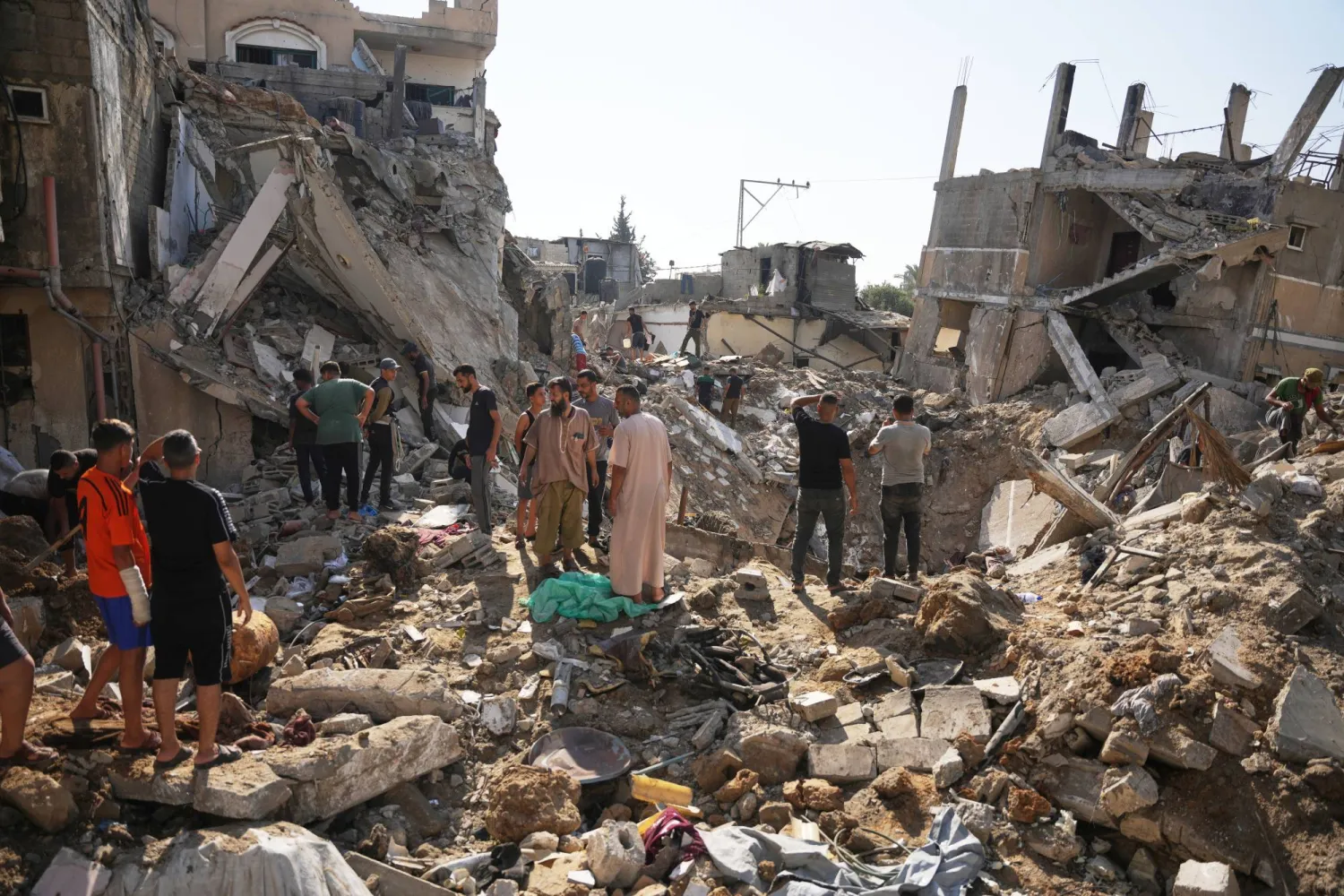
Palestinians inspect destroyed buildings at the scene of an Israeli airstrike, at al-Maghazi refugee camp, central Gaza Strip, Saturday, Aug. 1, 2026. (AP Photo/Abdel Kareem Hana)
TT

Israeli Strikes Kill Two in Gaza, Destroy Medicine Storage Warehouses

Palestinians inspect destroyed buildings at the scene of an Israeli airstrike, at al-Maghazi refugee camp, central Gaza Strip, Saturday, Aug. 1, 2026. (AP Photo/Abdel Kareem Hana)

Israel's military on Saturday killed two Palestinians in Gaza and destroyed two warehouses near a hospital that were said to be storing medicine in separate strikes, amid uncertainty over whether Israel has accepted a deal reached with Hamas over the group's disarmament.

Palestinian health officials said two Palestinians were killed in the Sheikh Radwan area of Gaza City in central Gaza in an Israeli air strike. A military spokesperson said those targeted were Hamas militants but declined to provide further details.

In an earlier incident, an Israeli air strike destroyed two warehouses that were used to store medicine by the Al-Aqsa Martyrs Hospital in Deir al-Balah in southern Gaza, the Palestinian health ministry in Gaza said in a statement.

Several hours after the strike, the Israeli military said it had struck a Hamas hideout near the hospital which the group used to store weapons. Other sites in Gaza that it said were used by Hamas to store arms were also struck, a military statement said.

The military said the strikes were directed by the Shin Bet intelligence agency. It did not disclose any evidence to support the claim that Hamas was storing weapons at any of the sites.

Reuters footage of the Deir al-Balah strike showed a crater several metres wide marking the site of the explosion, with debris strewn across the area, including what appeared to be medical supplies, close to a densely packed tent encampment.

Two other warehouses storing medicine and the hospital's outpatient clinic were damaged in the strike, the Palestinian Health Ministry said. There were no immediate reports of any injuries.

The hospital said the warehouses had stored essential medical supplies used to treat kidney failure patients undergoing dialysis, along with other materials like gauze used in wound care and routine treatment.

"The Israeli occupation has committed a heinous crime," Khalil al-Daqran, a doctor at the hospital, said of the strike.

"In the middle of the night, (the military) targeted a warehouse containing medical supplies for the hospital, and the occupation completely destroyed it," he told Reuters.

Witnesses said the military had issued an evacuation warning for the area before carrying out the Deir al-Balah strike.

Hospitals and other civilian sites are protected under international humanitarian law, although that protection can be lost if they are used for military purposes. Israel's military says Hamas and other armed groups operate from within civilian areas and facilities, including hospitals.

Fatima Sharab, a displaced Palestinian living in a tent near the warehouses, said many people in need of medical care had been sheltering in the area to be close to the hospital.

Israel has continued to carry out strikes on Gaza since agreeing last October to a US-mediated ceasefire, killing 1,222 Palestinians in the past nine months. Palestinian health officials say many of those killed were women and children. Hamas rarely announces its casualties.

US President Donald Trump on Thursday said there had been a breakthrough in his plan to end the war, which both Israel and Hamas agreed to last year and which started with the ceasefire. Trump said that Hamas, which ruled Gaza for nearly two decades before carrying out the October 7, 2023, attack on Israel that triggered the Gaza war, had agreed to lay down its weapons.

Israeli Prime Minister Benjamin Netanyahu is yet to comment publicly, while his National Security Minister Itamar Ben-Gvir has called the agreement unacceptable and said that Israel must continue to carry out its policy of assassinating Hamas leaders.

Trump's Board of Peace, established to implement his plan for ending the Gaza war, released a roadmap on Thursday outlining the final steps for carrying out the initiative. The document states that Israel will cease military operations as part of its commitment to Trump's 20-point plan, which it signed last year.



Al-Zaidi: Iraq Eyes Europe as It Seeks to Diversify Oil Exports

 German Chancellor Friedrich Merz, right, and Iraqi Prime Minister Ali al-Zaidi attend a press conference in Berlin, Germany, Tuesday, Sept. 15, 2026. (AP)
German Chancellor Friedrich Merz, right, and Iraqi Prime Minister Ali al-Zaidi attend a press conference in Berlin, Germany, Tuesday, Sept. 15, 2026. (AP)
TT

Al-Zaidi: Iraq Eyes Europe as It Seeks to Diversify Oil Exports

 German Chancellor Friedrich Merz, right, and Iraqi Prime Minister Ali al-Zaidi attend a press conference in Berlin, Germany, Tuesday, Sept. 15, 2026. (AP)
German Chancellor Friedrich Merz, right, and Iraqi Prime Minister Ali al-Zaidi attend a press conference in Berlin, Germany, Tuesday, Sept. 15, 2026. (AP)

Iraqi Prime Minister Ali al-Zaidi said on Tuesday that he discussed selling oil to Europe during visits to France and Germany, as Baghdad seeks to diversify its export routes and reduce its reliance on the Strait of Hormuz.

During a press conference with German Chancellor Friedrich Merz in Berlin, al-Zaidi said: "We want to expand and diversify our export routes".

He added that "Iraq cannot remain hostage to a single corridor" as recent events have demonstrated, referring to the Strait of Hormuz, which has been blockaded by Iran during the Middle East war.

Al-Zaidi said that he had discussed oil exports to Europe with Merz and French President Emmanuel Macron, whom he met in Paris on Monday.

Crude oil sales account for nearly 90 percent of Iraq's revenue but its exports have been hurt by the outbreak of the Middle East war between Iran and the United States.

Before the war began in February, Iraq produced around four million barrels per day, and exported an average of 3.4 million bpd, mostly via Hormuz.

Most of its oil exports go to East Asia, with China and India its largest buyers.

Due to the disruption, Iraq began exporting crude using tanker trucks through Syria, as well as through a pipeline to the Turkish port of Ceyhan, although these routes can handle only a fraction of its usual sea-bound trade.

Al-Zaidi said that Baghdad could "double its oil exports through the Mediterranean" to supply markets in Europe and the United States.

Al-Zaidi, who hopes to increase Iraq's oil production to 10 million barrels per day, said that "a large share, or nearly half, can go to European countries and the West".

He said that Iraq and Germany were expected to reach "an understanding on the export of crude oil" while Baghdad would purchase German technology and equipment.

Merz said that the main focus for Iraqi-German cooperation is the economy.

"Many German companies are now active in Iraq. They are developing new solutions, for example for energy supply," he said, adding that "the best example is an agreement on Iraq's electricity supply, which we will sign today".

Merz also expressed his concerns after Yemen's Houthis cemented their control over the Bab al-Mandeb waterway at the entrance to the Red Sea.

"This further exacerbates the situation on the energy markets, and also affects Germany," he said.


Lebanon Prosecutor Requests Charges for Ex-President Aoun Over Beirut Port Blast

Lebanon's then President Michel Aoun is pictured at the presidential palace in Baabda, Lebanon April 7, 2021. (Dalati Nohra/Handout via Reuters)
TT

Lebanon Prosecutor Requests Charges for Ex-President Aoun Over Beirut Port Blast

Lebanon's then President Michel Aoun is pictured at the presidential palace in Baabda, Lebanon April 7, 2021. (Dalati Nohra/Handout via Reuters)

A Lebanese prosecutor on Tuesday requested that former president Michel Aoun be indicted over the 2020 Beirut port blast that killed more than 200 people, a judicial official told AFP. 

The prosecutor at Lebanon's Court of Cassation asked the judge overseeing the case, Tarek Bitar, to "press charges against (former) president Aoun," said the official, requesting anonymity. 

The official added that charges were being sought against Aoun because he "had prior knowledge of the presence of ammonium nitrate at the port and its danger, without taking the necessary measures" or referring it to the country's Higher Defense Council. 

The massive explosion on August 4, 2020 killed more than 220 people, injured more than 6,500 and laid waste to swathes of the capital. 

Lebanese authorities have said the explosion was triggered by a fire in a warehouse where tons of ammonium nitrate fertilizer had been stored haphazardly for years, despite repeated warnings to senior officials. 

Nobody has been punished for the blast despite public anger and families of the blast victims demanding justice in a country long plagued by official impunity. 

In March, a judicial official told AFP that judge Bitar had completed his probe. 

He referred the case to the public prosecutor who was to study it, and prosecutor Mohammad Saab submitted his review on Tuesday, the official said. 

The review specified the responsibility of more than 70 defendants, including current and former politicians, security and military officials, and civil servants, some of whom were previously charged by Bitar. 

The charges remain up to Bitar, who could issue them in the coming weeks. 

The case had been bogged down by political and legal wrangling since 2023, after Iran-backed Hezbollah led a campaign demanding Bitar's removal and dozens of lawsuits also sought to remove him from the case. 

However, Bitar resumed his investigations last year as Lebanon's balance of power shifted. 

President Joseph Aoun and Prime Minister Nawaf Salam took office following a 2023-2024 war between Israel and Hezbollah, which weakened the Lebanese armed group. 

Since then, several legal impediments to Bitar's work have also been removed, including the lifting of a travel ban against him. 


Alarmed Yemenis Flee South as Houthis Keep Up Attacks

 Salma Mohammed, 60, a displaced Yemeni woman, sits inside her tent at the Al-Firdaws camp in Ras Imran, just outside Aden, Yemen, Monday, Sept. 14, 2026. (AP)
Salma Mohammed, 60, a displaced Yemeni woman, sits inside her tent at the Al-Firdaws camp in Ras Imran, just outside Aden, Yemen, Monday, Sept. 14, 2026. (AP)
TT

Alarmed Yemenis Flee South as Houthis Keep Up Attacks

 Salma Mohammed, 60, a displaced Yemeni woman, sits inside her tent at the Al-Firdaws camp in Ras Imran, just outside Aden, Yemen, Monday, Sept. 14, 2026. (AP)
Salma Mohammed, 60, a displaced Yemeni woman, sits inside her tent at the Al-Firdaws camp in Ras Imran, just outside Aden, Yemen, Monday, Sept. 14, 2026. (AP)

After a drone strike sent shrapnel flying into his wife's chest, killing her, Muhammad Aiyash and his three children fled with no belongings to a new makeshift camp for the displaced in the southern Yemeni city of Aden, the interim capital.

Panic has spread as Yemen's Houthis captured territories along the country's Red Sea coast that has enabled the Iran-aligned militants to seize another part of the country and tighten their grip over the Bab al-Mandeb Strait, one of the world's most important shipping routes for goods and commodities, including oil.

"By God, we do not possess even a single grain of flour. We have no mattresses and no clothes," said Aiyash, who is in his 60s and left his home behind in the ancient port city of Mokha in ‌a desperate search ‌for shelter in Yemen's latest crisis.

The UN refugee agency said on Tuesday ‌that ⁠more than 100,000 people ⁠had been internally displaced by the renewed conflict in Yemen, and that thousands more have fled by sea to Djibouti.

In the latest round of fighting, the Houthis have extended their control from the northern, most populous areas of Yemen, to cities and towns and islands in the west.

They have also opened a new area of combat in the Iran war, increasing pressure on ⁠global energy markets following the earlier effective closure of the Strait of Hormuz. The ‌Houthis have also stepped up attacks on Saudi Arabia.

'THE WAR CAME SUDDENLY'

At the Aden camp, families ‌sat beside tents, tending sheep and trying to assemble rudimentary shelters. Children stayed close to their parents as ‌adults carried belongings.

One displaced man, Tawfiq al-Kharij, showed a shrapnel injury to his leg as he sat with relatives outside a tent. He said he escaped with nothing but the clothes he was wearing.

"We were living peacefully in God's care, then the war came suddenly,” Kharij said. "Some died, and others survived."

UNHCR said on Tuesday that humanitarian access ‌remained "a major challenge".

"Insecurity, damaged roads, telecommunications disruptions and movement restrictions are affecting operations," the agency said in a statement.

Khadija Kudaf and her children had to walk for ⁠three days to get to ⁠Aden, a port city. "We didn't even bring the children's clothes," she said.

Yemenis are all too familiar with suffering.

The Arab world's most impoverished country has been mired in conflict since the Houthis seized the capital, Sanaa, in 2014, leading to a civil war that led to one of the world's biggest humanitarian crises.

A UN-brokered truce in 2022 largely halted major fighting, despite expiring six months later, but efforts to turn it into a lasting political settlement have stalled as regional tensions have intensified.

In Taiz province, northwest of Aden, another newly erected camp has begun to receive people fleeing fighting. Women and children carried water in jerrycans at the camp, while others washed clothes and gathered around tents.

A displaced woman there, Taghreed Salem, said families were struggling to find basic supplies.

“We arrived fleeing from the war, from the shells, from the missiles, from the aircraft that strike,” Salem said. “We came as newly displaced people. We want water, we want anything from them,” she said.