


Five of Cuba's 15 Provinces Without Power as Grid Fails Again

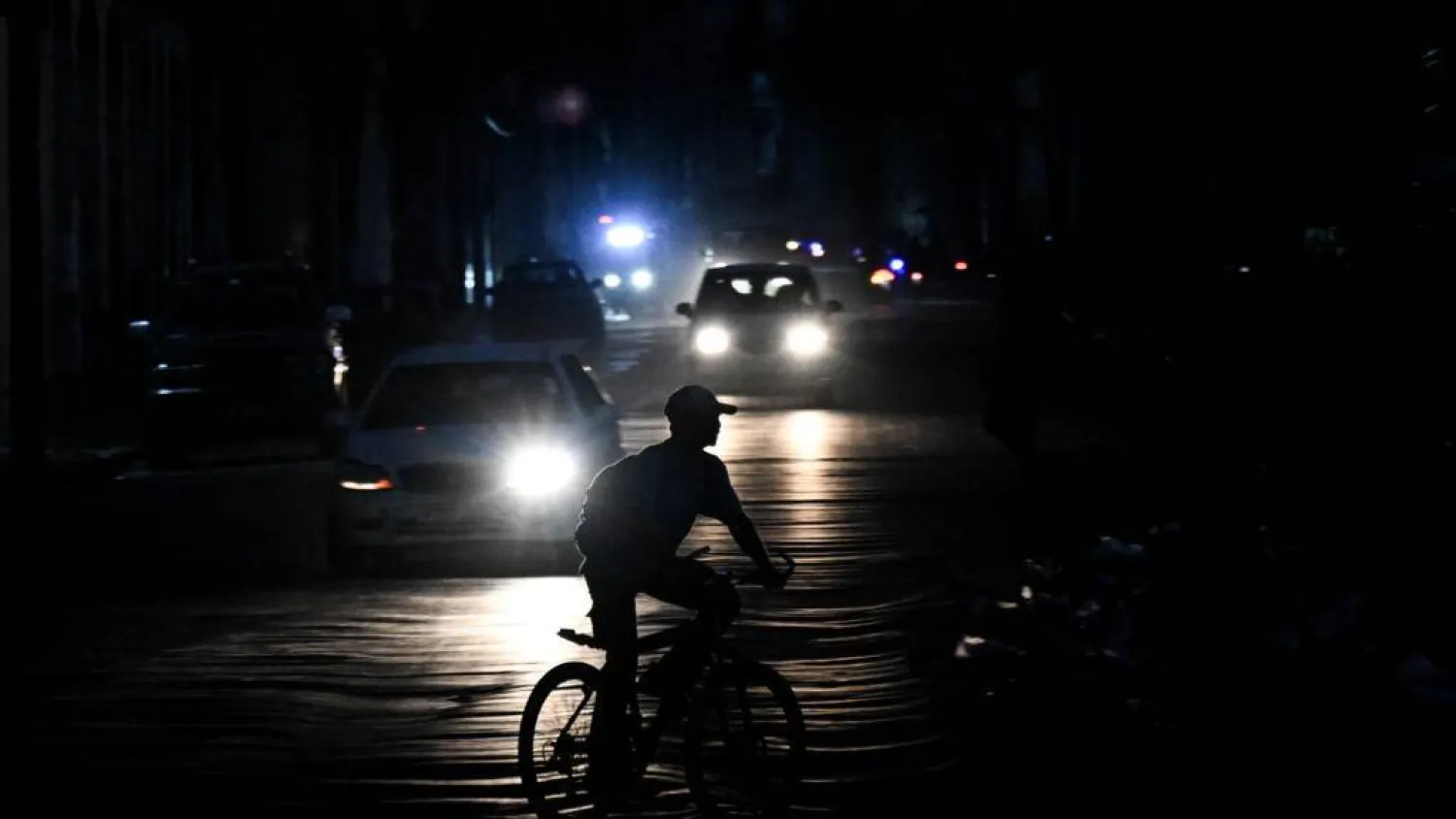
A man rides his bicycle down a street during a blackout in Havana. YAMIL LAGE / AFP
TT

Five of Cuba's 15 Provinces Without Power as Grid Fails Again

A man rides his bicycle down a street during a blackout in Havana. YAMIL LAGE / AFP

Havana and other parts of western Cuba were plunged into darkness Saturday due to the country's latest power grid failure, the state-run electric company announced.

Five of 15 provinces had no power due to a "partial collapse" of the electricity grid at 6:07 pm (2207 GMT), Cuba's UNE said on X.

Cuba is reeling from its worst economic crisis in decades -- one made worse by the fuel blockade imposed by US President Donald Trump in January as part of a pressure campaign aimed at ending six decades of communist rule.

UNE says the fuel shortages have made the national grid more susceptible to outages and made the use of emergency generators -- which typically run on diesel fuel -- all but impossible.

In recent weeks, some of the blackouts have lasted more than 30 hours in Havana, and for several days in other parts of the island nation, which has a population of 9.4 million people.

Since the start of 2026, Cuba has experienced five nationwide blackouts, three of them in July within a period of 10 days. Since late 2024, there have been 10 such total power outages.

Cubans are not shy about admitting that they are increasingly weary of the constant disruptions to daily life.

"We live practically like fireflies here -- in the dark all the time. You never know when you'll have power; it's our sad reality," Julian Gonzalez, a 72-year-old carpenter, told AFP.

Like many Havana residents who live near the Malecon, a coastal esplanade and seawall in the capital, Gonzalez was out trying to catch a bit of air.

"It's better than sitting at home feeling bitter," he said.

Havana blames Washington's punitive measures for the dire state of its electricity grid, while the US says the fault lies with Cuba's government and its mismanagement of the economy.

The seven thermal power plants that form the national grid's backbone have all been in operation for more than 40 years, and are in various states of disrepair.

Relations between Washington and Havana have been tense since the start of the year, especially since US forces snatched Venezuelan leader Nicolas Maduro from Caracas in early January and brought him to the US to face federal charges.

Maduro had long been a staunch ally of Cuba.

Washington has authorized the arrival of only one Russian tanker -- carrying 100,000 tons of crude -- which came in March. Those reserves have since been exhausted.

In addition to its oil blockade, the Trump administration has ramped up sanctions against Cuban state-owned businesses, prompting many foreign businesses to suspend operations in the country.

The United States has also indicted former president Raul Castro, brother of the late revolutionary leader Fidel Castro, over the downing of two civilian planes three decades ago.

In late June, Cuban Foreign Minister Bruno Rodriguez said "no progress" had been made in months of bilateral discussions.

But under pressure from all of the US measures, Cuban lawmakers adopted a raft of free-market reforms aimed at rolling back the state's role in the economy and attracting investment in everything from banking to tourism and agriculture.

And on Wednesday, Havana said it would open up major sectors such as gas stations, electricity generation, trash collection and pharmacies to private firms.



Sweden Expels Iran Embassy Employee, Summons Ambassador

A Swedish flag hangs outside a store on a busy street as visitors walk past in the background in the old town of Stockholm, Sweden, July 14, 2023 REUTERS/Tom Little/File Photo Purchase Licensing Rights
TT

Sweden Expels Iran Embassy Employee, Summons Ambassador

A Swedish flag hangs outside a store on a busy street as visitors walk past in the background in the old town of Stockholm, Sweden, July 14, 2023 REUTERS/Tom Little/File Photo Purchase Licensing Rights

Sweden said Wednesday it had expelled an Iranian embassy employee and summoned the country's ambassador, accusing Tehran of making threats against Jewish and Israeli interests in Sweden.

"We know that Iran, over a long period of time, has conducted activities that threaten security in and against Sweden, targeting both individuals who oppose the Iranian regime and various Jewish and Israeli interests in our country. This has, among other things, been done by making use of criminal networks," Justice Minister Gunnar Strommer said in a statement to AFP.


Amnesty Says Iran Committed ‘Crimes Against Humanity’ in Crackdown on 2022 Protests

Iranian women walk in a street on the fourth anniversary of protests following Mahsa Amini's death in downtown Tehran, Iran, 16 September 2026. (EPA)
TT

Amnesty Says Iran Committed ‘Crimes Against Humanity’ in Crackdown on 2022 Protests

Iranian women walk in a street on the fourth anniversary of protests following Mahsa Amini's death in downtown Tehran, Iran, 16 September 2026. (EPA)

Iranian authorities committed crimes against humanity in the crackdown on 2022 protests that left hundreds dead, Amnesty International said Wednesday, adding Tehran's suppression of new demonstrations this year bore the "same hallmarks" but on an even wider scale.

The crackdown in 2022 amounted to "crimes against humanity" including murder, torture, rape and enforced disappearance, Amnesty said in a report marking four years since those protests, warning that the authorities' actions earlier this year were "on an even deadlier and more staggering scale".

The London-based rights group named 87 national and regional officials, six of whom were subsequently killed in US-Israeli air strikes, who it believed were responsible in the chain of command and should face international justice.

Several months of protests against the country's theocratic authorities known as the "Woman. Life. Freedom." movement erupted in September 2022 following the custody death of Iranian Kurdish woman Mahsa Amini who had been arrested for allegedly violating the strict dress rules for women.

These were the biggest protests in Iran in recent years until demonstrations earlier this year sparked by anger over the cost of living that peaked on the nights of January 8 and 9.

On both occasions authorities responded with a deadly crackdown that caused international outrage. Amnesty's 1,000 page report focused on the 2022 protests while making clear that the crackdown in 2026 followed the same pattern while being even more severe.

"The extensive evidence gathered and analyzed in our report leaves no doubt: Iranian authorities committed crimes against humanity to crush the 2022 Woman Life Freedom uprising," said Agnes Callamard, Amnesty International's Secretary General.

Amnesty urged the UN General Assembly to "create an international criminal justice mechanism aimed at prosecuting those most implicated".

- 'Unlawfully killed' -

The 87 officials it named included former supreme leader Ali Khamenei and top figures in the Revolutionary Guards who were killed in the US-Israeli war this year.

But some others, including Ahmad Vahidi, who was then the interior minister and now chief of the Revolutionary Guards, are still alive.

"The security forces deployed by the authorities unlawfully killed hundreds of protesters and bystanders, including dozens of children" in the crackdown from September to December 2022, Amnesty said.

"They subjected thousands more to arbitrary arrests, incommunicado detention, enforced disappearance and torture or other ill-treatment. They raped and committed other sexual violence against some of those arrested in connection with the protests," it added.

Amnesty said it had identified 377 protesters and bystanders, including 56 children, who lost their lives during the 2022 protests, of whom at least 326 were killed by security forces, including with metal pellets fired at close range.

- 'Unprecedented massacres' -

One of those killed identified by Amnesty in the report was 62-year-old Minoo Majidi who was hit by metal pellets while protesting in the western city of Kermanshah in September 2022.

"She was killed on the street. She had gone to the street for change, to shout 'freedom'," her daughter Mahsa Piraei, who lives outside Iran, told AFP.

"The world thinks the protests were about freedom for women. They were, but they were also about freedom for people and the right to life," she added.

Amnesty described the crackdown this year as the "unprecedented massacres of thousands of protesters and bystanders" which "bear the same hallmarks as the crimes against humanity documented in this report, yet on an even deadlier and more staggering scale".

"Seeking justice is partly for my mum but to help the still many lives who are in danger," Piraei added, referring to the dozens of people arrested during the January protests who rights groups say are at risk of execution.

They include Ali Zarei, who was blinded in one eye during 2022 protests and then took refuge in Germany, but returned to Iran this year and was arrested and sentenced to death.

"We need to shout out their names," Piraei added.


Russian Drones Hit Ukrainian Bus and Train, Killing Five, Officials Say

 A woman crosses a road as smoke rises in the background from the site of a Russian drone strike, amid Russia’s attack on Ukraine, in Kyiv, Ukraine, September 16, 2026. (Reuters)
A woman crosses a road as smoke rises in the background from the site of a Russian drone strike, amid Russia’s attack on Ukraine, in Kyiv, Ukraine, September 16, 2026. (Reuters)
TT

Russian Drones Hit Ukrainian Bus and Train, Killing Five, Officials Say

 A woman crosses a road as smoke rises in the background from the site of a Russian drone strike, amid Russia’s attack on Ukraine, in Kyiv, Ukraine, September 16, 2026. (Reuters)
A woman crosses a road as smoke rises in the background from the site of a Russian drone strike, amid Russia’s attack on Ukraine, in Kyiv, Ukraine, September 16, 2026. (Reuters)

Russian drones struck a passenger bus and a train in southern Ukraine on Wednesday, killing five people, Ukrainian officials said, as Moscow pressed on with strikes on transport links and infrastructure.

A photo posted on Telegram by a regional governor showed a white vehicle with blown-out windows and a line of what appeared to be blood streaming down its side. Reuters has not verified the image.

"There is no military logic to this, just another act of brutality," Ukraine's President Volodymyr Zelenskiy said on social media, urging the US and ‌Europe to press ‌ahead with toughening sanctions against Russia.

ESCALATING STRIKES ON ECONOMIC TARGETS

Moscow ‌and ⁠Ukraine have traded ⁠escalating strikes in recent months on logistics and other economic targets, aimed at hampering each other's war effort and damaging morale.

With Ukraine's airspace closed since Russia's full-scale invasion in 2022, buses and trains have become a vital transport link for ordinary Ukrainians and businesses.

The drone attack on the passenger bus near the frontline city of Nikopol killed four men and a woman early on Wednesday, police said.

A further seven people were ⁠injured in the attack, said the governor of the surrounding Dnipropetrovsk ‌region, Oleksandr Hanzha, who posted the photo.

There was ‌no immediate comment from Russia on the attack. Both Ukraine and Russia deny deliberately targeting ‌civilians in the war, triggered by Moscow's full-scale invasion of its neighbor.

ATTACK ON PASSENGER ‌TRAIN

A Russian drone also attacked a passenger train in Ukraine's southern Mykolaiv region, the acting regional governor said.

All 168 passengers and crew were evacuated and no one was injured, Heorhii Reshetilov said on Telegram. The train was attacked twice more after the first strike, he ‌said.

Zelenskiy said that, in addition to the Mykolaiv train attack, a locomotive in Kovel — near the border with Poland — was also ⁠struck.

The incidents follow ⁠similar attacks recently, including on a train near Ukraine's border with NATO-member Poland on Sunday, shortly after European diplomats and political figures had used the same line.

Russia has intensified its attacks on Ukrainian railways, hitting 120 passenger wagons, 304 locomotives and 43 railway stations so far this year, the state rail operator told Reuters.

The company said that Russia has attacked 1,700 railway facilities in total since the start of the year, up from 1,206 facilities in 2025 and 842 in 2024.

"Russian forces strike passenger trains, locomotives, stations, and railway routes knowing exactly how essential they are for civilians, evacuations, and Ukraine's economy," Ukraine's Foreign Minister Andrii Sybiha said on X.

"This is not collateral damage. It is a systematic hunt for people and an attempt to paralyze civilian life," he said.