


Ceuta Grapples with Aftermath of Border Surge after Most Migrants Leave the Spanish Territory

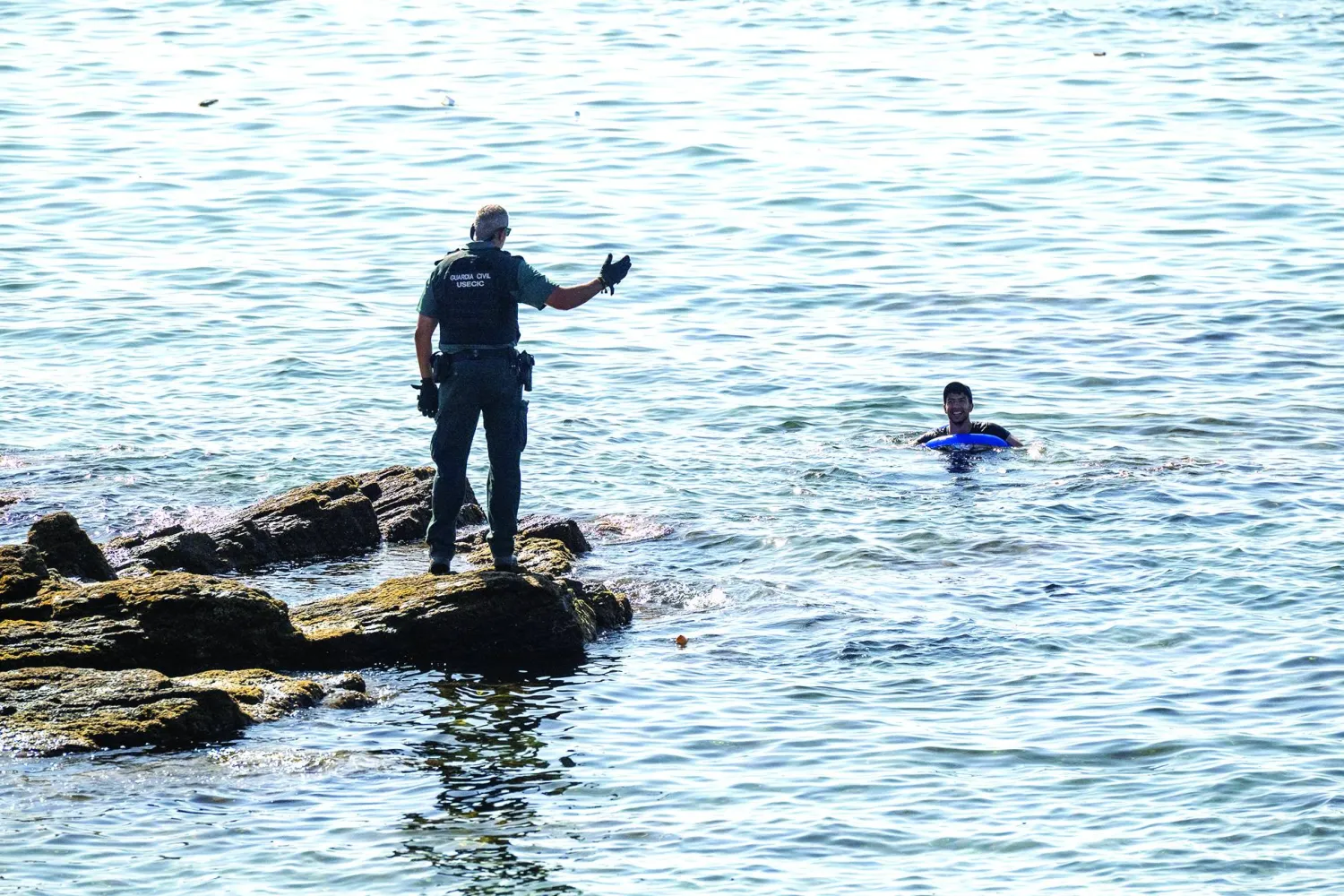
02 August 2026, Spain, Ceuta: A Spanish Civil Guard officer warns migrants attempting to cross into the Spanish enclave of Ceuta from Morocco. Photo: Marcos Moreno/EUROPA PRESS/dpa
TT

Ceuta Grapples with Aftermath of Border Surge after Most Migrants Leave the Spanish Territory

02 August 2026, Spain, Ceuta: A Spanish Civil Guard officer warns migrants attempting to cross into the Spanish enclave of Ceuta from Morocco. Photo: Marcos Moreno/EUROPA PRESS/dpa

Ceuta over the weekend no longer looked like a city on edge, but residents were still rattled by the events of the week.

Most of the 60,000 migrants who swam, scrambled and later charged into the tiny Spanish exclave in North Africa this week had walked back to Morocco by Sunday, but some stayed on in the hills surrounding the city. Spanish authorities continued searching for bodies in the waters near the stretch of urban beach that tens of thousand of migrants had breached days earlier.

Shops in Ceuta reopened, and the usual blend of residents and tourists in the city of 84,000 were filling the open-air terraces, restaurants and cafes.

At least 72 migrants died, including some who drowned and others who were killed in a stampede to cross a breakwater barrier, Spanish authorities said Sunday. Morocco reported 11 deaths on its side of the border, but it wasn’t immediately clear if these were in addition to those reported by Spain. The kingdom's authorities blamed misinformation and human traffickers for the breach, adding that they were investigating the events, The Associated Press said.

But the city that prides itself on being home to four cultures was still grappling with the aftermath of the border surge, with locals disagreeing on what caused it and who exactly is to blame.

“It's not the young men's fault,” said Mohamad Abdelkader Driss, 44, a waiter at a fish restaurant in town. “If you open the border, of course everyone comes in, but the young men aren't to blame. The authorities are responsible.”

Some migrants who returned to Morocco described a border that was effectively open and said authorities did little as they watched thousands of people cross.

The unauthorized arrivals on Thursday and Friday of 50,000 to 60,000, mostly young men, swelled Ceuta's population by more than half. Abdelkader lamented what happened, but said that those who breached the border behaved relatively well.

“It could have been much worse,” he said.

Far-right politicians call for remaining migrants to be expelled

The humanitarian crisis caused by the sudden rush of people reignited a debate around immigration in Europe and beyond. Over the weekend, far-right, anti-immigrant Spanish politicians and well-known right-wing influencers descended on the city, sparking counterprotests that included members of the Spanish city's large Muslim population, many of whom are of Moroccan descent.

Alvise Pérez, a far-right Spanish politician and member of the European Parliament, called on Saturday evening for migrants to be expelled as he faced an angry crowd of rival protesters. Pérez eventually had to shelter in a bar as residents banged on the windows, until police escorted him away.

Among the counter-protesters on Saturday was 20-year-old Ceuta resident and student Noor Ahmed. She denounced the protest and presence of figures like Pérez in her city as opportunistic.

“They just want to take advantage of the humanitarian crisis Ceuta is currently experiencing,” Ahmed said.

Santiago Abascal, the leader of the far-right Vox party, visited Ceuta on Sunday, slamming the Spanish government for the surge in migrant arrivals, which he called “an invasion.”

“The frontiers of Ceuta and Melilla are the walls of our home and homeland, and they are not being protected by a corrupt and traitorous government,” he said.

The Pope said he was alarmed

Pope Leo XIV on Sunday said he was “following with concern the alarming situation in Ceuta, asking God ... that solutions of peace, stability and justice may be found.”

Migration has been one of Pope Leo’s priorities, which he underlined during a recent visit to Spain's Canary Islands, one of Europe’s main migrant entry ports.



North Korea Preparing Further Russia Troop Deployments, No Sign Move Imminent, Seoul Says

FILE - Russian President Vladimir Putin, left, and North Korea's leader Kim Jong Un examine a launch pad of Soyuz rockets during their meeting at the Vostochny cosmodrome outside the city of Tsiolkovsky, about 200 kilometers from the city of Blagoveshchensk in the far eastern Amur region, Russia, on Wednesday, Sept. 13, 2023. (Mikhail Metzel, Sputnik, Kremlin Pool Photo via AP, File)
TT

North Korea Preparing Further Russia Troop Deployments, No Sign Move Imminent, Seoul Says

FILE - Russian President Vladimir Putin, left, and North Korea's leader Kim Jong Un examine a launch pad of Soyuz rockets during their meeting at the Vostochny cosmodrome outside the city of Tsiolkovsky, about 200 kilometers from the city of Blagoveshchensk in the far eastern Amur region, Russia, on Wednesday, Sept. 13, 2023. (Mikhail Metzel, Sputnik, Kremlin Pool Photo via AP, File)

South Korea's Defense Ministry said North Korea was continuing preparations for an additional troop deployment to Russia, but had detected no signs that such a deployment was imminent, according to a South Korean lawmaker's office.

The assessment came ‌after North ‌Korea's Kim Yo Jong, sister of leader Kim ‌Jong ⁠Un, last week ⁠denied Ukrainian President Volodymyr Zelenskiy's claim that Pyongyang planned to send up to 50,000 more troops to Russia to fight for its ally, Reuters said.

South Korea's Defense Ministry said in a statement to lawmaker Yu Yong-weon that North Korea had continued to supply Russia with weapons systems, including short-range ballistic missiles, according to Yu's office.

North ⁠Korea is estimated to have supplied Russia with ‌more than 15 million rounds of ‌artillery ammunition, measured in 152-millimetre shell equivalents, it said.

The lawmaker's office, ‌citing a South Korean Defense Intelligence Agency assessment, said North ‌Korean missiles used in the war may have improved in accuracy through battlefield data, alongside Russian technical advice and component support.

The ministry also said the development of some North Korean ballistic missiles and multiple rocket ‌launchers assessed as being intended for use in a conflict with South Korea was nearing completion, the ⁠lawmaker's office ⁠said.

The ministry added that North Korea's Hwasong-12 intermediate-range ballistic missile, capable of reaching the US territory of Guam, was being prepared for operational deployment, according to Yu's office.

North Korea's intercontinental ballistic missiles have the flight capability to reach the US mainland, the ministry said, but key technologies, including warhead re-entry, have not been verified because all test launches have been conducted on lofted trajectories.

North Korea and Russia have deepened military cooperation since Moscow's invasion of Ukraine in 2022, with Pyongyang supplying artillery ammunition and missiles since 2023 and deploying troops from 2024, according to South Korean, Ukrainian and Western assessments.

Moscow and Pyongyang have previously denied arms transfers.


US Vows 'Economic D-Day' as Iran Threatens to Halt all Oil Exports

Image published by the Iranian Parliament's website from Sunday's meeting of the Foreign Policy and National Security Committee.
TT

US Vows 'Economic D-Day' as Iran Threatens to Halt all Oil Exports

Image published by the Iranian Parliament's website from Sunday's meeting of the Foreign Policy and National Security Committee.

The US threatened Iran with what it called "the greatest financial offensive ever marshalled" as it prepared to roll out economic sanctions on Monday that target Iran's trade partners.

Iran in turn vowed to shut down all oil exports from the Gulf "if the economic war continues." US Treasury Secretary Scott Bessent will hold a press conference at 1 p.m. EDT (1700 GMT) on Monday amid promises to reveal even more severe measures on a country that has endured near-continuous economic sanctions since the Iranian Revolution of 1979, Reuters said.

"At dawn begins an economic D-Day — the single greatest financial offensive ever marshalled against an adversary," Bessent wrote in an opinion piece published in the Financial Times on Sunday.

The warring nations have not conducted military strikes against each other for weeks, ‌but they also ‌have not engaged in meaningful talks to end the six-month-old conflict.

Thousands of people ‌have ⁠died, most of ⁠them in Iran and Lebanon, since the US and Israel began strikes on February 28, degrading much of Iran's conventional military capacity and inflicting economic pain while killing Iranian Supreme Leader Ali Khamenei.

But Iran has preserved enough missile and drone capability to attack its Gulf neighbors and threaten oil tankers in the Strait of Hormuz, bringing shipping in the key waterway to a near standstill and pressuring world fuel prices.

The exact state of Iran's nuclear program, which the Americans and Israelis aim to wipe out, remains unknown. Without detailing specific measures, Bessent signaled the US would target "fearful nations" that practice "appeasement" ⁠by engaging with Iran's economy and financial system.

"They would do well to consider ‌the consequences of sustaining it," he wrote in the Financial Times. Iran ‌has been bracing for the sanctions for days, issuing a series of strongly worded statements hinting at a major military response.

Mohsen ‌Rezaei, secretary of Iran's Supreme National Security Council, on Sunday suggested economic retaliation.

Rezaei wrote in a social media post that if the economic war continues, “not ‌a single drop of oil will be exported”, neither through the Strait of Hormuz nor from anywhere in the Arabian Gulf . "Iran will regard any country’s participation in or support for America’s economic war against the Iranian people as an act of war." Bessent previously urged China to cooperate with the US, noting China historically has received half ‌of its oil imports from the Gulf region. A spokesperson for China's embassy in Washington responded with a statement that "sanctions and pressure do not help resolve the problem," ⁠while calling for diplomacy.

Iran's economy ⁠was already under pressure from international sanctions before the US and Israeli attacks destroyed parts of its infrastructure. Though Tehran remains outwardly defiant, Iranian officials have warned that further economic punishment could increase hardships, reignite unrest and further erode the Iranian Republic's legitimacy.

Iran entered the war with high inflation, a weakening currency, energy shortages, sanctions and deep structural weaknesses, and must now contend with damaged infrastructure, disrupted trade, lost production and the cost of rebuilding.

In the absence of official face-to-face talks between the US and Iran, which were last conducted in June in Switzerland, other nations including Qatar, Pakistan and Türkiye have attempted to promote diplomacy. Iran said Pakistan's army chief, Asim Munir, will visit Tehran on Monday as part of efforts to restore peace and security in the region, but gave few details.

Pakistan has been mediating in the conflict and a Pakistani government source said Munir would touch on recent developments including the US threat of new sanctions. US-Israeli strikes on Iran and Israeli attacks on Lebanon during the war have killed thousands and displaced millions. The US reported 18 military personnel killed and more than 750 wounded.


US: Pro-Palestinian Protesters Sentenced over Blocking Golden Gate Bridge Traffic in 2024

The Golden Gate Bridge during sunrise seen from Marin Headlands viewpoint in Marin County, California, US October 5, 2024. REUTERS/Manuel Orbegozo/File Photo
TT

US: Pro-Palestinian Protesters Sentenced over Blocking Golden Gate Bridge Traffic in 2024

The Golden Gate Bridge during sunrise seen from Marin Headlands viewpoint in Marin County, California, US October 5, 2024. REUTERS/Manuel Orbegozo/File Photo

Seven protesters who blocked traffic on the Golden Gate Bridge in a 2024 pro-Palestinian protest against Israel's assault on Gaza have been sentenced to 30 days, with credit for time already served.

They were convicted in July of misdemeanor charges by a San Francisco jury that remained deadlocked on the more serious charge of felony conspiracy.

Defense attorneys said demonstrators acted out of a moral responsibility to oppose the devastation from Israeli strikes on Gaza and Washington's support for its ally.

San Francisco District Attorney Brooke Jenkins said the protest caused ⁠a safety risk ⁠for those stuck in traffic and there should be consequences when laws are broken.

"Throughout history, civil disobedience has mostly involved accepting legal consequences," Superior Court Judge Teresa Caffese was quoted as saying by KQED.

"In that spirit, those who blocked the bridge and disrupted the lives of hundreds of ⁠commuters should be treated respectfully, but should also be prepared to accept the consequences of their actions."

The sentences included half the time in county jail while the remaining days can be served at a work release program operated by the San Francisco Sheriff's Office. There will be four days' credit for previous time already served. The sentencing also included six months of probation, and fines and restitution of over $1,000, Reuters reported.

The defendants will remain free while the case is appealed, SFGate ⁠reported.

Defense ⁠attorneys argued that protesters resorted to blocking the bridge after writing letters and appealing to congressional representatives produced no result.

The jury convicted the seven protesters on misdemeanor counts including false imprisonment, obstruction of thoroughfare, unlawful assembly and in one defendant's case refusal to disperse.

The jury did not reach a verdict on the most serious charge of felony conspiracy, an agreement between two or more people to commit a crime coupled with an overt act, which could have had a sentence of up to 15 years. Prosecutors said they will not retry the charges.