

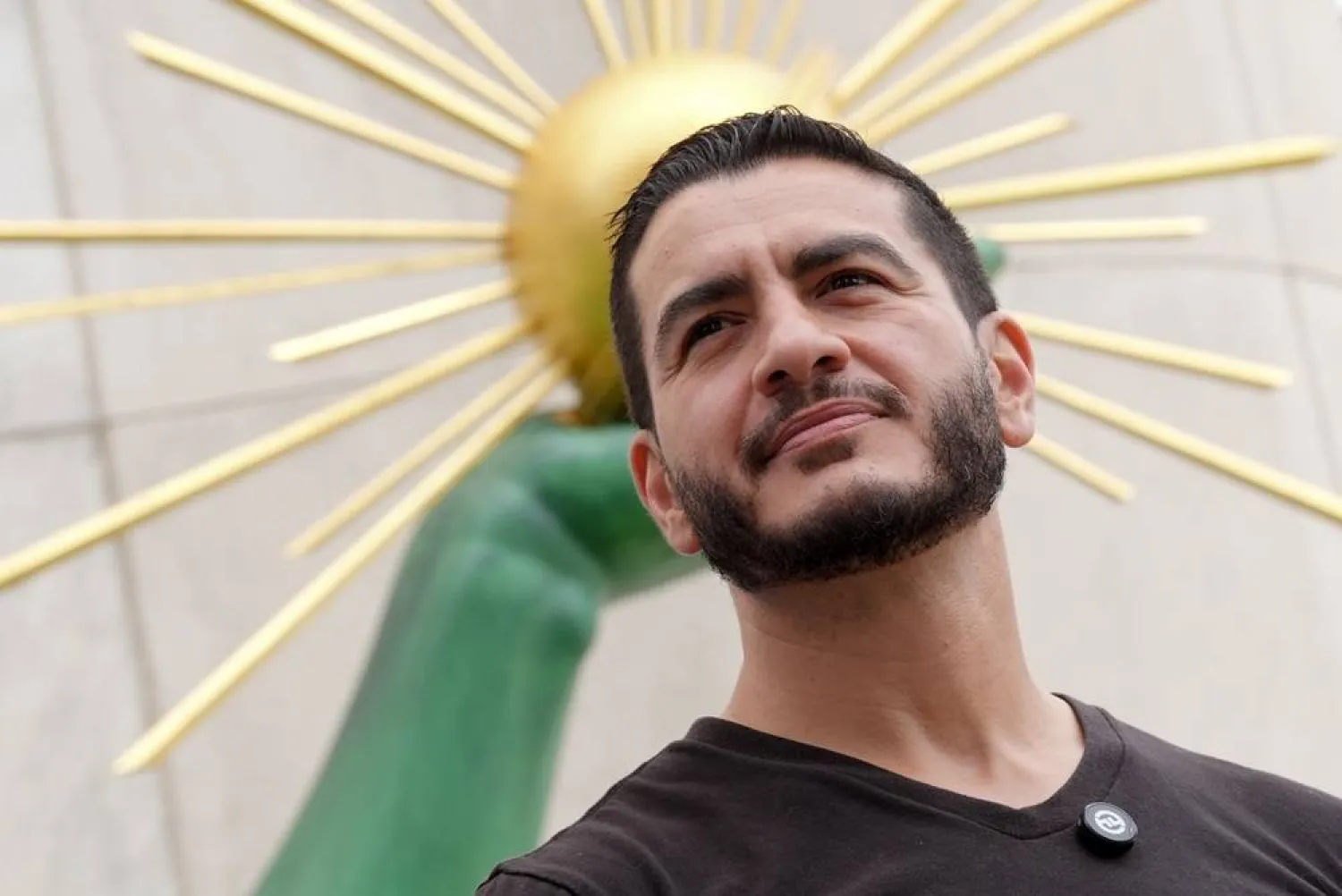

Michigan Primary Puts Democratic Divide on the Ballot

Abdul El-Sayed, a progressive candidate in the Democratic primary for US Senate in Michigan, attends a news conference at the Spirit of Detroit following the March of the Many, Sunday, Aug. 2, 2026, in Detroit. (AP)
TT

Michigan Primary Puts Democratic Divide on the Ballot

Abdul El-Sayed, a progressive candidate in the Democratic primary for US Senate in Michigan, attends a news conference at the Spirit of Detroit following the March of the Many, Sunday, Aug. 2, 2026, in Detroit. (AP)

US Democrats vote Tuesday in their marquee primary in Michigan, choosing between a left-wing insurgent and an establishment-backed congresswoman in a contest that has become a proxy war over Israel, electability and the future of the national party.

The winner will face former Republican congressman Mike Rogers in November for the seat being vacated by retiring Democratic Senator Gary Peters, a race central to the party's difficult effort to win control of the Senate.

Democrats must defend Michigan while gaining four Republican-held seats to control the upper chamber, making the primary more than an ideological exercise in a state that has swung between the two parties in recent national elections.

Analysts say the results will show whether a current leftist surge among Democrats can move beyond party safe seats and win in battlegrounds with national consequences -- or whether Michigan's Democratic establishment can still hold the line.

Abdul El-Sayed, a former Wayne County health director backed by leftist leaders Bernie Sanders and Alexandria Ocasio-Cortez, has cast himself as a working-class fighter willing to confront corporations, party leaders and increasingly unpopular pro-Israel donors.

Haley Stevens, a four-term lawmaker from the Detroit suburbs, has built her campaign around experience, manufacturing and electability. She is supported by establishment figures from Senate Democratic leader Chuck Schumer to Michigan Governor Gretchen Whitmer.

- Israel divide -

Several recent polls have shown El-Sayed ahead, raising the prospect of the left's biggest victory yet in a primary season marked by a series of anti-establishment wins.

His allies say the campaign's volunteer energy proves progressives can build a statewide coalition without relying on Washington's traditional donor network.

"Momentum doesn't happen by accident," said Joseph Geevarghese, executive director of the grassroots group Our Revolution, which says its volunteers have made more than 300,000 voter contacts for El-Sayed.

Stevens is counting on support that she says may be underrepresented in opinion polls -- from Black voters, older Democrats and people without college degrees.

The bitterest divide has been over the United States' deep support for Israel.

Stevens has defended continued military backing for the country and rejected accusations that Israel committed genocide in Gaza.

El-Sayed has called for an end to unconditional US aid, attacked the influence of the American Israel Public Affairs Committee (AIPAC) lobby group, and said Israel should not exist specifically as a Jewish state.

AIPAC spending and outside advertising totaling $90 million -- in a state with a large Arab American population and deep anger over the Gaza war -- has made Michigan another national test of the pro-Israel lobby's ability to shape Democratic primaries.

- 'Brutality' -

The candidates have traded increasingly personal attacks, with El-Sayed calling Stevens "the least capable candidate in America," while she has accused him of blaming his problems on Jewish Americans.

Congresswoman Debbie Dingell, who has remained neutral, warned that the "brutality" and "ugliness" of the campaign could make it harder for Democrats to unite afterward.

Both camps insist their candidate offers the stronger path against Rogers.

Stevens points to Michigan's tradition of electing pragmatic Democrats while El-Sayed argues that a candidate powered by grassroots enthusiasm is more likely to turn out working-class and younger Democrats.

Michigan voted narrowly for President Donald Trump in 2024, even as Democrat Elissa Slotkin edged Rogers in that year's Senate race, underscoring both the state's competitiveness and the risks of a divided party.

The ideological struggle extends down the ballot.

In Detroit's safely Democratic 13th district, congressman Shri Thanedar is fighting for survival against state lawmaker Donavan McKinney, who is backed by Sanders, Justice Democrats and several members of the Congressional Black Caucus.

Thanedar benefited in previous elections from multiple Black candidates dividing the vote. This time, progressive and Black political organizations have largely united behind McKinney in a historically Black district, making the incumbent vulnerable to the anti-establishment mood sweeping Democratic primaries.




Russia Wants AI, Digital Cooperation with China, Putin Tells Xi

FILE - Russian President Vladimir Putin, left, gestures while speaking to Chinese President Xi Jinping during the Shanghai Cooperation Organization (SCO) summit in Samarkand, Uzbekistan, Sept. 16, 2022. (Sergei Bobylev, Sputnik, Kremlin Pool Photo via AP, File)
TT

Russia Wants AI, Digital Cooperation with China, Putin Tells Xi

FILE - Russian President Vladimir Putin, left, gestures while speaking to Chinese President Xi Jinping during the Shanghai Cooperation Organization (SCO) summit in Samarkand, Uzbekistan, Sept. 16, 2022. (Sergei Bobylev, Sputnik, Kremlin Pool Photo via AP, File)

Moscow aims to cooperate with Beijing in the field of artificial intelligence and digital innovation, Russian President Vladimir Putin told China's Xi Jinping on Monday as the leaders met in Kyrgyzstan.

They arrived in the central Asian country for a two-day summit of the Shanghai Cooperation Organisation (SCO), a regional bloc that seeks to serve as a counter-balance to the West.

Russia, with its troops bogged down in Ukraine, has deepened ties with its main oil customer China, which has never condemned Moscow for its four-and-a-half-year invasion.

"Cooperation is successfully developing on all fronts," Putin told Xi ahead of their talks.

They last met in May in Beijing.

"Digital innovations, including in artificial intelligence technologies, are also opening up new opportunities for the economic development of our countries," Putin said.

The Kremlin has in the past months sought to tighten its control over the online sphere, imposing intermittent mass internet shutdowns and restrictions on popular messaging apps.

Moscow is pushing Russians to embrace the state-backed Max messenger platform -- an unencrypted super-app similar to China's WeChat that critics say raises privacy and snooping concerns.

It has repeatedly threatened foreign-owned sites with bans, part of what rights advocates say is a broader attempt by authorities to control and monitor internet use.


Pentagon Signs 7-year Deals to Increase Missile Production

FILE - The Pentagon is seen from the air, July 15, 2026, in Washington. (AP Photo/Alex Brandon, File)
TT

Pentagon Signs 7-year Deals to Increase Missile Production

FILE - The Pentagon is seen from the air, July 15, 2026, in Washington. (AP Photo/Alex Brandon, File)

The Pentagon said on Monday it secured seven-year agreements with General Dynamics Ordnance and Tactical Systems (GD-OTS) and Lockheed Martin to increase missile production.

The agreements are designed to "increase production quantities and accelerate delivery schedules for critical missile subcomponents supporting the Terminal High Altitude Area Defense (THAAD) and Patriot Advanced Capability-3 Missile Segment Enhancement (PAC-3 MSE) interceptor programs," the Pentagon said.


Israel Signs Three-billion-euro Arms Export Deal with Greece

Greece to buy a defense system from Israel (Reuters)
TT

Israel Signs Three-billion-euro Arms Export Deal with Greece

Greece to buy a defense system from Israel (Reuters)

Israel's defense ministry announced Monday it had signed a deal with Athens worth approximately three billion euros (almost $3.5 billion) to set up the "Achilles Shield" aerial defense system for Greece. 

"Under the deal, Israel will build Greece a comprehensive, multi-layered air defense array, drawing entirely on Israeli-made systems and on the extensive operational experience Israel's defense establishment has gained during the war," the ministry said in a statement. 

"This is the largest defense export deal in the history of Israel-Greece relations, and one of the largest in the history of the State of Israel," it added. 

The deal was signed by the Israeli defense ministry's director general, Major General (Res.) Amir Baram, and his Greek counterpart, Ioannis Bouras, in Tel Aviv. 

A Greek defense ministry source had told AFP in late July about an upcoming purchase of Israeli-made anti-missile, anti-aircraft and anti-drone systems, part of a broader defense investment for the Achilles Shield of 4.2 billion euro ($4.8 billion). 

In a statement, the Greek Defense Ministry said the multi-billion euro purchase was part of "the greatest reform of its armed forces in its history". 

Greek Defense Minister Nikos Dendias was quoted in the statement as saying that recent technological developments "have long rendered existing defense doctrines completely obsolete". 

"Greece is the first country in the European Union to adopt" a multi-layered air defense system such as the Israeli one, he added. 

According to the Israeli Defense Ministry, the export deal includes the David's Sling, Barak MX and SPYDER interception systems, air surveillance radars, and "a new national command and control system". 

All the equipment is manufactured by Israeli defense contractors Rafael and Israel Aerospace Industries and its subsidiary ELTA Systems. 

A supplementary 26 million euro deal was also signed to provide Greece with Rafael's defense systems against drones, the ministry said. 

"Israel and Greece share common strategic interests and face shared regional challenges," said Defense Minister Israel Katz, quoted in the statement. 

"At a time when actors with hegemonic ambitions are seeking to expand their influence and undermine stability in the region, Israel and Greece will continue to deepen their defense and strategic cooperation," he said, in a likely reference to Türkiye. 

Greece is now one of only four European NATO members to spend at least three percent of GDP on its military, amid decades of tensions with neighboring Türkiye. 

Israel has also increasingly locked horns with Türkiye, having struck a disused military base in northwest Syria, claiming it wanted to avert Turkish troops deploying to the facility. 

In 2023, Israel signed a deal with Germany to provide the Arrow 3 anti-ballistic missile defense system, which was expanded in December for a total value of $6.5 billion, the country's largest-ever military export contract.