


SoftBank's AI Funding Plans to Face Reckoning at Earnings

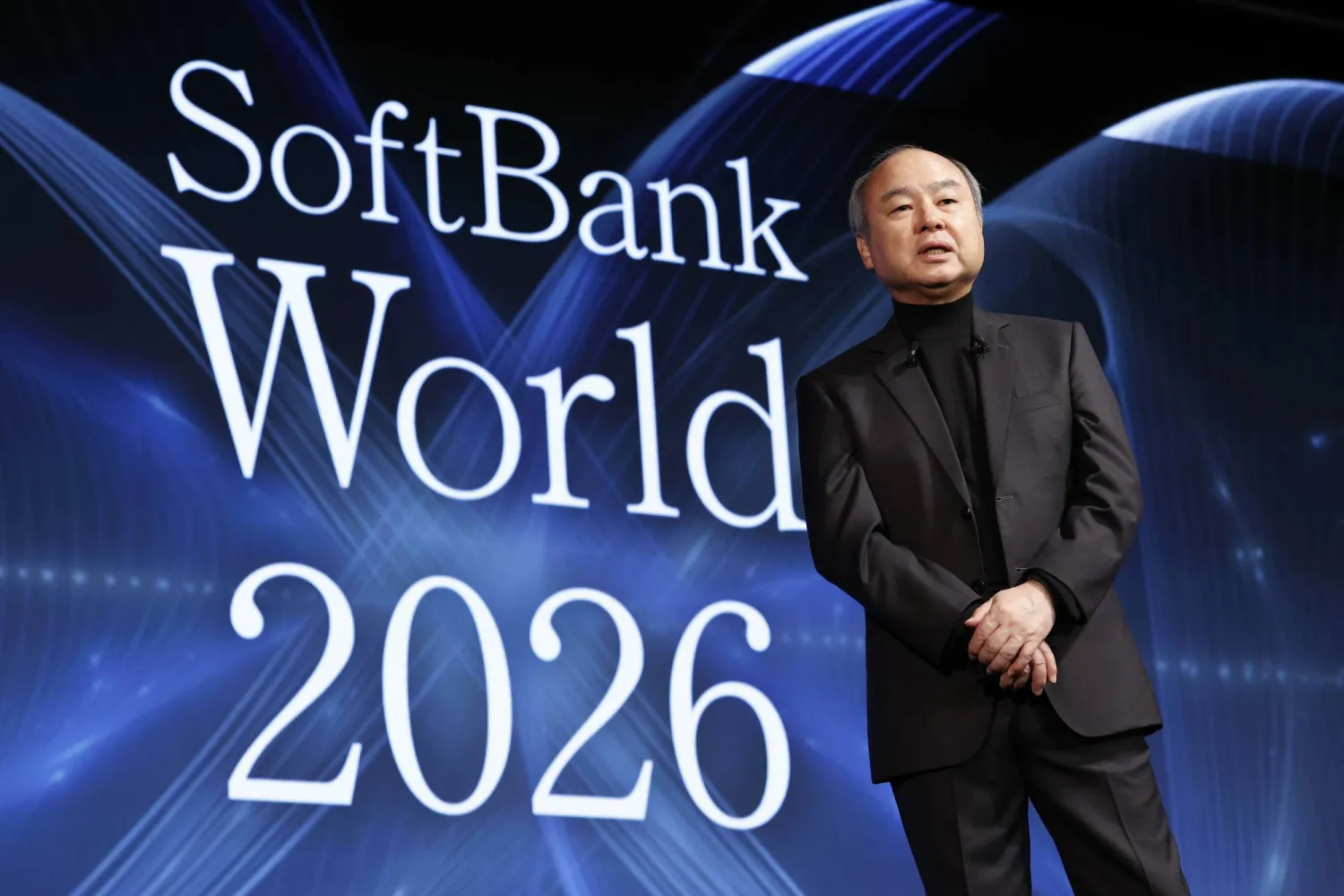
Masayoshi Son, Chairman and CEO of SoftBank Group Corp., speaks during the 'SoftBank World 2026 AX for Japan' technology event in Tokyo, Japan, 14 July 2026. EPA/RODRIGO REYES MARIN
TT

SoftBank's AI Funding Plans to Face Reckoning at Earnings

Masayoshi Son, Chairman and CEO of SoftBank Group Corp., speaks during the 'SoftBank World 2026 AX for Japan' technology event in Tokyo, Japan, 14 July 2026. EPA/RODRIGO REYES MARIN

Technology investor SoftBank Group reports first-quarter earnings on Thursday, with analysts focused on how it will fund its ongoing investment in OpenAI and the impact ​of rising leverage on its balance sheet.

SoftBank has become one of the biggest backers of OpenAI and its ability to keep funding its ambitions in artificial intelligence has become a key test for the broader AI investment boom. The finances of AI firms are facing heightened investor scrutiny as financing needs grow and the use of debt increases.

SoftBank announced record net profit in the year ended March 2026, but its share price has dropped by almost half since the start of June, and the cost to insure its debt against default has soared.

SoftBank is expected to post net profit of 148.4 billion yen ($941.2 million) over the April-June quarter, according to the average of four analysts polled by LSEG.

Under founder Masayoshi Son's push ‌to make the Japanese conglomerate ‌a dominant investor in AI, SoftBank has committed more than $60 billion to OpenAI ​and ‌related AI ⁠infrastructure projects. He ​recently ⁠dismissed talk of an AI bubble as "blasphemy" and 15 out of 20 sell-side analysts polled by LSEG had a buy or strong buy rating on the stock in August.

Investors, however, are questioning how SoftBank will fund its commitments, with $30 billion of obligations due in the second half of 2026 and growing reliance on loans secured against its holdings, Reuters reported.

SoftBank has a $40 billion bridging loan, but this matures in March 2027. It has arranged a $20 billion margin loan on its stake in chip designer Arm, but its attempt to use its OpenAI holding as collateral for another loan has been held up as lenders have become more cautious about extending credit backed by private companies.

"We ⁠think Arm has a solid credit profile but OpenAI is very weak. It's a startup ‌with significant AI innovation risk and lots of competition," S&P Global Ratings' Makiko Yoshimura ‌said.

S&P raised SoftBank's credit outlook to stable from negative in July due to ​the rise in Arm's share price, which reduced the ratio ‌of its debt to asset value.

SoftBank has maintained a loan-to-value ratio below its self-imposed limit of 25% in normal times ‌even as its OpenAI investment has grown. It also maintains two years' worth of bond redemptions in cash and cash equivalents.

"As of March I can say our loan to value and cash position have been improving," Chief Financial Officer Yoshimitsu Goto said at last quarter's earnings briefing.

Unlike SoftBank, S&P's criteria for calculating the loan-to-value ratio include margin loans backed by investee company shares, bringing its estimated ratio at the end of March to ‌33%, compared with SoftBank's internal figure of 17%.

But the ratings agency expects this figure to have dropped to between 20% and 25% in June.

Nevertheless, some analysts highlight SoftBank's vulnerability to ⁠further reratings of AI companies.

"If ⁠Arm's valuation drops, the value of the loan against it does not," said Amir Anvarzadeh of Asymmetric Advisors. "A significant drop in the price of its assets could mean a liquidity squeeze," Anvarzadeh said.

Fitch Ratings has identified an AI market correction as a major credit risk, citing rising valuations, the scale of AI capital expenditure and the uncertainty of AI company returns.

"SoftBank, Arm and memory stocks are likely to continue to come under pressure until end users and corporates show that this is the beginning of a productivity surge," MST Financial analyst David Gibson wrote in a note.

While the latest AI models are becoming increasingly powerful, competition from much cheaper and similarly effective Chinese AI models may spark a price war, hitting the margins of frontier developers such as OpenAI as well as demand for the chips powering them, analysts say.

The key question for SoftBank is whether OpenAI is able to secure funding from other parties - either through a public listing or another private round - at a higher valuation, analysts say.

OpenAI is reported to ​be seeking an IPO valuation of $1 trillion, a jump from ​its $852 billion valuation, although a New York Times report suggested this may be delayed to next year.

Others are more skeptical.

"The true value of OpenAI is perhaps no more than $300 billion, judging by the smaller IPO plans of the Chinese players," Anvarzadeh said.



How to Turn Your Phone Into a Personal Health Dashboard

From left, the Google Health, the Samsung Health and Apple’s Health apps offer plenty of tools and features to help you manage your diet, exercise and personal safety. (Google; Samsung; Apple)
TT

How to Turn Your Phone Into a Personal Health Dashboard

From left, the Google Health, the Samsung Health and Apple’s Health apps offer plenty of tools and features to help you manage your diet, exercise and personal safety. (Google; Samsung; Apple)

New York: JD Biersdorfer

The health app on your phone’s home screen has many uses, even if you don’t have a smartwatch or fitness tracker. With a little manual effort, you can use the app to get a better idea of your general wellness.

For example, you can keep a food-and-fitness diary there. Most phones provide a free basic step-counting function. And you can link other exercise and diet apps you use to streamline your data.

Many medical providers let you import records from your doctor, and you can create a “medical ID” for your phone’s lock screen in case of emergency.

Here’s how to get started.

Choose Your App

Although third-party options abound, the basic health apps from Google, Samsung and Apple have been available for years and have been steadily adding new features:

Google recently revamped its Google Health app (formerly its app for FitBit devices) and is phasing out the older Google Fit software. Google Health is free in the app stores for Android and iOS.

Samsung Health updated last month, comes with Galaxy phones. It is also available for other Android and iOS users, particularly those using Samsung’s fitness trackers and smartwatches.

Apple’s Health app comes preinstalled on iPhones and iPads (and collects data from paired Apple Watches). It does not have an Android version.

The menus in the health apps can be a little overwhelming, so take time to explore. Each app offers a place to manually log your daily workouts, food intake, emotional state and sleep time.

You can set up medication reminders. And if you use a compatible separate exercise or diet app, you can often link it to the health app so you don’t have to log updates twice.

Many phones have an automatic step-counting feature already enabled. While not as precise as some dedicated sensors, the step count shown on the main screens of Google Health, Samsung Health and Apple’s Health, can give you a general idea of your daily distance. (If your phone isn’t counting your steps, check your settings to make sure the fitness-tracking feature is turned on.)

Sync Health Records

Many health care providers use “patient portal” sites like MyChart that allow you to log in and see your test results and other electronic medical records. If the provider’s site is compatible with your health app, you can synchronize those records to have them all in one place. You’ll need the login credentials you use for the provider’s online patient portal.

If you have confidentiality concerns about pulling in digital records to a different app, check your health app’s privacy policy before you proceed. Google Health, Samsung Health and Apple’s Health all have explanations on their sites. Note that federal privacy laws generally don’t apply to mobile devices.

The Google Health support site has a page of detailed instructions. To sync your records directly from your health care provider, open the Google Health app, tap the Connections icon in the upper-left corner of the screen and tap Medical Records; iOS users must tap Apps and Services first to get to the Medical Records option. On the

Medical Records screen, select Manage Connections and then the Add More Providers button to search and sync your files.
In Samsung Health, open the app, tap the Home tab at the bottom of the screen, scroll down and tap to Health Records to get started.

In Apple’s Health app, from the Summary screen, tap your profile icon in the upper-right corner. On the next screen, tap Health Records and follow the onscreen prompts so you can view your files, test results and other data from your doctor, or share information.

Create a Medical ID

Even if you don’t plan to use it as a personal-health database, your phone can show important information to emergency medical workers on your phone’s lockscreen, should you be incapacitated. These details can include blood type, any current prescriptions or health conditions you have, and your organ-donor status.

On many Android models, open the Personal Safety app, and tap the Your Info tab at the bottom of the screen. There, you can add your medical information and an emergency contact person.

On a Samsung Galaxy phone, tap the Settings icon, select Safety and Emergency, and then tap the options for adding medical and emergency contact information.

On an iPhone, open the Health app. If you aren’t prompted to set up your Medical ID, tap your profile photo in the top-right corner and choose Medical ID. On the next screen, add or edit the details you wish to share, and give permission to have the information displayed when your phone is locked.

Setting up a smartphone medical ID is worth your time: A recent study led by the University of Rochester showed the information was useful for patient care in 75% of cases.

The New York Times


Saudi Communications Minister Discusses Expanding AI, Quantum Computing Partnerships in France

Saudi Minister of Communications and Information Technology Abdullah Alswaha meets with Electronic Arts Chairman and CEO Andrew Wilson in Paris. (SPA)
TT

Saudi Communications Minister Discusses Expanding AI, Quantum Computing Partnerships in France

Saudi Minister of Communications and Information Technology Abdullah Alswaha meets with Electronic Arts Chairman and CEO Andrew Wilson in Paris. (SPA)

Saudi Minister of Communications and Information Technology Abdullah Alswaha held a series of meetings during his visit to France with senior executives from leading global companies in artificial intelligence (AI), digital content and digital entertainment, gaming, and quantum computing.

The meetings aimed to expand high-impact partnerships, facilitate knowledge transfer, develop national capabilities, and strengthen the Kingdom of Saudi Arabia’s position as a global hub for artificial intelligence, electronic gaming, and emerging and advanced technologies, reported the Saudi Press Agency on Monday.

Alswaha discussed with Ubisoft CEO and Co-Founder Yves Guillemot, Sony Group CEO Hiroki Totoki, Riot Games CEO Dylan Jadeja, and Electronic Arts Chairman and CEO Andrew Wilson the use of AI in developing the gaming, entertainment, and content industries, as well as developing Saudi talent and empowering developers and content creators in the Kingdom to build globally competitive experiences and intellectual properties.

Saudi Minister of Communications and Information Technology Abdullah Alswaha meets with Sony Group CEO Hiroki Totoki in Paris. (SPA)

He discussed with Thales Group Chairman and CEO Patrice Caine the security of artificial intelligence applications, data protection, knowledge transfer, and the development of national capabilities in advanced technologies, building on the partnership between the group and the Kingdom spanning more than five decades.

Alswaha visited the headquarters of Pasqal in Paris, where he toured its laboratories and reviewed its advanced quantum computing technologies, in the presence of CEO Dr. Wasiq Bokhari and Chairman of the Board of Pasqal Arabia Prince Abdulaziz bin Turki bin Talal.

He discussed expanding the presence of quantum computing technologies in the Kingdom, integrating them with artificial intelligence, and developing national capabilities and talent.

In the field of advanced artificial intelligence, he discussed with Advanced Machine Intelligence Co-Founder Laurent Solly the future of the next generation of artificial intelligence models and their capabilities in understanding, prediction, and planning, as well as their applications in robotics, automation, and industry, in addition to enabling Saudi researchers and developers to build new applications and technologies.

The visit builds on the Kingdom's efforts to forge effective international partnerships, attract high-quality technologies and investments, and empower national talent to lead opportunities created by the intelligent era, supporting the objectives of Saudi Vision 2030.


Alibaba Shares Slide after $10.2 Billion AI Share Sale Offered at Sharp Discount

FILE PHOTO: An Alibaba logo is displayed at the company's booth at China International Fair for Trade in Services (CIFTIS) in Beijing, China, September 10, 2025. REUTERS/Maxim Shemetov/File Photo
TT

Alibaba Shares Slide after $10.2 Billion AI Share Sale Offered at Sharp Discount

FILE PHOTO: An Alibaba logo is displayed at the company's booth at China International Fair for Trade in Services (CIFTIS) in Beijing, China, September 10, 2025. REUTERS/Maxim Shemetov/File Photo

China's Alibaba shares slumped in Hong Kong trade on Monday after it launched a $10.2 billion share sale at a steep discount to fund its AI ambitions, with investors focused on stock dilution and execution risks.

The e-commerce and cloud computing giant said it would sell HK$80 billion ($10.2 billion) of new shares at HK$112.70 each, an 8.4% discount to Friday's close, to fund chips, AI infrastructure and models.

AI has become Alibaba's biggest driver of revenue growth at a time when e-commerce growth is stagnating, and its Qwen AI models are some of the most popular in China. Even so, some investors have reservations about how successful it will be.

"Alibaba's DNA is in e-commerce, not advanced tech," said Yang Tingwu, vice general manager of asset manager Tongheng Investment.

"No matter how much it invests in AI hardware, it will likely be outmaneuvered by competitors in tech innovation."

Its Hong Kong shares fell as much as 10.5% but pared losses in the afternoon to trade in line with the discount offered.

The sale of 710 million ordinary shares is equivalent to 3.6% of enlarged total shares outstanding.

It drew strong demand, attracting $28 billion of orders, including $6 billion from long-only and sovereign investors, three people with knowledge of ⁠the matter said.

About ⁠40% of the book will go to long-only and sovereign investors, including major sovereign wealth funds in Europe, Asia and the Middle East, two of the people said.

Investors included the Qatar Investment Authority (QIA), Norway's Norges wealth fund and Hillhouse, according to one person.

Alibaba, Hillhouse, QIA and Norges did not immediately respond to Reuters requests for comment.

Alibaba chairman Joe Tsai bought 720,000 Hong Kong shares at an average price of HK$112 apiece, for about HK$80 million in aggregate, while Eddie Wu, the group's chief executive, bought 350,000 Hong Kong shares at an average price of HK$111.6 per share, totaling HK$40 million, according to the group's stock exchange disclosures later on Monday.

As the US and China vie for tech supremacy, investment in AI and related infrastructure such as data centers ⁠has reached dizzying heights.

The biggest Chinese AI names are, however, investing only a fraction of what their US counterparts are spending. Most fundraising globally is also conducted via heavy debt issuance — a trend that has begun to test the limits of investor demand. Japan's SoftBank on Monday announced it would issue $6.3 billion in bonds to retail investors — its biggest debt offering to date.

Alibaba's stock sale is the largest-ever follow-on offering of new shares by a Hong Kong-listed company and the third-largest globally this year after offerings of nearly $85 billion from Alphabet and $20 billion from Intel.

"Alibaba's placement — landing alongside massive capital raises by Alphabet and Intel in the US — proves that American and Chinese tech giants are operating off the exact same strategic playbook," said Winston Ma, an adjunct professor at NYU School of Law and former head of North America for sovereign wealth fund China Investment Corp.

"The global sovereign investors aren't blind to US-China tech friction — they are compartmentalizing it," Ma said, adding that they were more comfortable with compliance issues when investing in Chinese commercial cloud and open-weight AI plays over restricted semiconductor hardware.

Capital Group, one of the world's largest active investment managers, estimates that AI-related capital expenditure by the biggest US hyperscalers — Microsoft, Amazon, Alphabet, ⁠Meta and Oracle — reached $791 billion as of ⁠July 31. That compares with $118 billion for China's ByteDance, Alibaba, Tencent and Baidu.

Part of the reason for the more subdued Chinese spending has been a lack of access to Nvidia's most advanced AI chips due to US export controls. That in turn has pushed Chinese firms to develop more efficient AI models and infrastructure that require less computing power and capital.

The share placement comes a week after Alibaba reported quarterly net profit that tumbled 75% from a year earlier, primarily due to AI-related spending.

Underscoring how AI has leapt to become a key priority, Alibaba this year separated its AI operations from its cloud business, with the new unit to be led by CEO Eddie Wu.

In addition to positioning itself as a key AI partner for companies operating in China, it is preparing a listing of its chipmaking arm T-Head and developing AI agents linking services across its sprawling ecosystem, including shopping, food delivery, travel and entertainment.

Separately, Alibaba has helped train a large language model that Apple will sell in the Chinese market, sources have said.

At earnings, Alibaba said it had committed nearly half of its three-year capital expenditure plan of 380 billion yuan ($56.5 billion), but that AI computing investments have a "high certainty" of returns.

Wu said such investments are expected to break even within three years, possibly even 2.5 years, as margins improve and proprietary chips replace third-party hardware.