

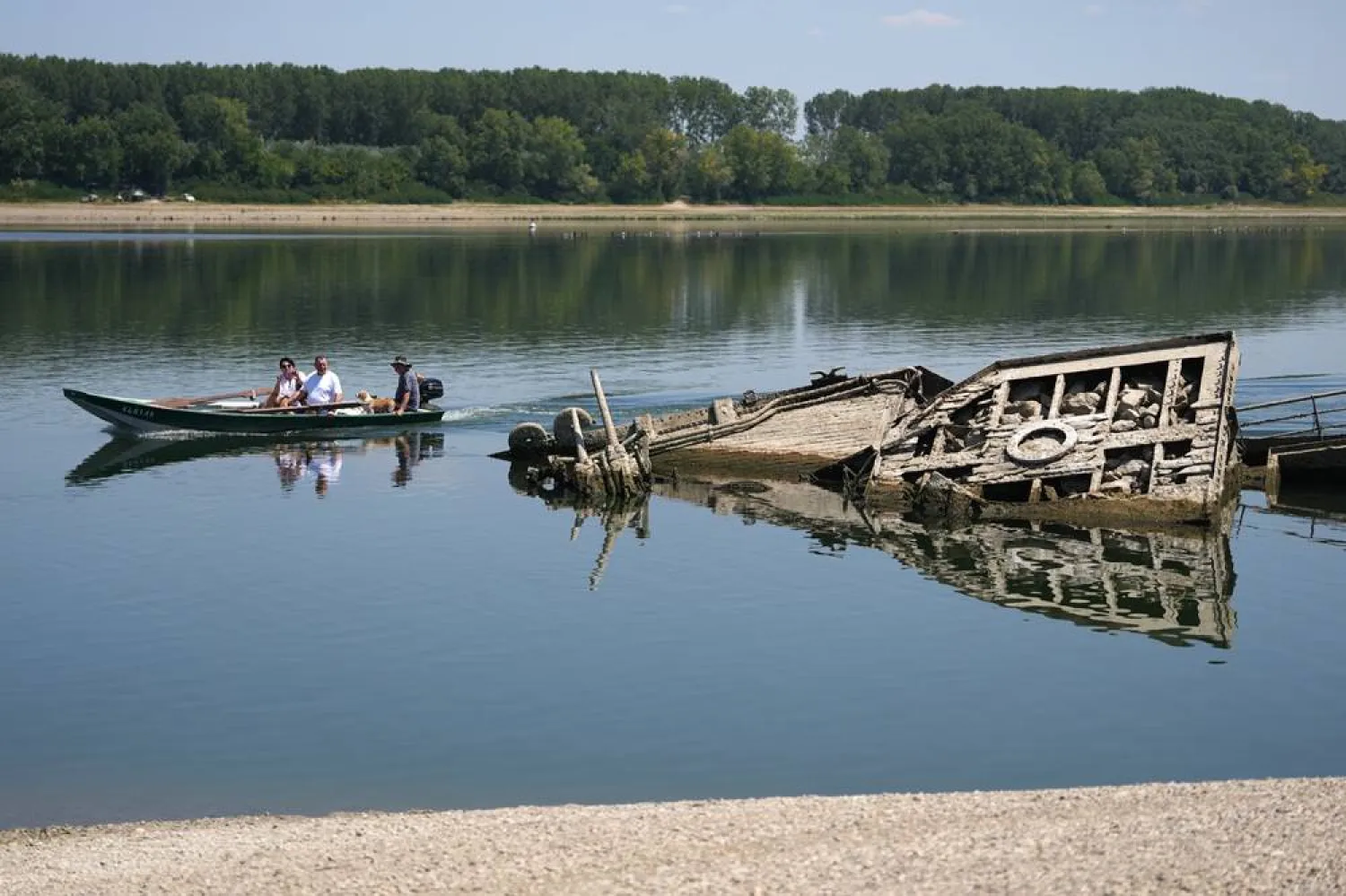

Danube River’s Water Is Dropping So Low That World War II Ships Are Emerging

People watch the wreckage of a WWII German warship, emerged due to the drought, in front of Djerdap II, a large dam on the Danube River, between Romania and Serbia, near Prahovo, Serbia, Tuesday, Aug. 4, 2026. (AP)
TT

Danube River’s Water Is Dropping So Low That World War II Ships Are Emerging

People watch the wreckage of a WWII German warship, emerged due to the drought, in front of Djerdap II, a large dam on the Danube River, between Romania and Serbia, near Prahovo, Serbia, Tuesday, Aug. 4, 2026. (AP)

Water levels on the Danube River, the second longest in Europe, have dropped so low because of drought that the hulks of dozens of World War II German battleships are emerging into view.

They are a curious distraction from the summer heat crisis. The Danube’s record low water levels also have forced power plants to the brink of shutting down, and governments across Central and Eastern Europe are taking steps to conserve electricity.

In the middle of the river separating Serbia and Romania near the Serbian port of Prahovo, a rusty hull is now visible along with a broken mast where the Nazi flag used to fly.

The ships, some still laden with weapons, belonged to Nazi Germany’s Black Sea fleet that the Germans deliberately sank as they retreated from Romania and as Soviet forces advanced deeper into Europe near the end of the war.

Historians say up to 200 German warships were scuttled in September 1944 near Prahovo in the Danube gorge as they came under Soviet fire. The idea behind the deliberate sinking was to slow down the Soviet advance in the Balkans. But Nazi Germany surrendered months later, in May 1945.

The sight of the old warships is a reminder that the Serbian government, with European Union financial support, has long been trying to do something about them. Some were removed from the river by Communist Yugoslav authorities, but most have remained because of the explosives they carried.

Now, however, authorities are trying to keep traffic flowing on the Danube, which flows through 10 nations, as the dropping water levels create dangerous conditions. Experts have linked the unusually hot weather to global warming and other factors.

Krsta Brandic, a Prahovo resident, said the low water levels have almost stopped ship traffic: “As you can see, the (big) ships can’t pass anymore."



Indonesia Moves 8 Endangered Orangutans to Safety after Borneo Fires

A Borneo orangutan (Pongo pygmaeus) named Mama Lifa, along with her baby Lifa (unseen), who were rescued from an area affected by wildfires, leave the cage during translocation at Batu Nyambu protected forest area in Ketapang regency, West Kalimantan province, Indonesia, October 9, 2026. Muffidz Ma’sum/Yayasan Inisiasi Alam Rehabilitasi Indonesia (YIARI)/ Handout via REUTERS
TT

Indonesia Moves 8 Endangered Orangutans to Safety after Borneo Fires

A Borneo orangutan (Pongo pygmaeus) named Mama Lifa, along with her baby Lifa (unseen), who were rescued from an area affected by wildfires, leave the cage during translocation at Batu Nyambu protected forest area in Ketapang regency, West Kalimantan province, Indonesia, October 9, 2026. Muffidz Ma’sum/Yayasan Inisiasi Alam Rehabilitasi Indonesia (YIARI)/ Handout via REUTERS

Indonesian authorities and conservation workers successfully moved eight orangutans to a safe location after the endangered primates' homes were destroyed by wildfires in the forests of Borneo, they said on Sunday.

The Southeast Asian nation is battling its most intense wildfires in 11 years, mainly on Sumatra and Borneo islands, and the government has warned the blazes could continue until November, aggravated by the El Niño weather pattern.

Three mother-child pairs and two adolescent male orangutans were among those rescued between August and September from several locations, ⁠the Indonesian government ⁠and wildlife foundation, Yayasan Inisiasi Alam Rehabilitasi Indonesia (YIARI) said in a statement.

"Their relocation to Batu Nyambu protected forest is expected to give the eight orangutans a chance to return to living naturally," the statement read, according to Reuters.

Orangutans are critically endangered great apes found in the wild ⁠only on the Southeast Asian islands of Borneo and Sumatra, with Indonesia home to all three recognized species, according to the World Wildlife Fund. Populations have declined due to deforestation, wildfires and poaching.

The relocation operation took six hours by car, one hour on boats, and two more hours on foot, with the orangutans in cages carried on bamboo poles. Before they were moved, YIARI conservationists checked the animals' health.

Since August, the West ⁠Kalimantan Natural ⁠Resources Conservation Agency and YIARI have rescued 46 orangutans affected by fires, agency head Murlan Dameria Pane said.

From January to July this year, fires burned around 202,000 hectares (500,000 acres) in Indonesia. No official data for subsequent months has been released, but non-governmental organizations estimate fires have burned at least 600,000 hectares more since.

Haze from the fires has caused 175,000 cases of respiratory illness in Indonesia, with the smog affecting neighboring Singapore and Malaysia where many schools were closed on Friday as air quality deteriorated.


'No Divisions, No Borders', French Astronaut Says of Seeing Earth

European Space Agency (ESA) French astronaut Sophie Adenot cries while speaking to the media as she returns to Europe, following the return of NASA's SpaceX Crew-12 mission to Earth after nearly eight months in space, in Cologne, Germany, October 10, 2026. REUTERS/Thilo Schmuelgen
TT

'No Divisions, No Borders', French Astronaut Says of Seeing Earth

European Space Agency (ESA) French astronaut Sophie Adenot cries while speaking to the media as she returns to Europe, following the return of NASA's SpaceX Crew-12 mission to Earth after nearly eight months in space, in Cologne, Germany, October 10, 2026. REUTERS/Thilo Schmuelgen

French astronaut Sophie Adenot went through "all human emotions, from the most joyful to the hardest" during her eight months in space, she said back on solid ground on Saturday in Germany.

Adenot splashed down in the Pacific Ocean Thursday off the coast of California in the Dragon capsule that carried Crew-12, having returned to Earth from a mission on the International Space Station (ISS), Agence France Presse reported.

She had spent a total of 235 days in space, breaking the record for the longest uninterrupted orbital stay by a European astronaut.

At 400 km away from Earth, Adenot could see there are "no divisions, no borders" but "just a precious planet that we all share," she said Saturday on the tarmac of the European Space Agency (ESA) training center in Cologne, occasionally in tears.

The 44-year-old astronaut looked visibly weakened on her arrival in Germany and was assisted by two ESA physicians.

In space, the body adapts to the absence of gravity, which leads to bone loss, muscle wasting, cardiovascular deconditioning and even visual problems.

Adenot must now begin an intensive recovery program of about three weeks to regain her pre-flight condition.

"It's a cocktail of astonishing emotions, it's incredible. It's great to be back on Earth, but it also comes with its share of challenges, especially physiological ones," she told a press conference.

She also described the "difficult" moment of Thursday's splashdown, when the capsule bringing back the four astronauts on her team had to endure "a lot of waves for 25 minutes.”

"And when the commandos pulled me out of the capsule, the first thing I said to them was, 'Send me back to space, please!' It was much easier up there," she added.

During the mission, Adenot became the first French female astronaut to venture outside the space station for a spacewalk. In all, she undertook three spacewalks on August 18 and 25, and September 1.


Wolf Near Athens Removed after Suspected Attacks

An ambulance leaves Corinth General Hospital, in Greece, Friday, Oct. 9, 2026. (AP Photo/Vasilis Psomas)
TT

Wolf Near Athens Removed after Suspected Attacks

An ambulance leaves Corinth General Hospital, in Greece, Friday, Oct. 9, 2026. (AP Photo/Vasilis Psomas)

Greek conservation groups have caught and removed a male wolf suspected of links to attacks on joggers in Mount Parnitha near Athens in recent months, officials said late on Thursday.

The move was authorized by the environment ministry after the animal allegedly attacked and slightly injured a jogger in a forested area of the rural town of Kryoneri, northeast of the capital, on September 24, the Callisto group said, according to AFP.

"After a lengthy chase during the night of October 5 to 6, 2026, the male wolf that had alarmed the residents of the Kryoneri, Varybobi and Olympic Village settlements in recent months due to his frequent appearances within the urban fabric was successfully and safely tranquilized," the group said.

The wolf had been fitted with a tracking collar in July and returned to the woods but it continued to return to urban areas near Mount Parnitha, mainly to prey on stray cats, Callisto said.

"(It) continued to display bold behavior, even following citizens at close range," the group said.

The wolf allegedly attacked a jogger in February and again in September.

It was taken to a wolf sanctuary operated by the Arcturos wildlife organization in northern Greece.

Wolves are protected in Greece under the Bern Convention, to the consternation of many farmers who claim their numbers have swelled in recent years.

The population stands at 2,075 individuals, mainly in the north of the country, according to a recent study by Callisto.

In mid-August, a female wolf suspected of having attacked and injured a four-year-old child near Thessaloniki was also captured.

She was found to be missing a leg and was in poor health.

In September 2025, another wolf reportedly attacked and injured a five-year-old girl near a seaside resort in Chalkidiki, northern Greece.

On its website, Callisto explained that wolves inhabited remote areas far from people when suitable wild prey is abundant there. But when that natural habitat is destroyed, they move closer to areas where they could find food.

In Greece, "populations of wild ungulates that could naturally sustain wolves-such as roe deer and wild boar-remain relatively sparse...

"As a result, wolves in Greece currently depend to a significant extent on livestock, refuse dumps, animal carcasses originating from slaughterhouses and livestock farms, and other human-associated food sources," it explained.