


Why Were There No Tiny Dinosaurs? You Might Blame the Mammals

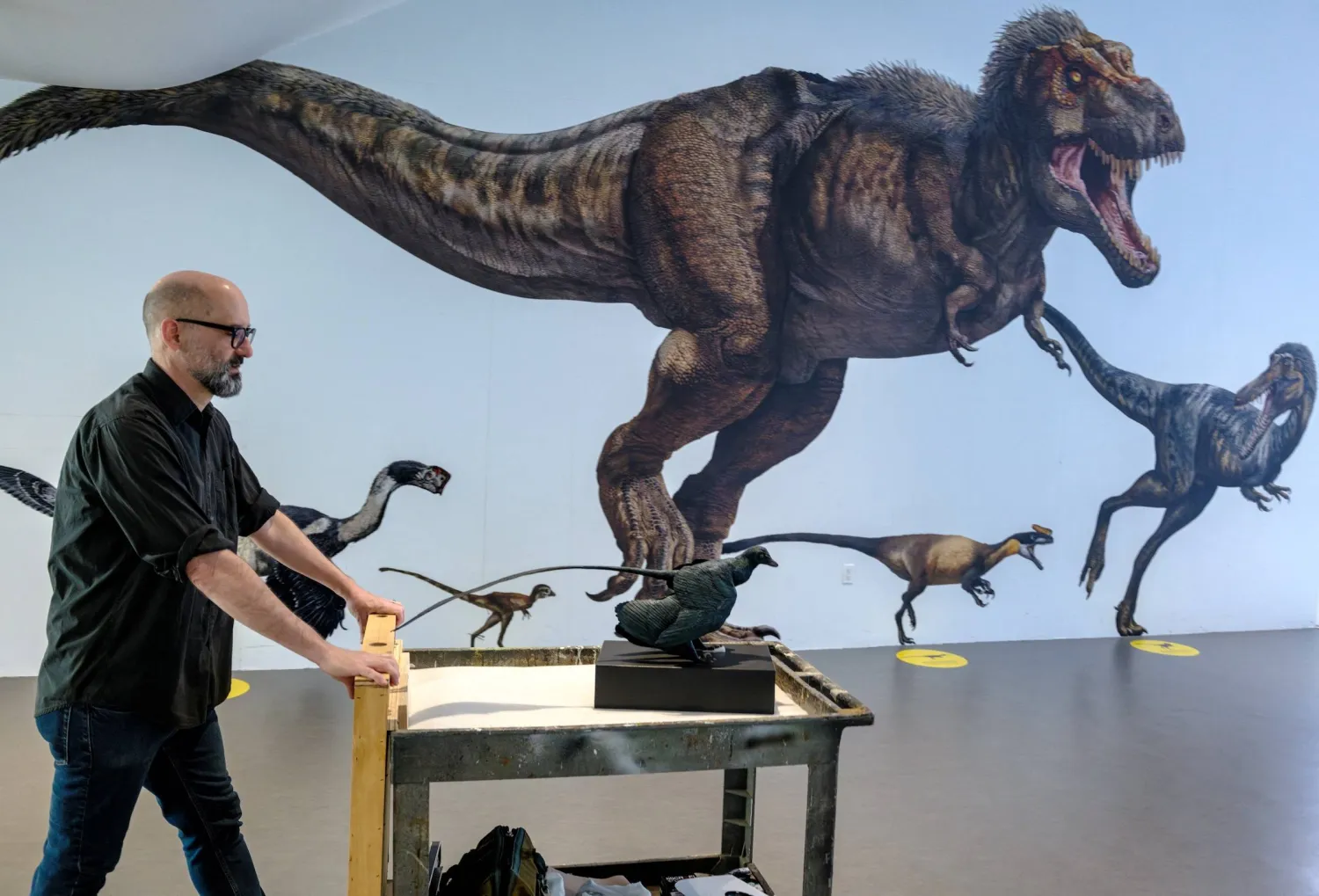
A model of the small dinosaur Microraptor being put on display at the American Museum of Natural History in New York, seen in this photograph released on August 5, 2026. Alvaro Keding/American Museum of Natural History/Handout via REUTERS
TT

Why Were There No Tiny Dinosaurs? You Might Blame the Mammals

A model of the small dinosaur Microraptor being put on display at the American Museum of Natural History in New York, seen in this photograph released on August 5, 2026. Alvaro Keding/American Museum of Natural History/Handout via REUTERS

Everyone knows dinosaurs got really big. Some of the long-necked plant-eaters were the largest land animals ever on Earth, as shown by Argentinosaurus, perhaps 70 to 90 tons and upwards of 100 feet (30 meters) long. But how about tiny dinosaurs, like the size of a mouse? As far as we know, none ever existed.

New research investigates this phenomenon. Scientists employed mathematical models to explore the evolution of body size across vertebrate groups. They determined that energetics and physiology can account for the sizes of mammals, birds that fly and turtles, but these factors fail to explain the absence of really small dinosaurs, aside from their avian descendants.

The researchers see other dynamics at play. They hypothesized that because early mammals — most of them puny shrew-sized critters — had ably filled ecological niches for small animals, their presence prevented dinosaurs from evolving tiny body sizes adapted to such niches.

"We know based on observations of living animals and the fossil record that most animal groups have members that achieve very small body sizes, and that these small animals typically dominate their ⁠ecosystems," said paleontologist ⁠Stephanie Lechki, a postdoctoral fellow at Princeton University in New Jersey and co-leader of the study published in the journal Evolution.

"A small animal typically requires fewer resources and can achieve reproductive maturity and reproduce more quickly than a large-bodied animal," Reuters quoted Lechki as saying.

The smallest dinosaurs included the likes of crow-sized Microraptor, weighing as little as 15 ounces (430 grams); Fruitadens, at 26 ounces (730 grams); and Anchiornis, at 19 ounces (530 grams). These were still much larger than today's smallest bird, the bee hummingbird (about 1.75 grams); smallest mammal, the Etruscan shrew (about 1.8 grams); and smallest lizard, the dwarf gecko (about 0.15 grams).

"Most living species are small, much smaller than us, and smaller than even the smallest dinosaurs," said paleontologist and study co-leader Roger ⁠Benson, curator of dinosaur paleobiology at the American Museum of Natural History in New York.

That includes approximately 90% of extant bird species and 75% of extant mammal species.
"Think of rodents, shrews, bats, songbirds, most lizards, frogs, so many small species. This suggests that there are many more niches available to small-bodied species. The absence of tiny dinosaurs means that all those abundant niches were closed to them," Benson said.

Dinosaurs first appeared roughly 230 million years ago and eventually became the dominant land animals, holding that status until an asteroid struck Earth 66 million years ago, causing a mass extinction of species. Mammals during the age of dinosaurs thrived in ecological niches perfect for small body sizes like insectivores and seed eaters.

"It is likely that small-bodied early mammals outcompeted dinosaurs, preventing them from reaching small body sizes. Similarly, large dinosaurs likely outcompeted early mammals, preventing them from reaching large body sizes," Lechki said.

It was only after the asteroid struck that mammals achieved larger body sizes and expanded into ecological niches previously occupied by dinosaurs like large plant eaters ⁠and apex predators.

Another potential explanation for ⁠the lack of evidence for tiny dinosaurs is that they did exist but their fossils have been elusive. The researchers said this seems improbable because fossil deposits containing dinosaur remains often also preserve the remains of numerous small animals.

MATHEMATICAL MODELS

The mathematical models forecast how evolutionary forces drove body size based on the physiology of an animal's energy uptake from ecosystem resources, and the rate at which the animal converts that to offspring. Evolutionary forces favor body sizes at which the rate of energy invested in offspring is maximum, Benson said.

Dinosaurs defied the models even though birds, which evolved from small feathered dinosaurs and first appeared about 150 million years ago, conformed to the models — though not flightless birds. Snakes and crocodilians also deviated from the mathematical models.

The dinosaurs from which birds evolved were from a lineage called theropods to which giants like Tyrannosaurus rex — which reached roughly 40-1/2 feet (12.3 meters) long and perhaps 8 tons — also belonged. Some flightless birds became sizable. For instance, the elephant birds that inhabited Madagascar until about a millennium ago reached more than half a ton.

"Birds evolved most of their flight adaptations around 130 million years ago and immediately became small," Benson said. "We think that flight might have allowed birds to escape from ecological competition and invade tiny body sizes. This ultimately explains the tremendous biodiversity of living birds, which have more than 12,000 species."



Green Riyadh Launches Tree-Planting and Cleanup Campaign

File photo of the Saudi capital Riyadh - File/AAWSAT
TT

Green Riyadh Launches Tree-Planting and Cleanup Campaign

File photo of the Saudi capital Riyadh - File/AAWSAT

Green Riyadh, one of the programs overseen by the Royal Commission for Riyadh City, has launched a tree-planting and cleanup campaign at Shuaib Umm Qasr to coincide with Saudi National Day celebrations, the Saudi Press Agency said Sunday.

The campaign will be held on September 23 from 1:00 p.m. to 5:00 p.m. and is open to male and female volunteers from all segments of society. Participants will receive volunteer certificates in recognition of their active contributions to environmental service.

The initiative aims to attract volunteers to participate in tree planting and cleanup activities, thereby promoting community engagement and a culture of volunteerism while supporting national efforts to protect the environment and achieve sustainability.


82-year-old Dies after Beach Fight in Greece over Sun Lounger

Tourists from a nearby hotel watch military helicopters fly overhead during Medusa 15, a joint military exercise led by Greece and Egypt, at Maleme on the Greek island of Crete, Friday, Sept. 18, 2026. (AP Photo/Thanassis Stavrakis)
TT

82-year-old Dies after Beach Fight in Greece over Sun Lounger

Tourists from a nearby hotel watch military helicopters fly overhead during Medusa 15, a joint military exercise led by Greece and Egypt, at Maleme on the Greek island of Crete, Friday, Sept. 18, 2026. (AP Photo/Thanassis Stavrakis)

An 82-year-old man died Sunday after he got into a fight over a sun lounger on a beach in Greece near Athens, local media reported.

The octogenarian had a dispute with a 76-year-old man and a 21-year-old woman over the sun lounger, with the argument degenerating into a scuffle between the two men, according to police, the ANA news agency and ERT state television channel reported.

The 82-year-old, badly hurt, was transported to hospital from the Vouliagmeni beach resort area where the argument broke out. He was later declared dead at the hospital, AFP said.

Both the 76-year-old man and the 21-year-old woman were arrested, ANA said, with police investigating what happened.


10 Lions Die in Suspected Poisoning at Tanzania Wildlife Reserve

Lions are seen in their counpound at the Artis Amsterdam Royal Zoo in Amsterdam, Netherlands in this handout photo released to media on January 28, 2021. Artis Amsterdam Royal Zoo/Handout via REUTERS
TT

10 Lions Die in Suspected Poisoning at Tanzania Wildlife Reserve

Lions are seen in their counpound at the Artis Amsterdam Royal Zoo in Amsterdam, Netherlands in this handout photo released to media on January 28, 2021. Artis Amsterdam Royal Zoo/Handout via REUTERS

Ten lions were found dead in Tanzania's Ngorongoro wildlife reserve this week and preliminary findings suggest they may have been poisoned, the area's management authority said.

The deaths raise concerns over the conservation of lions in one of Africa's most renowned wildlife ecosystems. Poisoning has been a recurring threat to large ⁠carnivores across parts ⁠of East Africa, often linked to conflicts between predators and livestock owners.

The lions were discovered on September 18 in the Ndutu area of Endulen Ward in Arusha ⁠region, Reuters quoted the Ngorongoro Conservation Area Authority as saying in a statement released late on Saturday.

"Preliminary findings suggest the animals may have died after ingesting poison," the authority said, adding that it had launched an investigation to determine the cause and identify those responsible.

The Ngorongoro Conservation Area, a UNESCO ⁠World ⁠Heritage Site in northern Tanzania, is one of the country's leading tourism attractions. It is home to a wide range of wildlife, including lions, elephants, buffaloes and endangered black rhinos.

Last month, police arrested four suspects in an investigation into the deaths of 18 elephants across the border in Kenya.