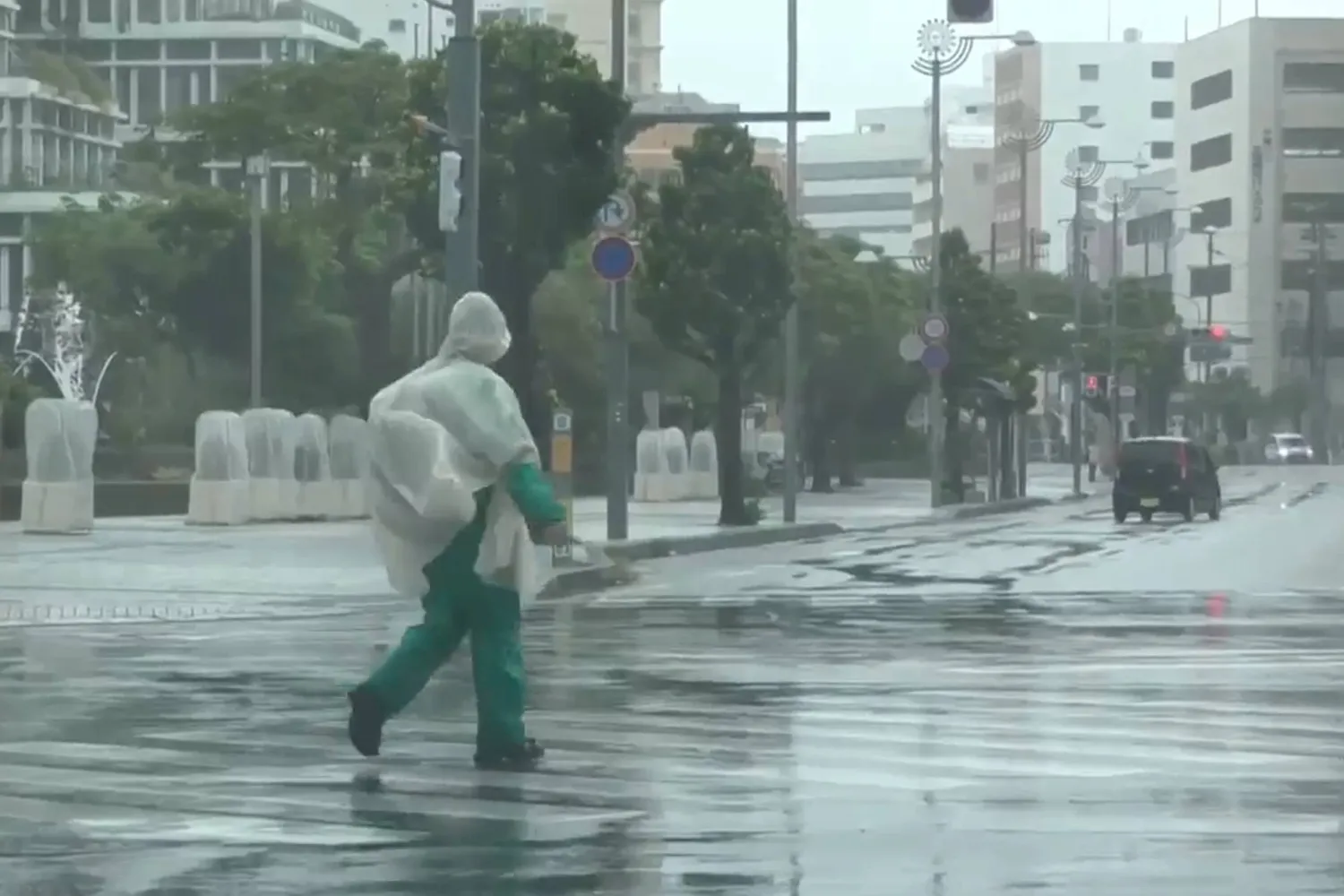
Airport Closes in Okinawa as Typhoon Dolphin Hits Parts of Southern Japan

 In this image made from video provided by NTV-NNN, a person walks in the rain as typhoon Dolphin approaches the city, in Naha, Japan, Friday, Aug. 7, 2026. (NTV-NNN via AP)
In this image made from video provided by NTV-NNN, a person walks in the rain as typhoon Dolphin approaches the city, in Naha, Japan, Friday, Aug. 7, 2026. (NTV-NNN via AP)
TT

Airport Closes in Okinawa as Typhoon Dolphin Hits Parts of Southern Japan

 In this image made from video provided by NTV-NNN, a person walks in the rain as typhoon Dolphin approaches the city, in Naha, Japan, Friday, Aug. 7, 2026. (NTV-NNN via AP)
In this image made from video provided by NTV-NNN, a person walks in the rain as typhoon Dolphin approaches the city, in Naha, Japan, Friday, Aug. 7, 2026. (NTV-NNN via AP)

Typhoon Dolphin moved over Japan's southern remote islands Friday, causing a main airport on Okinawa to close and grounding all flights in and out of the island, while sending hundreds of people to take shelter at evacuation centers.

The typhoon was just north of the main island of Okinawa with maximum winds of 144 kph (89 mph) as of Friday afternoon, according to the Japan Meteorological Agency.

Three men in their 70s were slightly injured — two of them were caught in the wind and a third one fell from a stool, apparently blown off by the wind while preparing for the storm, the Okinawa prefecture said.

The Naha Airport on Okinawa Island said it closed Friday and all domestic and international flights in and out of Naha have been canceled.

As of midday Friday, 240 people had taken shelter at evacuation centers across Okinawa, the prefecture said.

With Dolphin expected to affect part of Japan’s southern main island of Kyushu, residents whose houses were damaged by last week’s deadly earthquake were placing blue tarps on roofs and walls to prevent water damage.

The agency predicted strong winds, heavy rain and high waves in the Okinawa region through Sunday, urging residents in the area to stay indoors.

The storm will weaken over the weekend as it heads toward China’s eastern coast, where it is expected to make landfall Monday morning.


Italy's Catania Airport Reopens as Etna Threat Downgraded

Visitors climb Mount Etna as smoke rises from its volcano in Catania, on the Mediterranean island of Sicily, on September 28, 2026. (Photo by Roman PILIPEY / AFP)
TT

Italy's Catania Airport Reopens as Etna Threat Downgraded

Visitors climb Mount Etna as smoke rises from its volcano in Catania, on the Mediterranean island of Sicily, on September 28, 2026. (Photo by Roman PILIPEY / AFP)

Italy's Catania airport resumed flights on Tuesday after briefly halting operations due to renewed volcanic activity from nearby Mount Etna and adverse weather conditions, in the latest stop-and-go disruption to air traffic.

According to Reuters, Operator SAC said ⁠flights to and ⁠from the airport had resumed with immediate effect after the volcanic alert level was lowered from red to ⁠orange.

The hub had previously suspended operations until 1300 GMT on Tuesday, only hours after ending a three-day shutdown on Monday evening.

The Sicilian airport, Italy's fifth-busiest by passenger traffic, is often disrupted by volcanic ⁠ash ⁠interference from Mount Etna, Europe's highest and most active volcano.

The latest shutdown affected thousands of passengers and placed significant pressure on other Sicilian airports, as airlines diverted flights away from Catania.


Scientists: Rising Seas Threaten Spread of Marine Invaders

An aerial view of fishermen returning from sea at the traditional fishing port in Banda Aceh, Indonesia, 29 September 2026. EPA/HOTLI SIMANJUNTAK
TT

Scientists: Rising Seas Threaten Spread of Marine Invaders

An aerial view of fishermen returning from sea at the traditional fishing port in Banda Aceh, Indonesia, 29 September 2026. EPA/HOTLI SIMANJUNTAK

Sea-level rise driven by climate change could help invasive marine species spread into newly flooded coastal areas, threatening biodiversity and some economic activities, researchers warned in a study published Monday.

The findings in Nature Ecology & Evolution highlight the links between the climate and biodiversity crises, with global warming altering ecosystems and creating new opportunities for non-native species to thrive.

That could "potentially expose ecosystems and human activities that have not previously been affected by these species," said study co-author Xuan Liu of Beijing Normal University.

The researchers modelled the potential future spread of 122 established non-native marine animals, including fish, crustaceans, molluscs and sea stars, under different climate and sea-level scenarios.

Climate change causes sea levels to rise through thermal expansion -- ocean water increases in volume as it warms -- and the melting of glaciers and ice sheets.

Global sea levels are projected to rise by about 20 centimeters (eight inches) by 2050 and 56 cm by 2100 under a scenario of moderate growth in greenhouse gas emissions.

That would see around 360,000 square kilometers (139,000 square miles) of coastal land flooded by mid-century, rising to 550,000 square kilometers by the end of the century.

More than two-thirds of the newly flooded coastal land -- roughly 290,000 to 470,000 square kilometers -- could become suitable for the marine non-native animals studied, particularly around estuaries at mid-latitudes, AFP quoted the authors as saying.

The risk is concentrated in regions including the eastern United States, Gulf of Mexico, North Sea, Gulf of Guinea, Arabian Gulf, northern Bay of Bengal, southeastern China and northern Australia.

Several species examined are already established in Europe, including the Pacific oyster, Atlantic blue crab and the veined rapa whelk, a predatory sea snail.

"Estuaries are particularly at risk because they are directly connected to the ocean and are also major hubs of human activity," Liu said.

Such areas could provide stepping stones for marine invaders moving further inland as the sea advances, the study said.

The findings come as governments prepare for two UN-backed international summits on the twin biodiversity and climate crises: COP17 in October and COP31 in November.

A global assessment by the UN's expert scientific panel on biodiversity, IPBES, estimated that economic costs from biological invasions exceeded $423 billion in 2019.


Cape Town Divided Over Plan to Remove its Monkeys

The baboons’ presence has affected house prices on the Cape Peninsula, as they raid bins and kitchens and poo on properties. (Nic Bothma/Reuters)
TT

Cape Town Divided Over Plan to Remove its Monkeys

The baboons’ presence has affected house prices on the Cape Peninsula, as they raid bins and kitchens and poo on properties. (Nic Bothma/Reuters)

At the edge of Da Gama Park, where suburb meets the mountain, Cape Town’s baboons have caused conflict, with a furious debate raging over whether the monkeys can coexist with humans or whether they should be kept away.

On Monday, Cape Town’s city council has said it will “imminently” round up two baboon troops coming into repeated conflict with residents. The animals will be sterilized and permanently moved to a newly constructed sanctuary.

The plan has been fiercely criticized by animal rights activists, who say the monkeys should remain roaming freely, and that less destructive options have not been properly considered, according to The Guardian.

Cape Town’s baboon problem has been brewing since the 2000s, after the city stopped culling troops in the late 1990s after pressure from the public. But in the past two years it has reached boiling point.

A 2025 census found that the population had grown by a third since 2000, from 360 baboons to 493, now living in 12 managed troops.

As a result of the population boom, troops of chacma baboons on the city’s peninsula regularly rip off roof sheeting, sneak into unlocked cars and raid food pantries.

Some monkeys are now staying up late into the night to break into homes in Simon’s Town and nab snacks from convenience stores. Residents can no longer barbecue or host garden parties for fear of the marauding baboons.

“It’s depreciated property values because it’s hard to sell a house when it’s covered in baboon feces and paw prints, and you know they’re coming every day,” said Justin O’Riain, a behavioral ecologist at the University of Cape Town who has long studied the local baboons.

Cape Town’s geography is partially to blame. Much of the problem is confined to the Cape Peninsula, a narrow sliver of land stretching from the city center to Cape Point.

Here, baboons are boxed in between the steep, protected area of Table Mountain national park and the sprawling urban development that stretches to the Atlantic Ocean.

“The underlying issue is that baboons will seek low-lying land. That is their natural drive – it’s better access to water and more productive vegetation,” said Joselyn Mormile, who leads the Cape Baboon Partnership (CBP), a nonprofit organization that works with the city and local conservation authorities to manage the baboons.

“But throughout the peninsula, we’ve developed most of those places. It’s a constant battle between the two,” she noted.