


Astronomers Watch the Whole Process as Huge Star Dies

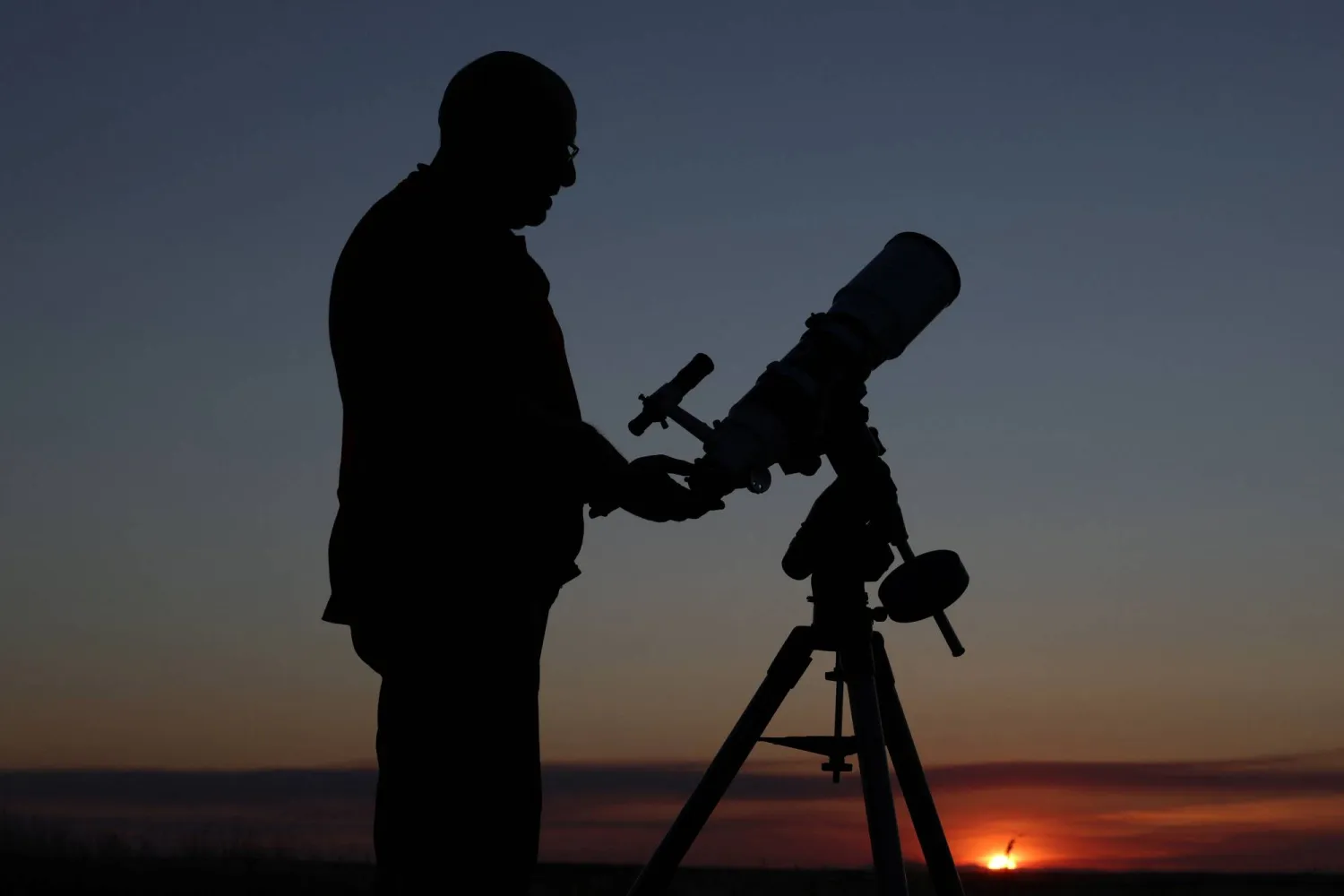
Retired shepherd and self-taught astronomer Joaquin Tapioles disassembles one of his telescopes outside the farming village of San Agustin del Pozo, Spain, July 22, 2026. REUTERS/Violeta Santos Moura
TT

Astronomers Watch the Whole Process as Huge Star Dies

Retired shepherd and self-taught astronomer Joaquin Tapioles disassembles one of his telescopes outside the farming village of San Agustin del Pozo, Spain, July 22, 2026. REUTERS/Violeta Santos Moura

Astronomers have taken the rare opportunity to observe the explosive death of an enormous star from start to finish, gaining a new understanding of how this kind of violent event can transpire in more ways than previously known.

The observations began in March when China's Einstein Probe space telescope detected a momentary flare of X-rays caused when a powerful shock wave triggered by the explosion in the collapsing stellar core tore through the doomed star's surface.

This is called a shock breakout. It is thought to occur in every supernova but is notoriously hard to spot because of how brief it is. In fact, this one was the first since 2008 to be observed.

"It requires serendipity to catch it in real time," said astronomer Brendan O'Connor, a postdoctoral fellow at Carnegie Mellon University in Pittsburgh and lead author of one of two scientific papers describing the supernova published in the Astrophysical Journal Letters.

"You can think of the shock like radar — as the shock plows through the star's outer layers and any material in the vicinity, it leaves an imprint on the signal that we detect ⁠in X-rays. We can ⁠use these X-rays to give us an unprecedented, close-up view of the star at the brink of collapse," said astronomer Jillian Rastinejad, a NASA Einstein Fellow at the University of Maryland and lead author of the other study.

Researchers quickly marshaled a battalion of telescopes, including the orbiting Chandra X-ray Observatory and a host of ground-based facilities, to continue the observations for almost three months until the supernova's location passed behind our sun, from the perspective of Earth.

The star was located roughly 500 million light-years from Earth in a relatively nearby galaxy. A light-year is the distance light travels in a year, 5.9 trillion miles (9.5 trillion km).

The star was estimated to be around 30 times more ⁠massive than the sun, prior to the supernova, Reuters reported.

"This would be among the most massive stars, probably larger than Betelgeuse," Rastinejad said, referring to one of the brightest stars in the night sky, a stellar behemoth believed to be nearing a supernova death, located in the Milky Way about 500 to 600 light-years from Earth.

The blast is thought to have left behind a black hole, an exceptionally dense object with gravity so strong not even light can escape. Before the explosion, this was a Wolf-Rayet star, a rare and gigantic kind that had shed its outer layers of hydrogen and helium through powerful stellar winds.

The star's explosion was classified as a "broad-lined Type Ic" supernova, involving a star with stripped outer layers and with the material ejected by the blast moving at an extreme velocity — in this case a bit more than 10% of the speed of light.

The supernova displayed many characteristics of powerful stellar explosions often associated with a phenomenon called a gamma-ray burst — an intense flash of gamma-ray radiation, the highest-energy form of light — but ⁠in this case there was ⁠no evidence of one.

"One of the central unanswered questions in the field is why some collapsing massive stars launch jets of material near the speed of light that escape the star and produce gamma-ray bursts, while apparently similar stars do not," O'Connor said.

"The fast-moving matter in the jet collides with itself in discrete shocks to produce the gamma-rays we see in gamma-ray bursts," O'Connor said.

One possibility is that this jet was "choked" — prevented from surging into space — either by the surface of the star or by dense material that had surrounded the star in the final stages of its life.

"The existence of choked jets was theorized decades ago, but yet to be conclusively identified. The difference between a successful and choked jet is whether the jet is moving fast enough, or is powerful enough, to break out of the surrounding stellar material," O'Connor said.

This represented the first supernova of its type observed without a gamma-ray burst and jet of material.

"The finding shows that the most massive stars die in more ways than astronomers previously thought," Rastinejad said.

"These extreme supernovae are laboratories for astrophysicists to study how the laws of physics behave in extreme environments — think high densities, high temperatures, material that is several times the mass of our sun — that we can't recreate here on Earth. By studying them, we learn more about the laws of our universe," Rastinejad said.



Climate Change Hits Trout and Salmon in UK’s Prized Chalk Streams

This photo taken on August 25, 2026 shows Bob Wellard, director of the Piscatorials Society, fly-fishing in the Candover Brook, a chalk stream tributary of the River Itchen, near Winchester, Hampshire, southern England. (AFP)
TT

Climate Change Hits Trout and Salmon in UK’s Prized Chalk Streams

This photo taken on August 25, 2026 shows Bob Wellard, director of the Piscatorials Society, fly-fishing in the Candover Brook, a chalk stream tributary of the River Itchen, near Winchester, Hampshire, southern England. (AFP)

A fly fisherman cast his line into the crystal-clear waters of the Itchen, a chalk stream in Hampshire in southern England, home to salmon and trout hit by climate change.

A summer of record-breaking temperatures and drought is threatening the ecological balance of rare chalk streams -- rivers formed on chalk beds that are largely unique to England -- and the fish that depend on them.

Wading through a branch of the Itchen near Winchester, Robert Wellard, director of fisheries at the Piscatorial Society and a recreational angler, dipped a thermometer into the clear water, drawing a reading of 17C.

"We should be more around 12 or 13 degrees" in August, said Kathryn Boler, manager of the Freshwater Programme for the Hampshire and Isle of Wight Wildlife Trust.

Chalk streams, which are fed naturally by underground springs filtered through porous chalk bedrock, are known for their clear, cool and mineral-rich waters where fish such as brown trout and salmon thrive.

Out of 200 rivers of this type recorded in the world, 85 percent are found in England, according to the Wildlife Trust, which looks after the UK's nature reserves.

These unique habitats have been at the forefront of climate change for years, with this summer's successive heatwaves and bone-dry conditions warming the water, depleting groundwater reserves and reducing river flows.

"This year it's been unique in the sense that we have had them (heatwaves) pretty much back-to-back. And so that puts a huge amount of stress on the natural environment," said Wellard.

During heatwaves, "we've seen water temperatures... creeping up well above their normal temperature range," said Wellard, noting that water temperatures this summer reached levels which start affecting wild fish.

Several angling clubs -- which primarily practice catch-and-release fishing -- have temporarily limited activity to reduce the stress on the fish.

- 'Trapped' -

In water temperatures above 19C, salmon and trout experience "extra stress on their bodies", said Boler, as it reduces the oxygen available in the water and increases the physiological needs of fish.

The Itchen chalked up a high of 21.7C in July, according to figures by the Environment Agency (EA), an arm's-length government body which deals with environmental protection in England.

Falling river flows in drought conditions also expose the fish to predators.

For Atlantic salmon, which come to chalk streams to spawn and are already classified as endangered, the situation is particularly concerning.

"With the lower flow, salmon are effectively more trapped, and more susceptible to predation from things like harbor seals and cormorants," explained Paul Vignaux, who heads a local association for landowners and anglers in the Itchen.

In 2022, only 180 salmon came to spawn in the Itchen. Preliminary figures for last year counted 250 individuals -- 32 percent of the threshold considered necessary for the species' conservation, Vignaux noted.

This summer was also difficult for young freshwater salmon, the Environment Agency said in its July salmon count of the Itchen and another nearby chalk stream the Test, with their "abundance and size ... far lower than usual".

According to an EA model, the average temperature of rivers where brown trout live in England is expected to exceed the tolerable limit "at most sites by 2070".

The critical threshold for salmon is expected to be exceeded in half of their habitats by 2080.

Scientists say that climate change is increasing the frequency and intensity of heatwaves, drought and other extreme weather conditions.

Combined with river pollution, chalk streams are facing the perfect storm as declining water flows also cause pollutants to become more concentrated.

In July, wastewater treatment company Southern Water admitted discharging pollutants in 2023 into the Test.

Scientists, environmentalists and anglers are calling for agencies to restore rivers to a more natural state, reduce water extraction and plant trees to improve shade.

"It's really essential that as much water as possible stays in the rivers," said Boler.


Riyadh Launches ‘Digital District’ to Bolster Status as Global Hub for Talent, Innovation

The initiative aims to strengthen Riyadh’s position as a global hub for technology talent and digital creativity. (SPA)
TT

Riyadh Launches ‘Digital District’ to Bolster Status as Global Hub for Talent, Innovation

The initiative aims to strengthen Riyadh’s position as a global hub for technology talent and digital creativity. (SPA)

The Royal Commission for Riyadh City (RCRC) announced Thursday the launch of the “Riyadh Digital District,” a strategic initiative designed to attract global technology talent, foster entrepreneurship and build a knowledge-based economy driven by digital leadership and technological innovation.

The initiative aims to strengthen Riyadh’s position as a global hub for technology talent and digital creativity and place it among the world’s top 10 technology districts, in line with Saudi Vision 2030.

Ibrahim bin Muhammad Al-Sultan, Minister of State, Cabinet member and CEO of the RCRC, said the initiative would help establish Riyadh as a global destination for technology companies, talent and digital entrepreneurship.

Al-Sultan expressed his gratitude to Custodian of the Two Holy Mosques King Salman bin Abdulaziz and Prince Mohammed bin Salman, Crown Prince and Prime Minister, for their support of the commission’s projects.

“This step reflects the leadership’s commitment to advancing the capital toward global leadership in promising future sectors,” he said, adding that it supports Vision 2030 goals of building a diversified and prosperous economy based on digital leadership and technological innovation.

The district will focus on attracting companies and specialized talent in six key fields: Artificial Intelligence and Big Data, Cybersecurity, Computing and Cloud Services, the Internet of Things (IoT), Blockchain Technologies, and Robotics and Unmanned Aerial Systems. These sectors account for the majority of global investments in technology innovation companies, highlighting their pivotal role in driving future growth and technological advancement.

Overseen by the RCRC, the Digital District is conceived as an integrated digital business ecosystem within Riyadh, bringing together technology companies, talent and investment.

It will provide a supportive technical and regulatory environment for global and regional technology companies and startups seeking to establish operations in Riyadh and expand across the Middle East and North Africa.

Companies will have access to dedicated spaces near technology firms and communities, as well as opportunities to collaborate with government agencies and the private sector.

The initiative also seeks to develop digital skills, attract investment and create sustainable jobs by helping companies build technology teams and expand their Riyadh operations.

Regular meetings and open events will bring together founders, engineers, researchers and investors to foster an active technology community.


Riyadh Hosts UNESCO Global Forum on AI Ethics with Participation from 194 Countries

Riyadh Hosts UNESCO Global Forum on AI Ethics with Participation from 194 Countries
TT

Riyadh Hosts UNESCO Global Forum on AI Ethics with Participation from 194 Countries

Riyadh Hosts UNESCO Global Forum on AI Ethics with Participation from 194 Countries

Riyadh will host the fourth edition of the UNESCO Global Forum on the Ethics of Artificial Intelligence (GFEAI 2026) from September 14 to 17, bringing together a broad international community representing 194 countries. The forum will convene decision-makers, experts, academics, and representatives of international organizations, as well as public- and private-sector leaders from around the world.

GFEAI 2026 is organized by the Saudi Data and AI Authority (SDAIA) in partnership with UNESCO, and in cooperation with the International Center for AI Research and Ethics (ICAIRE), the Saudi Press Agency said on Friday.

GFEAI is one of the international platforms focused on AI ethics. The 2026 edition aims to strengthen global dialogue on responsible AI governance, facilitate the exchange of expertise and best practices, and explore ways to harness AI technologies to support sustainable development and promote societal prosperity.

Over four days, GFEAI 2026 is set to address key topics including AI ethics and governance, capacity building, responsible innovation and international policies, through high-level sessions and specialized workshops, bringing together experts and policymakers from around the world.

The Kingdom of Saudi Arabia’s hosting of GFEAI 2026 reflects its continued efforts to support the principles of AI ethics and strengthen AI governance at both the national and international levels, support multilateral cooperation in developing frameworks for the responsible and trustworthy use of emerging technologies, align with the objectives of Saudi Vision 2030, and strengthen the Kingdom’s contribution to shaping the future of AI globally.