

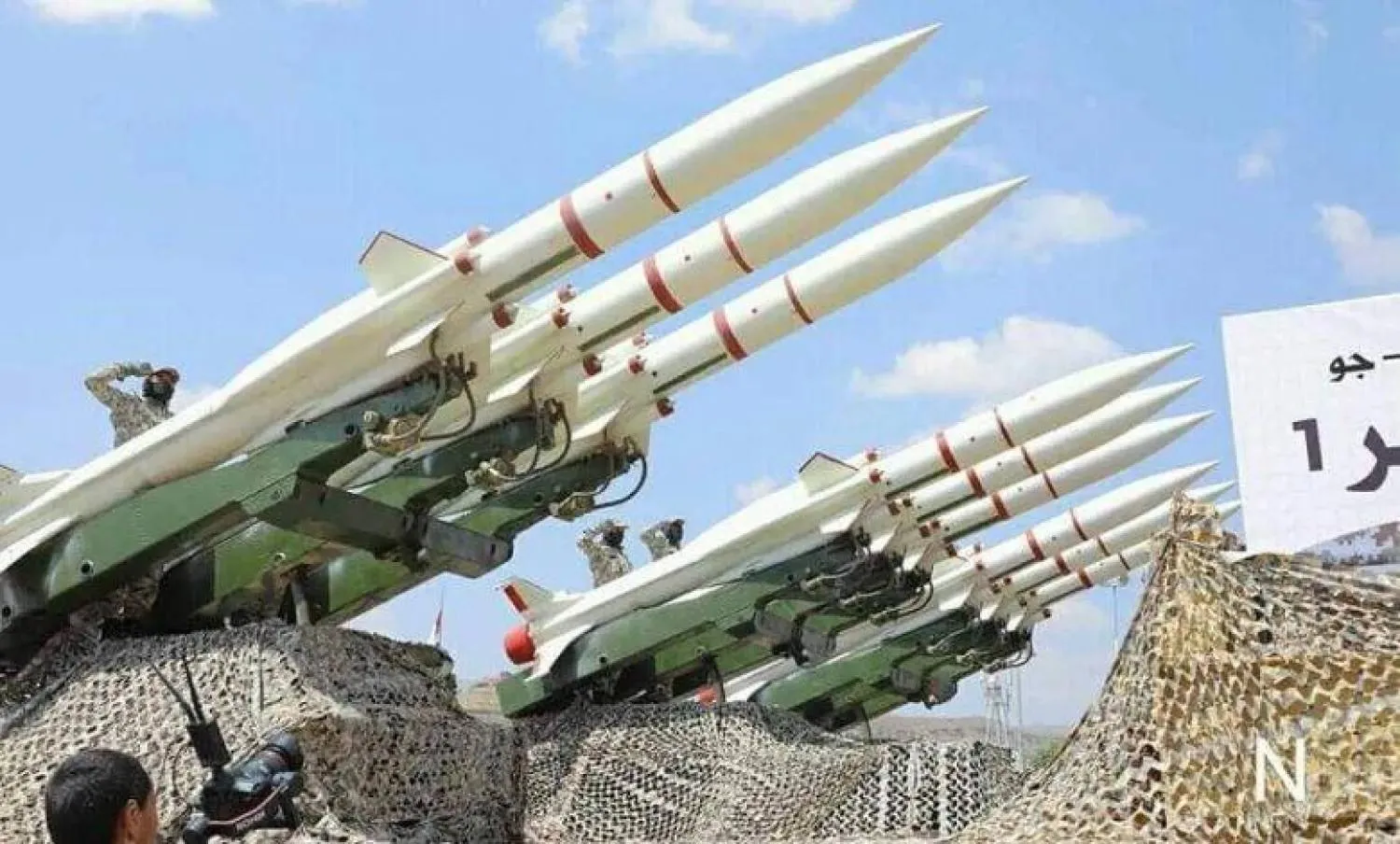

Houthis Step Up Missile, Drone Attacks on Yemen's Marib

Houthi missiles that the Yemeni government says are smuggled to the group by Iran. (Houthi media)
TT

Houthis Step Up Missile, Drone Attacks on Yemen's Marib

Houthi missiles that the Yemeni government says are smuggled to the group by Iran. (Houthi media)

The Iran-backed Houthi group in Yemen intensified attacks on government forces in the Marib province, east of Sanaa, on Friday, a day after launching a major ballistic missile and drone assault on military positions in Marib and Hadramawt.

The renewed hostilities, among the most serious in Yemen in years, have raised fears that the relative calm in place since the 2022 truce could unravel, while fueling public and political calls for a broader military response against the group.

Residents said missiles and drones struck government positions in Marib on Friday, with successive explosions heard around the city and near camps for displaced people. Plumes of smoke were seen rising from the area as strikes also targeted Harib district.

Field sources cited deaths and injuries, including among displaced people. State-run Saba TV said government air defenses intercepted several explosive-laden drones launched by the Houthis over Marib. The group also targeted the city with missiles and drones, according to the channel, which noted that Marib hosts Yemen’s largest concentration of displaced people.

Friday’s violence followed a large-scale Houthi assault Thursday on Yemeni armed forces camps and units in Marib and Hadramawt, described by Yemeni sources as the most serious flare-up since the 2022 truce largely halted major ground operations.

According to Yemen’s Defense Ministry, the assault began at 10:40 a.m. Thursday and involved ballistic missiles and drones targeting several military camps and units across the two provinces.

The targeted positions housed troops tasked with securing government-held areas and international roads and countering Houthi operations and smuggling networks. The assault left several military personnel dead or wounded.

The ministry vowed that government troops would respond “at the appropriate time and place,” stressing that the strikes would not undermine their ability to carry out their duties or continue the battle to defend the republic and restore the state.

Field sources put the toll at dozens of soldiers killed or wounded in strikes on Emergency Forces and Homeland Shield positions in the two provinces, while the Defense Ministry confirmed 17 military fatalities.

The violence came as the ministry was conducting security and military operations in government-held provinces, particularly Hadramawt and Al-Mahra, targeting smuggling gangs and criminal cells following a series of assassinations of military personnel.

Authorities described the campaign as an effort to strengthen the state’s presence, secure roads and protect residents. The Emergency Forces media center linked the Houthi assault to recent government successes in pursuing wanted suspects and dismantling smuggling networks.

Al-Alimi orders response

Following Thursday’s attacks, an official in the office of Presidential Leadership Council Chairman Dr. Rashad al-Alimi said he was closely monitoring developments and had held a series of calls with council members and governors Sultan al-Arada of Marib and Salem al-Khanbashi of Hadramawt, as well as military and security commanders in both provinces.

Al-Alimi instructed government, military, security and health authorities to mobilize resources to care for the wounded, honor those killed and support their families. He also stressed the need to respond to the source of the threat.

The attacks have fueled growing anger among Yemenis and calls for tougher military action rather than treating individual Houthi strikes as isolated incidents.

Supporters of that approach argue that repeated missile and drone attacks, alongside government military and security operations, warrant a more comprehensive response.

Marib under threat

Marib holds particular military, economic and humanitarian importance and is home to large numbers of displaced Yemenis. Missile and drone strikes on the city have heightened concerns for civilians, particularly if they become more frequent or expand in scope.

The province was one of the main battlegrounds between government troops and the Houthis during the war before large-scale ground fighting subsided following the 2022 truce.

Renewed strikes on government positions have raised questions over whether the Houthis will limit their campaign to long-range attacks or move toward broader ground operations.

The Yemeni government views the latest hostilities as part of wider Houthi military activity extending beyond domestic front lines, particularly amid continued attacks on commercial shipping in the Red Sea and the resulting threat to international maritime routes.

It says that simultaneous military activity inside Yemen and attacks at sea reflect the Houthis’ continued use of armed force to advance their agenda as political efforts to preserve the country’s fragile calm face mounting challenges.



Syrian Authorities Say Killed Assad-Era Officer After Clash

A member of Syria's internal security forces in Tartus city. (SANA)
TT

Syrian Authorities Say Killed Assad-Era Officer After Clash

A member of Syria's internal security forces in Tartus city. (SANA)

Syrian security forces said on Sunday that they killed an army commander who served under ousted ruler Bashar al-Assad, after he opened fire on them as they tried to arrest him.

In a statement, the forces accused Firas Abdul Karim Hammoud of having taken part in anti-government insurrections that killed security personnel.

Since Assad's fall in December 2024, Syria's new authorities have arrested dozens of security officials from his rule, and trials began in April.

The security forces said they "neutralized Firas Abdul Karim Hammoud... following an armed clash and a raid on his hideout in the town of Safita" in Tartus province in the coastal Alawite heartland.

Hammoud had previously "opened fire on security personnel during an attempt to arrest him", they added.

"During the recent operation, he again opened fire and initiated a firefight with the security forces... necessitating their response."

They said Hammoud served as a commander of the special forces in the so-called "25th Division" under Assad's rule.

They accused him of working under Assad-era general Ghiath Dalla in leading pro-Assad groups on the coast after the former president's fall.

They added that he was involved in "armed insurrection operations" against state institutions that killed security personnel.

Dalla, a former officer in the much-feared Fourth Brigade, had announced on social media last year the formation of a "military council for the liberation of Syria".

The announcement came shortly before deadly violence targeting the Alawite minority, to which Assad's family belongs, erupted on the Syrian coast in March 2025.

Authorities accused armed Assad supporters of sparking the violence by attacking security forces in an ambush.


Iraq Sentences US-Sanctioned Oil Official to Prison

The sun sets behind apartment buildings in Baghdad, Iraq, Friday, Aug. 28, 2026. (AP)
TT

Iraq Sentences US-Sanctioned Oil Official to Prison

The sun sets behind apartment buildings in Baghdad, Iraq, Friday, Aug. 28, 2026. (AP)

Iraq sentenced a US-sanctioned oil official to seven years in prison after he was arrested as part of a government-led anti-corruption campaign, the country's anti-graft body said on Sunday.

Deputy oil minister for distribution affairs Ali al-Bahadli is among dozens of officials who were detained in June during anti-graft raids that took place in several areas, mostly in Baghdad's fortified Green Zone.

The Commission of Integrity said in a statement that an anti-corruption court sentenced Bahadli to seven years in prison for "illicit gains".

The ruling requires Bahadli to return to the state an amount equivalent to more than $20 million in ill-gotten gains, in addition to paying a fine of the same amount.

The United States imposed sanctions on Bahadli in May, accusing him of fraudulently mixing Iraqi and Iranian oil as part of a scheme to help Iran avoid sanctions.

At the time, Iraq's oil ministry denied the accusations against Bahadli, who was then arrested during the anti-graft raids.

Iraqi authorities said that the raids were part of new Prime Minister Ali al-Zaidi's campaign to fight the corruption that has plagued Iraq for decades.

But several Iraqi officials told AFP that the raids were also part of al-Zaidi's campaign against funding for pro-Iran armed groups and the smuggling of Iranian oil.

Iraq has been under mounting pressure from the United States to curb Tehran's influence and rein in Iran-backed armed factions, which Washington designates as terrorist groups.

Al-Zaidi, who took office this year with the blessing of the United States, has pledged to ensure the armed factions that emerged after the US-led invasion hand over their weapons to the state.

In Iraq, corruption is especially rampant across public institutions, but convictions typically target mid-level officials or minor players and rarely those at the top of the power hierarchy.


US News Agency Says Crew Attacked by Israeli Settlers in West Bank

 Israeli settlers look out through a metal fence, as an Israeli flag flutters nearby, on the day of their weekly tour in Hebron, in the Israeli-occupied West Bank, August 29, 2026. (Reuters)
Israeli settlers look out through a metal fence, as an Israeli flag flutters nearby, on the day of their weekly tour in Hebron, in the Israeli-occupied West Bank, August 29, 2026. (Reuters)
TT

US News Agency Says Crew Attacked by Israeli Settlers in West Bank

 Israeli settlers look out through a metal fence, as an Israeli flag flutters nearby, on the day of their weekly tour in Hebron, in the Israeli-occupied West Bank, August 29, 2026. (Reuters)
Israeli settlers look out through a metal fence, as an Israeli flag flutters nearby, on the day of their weekly tour in Hebron, in the Israeli-occupied West Bank, August 29, 2026. (Reuters)

Israeli settlers attacked an NBC crew in the central West Bank Saturday, as they were interviewing a Palestinian woman who said she’d been driven out of her house by settlers, the network said.

NBC’s American correspondent Matt Bradley, two other crew members and the woman they were interviewing were all treated for injuries sustained during the attack, NBC said. There were no further details on their injuries.

The assault was caught on video and shared by NBC, with footage showing masked settlers approaching the crew with sticks and beating the crew’s vehicles.

Israel’s military said it was “aware of reports of Palestinian injuries, including a Palestinian woman who sustained non-life-threatening injuries and was evacuated by the Red Crescent for medical treatment.” It did not comment on the attack on the NBC crew.

It was the latest in a growing wave of violence by West Bank settlers. Prime Minister Benjamin Netanyahu issued a rare condemnation of the violence on Saturday. The Israeli leader has come under heavy US criticism for the settler attacks.

Settlers seized British activist and held him locked in shed

Israeli settlers seized a British activist from a Palestinian village in the West Bank and locked him in a shed before turning him over to police, his lawyer said Sunday.

The lawyer, Inbar Shaked Vardi, said settlers held her client, Finn Joughin, for half an hour Saturday before turning him over to Israeli police. Joughin was set to appear before a Jerusalem court later Sunday, she said.

Video showed two settlers, one armed, restraining Joughin and marching him away from the village.

It was not immediately clear what led to his capture. Settlers say he assaulted a child, accusations Vardi vehemently denied.

Settlers point to a video where the activist uses his body in an apparent attempt to block a settler boy from passing through a fence. Vardi said the video shows he was trying to protect the village.

Police said they were investigating and holding Joughin in custody on suspicion of committing an indecent act against a minor.