Saudi Arabia Leads Nuclear Science Olympiad, Wins 'Nuclear Science Ambassador' Title
Abdulaziz Al-Karidis crowns Saudi student Amjad Al-Darwish with first place in the International Nuclear Science Olympiad (SPA)
Saudi Arabia has secured first place at the third edition of the International Nuclear Science Olympiad (INSO 2026) held in Jeddah and received the title of "Nuclear Science Ambassador.”
The Kingdom also secured four international awards comprising two gold medals, one silver, and one bronze.
Saudi student Amjad Al-Darwish won the overall competition and a gold medal, earning the title of “Nuclear Science Ambassador” after recording the highest combined score in the theoretical and practical examinations.
Fellow Saudi student Jana Al-Sabil also won a gold medal and was named the Olympiad’s Best Female Student, an award presented by the International Atomic Energy Agency.
Saudi Arabia’s Abdulaziz Al-Sharait won the silver medal, while Saleh Al-Harbi secured bronze.
Saudi winning students in the Olympiad: Amjad Al-Darwish, Jana Al-Sabil, Abdulaziz Al-Sharait, and Saleh Al-Harbi (Mawhiba)
The achievement reinforces Saudi Arabia's growing presence in international scientific competitions and highlights the excellence of its students in advanced science and technology.
Secretary-General of the King Abdulaziz and His Companions Foundation for Giftedness and Creativity (Mawhiba) Abdulaziz Al-Karidis affirmed that the achievement reflects the support and care provided by the Saudi leadership to the Saudis, and its commitment to investing in citizens, developing their capabilities, and enabling them to compete globally in priority scientific fields.
He noted that these efforts contribute to building a knowledge-based and innovation-driven economy.
Al-Karidis added that Saudi Arabia's success in hosting INSO 2026, alongside its students' outstanding results, reflects the continued development of the national talent and creativity ecosystem, the effectiveness of programs for preparing scientific teams, and Saudi Arabia's organizational capabilities in hosting major international scientific events to the highest standards.
Saudi Arabia hosted the third edition of the olympiad in Jeddah from August 2 to 9, marking the first time the event has been held in the Middle East, with the participation of 120 students and scientific experts representing 19 countries.
The event was jointly organized by the Ministry of Education, Mawhiba, and King Abdullah City for Atomic and Renewable Energy (KACARE), and hosted by King Abdulaziz University under the slogan "Bright Minds, Promising Future."
Study: Global Deforestation Slowed in 2025 but Surged in Congo Basinhttps://english.aawsat.com/varieties/5329389-study-global-deforestation-slowed-2025-surged-congo-basin
Deforestation from illegal mining borders the Malinowski River in the Tambopata National Reserve in Puerto Maldonado, Peru, Tuesday, Aug. 11, 2026. (AP Photo/Guadalupe Pardo)
Study: Global Deforestation Slowed in 2025 but Surged in Congo Basin
Deforestation from illegal mining borders the Malinowski River in the Tambopata National Reserve in Puerto Maldonado, Peru, Tuesday, Aug. 11, 2026. (AP Photo/Guadalupe Pardo)
Deforestation slowed worldwide last year, but the improvement is unlikely to last as the situation deteriorates in Central Africa and an exceptionally strong El Nino weather pattern intensifies, a new study said on Wednesday.
Seven million hectares of forest -- roughly the size of the Republic of Ireland -- were permanently destroyed in 2025, a 15-percent drop from the previous year, according to the annual Forest Declaration Assessment.
The slowdown, however, is not enough to keep the world from missing a pledge to end deforestation by 2030, according to the report, which was drafted by a coalition of research groups and non-governmental organizations.
The 2025 figure is "encouraging but so far it's the exception, not a new trajectory", Erin Matson, the study's co-author and lead consultant at advisory group Climate Focus, said in a media briefing.
To meet the target, agreed at the United Nations' COP26 climate talks in 2021, deforestation would have to fall by around one million hectares per year.
Clearing forests for agriculture or mining operations remains the leading drivers of deforestation.
Last year's improvement was due in part to progress in Latin America, with a 33-percent drop in what has historically been the world's deforestation "hot spot", according to the study.
The authors pointed particularly to Brazil's deforestation action plan and increased enforcement in the country's Amazon, AFP reported.
Progress in the region, however, "rests heavily on the choices of a small number of governments and remains highly vulnerable" to recent and upcoming elections across the Amazon basin.
Brazil's left-wing leader, Luiz Inacio Lula da Silva -- who has vowed to end illegal deforestation by 2030 -- faces populist right Senator Flavio Bolsonaro in a runoff presidential election on October 25.
Deforestation had surged under the administration of Bolsonaro's father, far-right former president Jair Bolsonaro.
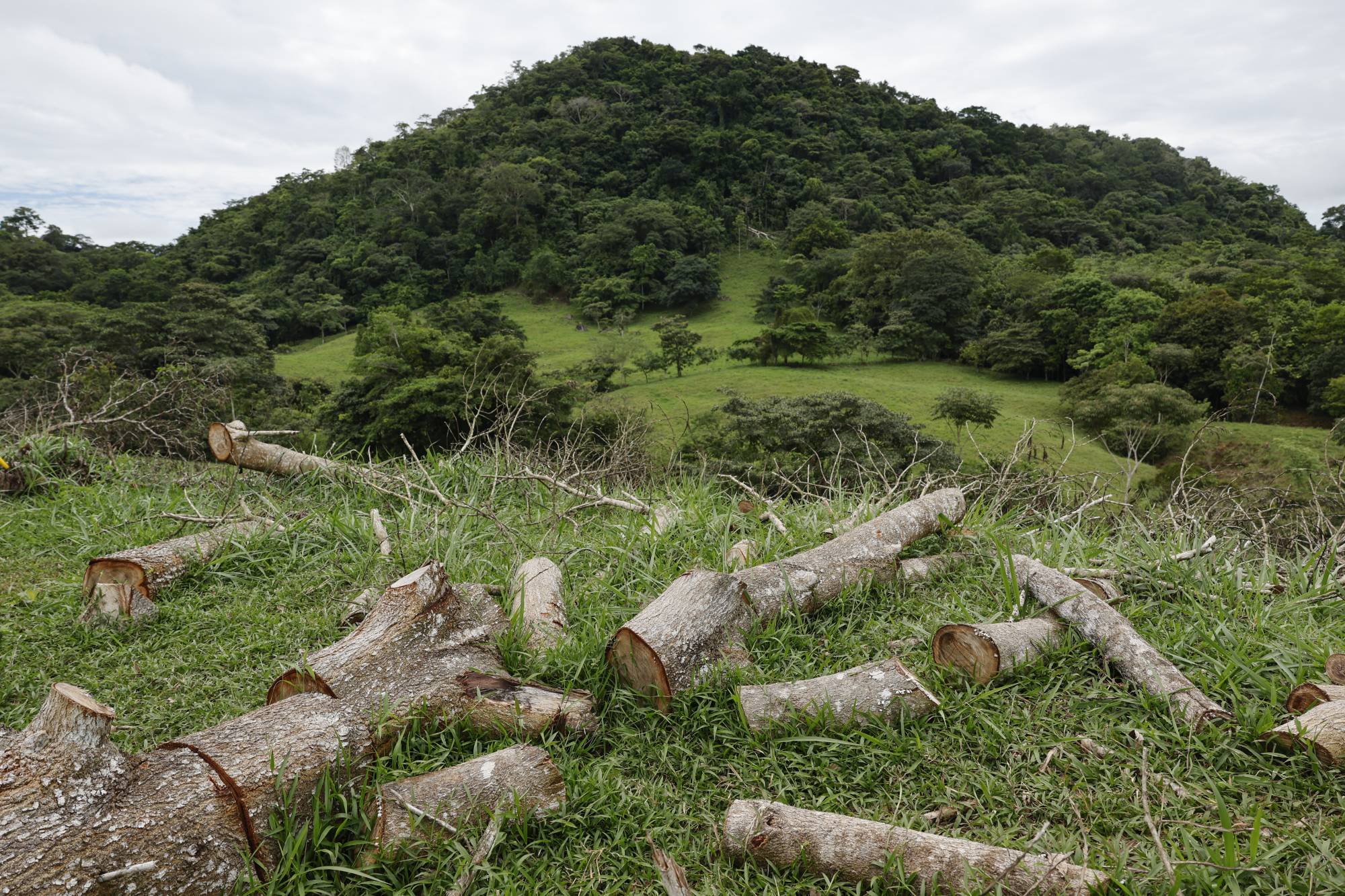
Trunks of a tree in Capira, Panama, 06 October 2026. EPA/Bienvenido Velasco
Progress could also be threatened in Colombia and Peru, where hard-right presidents were recently elected, according to the experts.
Across the Atlantic in Africa, the situation deteriorated in the Congo basin, where rainforest loss reached 2.4 million hectares -- near the same level of deforestation as the Amazon for the first time.
"Losing such a size of forest every year is a disaster," said Sam Nguiffo, a lawyer and founder of the Centre for Environment and Development in Cameroon.
"As humanity, we clearly cannot afford that because it will be totally irreversible," he said.
Logging for timber or felling trees for agriculture or mining appear to prevail in forest management in Central Africa, Nguiffo said.
Deforestation has a "massive impact on the cultural identity and on the livelihood of local and indigenous communities", he said.
"The erosion of the forest, both in size and in number of species, reduces the space available for communities and fuels conflicts," the lawyer added.
El Nino, the warming phase of a natural climate cycle, also threatens progress because its effects include droughts, creating conditions for wildfires.
The current El Nino event, which emerged in June, is expected to peak later this year but is already shaping up to be the strongest ever observed.
El Nino has been associated with strong drought in Indonesia, where tracts of forest and plantations have been burning in biodiverse Borneo and South Sumatra for months.
"If projections of the historically strong 2026-27 El Nino materialize, drought and fire risks will intensify further across tropical forest regions," the deforestation report said.
Matson, of Climate Focus, noted that there was a "huge spike" in tree cover loss during the last "super" El Nino event in 2015-2016.
"We can't fully predict the future but it's unlikely, I would say, that in 2026 we'll see the same kind of reductions (in deforestation) that we saw last year," she said.
Cyber Attack Hits Fridges in French Supermarkets, Spoiling Food Worth Millions of Euroshttps://english.aawsat.com/varieties/5329387-cyber-attack-hits-fridges-french-supermarkets-spoiling-food-worth-millions-euros
View of the closed frozen food aisle at a supermarket near Nantes after a cyberattack targeted refrigeration systems at French supermarket chains, causing food losses and fires at several stores, France, October 12, 2026. REUTERS/Stephane Mahe
Cyber Attack Hits Fridges in French Supermarkets, Spoiling Food Worth Millions of Euros
View of the closed frozen food aisle at a supermarket near Nantes after a cyberattack targeted refrigeration systems at French supermarket chains, causing food losses and fires at several stores, France, October 12, 2026. REUTERS/Stephane Mahe
Hundreds of French supermarkets have been hit by a cyber attack that caused their fridges and freezers to heat up, spoiling fresh and frozen food estimated to be worth millions of euros.
Hackers gained control of the software that regulates the temperatures of the refrigeration units, forcing some to warm to 50C (120F) overnight, according to one supermarket chain affected.
The chief executive of Coopérative U said several of its supermarkets had been hit by the “extremely serious and unprecedented” attack, according to BBC.
More than 100 of the chain's supermarkets were targeted, while 180 stores from Intermarché and its Netto brand were affected, with a spokesman saying that another 100 shops were urgently disconnected from the internet to prevent the same thing happening to them.
Other major food retailers including Carrefour, Monoprix and E.Leclerc were also hit by the attack, which targeted software provided by Danish engineering firm Danfoss.
The software allows retailers to manage their cold units remotely.
Normally, supermarket freezers go through a short period of defrosting overnight, in which temperatures rise slightly. But the hackers ordered the units to heat up and stay hot, although Danfoss did not confirm any reports about just how warm the fridges and freezers could become in that process.
Danfoss said the affected cold units were older models whose security software could not be updated to ward off a risk they had identified.
The firm added in a statement that it had “long advised” businesses to keep supported systems up to date.
“Reliable refrigeration is critical to our customers' operations, and we remain committed to supporting our customers and helping them maintain secure and reliable systems they are used to.”
About 700 Affected Supermarkets
French Finance Minister Roland Lescure told Parliament on Tuesday that about 700 of the country’s 10,000 supermarkets were affected.
He said there was no risk to France’s food supplies but acknowledged that the attack “touches the heart of our food security.”
“It was a wake-up call for everyone,” he said, according to AP.
The Paris prosecutor’s office said Tuesday that its cybercrime unit was investigating the large-scale attack, including the extent of damage caused by spoiled food and reports of fires.
Before Lescure’s statement, figures supplied by individual chains suggest about 400 stores were affected out of 15,000 or so overall in France.
Carrefour said fridges in 80 of its 6,000 stores were hacked, while Monoprix said 5% of its 400-plus stores had been hit, with food removed from sale if its condition could not be guaranteed.
In a statement to the BBC, Mousquetaires Group - which owns Intermarché and Netto - said some fresh and frozen food display units remained out of service on Monday afternoon.
The stores had “taken all necessary precautions to remove the products from these units”, it said, adding that staff were working to restock the shelves “as soon as possible.”
Intermarché said its fridges had heated up to 50C for six hours overnight into Monday, and the retailer had thrown away all the affected food to avoid health risks, the Reuters news agency reported.
As a result of the attack, managers arriving at branches of several supermarket chains on Monday morning were hit by a wave of hot air from the freezers. In some places there were even small fires.
French broadcaster BFMTV published an image showing a freezer in an ice cream aisle displaying a temperature of 26.5C.
Two supermarkets in the Alsace region reported losses of €270,000 (£228,000) between them, the broadcaster added, meaning the nationwide total could run into the millions.
French prosecutors have opened a specific cyber-crime investigation into the incident, which the Paris prosecutor's office called a “large-scale cyber-attack affecting the refrigerators of several major food retail chains across France.”
European Food Commissioner Christophe Hansen condemned the hack in a post on X and added: “Food security requires more attention at all levels. Because the weaponization of food has become a reality.”
In a post on X, Coopérative chief executive Dominique Schelcher said staff were “fully mobilized, in co-ordination with refrigeration specialists, to restore the situation as quickly as possible.”
As Species Decline, Green Turtles Offer Glimmer of Hopehttps://english.aawsat.com/varieties/5329377-species-decline-green-turtles-offer-glimmer-hope
This underwater photo taken on September 25, 2026 shows an endangered adult green sea turtle resting on the sandy seabed next to a coral reef formation off the coast of Mataking Island in Semporna, in Malaysia's eastern state of Sabah. (Photo by SAI AUNG MAIN / AFP)
As Species Decline, Green Turtles Offer Glimmer of Hope
This underwater photo taken on September 25, 2026 shows an endangered adult green sea turtle resting on the sandy seabed next to a coral reef formation off the coast of Mataking Island in Semporna, in Malaysia's eastern state of Sabah. (Photo by SAI AUNG MAIN / AFP)
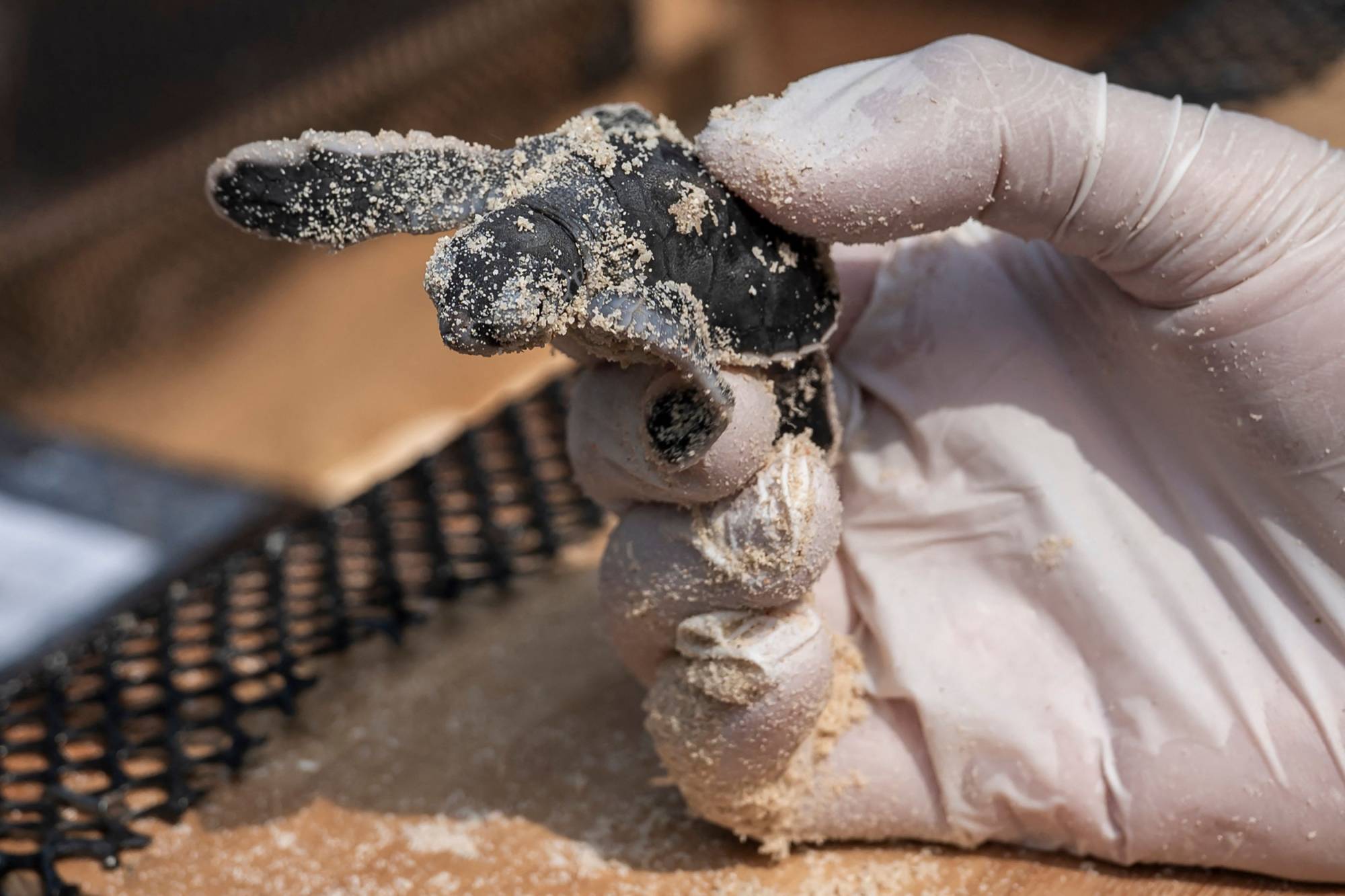
The palm-sized green turtle hatchling flailing through the sand on a Malaysian island may seem vulnerable, but its species has emerged as a symbol of hope for wildlife conservation.
Green turtles have made the rare jump from endangered to "least concern" in global conservation rankings, a remarkable success when many species are declining.
Conservation NGO World Wildlife Fund (WWF), in its biannual Living Planet Report released Thursday, found a 73-percent decline in the average size of monitored wildlife populations over 53 years.
But around 50 percent of the thousands of vertebrates monitored for the report are stable or increasing.
That includes green turtles, thanks to decades of efforts including egg relocation, marine protection and trade bans.
Malaysian turtle expert Juanita Joseph has spent years on the frontlines, carrying out cutting-edge genetic research and even convincing her own father to stop eating turtle eggs.
Still, when the International Union for the Conservation of Nature last year announced green turtles were no longer endangered, she could hardly believe it.
"Never in my mind (did I think) that one day turtles can be 'least concern'. I cried... I said I've done my part," she told AFP at Universiti Malaysia Sabah, where she is a professor.
This photo taken on September 24, 2026 shows a conservationist holding a green sea turtle hatchling on Mataking Island, off Semporna in Malaysia's eastern state of Sabah. (Photo by SAI AUNG MAIN / AFP)
All six other sea turtle species are still vulnerable or critically endangered, apart from the flatback turtle, whose status is unclear because of data shortages.
Turtles are targeted for food and their shells, killed in fishing nets, and constrained by development and pollution at nesting beaches and feeding grounds.
Climate change also skews populations more female because heat determines sex development in eggs.
Even now, recovery is uneven. While green turtles globally are "least concern", some regional populations are still endangered and declining.
- 'Our heritage' -
Malaysia is something of a regional exception. Green turtle nesting at Sabah state's Turtle Islands has tripled since the 1970s to over 20,000 nests annually.
That reflects "over five decades" of work, said Sabah Parks director Maklarin Lakim.
The Turtle Islands have been protected since 1977, and Sabah banned turtle meat and egg consumption in 1997.
"This is our heritage, this is our biodiversity," Maklarin said.
"We would like to protect that as long as possible."
Much of the conservation success has relied on people like Sitti Rasah Abdul, 50, from a fishing community on Malaysia's Omadal island.
Since 2012, she and other members of a women's cooperative have relocated turtle eggs from beaches to a hatchery to protect them from predators and poachers.
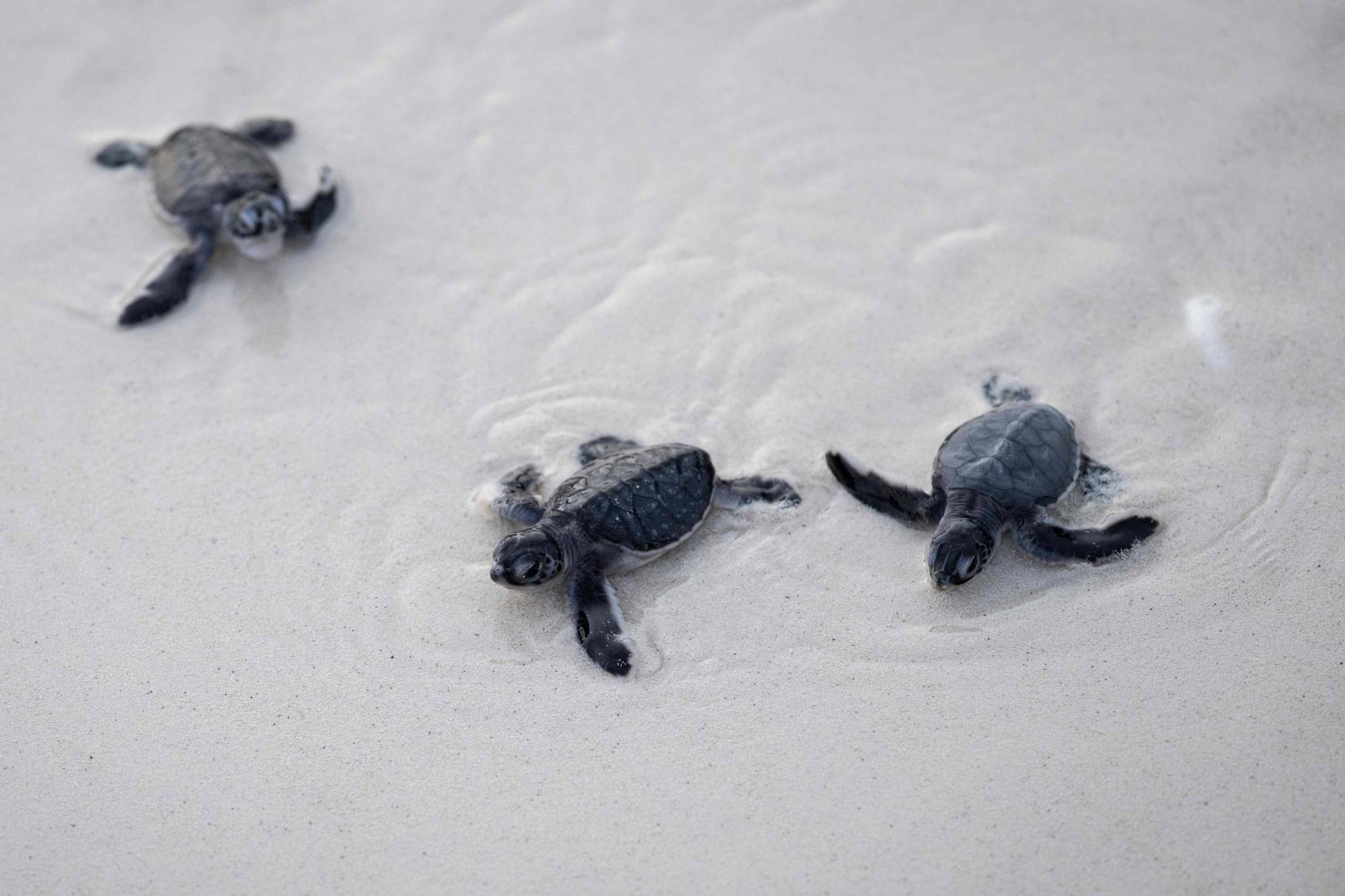
This photo taken on September 25, 2026 shows newborn green turtles crawling across a sandy beach towards the sea after being released from a wildlife protected area on Mataking Island, Semporna, in Malaysia's Sabah region. (Photo by SAI AUNG MAIN / AFP)
The 20-strong team started conservation work with WWF, but now self-funds, ploughing 10 percent of revenue from their handicraft and catering business into turtle protection.
"I'm already old," said Rasah, on the wooden jetty that extends from her home into aquamarine seawater.
"But I feel a sense of responsibility to ensure that there are still turtles around for the next generation."
A 45-minute boat ride away, green and hawksbill turtle hatchlings emerged from relocated nests in a hatchery at the high-end Mataking Reef Resort.
Hotel owner Sophia Sie fell in love with turtles decades ago when her father acquired land on Mataking island, and now around 10 percent of her staff works on conservation.
In 2006, "we had about 600 eggs collected... today we have about 36,000 eggs," Sie told AFP.
Guests can release hatchlings, and while Sie considers conservation a passion, it is also good business.
"The survival of our business here is very much dependent on the natural resources and the beauty around us," she said.
- 'Long-term project' -
The hatchlings tipped from a basket onto a Mataking beach face long odds. Just one in 1,000 will survive to sexual maturity at 20 years old.
Hatchlings spend around a decade in the open ocean, a period sometimes called the "lost years" because scientists know so little about it.
Working out where turtles spend those years, and where they forage and reproduce, is key to sustaining conservation success, said Gavin Jolis, marine species strategy manager at WWF-Malaysia.
The NGO has created the world's first global turtle DNA database, Shellbank, using samples from turtle tissue and shells to trace populations and even target poachers.
"In order to save sea turtles, we have to look at the life cycle," said Jolis.
"That's where the genetic work comes in."
The neat rows of test tubes in Joseph's lab contain bits of hatchling flipper snipped from babies that did not survive.
Sequencing them reveals a turtle's "haplotype", a kind of genetic fingerprint.
The work has already helped show that turtles foraging in parts of Malaysia come from Micronesia, and identified the likely source of turtle shell intercepted in Britain.
While each conservation effort faces different challenges, the battle to protect green turtles teaches "to really be resilient and patient with the work", said Jolis.
"We should not look at just a short-term project, it's a long-term project."
لم تشترك بعد
انشئ حساباً خاصاً بك لتحصل على أخبار مخصصة لك ولتتمتع بخاصية حفظ المقالات وتتلقى نشراتنا البريدية المتنوعة