

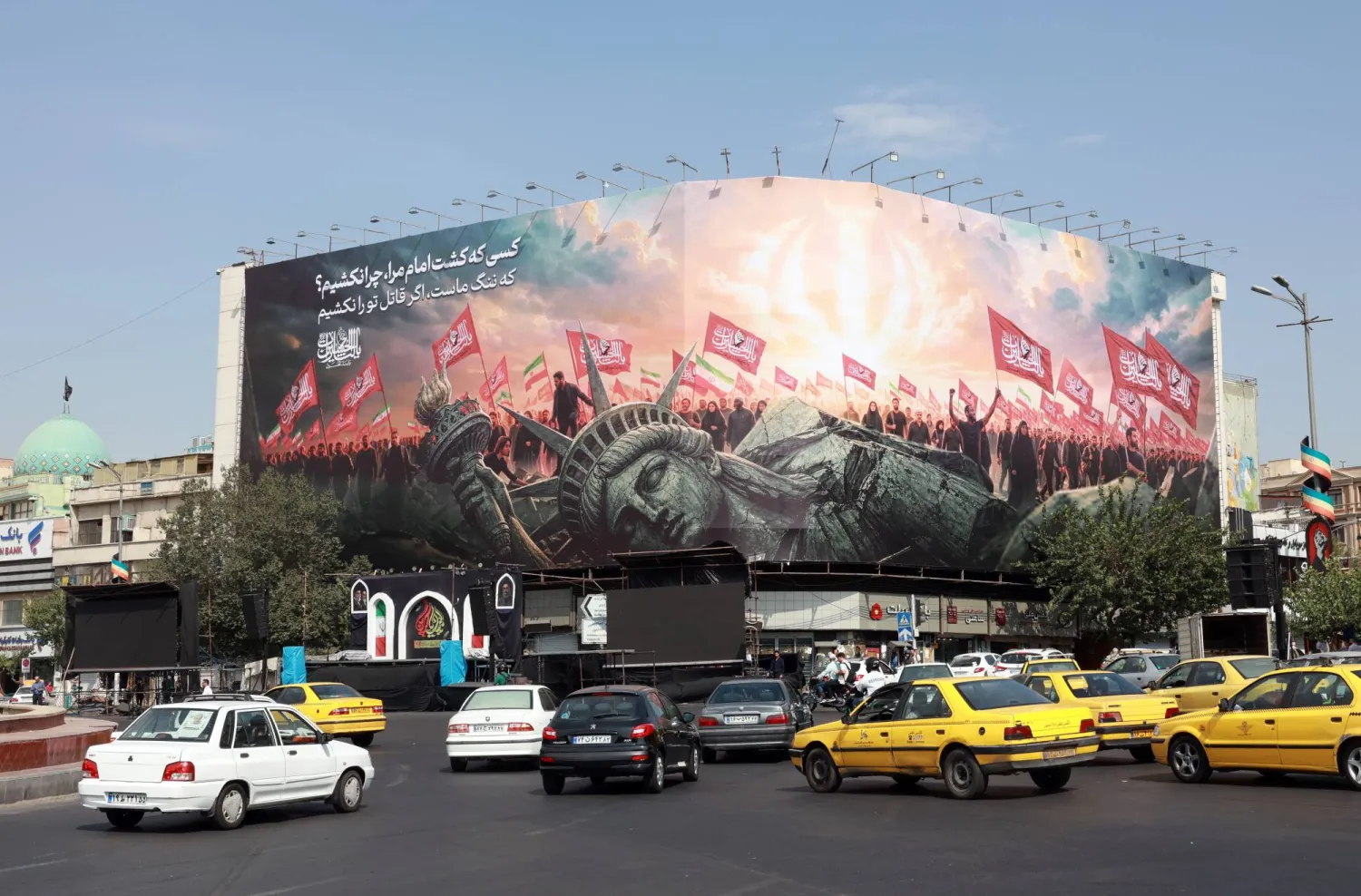

Iran Says Won't Reopen Hormuz Without US Meeting All Tehran's Conditions

Vehicles drive past an anti-US billboard at Enghelab Square in central Tehran, Iran, 09 August 2026. EPA/ABEDIN TAHERKENAREH
TT

Iran Says Won't Reopen Hormuz Without US Meeting All Tehran's Conditions

Vehicles drive past an anti-US billboard at Enghelab Square in central Tehran, Iran, 09 August 2026. EPA/ABEDIN TAHERKENAREH

Iran's Revolutionary Guards said on Sunday they would not reopen the Strait of Hormuz until the United States met all of Tehran's conditions set out the day before, including compensation for war damages.

Iran has imposed an effective blockade of the strait since the United States and Israel attacked in late February, and wants to charge tolls for passage, striking ships it accuses of attempting to circumvent its preferred route.

Continued attacks in the waterway, which was free to transit before the war, led to the collapse of an April ceasefire. Mediators have urged both sides to return to the terms of a subsequent June memorandum that set out a path for peace talks.

Iranian Foreign Minister Abbas Araghchi said discussions with Oman over transit and management of the strait were "approaching the final stages,” but added that the reopening of Hormuz "is subject to other conditions and compensation for the violation" of the June agreement.

He denied on Sunday that Iran was negotiating with the US, saying they were merely "exchanging messages" via intermediaries.

Iran's security chief Mohammad Bagher Zolghadr on Saturday laid out a list of demands for reopening the strait, including an end to the "war and aggression against Iran and its allies in Lebanon, Palestine, Yemen and Iraq.”

He also demanded the lifting of a US counterblockade of Iranian ports, the end of sanctions, the release of frozen assets and compensation for wartime damage, according to remarks reported by the Tasnim news agency.

Iran's Revolutionary Guards on Sunday said their strategy was to maintain the closure "until the enemy accepts all our conditions... the strait is now actually a theatre of war for us and not just a waterway.”



North Korea Defense Minister Dismissed

North Korean leader Kim Jong Un meets scientists, researchers and officials from key national defence research institutions at the headquarters of the Central Committee of the Workers' Party of Korea in Pyongyang, North Korea, August 29, 2026, in this photo released by North Korea's official Korean Central News Agency (KCNA). (KCNA via Reuters)
TT

North Korea Defense Minister Dismissed

North Korean leader Kim Jong Un meets scientists, researchers and officials from key national defence research institutions at the headquarters of the Central Committee of the Workers' Party of Korea in Pyongyang, North Korea, August 29, 2026, in this photo released by North Korea's official Korean Central News Agency (KCNA). (KCNA via Reuters)

North Korea's defense minister has been dismissed as part of a reshuffle of the country's military leadership, state media reported Sunday.

The "structural reorganization plans" were decided during a meeting on Saturday led by Kim Jong Un, the Korean Central News Agency (KCNA) said.

No Kwang Chol was not only dismissed as defense minister but also demoted in the ruling party leadership to "first vice-director of the Munitions Industry Department," KCNA said.

Kim Song Gi, director of the General Political Bureau of the Korean People's Army, was named as the new defense minister.

Another senior official, defense advisor Pak Jong Chon, was given the position of vice-chairman of the Central Military Commission and named to the ruling party's Political Bureau.

Several other promotions were also announced.

In a separate report, KCNA said Kim had lauded scientists, researchers and officials at a ceremony on Saturday for their advances in defense technology, giving them top national honors.

The honorees greatly contributed to "resolving scientific and technological problems of epochal significance in developing new combat weapon systems", KCNA said, without specifying the type of system.

A photo released by KCNA shows Kim pinning a medal on a recipient.

The nuclear-armed state's weapons research center "has recently developed exclusive technologies, to be regarded as an event in strengthening the capability for fighting a war", it added without giving details.

With such technologies, it has shown "the course of unique development of the country's military and technological capabilities", it said.

In late June, Kim oversaw tests of a new extended-range multiple rocket launcher and artillery.

- Trilateral drills -

The leadership shuffle comes shortly after joint annual drills between South Korea and the United States wrapped up.

The drills, which are regularly denounced by Pyongyang as preparations for an invasion, were closely watched this year after US President Donald Trump ordered them to be cut short.

Trump criticized the drills as provocative towards the North and bashed Seoul for not supporting his war against Iran.

The US president also praised North Korean leader Kim, whom he met twice during his first term in office, as he eyes a new meeting, potentially this year.

Despite Trump's overtures, North Korea has shown little sign of reciprocating, firing missiles and condemning the scaled-down drills.

Pyongyang has also slammed Washington's approval of arms sales to South Korea and plans to fund programs documenting human rights abuses in the North.

Military cooperation among Washington and its regional allies is meanwhile set to continue, with South Korea, the United States and Japan due to hold trilateral joint exercises -- called Freedom Edge -- from September 7 to 11 in international waters east and south of South Korea's Jeju Island.

"This exercise is a defensive drill conducted annually by the three countries to respond to North Korea's nuclear and missile threats and safeguard peace and stability in the region," Seoul's Joint Chiefs of Staff (JCS) said Friday.


Tests Loom for Popular UK PM Burnham as Parliament Returns

Britain's Prime Minister Andy Burnham smiles during a visit to Bath, western England, on July 22, 2026. (AFP)
TT

Tests Loom for Popular UK PM Burnham as Parliament Returns

Britain's Prime Minister Andy Burnham smiles during a visit to Bath, western England, on July 22, 2026. (AFP)

Andy Burnham has enjoyed a honeymoon first month as UK leader, but the hard trade-offs involved in governing are about to get real for the prime minister as parliament returns from its summer break in the coming days.

Since succeeding Keir Starmer on July 20, Burnham has pleased voters with several low-cost sweeteners, including cutting electricity bills and bus fares, while burnishing his casual man-of-the-people vibes.

He has poured pints of beer with his finance minister, played guitar in Ukraine, and kept up a prolific output of slick social media videos during a self-styled "listening tour" of Britain.

Projecting a sunnier outlook than the straitlaced Starmer, and benefiting from the woes besetting hard-right rival Nigel Farage, Burnham has sparked a poll bounce for his ruling Labour Party.

A YouGov survey published on August 18 found that 46 percent of Britons view him favorably, up 12 percentage points from when he first arrived at Downing Street.

With lawmakers on holiday, the new prime minister has largely been able to avoid thornier issues during his first weeks in office.

"He's benefited enormously from parliament not being there," former senior civil servant Jill Rutter told AFP, adding that it had allowed the 56-year-old Burnham to "control the narrative" so far.

MPs return to Westminster on Tuesday, when Burnham is expected to deliver his first speech to parliament as prime minister.

His government is set to announce that day whether it is watering down contentious plans to release thousands of prisoners early to ease chronic overcrowding in jails.

Then on Wednesday, MPs and the public will learn whether Burnham is any good at facing down the weekly grilling by the leader of the opposition when he takes part in his first Prime Minister's Questions session.

Looming on the horizon is his government's first budget on October 28, when Burnham must demonstrate that he can fund his pledges regarding cost-of-living support and ending rough sleeping, all while plugging a huge gap in defense spending.

He must do so against a backdrop of strained public finances and with limited levers to pull due to his commitment not to raise income tax, employee payroll contributions, or a value-added tax on consumer goods.

"That might be when reality starts to hit," former minister Tony McNulty, who served alongside Burnham in Labour governments of the early 2000s, told AFP.

McNulty, now a politics lecturer at Queen Mary University of London, insists Burnham is capable of taking tough decisions and "sticking" to them, despite opponents labelling him a "people pleaser".

- Trump meeting? -

Plenty of sensitive issues lie ahead, including welfare reform, how to fund social care, and whether to proceed with the scrapping of jury trials for many offences.

Whether to extract oil and gas at the controversial Jackdaw and Rosebank fields in the North Sea could be one of the most divisive questions.

"You either alienate the unions by saying no and get noises off from (US President) Donald Trump in a very unhelpful way," explained Rutter.

Or Burnham gives drilling a green light and "you alienate the Labour net zero (supporters) who say we're going to lose more support to the Greens".

Burnham will host his first European leader since taking office when French President Emmanuel Macron visits London this week.

It comes as he must decide how to proceed with a "reset" with the European bloc that was championed by Starmer ahead of a bilateral summit expected this year.

Burnham has said Britain must be "bolder" in getting closer to the bloc, but has ruled out rejoining the single market, customs union or allowing freedom of movement.

"The EU isn't handing out sweets just because we've got a sort of fun prime minister who likes (1980s English rock band) The Smiths," added Rutter.

A likely first meeting with Trump, possibly at the United Nations General Assembly next month, will be tricky for Burnham who once described the US president's policies as "poisonous".

Labour lawmaker Jess Phillips said on a Sky News podcast last week that Burnham must "show what his actual priorities are" but in doing so runs the risk of disappointing many MPs.

MP Luke Akehurst told AFP that Burnham's positive start "gives him a significant bank of political capital" among Labour colleagues "who will need to trust his judgement in addressing the range of complex policy issues that the government faces".


Venezuela Says Retains ‘Sovereignty’ in US Oil Deal

An oil tanker sails off the coast of Maracaibo, Venezuela, 29 August 2026. (EPA)
TT

Venezuela Says Retains ‘Sovereignty’ in US Oil Deal

An oil tanker sails off the coast of Maracaibo, Venezuela, 29 August 2026. (EPA)

Interim leader Delcy Rodriguez assured the public Saturday that Venezuela retains control of its oil under a new agreement that allows the United States significant access to it.

The United States will have majority control of 65 billion barrels of Venezuela's proven reserves in what President Donald Trump described Friday as "the biggest oil deal in world history."

"One thing must be absolutely clear: Venezuela retains ownership and sovereignty over its resources," Rodriguez said in a speech on state television.

The agreement with the United States aims to turn "cold, inert" resources underground to "a source of social and economic well-being for the people of Venezuela," she said.

Caracas says the deal involves $100 billion in private investment aimed at revitalizing the industry in a country with the world's largest proven oil reserves.

But a lack of transparency is raising concerns among Venezuelans, including supporters of the government. A flood of social media comments decried loss of sovereignty, meager benefits and political costs.

"We don't know who this will benefit -- whether it's Venezuela or (the United States)," said Jesus Salazar, a 68-year-old security guard.

"I have my doubts, but we'll have to wait and see what happens."

Venezuela's government has operated under intense pressure from the Trump administration since American forces ousted and captured long-time ruler Nicolas Maduro in January.

Washington allowed Rodriguez, his vice president, to stay on as interim leader so long as she toes Washington's line.

Venezuela's ruling party said Saturday it supports economic measures that "prioritize national interests and make it possible to overcome the impact of more than a decade of economic sanctions, unilateral coercive measures, and unjust blockades."

The party consistently blames US sanctions for the collapse of Venezuela's economy.

- Petrol and poverty -

Rodriguez has pushed through reforms in Venezuela's mining and petroleum industries, opening once tightly controlled sectors to private capital and foreign investment.

Washington, for its part, has eased sanctions imposed on Venezuela's oil sector under the Maduro government.

Oil production rose by 29.8 percent between January and July, reaching 1.2 million barrels per day -- still well below the three million barrels per day produced a quarter of a century ago.

The US deal aims to restore production to those levels, but analysts agree it would take time.

"The increase in production won't be seen for at least three or four years," said engineer Oswaldo Felizzola, a professor at the Institute of Higher Studies in Administration (IESA) in Caracas.

He welcomed the United States acting as a "guarantor" for investments in Venezuela, which has failed to attract significant capital for more than a decade.

"Without this, these fields would not be developed over the next 10 or 15 years," because state-owned Petroleos de Venezuela (PDVSA) "does not have the financial resources to do so."

An initiative of this magnitude could accelerate long-awaited economic recovery in Venezuela, a country still reeling from the brutal 80 percent contraction between 2014 and 2021 that plunged millions of Venezuelans into poverty.

Many survive on a monthly minimum wage equivalent to $0.16, plus government subsidies that can reach $240 per month -- still far short of the estimated $730 needed to buy basic food necessities for a family of five.

- Doubt and optimism -

Carlos Baco, a 74-year-old government employee, hopes oil revenues will start flowing under the new deal, but said he hasn't felt the effects of the increase in oil production over the past few months.

"Consumer goods and food are more expensive... the dollar is rising and prices are going up," he said. "It's impossible here."

Rodriguez has promised more than $204 billion in tax revenue from the deal, without providing details.

For analyst Elias Ferrer of the Orinoco think tank, the investment is good news, even without specifics.

"It's undoubtedly better than before. Before, this oil wasn't being extracted; if no one extracts it, no one pays royalties, and no one profits from it," he said.

"If everything is done correctly... this will be a great opportunity for Venezuela to see its oil sector revived," said attorney Dolores Dobarro, Venezuela's former deputy minister of energy.