


Self-taught Turkish 'Linguist' Keeps Dead Language Alive

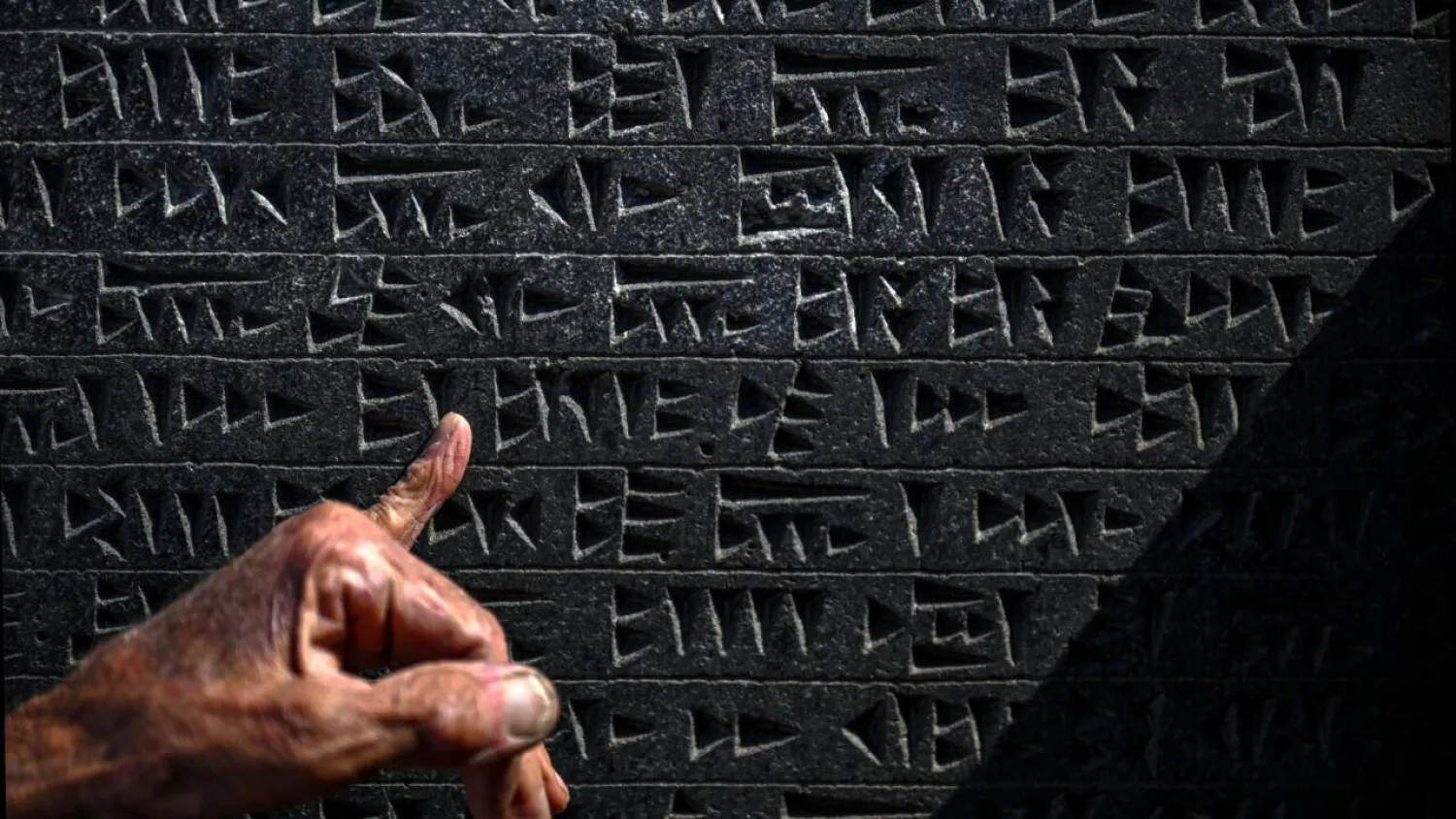
Kusman runs his finger over a tablet engraved with the ancient Urartu language. Ozan KOSE / AFP
TT

Self-taught Turkish 'Linguist' Keeps Dead Language Alive

Kusman runs his finger over a tablet engraved with the ancient Urartu language. Ozan KOSE / AFP

Mehmet Kusman did not spend very long at school, but he traced the ancient inscriptions chiseled into the black basalt rock and read: "Before me there was nothing. But by the power of the god Haldi I founded this city."

Kusman, 86, has dedicated his life to the fortress of Cavustepe in eastern Türkiye, and to learning the language of the vanished kingdom of Urartu, to honor its forgotten gods and rulers.

Brisk of step and sharp of mind despite his years and the hot winds that whip the castle, he stood at the foundations of a temple dedicated to Haldi. Kusman wore a cap bought in Los Angeles on which he has written "USA 2009" in the cuneiform script typical of the region's ancient civilizations.

Kusman was hired as a laborer on the Cavustepe excavations after his military service in the 1960s and there encountered his first stele.

"The inscription was very beautiful," he told AFP. But the head of the dig discouraged him from learning this "very difficult" script, which borrowed its cuneiform alphabet from Assyrian.

"His telling me 'No' hurt me," he said. "I became relentless, thinking: 'In my lifetime, I will learn it.'"

Despite a lack of formal education, Kusman began copying the inscriptions found during excavations carried out in eastern Türkiye, Iran and Armenia, over which Urartu once stretched.

In three years, he said, he mastered the alphabet, but "it took me 22 years to master 650 words" of vocabulary.

- One of the last -

Academics contacted by AFP praised Kusman's enthusiasm and devotion. He has become something of a local curiosity, calling himself "one of the last seven people in Türkiye to speak the Urartian language."

Erkan Konyar, professor of ancient history at Istanbul University, describes the kingdom as "one of the most powerful states of the ancient Near East, between the 9th and 7th centuries BC."

Urartu -- more recent than the great Mesopotamian kingdoms of Assyria, Sumeria and Babylon -- brought the tribal mountain communities together under a centralized state, building cities, fortresses, irrigation networks and vast food storage facilities, Konyar said.

Despite retiring in 2005, Kusman continues to watch over Cavustepe, said Konyar, a specialist on Tuspa, the kingdom's founding capital.

"For 60 years, he has lived amid the excavations and introduced thousands of visitors to the history of Urartu."

But Konyar is careful to qualify Kusman's claims to speak the language. In fact, historians do not really know how it was pronounced, he said.

"The available inscriptions allow us to understand it up to a certain point, but we lack vocabulary and texts," he said. "Only the meaning of certain words is known with certainty. So no one can claim to speak Urartian."

"Even in the time of Urartu, people did not speak this language; it was only written," said Mehmet Isikli, director of the Department of Near Eastern Archaeology at Ataturk University in Erzurum.

- 'Grandson of the Urartians' -

Kusman's passion for the language has made him a local celebrity. His lectures have taken him "to America, five times, to Germany, the Netherlands, Belgium," he said, reeling off the list with a touch of showmanship.

"Now, I'm thinking of going to Japan," he added.

Isikli is excavating the fortress of Ayanis, the last of the great strongholds built in the kingdom before it collapsed, 35 kilometers (22 miles) north of Van, with a commanding view of the lake.

"Our excavations may tell us something about the end of Urartu," he said, noting that researchers have found "the traces of a very powerful earthquake."

Isikli admits to a certain respect for the old guardian.

"I admire him," he added. "He has worked hard and brought Urartian culture to light.

"Mehmet Kusman provides a sort of publicity for Urartu, but it has nothing to do with academic work: he knows only a few alphabetical signs, or a few letters, and some very, very general information about them."

In his small stone hut at the entrance to the Cavustepe site, Kusman is undaunted by the doubters.

"I am a descendant of the Urartians, their grandson," he said. "They disappeared, but look, they are not all dead," he declared, as he stood to welcome visitors.




Tyre’s Ruins Survived the Strikes. Now Divers are Finding their Way Back Underwater

A diver passes above Roman-era columns at an archaeological site near the coast in the southern port city of Tyre, Lebanon, Thursday, Sept. 17, 2026. (AP Photo/Bilal Hussein)
TT

Tyre’s Ruins Survived the Strikes. Now Divers are Finding their Way Back Underwater

A diver passes above Roman-era columns at an archaeological site near the coast in the southern port city of Tyre, Lebanon, Thursday, Sept. 17, 2026. (AP Photo/Bilal Hussein)

Beneath the Mediterranean waters off the southern Lebanese city of Tyre, divers swim past stone walls, ancient structures and a submerged road — remnants of parts of a city that once stood above the water.

With a shaky ceasefire in place after the latest Israel-Hezbollah war, visitors are returning to Tyre, a city known for its Roman ruins and its much older Phoenician history. Diving operators say interest in the underwater archaeological sites is increasing, though the number of visitors remains below prewar levels, The Associated Press said.

“The diving season is not like it used to be before, but the number of people coming to dive to see the ruins is increasing day by day,” said Yousef al-Jundi, manager of the Lebanon Diving Center.

The remains underwater are part of Tyre’s wider archaeological landscape. UNESCO says substantial archaeological remains of the ancient city are submerged, while underwater archaeological research has documented walls, harbor structures and other remains along the former island and coastline.

“This is the identity of this city, which tells us how old this city is and what its history is,” al-Jundi said. He said the underwater sites attract divers from around the world who want to see what is commonly described as Tyre’s “sunken city.”

Tyre was one of the major Phoenician maritime cities of antiquity, with trading networks that extended across the Mediterranean. The city was also famous for its purple dye and later became an important Greek and Roman center. Its archaeological remains were added to UNESCO’s World Heritage List in 1984.

The war raised concerns over the preservation of those remains, both on land and underwater.

“We were worried about the archaeological sites on land, which were affected by the war and the strikes, but at the same time we were also worried about the archaeological sites underwater, but thank God they were not affected,” al-Jundi said.

Before the ceasefire in late June, Tyre came under intense Israeli airstrikes, with neighborhoods in the coastal city heavily damaged during the fighting. UNESCO’s World Heritage Committee placed Tyre on its List of World Heritage in Danger in July 2026, citing the threat and damage caused by the ongoing hostilities.

Ali Badawi of Lebanon’s Directorate General of Antiquities said protecting the underwater sites remains a challenge.

“They’re not very well protected," Badawi said, adding that “encroachments” sometimes happen. “But we are trying very hard through surveys and research that we’re conducting, and we’re trying to develop laws to ensure their safety in the future.”

Badawi said the authorities also want to expand research and investment in underwater tourism, including the creation of underwater archaeological parks that would allow more visitors to see the sites.

The effort comes as Tyre seeks to rebuild its tourism sector after the war, while preserving archaeological remains that reflect thousands of years of the city’s history.


Historic Linah Marks Saudi National Day with Heritage Events, International Performances

Linah is one of the most prominent historical sites in northern Saudi Arabia - SPA
TT

Historic Linah Marks Saudi National Day with Heritage Events, International Performances

Linah is one of the most prominent historical sites in northern Saudi Arabia - SPA

Historic Linah, located south of Rafha in Northern Borders Region, will celebrate Saudi National Day with a series of national and heritage events at the Historic Linah Market.

The program features performances by local and international artistic groups, along with a variety of artistic segments, solo musical performances, and equestrian and camel-riding displays, SPA reported.

The festivities will also include puppet shows, children’s competitions, and a musical evening showcasing traditional songs.

The Historic Linah Municipality has completed preparations across sites, parks, and roads, decorating streets with national flags and festive lighting to welcome visitors and create a celebratory atmosphere that reflects national pride.

Linah is one of the most prominent historical sites in northern Saudi Arabia.

Once a key stop along ancient caravan routes, the town’s historic palaces and market continue to stand as enduring witnesses to the region’s collective memory.


Germans Arrested for Louvre Stunt in Mona Lisa Hall

 A person photographs Leonardo da Vinci's painting Mona Lisa at the Louvre museum, Aug. 31, 2025, in Paris. (AP)
A person photographs Leonardo da Vinci's painting Mona Lisa at the Louvre museum, Aug. 31, 2025, in Paris. (AP)
TT

Germans Arrested for Louvre Stunt in Mona Lisa Hall

 A person photographs Leonardo da Vinci's painting Mona Lisa at the Louvre museum, Aug. 31, 2025, in Paris. (AP)
A person photographs Leonardo da Vinci's painting Mona Lisa at the Louvre museum, Aug. 31, 2025, in Paris. (AP)

Two Germans were arrested Saturday after they stuck two paintings on a wall of the hall that hosts the Mona Lisa in Paris's Louvre museum, police sources said.

The two men used sticky tape to stick the two paintings -- measuring 30 by 40 cm -- in the hall where visitors flock to see Leonardo Da Vinci's masterpiece.

One showed one of the two men wearing armor, while the other was a portrait of the two men accompanied by a woman.

Security officers at the museum detained the two men and called the police, who arrested them for minor damage to the wall. Interviewed by police, they said they had done it for fun.

The two men will be summoned to appear in court once the museum files a formal complaint for the damage, said the police sources.

The Mona Lisa itself, now behind a thick layer of protective glass, suffered no damage in the incident.

Museum officials are more than usually alert these days after a spate of heists at French museums and galleries, which have highlighted inadequate security in some cases and led to questions about whether criminal gangs see them as soft targets.

The Louvre itself was targeted last October when eight items of jewelry worth millions of dollars were stolen during a daylight heist.

Even though four suspects have been arrested, the stolen items have still not been found despite extensive searches by French investigators.

The burglary stunned the world, embarrassed France and revealed a series of security lapses, including the museum's old-fashioned CCTV system.

Many of the museum's security flaws had already been highlighted in a 2019 audit ordered by the museum, the findings of which were never acted on.

The Louvre welcomed around nine million visitors last year, far above its intended capacity, which has led to overcrowding problems.

In May, French President Emmanuel Macron announced a major overhaul of the museum, which will include a new space for the Mona Lisa and a new museum entrance.