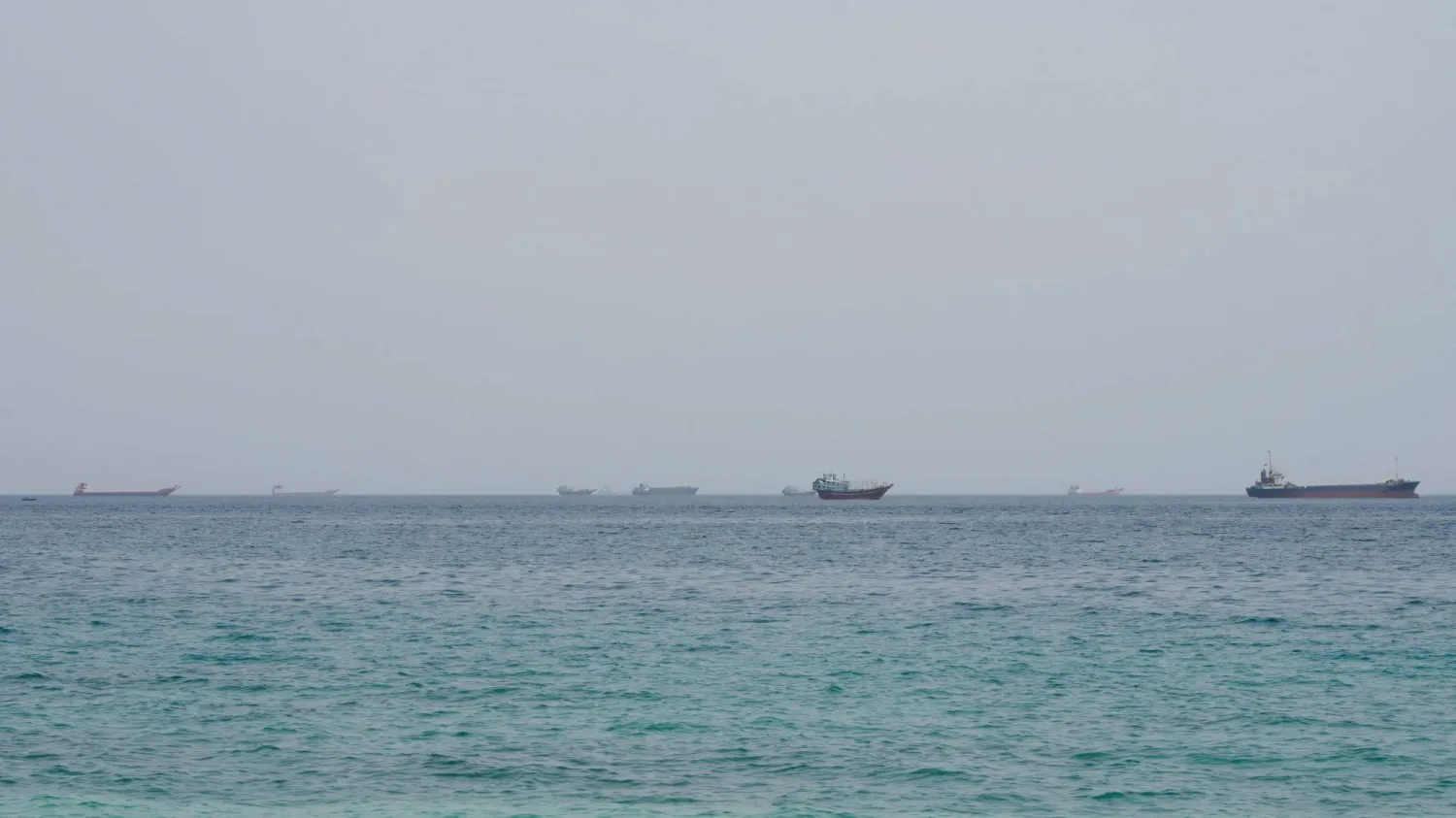
Iran Presses Demands on US as Shipping Standoff Grinds on

 Vessels near the Strait of Hormuz, as seen from Musandam, Oman, August 10, 2026. (Reuters)
Vessels near the Strait of Hormuz, as seen from Musandam, Oman, August 10, 2026. (Reuters)
TT

Iran Presses Demands on US as Shipping Standoff Grinds on

 Vessels near the Strait of Hormuz, as seen from Musandam, Oman, August 10, 2026. (Reuters)
Vessels near the Strait of Hormuz, as seen from Musandam, Oman, August 10, 2026. (Reuters)

An Iranian Foreign Ministry spokesperson said Iran will not reopen the Strait of Hormuz until the United States meets its conditions.

“It is up to the US side to stop and make amends for its illegal and destructive actions,” Esmail Baghaei said Monday, noting the American blockade of Iranian ports.

Iran wants the US to end the blockade, pay compensation for months of war damage, lift economic sanctions and release Iran's frozen assets. The closure of the Strait of Hormuz — a waterway that normally carries roughly one-fifth of the world's traded oil supplies — has become the war’s most lasting consequence.

The impasse has kept energy prices as a major focus of US politics ahead of November’s midterm elections.

Iran is holding separate talks with Oman over transit through the strait, including potentially a temporary shipping corridor. But it has said any actual reopening is contingent on talks with the US.


Trump Demands Iran Pay Compensation for Deaths as Hormuz Deal Hopes Fade

US President Donald Trump attends an event to sign executive orders related to birthright citizenship and the polysilicon industry, in the Oval Office at the White House in Washington, DC, US, August 6, 2026. (Reuters)
TT

Trump Demands Iran Pay Compensation for Deaths as Hormuz Deal Hopes Fade

US President Donald Trump attends an event to sign executive orders related to birthright citizenship and the polysilicon industry, in the Oval Office at the White House in Washington, DC, US, August 6, 2026. (Reuters)

US President Donald Trump on Monday demanded Iran pay compensation for the deaths of people he said it had killed in wars, attacks and protests, raising the rhetorical stakes with Tehran as hopes faded for an imminent deal to reopen the Strait of Hormuz. 

Trump said he was responding to Iran's earlier call for Washington to meet conditions, including recompensing Tehran for the damage caused in the more than five months since the US and Israel launched strikes on its territory. 

"I am likewise demanding compensation from Iran, for all of the people that they have killed and gravely wounded with their roadside bombs and many conflicts, for which they are famous," Trump wrote on ‌his Truth Social ‌service. 

The abrupt new US demand was not mentioned in any previous talks. Trump ‌said ⁠it would be ⁠included in all future negotiations with Iran, and would include calls for payments to families of hundreds of thousands of protesters he said Iran had killed. 

He also suggested Iran should compensate "families of those killed on the USS Cole", a reference to the October 12, 2000, attack on that naval vessel in Yemen which killed 17 US sailors, and has been blamed on al-Qaeda, not Iran. 

Iran had earlier said it was nearing a final pact with Oman defining new shipping lanes between them through the Strait of Hormuz but repeated that the US must meet conditions, including ⁠compensation and an end to sanctions and military threats before the key waterway ‌is reopened. 

The strait, through which about a fifth of global ‌oil and liquefied natural gas flowed prior to the conflict, has been effectively blocked since the US-Israeli attacks on Iran on February ‌28, pushing up oil prices and inflation. 

Oil prices had jumped 3% after the statement from ‌Iranian Foreign Ministry spokesman Esmaeil Baghaei, as initial optimism about a potential deal over the strait was tempered by Iran's talk of conditions. Brent crude extended gains to trade up 4.25% at 1720 GMT. 

Dutch and British front-month gas prices rose more than 10%. 

Trump, who has said the attacks on Iran were aimed at keeping Tehran from developing ‌nuclear weapons and degrading its ability to threaten the region, is under pressure to end a war that is deeply unpopular at home ahead of midterm elections ⁠in November. 

Washington and Tehran ⁠agreed to a ceasefire in June, but the US reimposed a blockade on Iranian shipping in the Gulf in July, a move that Tehran said violated the truce, which by then had already broken down. 


Iran Supreme Leader Names Guards General Abdollahi Military Chief

A delivery person rides a motorcycle near an image of Iran's Supreme Leader Mojtaba Khamenei at Valiasr Square in central Tehran on August 8, 2026. (AFP)
TT

Iran Supreme Leader Names Guards General Abdollahi Military Chief

A delivery person rides a motorcycle near an image of Iran's Supreme Leader Mojtaba Khamenei at Valiasr Square in central Tehran on August 8, 2026. (AFP)

Iranian supreme leader Mojtaba Khamenei named Revolutionary Guards general Ali Abdollahi head of the country's armed forces on Monday, while also confirming a new commander of the Guards, putting his imprimatur on the country's military.

Abdollahi had previously led the Khatam al-Anbiya, Iran's inter-branch central military command tasked with coordinating operations.

A statement on Khamenei's website announced that "Major General Ali Abdollahi has been appointed chief of staff of the armed forces. Brigadier General Ahmad Vahidi has also been appointed Commander-in-Chief of the Revolutionary Guard Corps with the rank of major general."

The pair represent Khamenei's first senior military appointments since being named supreme leader early in the Middle East war after the death of his father in US-Israeli strikes.


Iran’s President Says Supreme Leader Urges ‘Unity’ Amid US Sanctions

Iranian President Masoud Pezeshkian attends a press conference in Tehran, Iran, August 8, 2026. Iran's Presidential website/WANA (West Asia News Agency)/Handout via Reuters
TT

Iran’s President Says Supreme Leader Urges ‘Unity’ Amid US Sanctions

Iranian President Masoud Pezeshkian attends a press conference in Tehran, Iran, August 8, 2026. Iran's Presidential website/WANA (West Asia News Agency)/Handout via Reuters

Iran’s president said on Monday the country's supreme leader is calling for “unity and cohesion” as the country faces economic hardships and sanctions stemming from its war with the United States.

The meeting came amid signs of division among Iran's leaders.

President Masoud Pezeshkian described a nearly seven-hour meeting with Mojtaba Khamenei in an interview Monday with Iranian state television.

He told the state-run IRIB that he and Khamenei discussed “people’s livelihoods, the state of the market, employment, people’s housing,” as well as “problems that are now being created as a result of the (US) sanctions.” He didn’t say when or where they met.

Most important, he said, was Khamenei’s emphasis on unity.

“All of the enemy’s plans are aimed at creating division,” Pezeshkian said. “What we have to do is prevent divisions from emerging.”

It is only the second time the Iranian president said he has met with the new supreme leader since Khamenei was appointed in March following a US-Israeli strike that killed his father.

Khamenei, believed to have been wounded in the same attack, has not appeared in public since then.