Gold Eases from Over Two-Month Peak, Inflation Reports in Focus

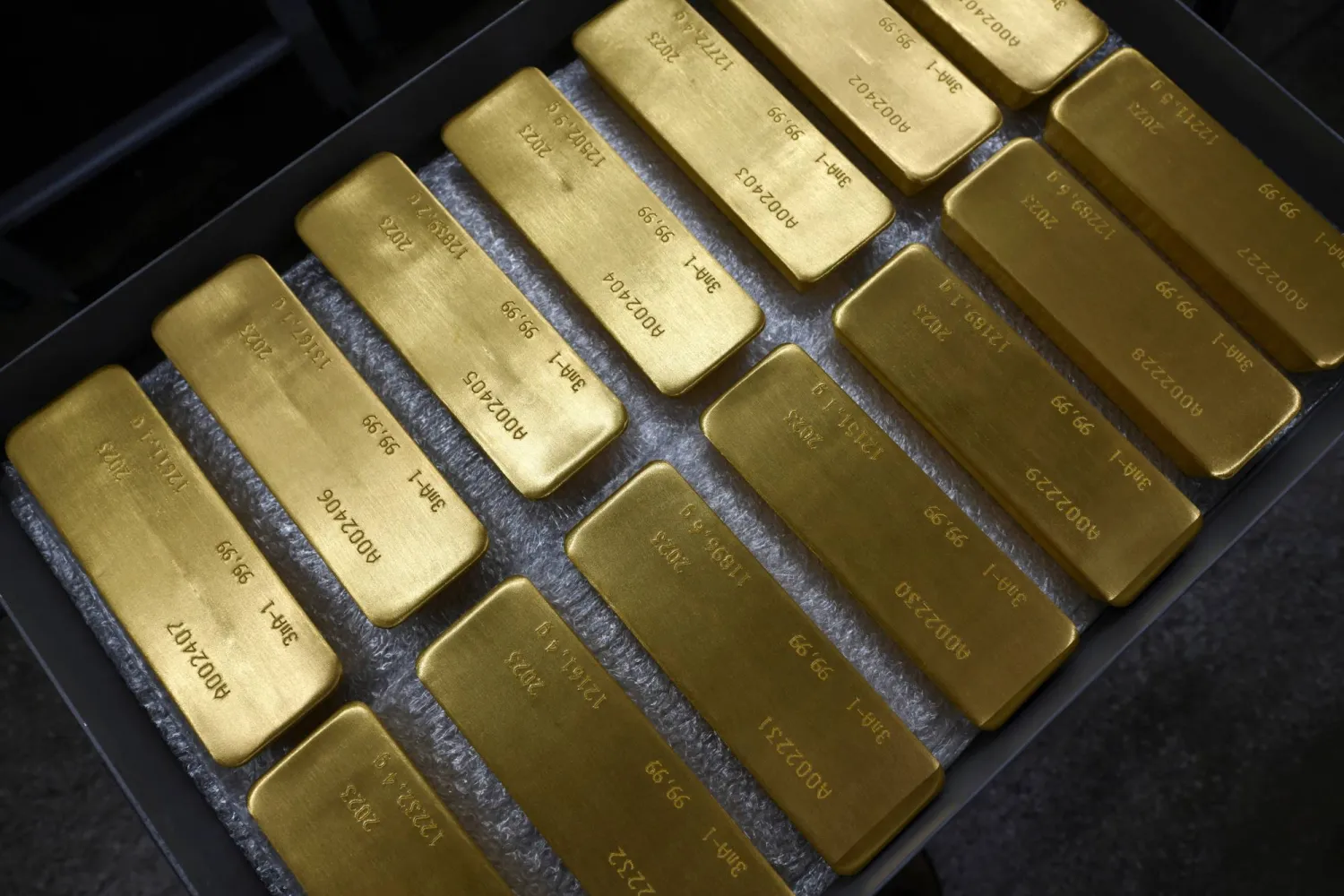
Ingots of 99.99 percent pure gold are placed in a workroom at Krastsvetmet precious metals plant in the Siberian city of Krasnoyarsk, Russia, January 31, 2023. (Reuters)
TT

Gold Eases from Over Two-Month Peak, Inflation Reports in Focus

Ingots of 99.99 percent pure gold are placed in a workroom at Krastsvetmet precious metals plant in the Siberian city of Krasnoyarsk, Russia, January 31, 2023. (Reuters)

Gold ticked lower on Tuesday after hitting its highest level in more than two months, while investors focused on upcoming inflation data for clues on the U.S. interest-rate outlook.

Spot gold was down 0.3% to $4,374.82 per ounce by 0548 GMT, after hitting its highest level since June 5 earlier in the session at $4,434.84.

US gold futures rose 0.4% ‌to $4,435.00.

Gold's move higher ‌in early session trading beyond $4,400 appears to ‌be ⁠driven primarily by ⁠renewed flows into the metal and a notable shift in the metal market sentiment, said Ahmad Assiri, Research Strategist at Pepperstone.

"If this change in sentiment continues to attract further flows, it could remain an important factor in determining whether gold can consolidate around $4,400 and potentially extend the recovery towards higher levels."

The US ⁠consumer price report due on Wednesday and ‌producer price data on Thursday are ‌likely to shape monetary policy expectations after weak July US jobs ‌data last week led markets to scale back bets that ‌the Federal Reserve would raise rates next month.

At its July meeting, the Federal Reserve kept rates steady, with three officials dissenting in favor of a hike.

Lower interest rates tend to support gold as ‌bullion pays no interest.

"If the data continue to point towards a cooling economy without a meaningful ⁠resurgence in ⁠inflation, markets could further reduce expectations for tighter policy. That would likely leave the dollar vulnerable and provide another supportive backdrop for gold," Fawad Razaqzada, a market analyst at Forex.com, said in a note.

On the geopolitical front, US President Donald Trump responded to Iran's conditions for a peace deal with his own demands that Iran pay compensation for people killed in wars, attacks and protests, in a rhetorical escalation likely to complicate efforts to reopen the Strait of Hormuz.

Among other metals, spot silver fell 1.7% to $64.64, platinum lost 0.4% to $1,745.68 and palladium declined 0.8% to $1,372.44.


Saudi Economy Relies on Non-Oil Growth Engines to Absorb External Shocks

Oil fields operated by Saudi Aramco (Aramco)
TT

Saudi Economy Relies on Non-Oil Growth Engines to Absorb External Shocks

Oil fields operated by Saudi Aramco (Aramco)

Saudi Arabia's economic indicators show a growing ability to withstand external shocks, supported by an expanding non-oil sector that has continued to grow despite geopolitical tensions and disruptions to regional trade and energy routes.

Although gross domestic product (GDP) contracted by 3.8% year on year in the third quarter of 2026, the pace of decline slowed from a 4.7% contraction in the second quarter. Non-oil activities grew by 1.9%, accelerating from 0.9% in the previous quarter, while oil activities declined by 20.4%.

The significance of this performance is particularly evident given the exceptional circumstances of the third quarter, including disruptions to shipping through the Strait of Hormuz and the temporary shutdown of the East-West Pipeline in September.

Seasonally adjusted real GDP also grew by 1.3% compared with the second quarter, indicating an improvement in economic activity on a quarterly basis and reflecting the ability of certain sectors to continue expanding despite the sharp contraction in oil activities.

Annual and Quarterly Performance

According to data from the General Authority for Statistics, oil activities were the main driver of the GDP contraction, contributing a negative 4.7 percentage points, while government activities subtracted 0.4 percentage points.

By contrast, non-oil activities made a positive contribution of 1.1 percentage points, while net taxes on products added approximately 0.1 percentage points.

The data also showed an improvement in economic performance on a quarterly basis, with seasonally adjusted real GDP increasing by 1.3% in the third quarter compared with the second quarter of this year.

The growth was driven by a 5.7% increase in oil activities and a 0.6% rise in non-oil activities, while government activities declined by 1.2%.

Last month, the International Monetary Fund (IMF) noted that Saudi Arabia's available fiscal buffers and alternative oil export facilities were helping limit the economic damage caused by the war. The Fund considered the Kingdom better positioned than its Gulf peers to contain the fallout from the disruptions.

The IMF projected a strong recovery in the Saudi economy in 2027, forecasting growth of 7.9% amid expectations of a rebound in oil activities and improvements in trade and shipping.

These projections are particularly significant in light of Saudi government estimates that the economy will contract by 3.6% in 2026, with the projected budget deficit rising to 4.9% of GDP.

The contrasting performance of oil and non-oil activities underscores the importance of the structural transformation underway in the Saudi economy.

Non-oil activities are no longer merely an additional contributor to GDP. They are playing an increasingly important role in absorbing shocks and limiting the transmission of volatility in the energy sector to the broader economy.

Promising Sectors

Since the launch of Vision 2030, the Saudi government has pursued a clear strategy to diversify income sources and broaden the economic base by accelerating non-oil growth and developing promising sectors.

These include information technology and artificial intelligence, transportation and logistics, tourism, entertainment and quality of life, renewable energy and sustainability, as well as mining, manufacturing and other targeted industries.

These efforts have helped diversify sources of economic activity and strengthen the contribution of non-oil sectors, giving the Saudi economy greater flexibility to withstand external fluctuations by diversifying sources of value added and expanding the role of domestic businesses and the private sector.

Consumer Spending

In this context, Dr. Abdullah Al-Mir, Assistant Professor of Economics at King Fahd University of Petroleum and Minerals, told Asharq Al-Awsat that the contraction in the Saudi economy during the third quarter was not broad-based. Instead, it was concentrated largely in oil activities, which declined by approximately 20%.

Non-oil activities, meanwhile, continued to grow by 1.9%, playing an important role in cushioning the impact of the sharp decline in the oil sector.

According to Al-Mir, government spending and private sector activity are two key pillars of this resilience. Continued consumer spending by households and the private sector helps sustain domestic demand in trade, retail, hospitality, services and transportation, all labor-intensive activities directly linked to the non-oil economy.

He noted that the Riyad Bank Purchasing Managers' Index (PMI) reached 55.3 in September 2026, remaining in expansion territory for the sixth consecutive month, reflecting continued improvement in non-oil private sector activity.

Al-Mir explained that the importance of non-oil activities becomes even clearer when the energy sector slows. Sustained activity in services, entertainment and domestic tourism helps small and medium-sized enterprises remain operational, preserves local supply chains and supports employment opportunities.

He emphasized the importance of strengthening the resilience of the non-oil private sector against external volatility.

Al-Mir added that one of the most significant signs of Saudi Arabia's economic transformation was the increase in the share of non-oil activities to 57.3% of the economy, describing it as a historic level that reflects a structural shift in the country's economic composition.

He linked this transformation to the decline in the unemployment rate among Saudi nationals to 6.5%, highlighting the potential impact of expanding non-oil activity on the labor market.

Al-Mir noted that sectors such as tourism, entertainment, technology and manufacturing continued to expand despite geopolitical disruptions that affected oil production and shipping, further demonstrating the structural transformation of the Saudi economy.

"Non-oil activities have a greater capacity to withstand shocks, while sustained investment momentum associated with Vision 2030 provides an alternative source of growth," he said.


Saudi Arabia Records 6,484 Franchise Registrations, Up 53%

A consumer goods store in Saudi Arabia (SPA)
TT

Saudi Arabia Records 6,484 Franchise Registrations, Up 53%

A consumer goods store in Saudi Arabia (SPA)

Commercial franchise registrations in Saudi Arabia grew by 53% during the first nine months of 2026, reaching 6,484, compared with 4,227 at the end of 2025, according to the Ministry of Commerce.

The ministry said the food and beverage, fuel and petroleum, and fashion and apparel sectors accounted for the highest number of franchise registrations in the Kingdom.

It explained that the Commercial Franchise Law aims to regulate and develop the sector, enhance transparency, protect the rights of all parties involved, and create an attractive investment environment.

It also seeks to improve the quality of goods and services and support the sustainability, growth and expansion of commercial activities.


Saudi Stock Market Falls 0.8% for Second Consecutive Session

A man walks past the Tadawul logo at the Saudi stock exchange (AFP)
TT

Saudi Stock Market Falls 0.8% for Second Consecutive Session

A man walks past the Tadawul logo at the Saudi stock exchange (AFP)

Saudi Arabia's benchmark Tadawul All Share Index (TASI) closed Sunday's session down 0.8% at 9,838 points, shedding 83 points amid total trading turnover of approximately SAR 3.1 billion.

The decline marked the index's second consecutive losing session after it fell 1% on Thursday to 9,922 points, ending a three-day winning streak that began with a 3.4% surge on Monday, followed by gains of 2.3% on Tuesday and 0.4% on Wednesday.

Despite Thursday's losses, the index ended last week up approximately 2.4%.

During Sunday's session, the benchmark fluctuated between a low of 9,789 points and a high of 9,923 points, moving further away from the 10,000-point threshold it had surpassed during trading last week.

Market Declines

Among heavyweight stocks, Al Rajhi Bank edged down approximately 0.1%, while ACWA Power fell around 3%.

Shares of Alujain and SPIMACO dropped approximately 10% each, while Saudi Reinsurance (Saudi Re) declined 8% and Jabal Omar Development fell around 7%.

Dr. Sulaiman Al Habib Medical Services Group and ZOUJAJ closed at SAR 214 and SAR 35.02, respectively, down 3% and 2% following the passing of their dividend eligibility dates.

Elm Leads Gains

In contrast, Elm shares surged approximately 9% following the release of the company's financial results.

SAHL rose around 4%, Sports Clubs Company gained more than 4%, and Watani Iron Steel advanced more than 2%.

BinDawood Holding and Sumou Real Estate each jumped 5%.