


Saudi Govt: Makkah Defense Agreement Strengthens Islamic Solidarity, Advances Common Interests

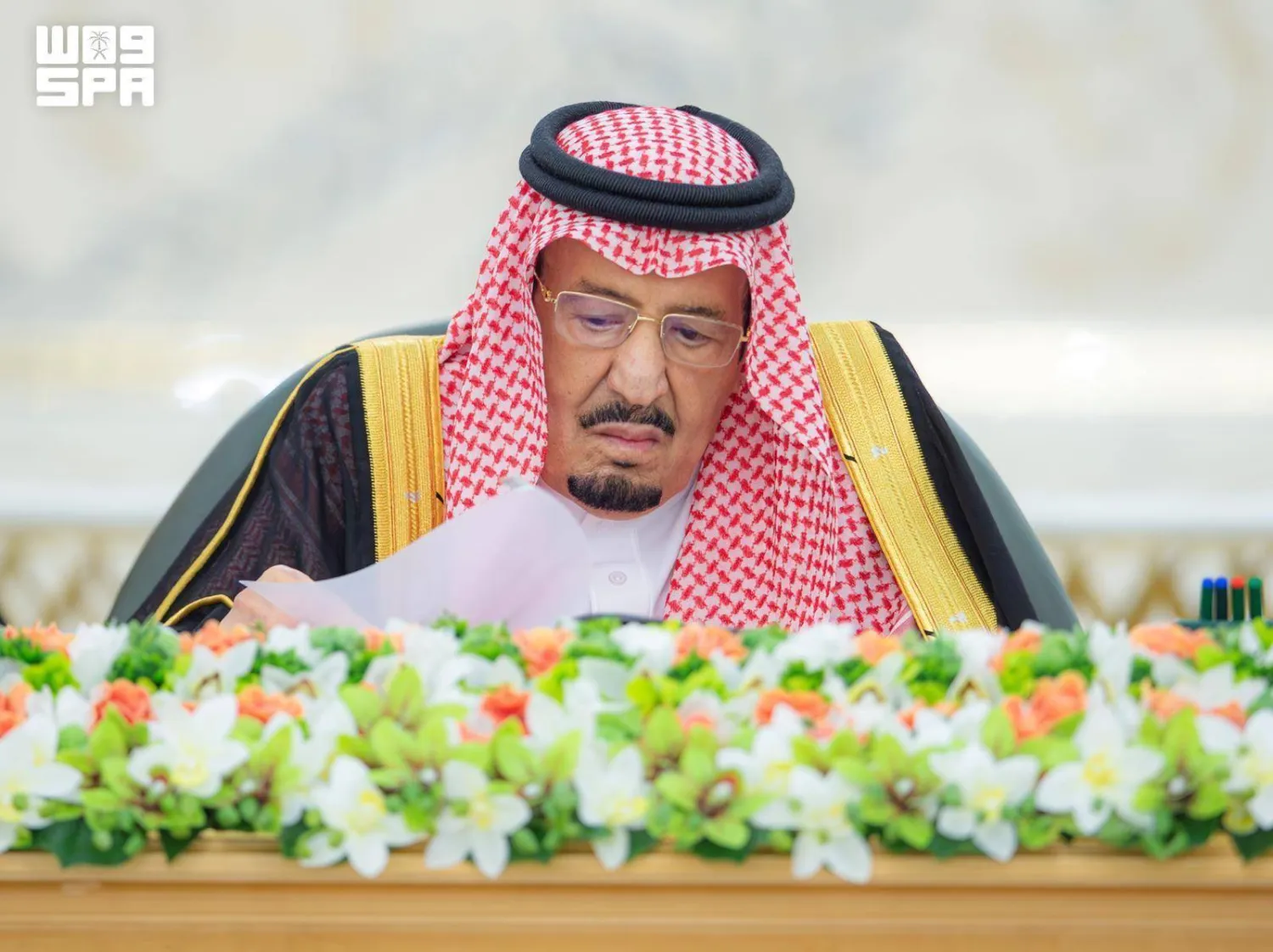
Custodian of the Two Holy Mosques King Salman bin Abdulaziz Al Saud chairs the Cabinet meeting in Jeddah on Tuesday. (SPA)
TT

Saudi Govt: Makkah Defense Agreement Strengthens Islamic Solidarity, Advances Common Interests

Custodian of the Two Holy Mosques King Salman bin Abdulaziz Al Saud chairs the Cabinet meeting in Jeddah on Tuesday. (SPA)

The Saudi government hailed on Tuesday the Makkah Joint Defense Agreement for reaffirming “the deep-rooted historical ties” between the Kingdom, Türkiye and Pakistan.

It also underscored their “shared commitment to strengthening the bonds of brotherhood and Islamic solidarity while advancing their common strategic interests.”

Custodian of the Two Holy Mosques King Salman bin Abdulaziz Al Saud chaired the Cabinet session that was held in Jeddah.

King Salman expressed his gratitude to Prince Mohammed bin Salman bin Abdulaziz Al Saud, Crown Prince and Prime Minister, Turkish President Recep Tayyip Erdogan; and Pakistan’s Prime Minister Muhammad Shehbaz Sharif for their successful and blessed efforts in convening the summit last week.

King Salman praised the outcomes of the tripartite summit in establishing a framework for a long-term defense partnership that will contribute to strengthening joint cooperation, coordination, and integration between the Kingdom, Türkiye, and Pakistan.

It will help in continuing efforts to address regional challenges and preserve international security and stability in a manner that supports the aspirations of the peoples of the region and the wider international community for a more prosperous and flourishing future.

The Cabinet was then briefed on the message received by King Salman from President of Zimbabwe Emmerson Mnangagwa, as well as the phone calls between Crown Prince Mohammed and French President Emmanuel Macron and Ukraine’s President Volodymyr Zelenskyy.

The Cabinet reviewed regional and international developments and Saudi Arabia’s efforts, through communication and coordination with brotherly and friendly countries, to support de-escalation in the region, advance diplomatic solutions, and strengthen all initiatives that respect the sovereignty and territorial integrity of states and ensure the security of waterways in the straits of Hormuz and Bab al-Mandeb as they are fundamental pillars of global economic stability.

The Cabinet welcomed the United Nations Security Council statement condemning the attacks and criminal acts committed by the terrorist Houthi militias in Yemen that threaten regional security and freedom of maritime navigation.

It reiterated Saudi Arabia's right to defend its security and resources and its unwavering support for the legitimate Yemeni government and UN-led efforts to achieve peace and stability in Yemen.

The Cabinet commended the steps taken at the Ministerial Meeting in Support of Jerusalem and its Holy Sites in Amman, reaffirming its categorical rejection of all attempts to alter the legal and historical status of Jerusalem or undermine its identity.

It called on the international community to halt Israeli violations in Gaza and the West Bank, protect holy sites, and support the Palestinian people.

The Cabinet noted Riyadh's hosting of the fourth UNESCO Global Forum on the Ethics of Artificial Intelligence in September, saying it reflects the Kingdom's commitment to multi-party global dialogue on emerging technologies and responsible AI use, contributing to a more inclusive and sustainable digital future.

The Cabinet also viewed the Kingdom's successful hosting of the International Nuclear Science Olympiad and Saudi students' top results in the competition as confirmation of its global leadership in scientific events and its commitment to empowering talented individuals in line with Saudi Vision 2030.


Saudi King Hails Forces Defending Kingdom, Condemns Houthi Attempts to Target Makkah

 King Salman bin Abdulaziz Al Saud chairing a Cabinet session in Jeddah - SPA
King Salman bin Abdulaziz Al Saud chairing a Cabinet session in Jeddah - SPA
TT

Saudi King Hails Forces Defending Kingdom, Condemns Houthi Attempts to Target Makkah

 King Salman bin Abdulaziz Al Saud chairing a Cabinet session in Jeddah - SPA
King Salman bin Abdulaziz Al Saud chairing a Cabinet session in Jeddah - SPA

Custodian of the Two Holy Mosques King Salman bin Abdulaziz Al Saud chaired the Cabinet session held on Tuesday in Jeddah.

The Custodian of the Two Holy Mosques praised and thanked Allah Almighty for the great blessings bestowed upon this country, and for the honor of serving the Grand Mosque, the Prophet's Mosque, and their visitors. As the Kingdom of Saudi Arabia celebrates its National Day tomorrow, the King expressed his wishes for further achievements and successes in the nation's journey of growth, progress, and leadership across all sectors, SPA reported.

The Custodian of the Two Holy Mosques acknowledged the role of military and security personnel and their brave heroes in defending the homeland and firmly confronting any aggression against the holy sites, the pilgrims, and the Kingdom's citizens and residents.

He also condemned the terrorist Houthi militia's repeated attempt to target Makkah—an act met with widespread international condemnation and denunciation—emphasizing that this heinous crime, which violates the sanctity of the holy sites, provokes the sentiments of Muslims worldwide.

The Cabinet then reviewed the outcomes of the visit by Prince Mohammed bin Salman bin Abdulaziz Al Saud, Crown Prince and Prime Minister, to the Arab Republic of Egypt, where discussions held with President Abdel Fattah El-Sisi underscored the depth of bilateral relations, the shared desire to enhance cooperation, and the commitment to ongoing consultation and coordination on issues of mutual interest to serve both peoples.

The Cabinet also reviewed the contents of a message HRH the Crown Prince received from King Abdullah II bin Al Hussein of Jordan, as well as the details of a phone call he received from French President Emmanuel Macron, which addressed regional developments, efforts to bolster regional stability, and measures to safeguard the freedom and safety of maritime navigation and waterways.

In a statement to the Saudi Press Agency following the session, Minister of Media Salman Al-Dossary said the Cabinet, upon its review of regional developments, emphasized the necessity of adhering to international law—specifically respect for state sovereignty, the peaceful resolution of disputes, and the guarantee of safe navigation in international waterways—to safeguard the security of states, fulfill the aspirations of peoples, and protect international trade and global supply chains.

The Cabinet reviewed the outcomes of several international conferences hosted by Saudi Arabia. It highlighted the recommendations issued by the ministerial meeting of the UNESCO Global Forum on the Ethics of Artificial Intelligence 2026, which support international cooperation to ensure sound AI development, strengthen governance frameworks, regulate emerging technologies, and harness them safely and inclusively to achieve the Sustainable Development Goals.

The Cabinet commended the success of the fourth edition of the Riyadh Global Medical Biotechnology Summit, which saw the launch of more than 40 agreements and initiatives aimed at localizing knowledge and innovation, advancing the sector, achieving national strategic targets, and boosting the contribution of global research to pharmaceutical discoveries and future technologies. These efforts reinforce the Kingdom's leadership in initiatives serving human health as a top priority.

The Cabinet also noted the unveiling of the first models from the national automotive company, CEER, marking a new strategic milestone toward establishing an advanced, sustainable industrial ecosystem. This step empowers the sector as a vital engine of economic growth—attracting investments, supporting national talent, and expanding the private sector's developmental role—in alignment with Saudi Vision 2030 objectives and cementing the Kingdom's standing as a leading regional and global industrial hub.


Foreign Ministers of Saudi Arabia, Arab and Islamic Countries Meet on UNGA Sidelines

The Saudi Ministry of Foreign Affairs logo
TT

Foreign Ministers of Saudi Arabia, Arab and Islamic Countries Meet on UNGA Sidelines

The Saudi Ministry of Foreign Affairs logo

The ministers of foreign affairs of the Kingdom of Saudi Arabia, Egypt, Qatar, Jordan, the United Arab Emirates, Indonesia, Pakistan, and Türkiye met in New York on September 21, 2026, on the margins of the 81st Session of the United Nations General Assembly.

The ministers expressed deep concern over the continued humanitarian suffering in Gaza and called upon Israel to immediately fulfill its outstanding commitments under the First Phase of the Comprehensive Plan, including by ensuring the immediate, safe and unhindered delivery of humanitarian assistance and Early Recovery supplies, and facilitating the rehabilitation of critical infrastructure. They stressed the imperative of preserving the ceasefire and ending all violations, SPA reported.

The ministers stressed that the Road Map constitutes an integral part of the Comprehensive Plan and provides the implementation framework for advancing its Second Phase, including decommissioning alongside full Israeli withdrawal, the deployment of the International Stabilization Force (ISF), the assumption by the National Committee for the Administration of Gaza (NCAG) of its responsibilities throughout the Gaza Strip, and the launch of Early Recovery and Reconstruction across Gaza. They called on all parties to fulfill their respective commitments in good faith and without delay.

The ministers reiterated their categorical rejection of any measures aimed at the expulsion or the forced displacement of the Palestinian people from their homeland or attempts to alter the territorial or demographic character of the Occupied Palestinian Territory.

They deplored in this context the illegal measures aimed at consolidating Israeli control and annexation, including the accelerating settlement expansion, land confiscation, demolition of Palestinian homes, settler violence and terrorism, and forced displacement, and called for their immediate reversal. They expressed grave concern over measures undermining the historical and legal Status Quo of the Muslim and Christian holy sites in Jerusalem.

The ministers welcomed the recent measures taken by the United Kingdom, as well as broader national and European efforts, in response to illegal Israeli settlement activity, including measures to halt trade with illegal Israeli settlements and called for further effective measures to end settlement expansion and ensure accountability for settler violence.

They also emphasized that Gaza must remain an integral part of the Palestinian territory and reaffirmed that the implementation of the Comprehensive Plan must contribute to the reunification of the West Bank, including East Jerusalem, and the Gaza Strip, and to a credible and irreversible pathway towards the exercise of the Palestinian people's right to self-determination and the realization of a sovereign, viable, and independent Palestinian State with East Jerusalem as its capital, through the implementation of the two-state solution.

The ministers commended the leadership of President Donald J. Trump and underscored the indispensable role of the United States in ensuring the implementation of the Comprehensive Plan. They called for sustained and active US engagement to ensure that all parties, including Israel, fulfill their commitments and obligations and overcome obstacles to implementing the Road Map. They stressed that tangible progress on the ground will strengthen the credibility of the Board of Peace and the authority of the plan and create deeply needed momentum.

The ministers reaffirmed their readiness to continue working collectively with the United States, the Board of Peace, the Palestinian Authority and all relevant parties to advance the full implementation of the Comprehensive Plan and its Road Map, alleviate the suffering of the Palestinian people, fulfill their right to self-determination and independent statehood and achieve a just, lasting and comprehensive peace in the region.


KSrelief, WHO Sign Joint Program to Treat Children with Acute Malnutrition in Yemen

The program is part of Saudi Arabia's efforts, represented by KSrelief, to strengthen cooperation and strategic partnership with WHO. SPA
TT

KSrelief, WHO Sign Joint Program to Treat Children with Acute Malnutrition in Yemen

The program is part of Saudi Arabia's efforts, represented by KSrelief, to strengthen cooperation and strategic partnership with WHO. SPA

The King Salman Humanitarian Aid and Relief Center (KSrelief) has signed a joint executive program with the World Health Organization (WHO) to purchase and distribute therapeutic response packages for children suffering from severe acute malnutrition across 35 nutritional care centers in Yemen.

On the sidelines of the 81st session of the United Nations General Assembly in New York, the program was signed on Monday by Adviser at the Royal Court and Supervisor General of KSrelief Dr. Abdullah Al Rabeeah and WHO Director-General Dr. Tedros Adhanom Ghebreyesus.

The program is part of Saudi Arabia's efforts, represented by KSrelief, to strengthen cooperation and strategic partnership with WHO to provide medicines, essential equipment, and specialized treatment for children suffering from acute malnutrition in countries in need.

Dr. Al Rabeeah and Ghebreyesus also discussed ways to strengthen cooperation and coordinate efforts in health and humanitarian relief, and reviewed progress on joint projects supporting the most vulnerable populations worldwide.

Tedros praised Saudi Arabia's humanitarian and medical work through KSrelief, highlighting the center's pivotal role in supporting healthcare systems and its swift response to health crises and emergencies in countries in need.