
US ‘Veto’ Stalls Talks to Complete Zaidi Govt in Iraq

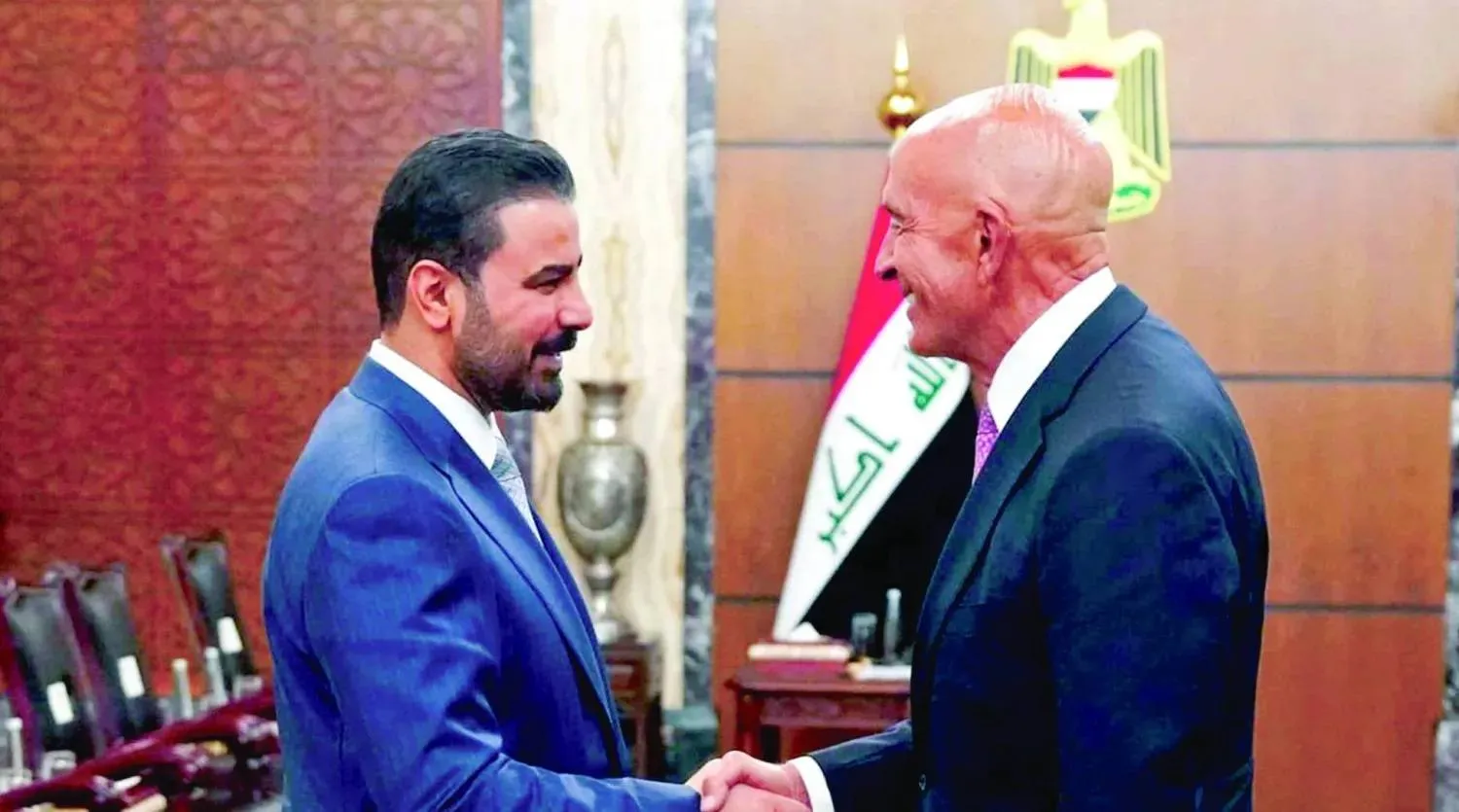
Iraqi Prime Minister Ali al-Zaidi meets US envoy Tom Barrack in Baghdad, June 16, 2026. (Government media)
TT

US ‘Veto’ Stalls Talks to Complete Zaidi Govt in Iraq

Iraqi Prime Minister Ali al-Zaidi meets US envoy Tom Barrack in Baghdad, June 16, 2026. (Government media)

A US “veto” has stalled talks to fill vacant posts in Iraqi Prime Minister Ali al-Zaidi’s government, political sources said, as Washington prioritizes a plan to bring armed factions’ weapons under state control despite Iranian objections.

Al-Zaidi told a meeting of the ruling Coordination Framework on Monday that he was close to completing his cabinet, which he announced in mid-May with 14 ministerial portfolios filled and nine posts vacant.

The vacancies include key ministries such as defense, interior, higher education and planning.

Iraq’s federal parliament has often approved incomplete governments in previous terms because of disputes among political parties and blocs over quotas and ministerial posts, with compromises reached later to fill the remaining portfolios.

But the formation of al-Zaidi’s government appears more complicated, and the remaining posts could stay vacant for months, according to a senior Framework official.

US ‘red lines’

The official told Asharq Al-Awsat that disputes over posts could delay completion of the government for a short period, but recent US intervention, particularly under al-Zaidi’s government, could hold it up for months.

The official said discussions within the Framework pointed to “a veto and red lines” imposed by the United States and US presidential envoy Tom Barrack on virtually all candidates nominated by the Framework.

“Some clearly believe Washington does not want the government completed at the moment,” the official said.

Several sources have previously said Washington categorically rejected representatives of armed factions taking ministerial posts and had raised the issue explicitly with al-Zaidi during his latest visit to Washington in July.

Framework uncertainty

Amid reports that Washington has rejected Laith al-Khazali for the post of deputy prime minister, the senior official said there was confusion within the Coordination Framework over the US position, saying Washington had placed red lines on most of its parties and factions.

“Take the State of Law coalition, for example. It has no factions or armed wings, but it too is under the weight of US anger and is not allowed to take ministerial posts,” the official said. “The same happened with its leader Nouri al-Maliki, whom the US president publicly rejected when he was nominated for prime minister.”

Maliki is the head of the State of Law coalition and Trump had vehemently opposed his nomination.

The official said the US priority appeared to be bringing weapons under state control and countering Tehran’s influence in Iraq, rather than completing the cabinet.

“Washington may prefer the defense and interior ministries to remain directly under Prime Minister al-Zaidi,” the official said.

Amid unconfirmed media reports that the head of Iran’s Quds Force is in Baghdad to counter moves to dissolve the armed factions, political sources said al-Zaidi’s announcement that the remaining cabinet posts would be filled was “a cover for the failure to reach an agreement with the Iranians over bringing weapons under state control, and for concerns about the fate of the government itself.”

After September

Kifah Mahmoud, political adviser to Kurdistan Democratic Party leader Masoud Barzani, said negotiations to fill the remaining government posts could take place in September at the earliest.

September 30 is the deadline set by the Baghdad government to resolve the issue of disarming the factions, he told Asharq Al-Awsat.

He added that Iraq’s federal constitution does not accept the presence of any armed faction outside the authority of the state and government.

Mahmoud agreed with the view that there was US resistance to completing the government, saying Washington had repeatedly opposed senior government posts going to figures close to armed factions.

“The two main parties in Kurdistan, the Democratic Party and the Patriotic Union, support al-Zaidi and his efforts to complete his cabinet,” he said.

“But the issue is tied to disputes among the leading forces within the Coordination Framework, as well as among Sunni parties.”

Still, Mahmoud said “serious US reservations over who holds government posts, and the red lines Washington has imposed, could obstruct al-Zaidi’s efforts to fill the remaining vacancies.”


RSF-Led Alliance Claims Capture of Strategic Sudanese City Near Ethiopian Border

Members of the RSF. (AP file)
TT

RSF-Led Alliance Claims Capture of Strategic Sudanese City Near Ethiopian Border

Members of the RSF. (AP file)

Sudan’s Tasis Alliance, of the Rapid Support Forces (RSF), announced that its troops have seized the strategic city of Qeissan in the Blue Nile state, southeastern Sudan after fierce fighting with the army.

The development marks a new shift on a front that has seen intensifying combat for months. It comes weeks after government forces advanced in southern Blue Nile and recaptured the nearby border city of Kurmuk and other positions.

The Sudan Founding Alliance, known as Tasis, brings together the RSF, led by Mohamed Hamdan Dagalo, known as Hemedti; the Sudan People’s Liberation Movement-North (SPLM-N), led by Abdelaziz al-Hilu; other armed Darfuri groups; and political and civilian forces.

Tasis was formed after its members signed a political charter in Nairobi in February 2025. It later established a parallel authority called the Government of Peace and Unity, headed by Hemedti, with al-Hilu serving as deputy chairman of the presidential council. The army-aligned government in Port Sudan does not recognize the authority.

Tasis claims full control

In a statement Tuesday, Tasis forces announced they had taken “full control” of Qeissan, about 170 kilometers southeast of Blue Nile’s capital, Damazin, and seized all military positions inside the city, along with large quantities of weapons and equipment that were still being inventoried.

The alliance said it was pursuing retreating army units and inflicting losses in personnel and equipment, without providing figures.

The army had not confirmed or denied losing the city by the time of publication, while no independent estimates of casualties were available.

Field sources reported that fierce clashes were continuing in several areas of Qeissan and that the situation on the ground was changing rapidly.

Strategic importance

Qeissan is strategically important because of its location near the Ethiopian border and along an area that has become a battleground for control of key movement and supply routes.

Fighting on the Blue Nile front has intensified in recent months following joint military operations by the RSF and SPLM-N against the army.

Qeissan came under its first major drone attack of the new campaign on February 27. Between March and June, alliance forces repeatedly tried to advance toward the city and cut government supply lines but failed to capture it.

Control of southern Blue Nile has shifted several times in recent months. Tasis captured Kurmuk in March before the army launched counteroffensives in July, retaking the city and other positions and expanding its control near the Ethiopian border.

The claim of Qeissan’s capture follows recent army gains in North Kordofan, where government forces and their allies retook Bara, Umm Sayala and Jabra al-Sheikh from the RSF, reopening the Export Road linking El Obeid and Omdurman.

Qeissan has repeatedly changed hands during Sudan’s past conflicts. It had remained under army control since war broke out between the military and the RSF on April 15, 2023, with ground fighting largely bypassing the area during the first two years. This year, however, it has emerged as a key front between the army and the RSF-SPLM-N alliance.


Peace Now Accuses Israeli Government of Weakening PA, Undermining Oslo Accords

Smoke rises during an Israeli controlled-demolition from the home of Palestinian Farouk Ramadan, who was involved and killed in clashes with Israeli settlers on July 24, killing two, in the Palestinian village of Tell in the occupied West Bank on August 11, 2026. (AFP)
TT

Peace Now Accuses Israeli Government of Weakening PA, Undermining Oslo Accords

Smoke rises during an Israeli controlled-demolition from the home of Palestinian Farouk Ramadan, who was involved and killed in clashes with Israeli settlers on July 24, killing two, in the Palestinian village of Tell in the occupied West Bank on August 11, 2026. (AFP)

The Israeli advocacy group, Peace Now, warned that the policy being implemented by the Israeli government in the West Bank weakens the Palestinian Authority and strains the 33-year-old Oslo framework through settlement expansion and shifted administrative powers.

In a report obtained by Ynet on Tuesday, Peace Now accused Israeli Prime Minister Benjamin Netanyahu’s government of carrying out an organized and consistent campaign to weaken the Palestinian Authority economically, politically, territorially and in terms of security.

It said the Israeli government violated the agreements signed in Oslo by expanding settlements and transferring authority in Areas A and B of the West Bank to the Civil Administration.

The movement then warned that these practices represent an Israeli undeclared annexation of the territories.

“Netanyahu’s government is playing with fire, disregarding its international commitments and endangering Israel’s security - all in order to take control of more territory and land in the West Bank,” Peace Now said.

It added that “the government’s actions in Areas A and B are not isolated incidents but part of an organized policy whose ultimate goal is to collapse the Palestinian Authority and create chaos that would allow it to expand settlements into cities and villages deep inside the West Bank.”

The Oslo Accords split the West Bank into three temporary zones: Area A (about 18% under Palestinian control), Area B (about 22% under joint control), and Area C (about 60% under full Israeli control). The five-year interim plan never shifted to a permanent treaty.

Since the Second Intifada, the Israeli military has routinely conducted operations, raids, and incursions into Area A, fundamentally altering the implementation of the original agreement.

Peace Now said the Israeli military further violated the agreement last year when it used land-requisition orders inside Area A for explicitly civilian settlement purpose, rather than for military purposes.

Also, Peace Now’s report said one of the main tools used to pressure the PA is the withholding of tax revenues collected by Israel on its behalf under the 1994 Paris Protocol.

The revenues amount to about 11 billion shekels (around $3.66 billion) a year and have historically accounted for more than 60% of the Palestinian Authority’s budget, according to Ynet.

Peace Now said only about half of the funds owed to the Palestinian Authority were transferred under the current government between 2022 and 2025. Since June 2025, not a single shekel has been transferred, according to the report.

It also noted the security cabinet measures introduced in February and which authorized the Civil Administration to enforce regulations and oversee environmental protection, water and archaeology in Areas A and B of the West Bank.

The Israeli government claimed the move was aimed at preventing environmental hazards and damage to heritage sites, it said.

Peace Now noted that the environmental and archaeological measures use definitions broad enough to enable Israeli civilian authorities to intervene in Palestinian construction across much of the West Bank.

It then cited Israeli military orders issued in July to requisition Palestinian land inside Area A for a road connecting two settlements.

The movement said it was the first time since the Oslo Accords were signed that military land-requisition orders had been used inside Area A for an explicitly civilian settlement purpose, rather than for military purposes.

Peace Now said it had also documented at least 23 settlement outposts established in Areas B over the past two and a half years.

But even when the military occasionally removes the outposts, they are rebuilt and expanded, including with permanent structures, it said.

The movement noted that the outposts have been accompanied by the construction of roads, the takeover of water sources and the displacement of Palestinian residents.

Settlers have also taken over abandoned Palestinian homes in Areas B and C after residents were forced to leave following repeated settler attacks.

The report mentions a June decision by the Civil Administration, which moved to strip the Palestinian municipality of Hebron of broad planning and construction powers relating to settlements and several holy sites in the heart of the city.

Peace Now stressed that the government has not formally announced the cancellation of the Oslo Accords, nor has it introduced legislation to annex the West Bank or dismantle the Palestinian Authority.

The group argued that the measures combined amount in practice to a process of undeclared annexation.

Israeli Finance Minister Bezalel Smotrich said the report was a “certificate of achievement for the Israeli government.”

He said, “What they call ‘the erosion of Oslo’ we call correcting an injustice resulting from 30 years of neglect,” according to Ynet.

“What they call ‘de facto annexation’ we call establishing Israel’s security belt,” the minister added. “I am proud of the settlement revolution I have led to prevent the establishment of a Palestinian terrorist state in the heart of the country. This is only the beginning.”


Report: US Negotiates Secret Deal Over Clandestine Syrian Assad-era Nuclear Site

US President Donald Trump and Syrian President Ahmed al-Sharaa meet at the White House in November 2025. (AFP/SANA)
TT

Report: US Negotiates Secret Deal Over Clandestine Syrian Assad-era Nuclear Site

US President Donald Trump and Syrian President Ahmed al-Sharaa meet at the White House in November 2025. (AFP/SANA)

The International Atomic Energy Agency (IAEA) will soon remove nuclear material stored at a clandestine site in Syria after the Trump administration reached understandings with Syria and Israel, according to Israeli and US officials cited by Axios on Tuesday.

The Trump administration and IAEA scrambled to reach a diplomatic agreement to secure the material and prevent an escalation involving Israel, Syria and possibly even Türkiye over the sensitive site.

US officials said the episode validates President Donald Trump's approach to Syria and shows how the US used its close relations with the new Syrian government to neutralize a potential crisis.

The dramatic, behind-the-scenes exchange of threats and diplomacy over the secret site, which played out for months before reaching a resolution several weeks ago, was kept secret and has not been previously reported.

Assad’s nuclear program

Bashar al-Assad's regime had developed a secret nuclear program centered on the clandestine Al-Kibar reactor.

After Israel bombed the reactor in 2007, the Syrian nuclear program was mostly destroyed. But several research-and-development and storage sites remained and were mostly inactive.

After the fall of the Assad regime in December 2024, the IAEA signed an agreement with the new Syrian government that allowed it to visit the Al-Kibar reactor and several other sites connected to Syria's past nuclear activity.

Charles Lister, a resident fellow at the Middle East Institute, said Syria's new government is eager to resolve sensitive issues inherited from the Assad regime, including its nuclear and chemical weapons files, that could damage its efforts to rehabilitate the country's international standing.

One of the facilities Israel has been closely monitoring over the last two years is called “Site 99.”

According to two Israeli officials city by Axios, the Assad regime stored nuclear material there that was part of the Al-Kibar nuclear reactor project.

A US official said the material included yellowcake, a powder from uranium ore that can later be further processed and eventually enriched as part of a nuclear fuel cycle.

The US official said the regime stored other residue and “leftovers” from the al-Kibar site at Site 99.

While the material at the site can't be used for a nuclear weapon, it can be used for a “dirty bomb” - a conventional explosive device that disperses radioactive material to contaminate an area rather than produce a nuclear explosion.

The Israeli officials said the Israeli army bombed the entrances to the site shortly after the fall of the regime to prevent access to it.

For more than a year, Israel and the US have been discussing the best way to deal with Site 99, a US official told Axios.

Senior officials from the White House National Security Council and its counterpart in the Israeli prime minister's office have been working closely on the issue.

Israel made clear to the Trump administration that it would not tolerate nuclear material remaining at the site, according to an Israeli official.

Israeli officials said Israel even threatened to bomb the site again if the nuclear material was not removed or if there were signs that Syria was trying to access the material.

A US official also said that while the Israelis were concerned, they were never on the verge of bombing the site.

Cooperation with Damascus

Eventually, a US official said, the US and Israel agreed the best approach was to get a “buy in” from the Syrian government to remove the material.

When the Trump administration raised the issue with the Damascus government, Syrian officials said they didn't know there was nuclear material at the site, sources said.

“Very few people in the US, Israel and Syria were aware of this,” a US official told Axios.

The same official said the US had established a productive relationship with the post-Assad regime. “When we work with the Syrians on things — they are good partners,” the US official said.

Several weeks ago, Israelis monitoring the site detected movements in the area that led them to suspect the new Syrian government was reneging on understandings and trying to access the nuclear material, according to Israeli and US officials.

The Israelis were even concerned that Türkiye was helping the Syrian government get hold of the nuclear material.

“The Israelis are always kicking the tires on different things to make sure it looks right and it's good they do that,” a US official said.

The Trump administration asked Israel not to take any action and brought the IAEA into the picture.

The result was an agreement that was signed three weeks ago between the IAEA and the Syrian government to remove the nuclear material from the site.

The White House, the IAEA and the Israeli prime minister's office declined to comment.

US officials say the work on Site 99 is still an ongoing operation. The material hasn't been removed yet.

But “we think everybody is happy with the result. Hopefully we will be able to kick off the removal process soon and end it before the end of the year,” the official said.