


Colombia Rescuers Find Woman Alive as Quake Death Toll Passes 200

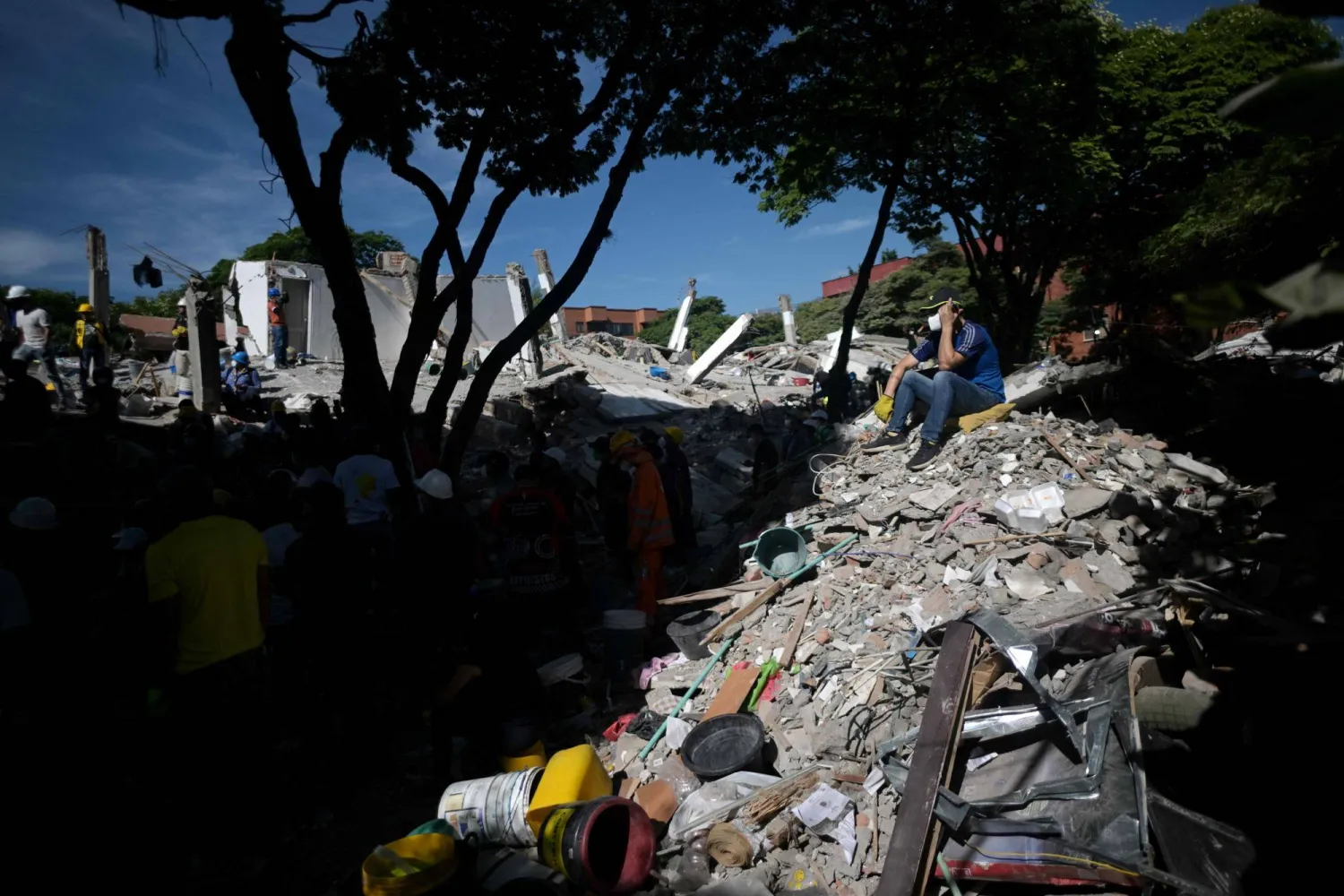
 A rescuer sits on the rubble of a collapsed building after an earthquake in Cali, Colombia on August 11, 2026. (AFP)
A rescuer sits on the rubble of a collapsed building after an earthquake in Cali, Colombia on August 11, 2026. (AFP)
TT

Colombia Rescuers Find Woman Alive as Quake Death Toll Passes 200

 A rescuer sits on the rubble of a collapsed building after an earthquake in Cali, Colombia on August 11, 2026. (AFP)
A rescuer sits on the rubble of a collapsed building after an earthquake in Cali, Colombia on August 11, 2026. (AFP)

Colombian rescuers pulled a 32-year-old woman alive from the rubble of a collapsed building Tuesday, sparking cheers and applause as exhausted crews raced to find more survivors from the country's strongest earthquake in a century.

Daniela Largo was carried from the wreckage wrapped in a blue blanket as rescuers embraced and relatives shouted out with joy.

Soldiers, firefighters and volunteers continued to scour collapsed buildings across western Colombia after Monday's 7.4-magnitude quake.

Authorities revised the death toll down to 216 after local officials in Cali corrected earlier figures.

"We were losing hope and then we received a call," said her mother Sandra Milena Perez in Pereira.

Perez said a local resident heard cries for help beneath the rubble and joined neighbors in removing debris before professional rescuers arrived.

"Thanks to him, today we're happy," she said. "At home her 12-year-old son is waiting for her."

In Pereira and in Cali, emergency crews used cranes, dogs and heavy machinery to search ruined buildings while volunteers formed human chains to clear debris by hand, hoping to reach people still trapped beneath collapsed structures.

As darkness fell, families prepared to sleep in parks as aftershocks rattled damaged neighborhoods where entire blocks had been reduced to rubble.

The quake overwhelmed parts of the health system, turning the rescue effort into one of Colombia's largest disaster responses in years.

"The house came down on top of us. I wasn't able to get out," said Beatriz Arcos, who was trapped with her husband and mother beneath their collapsed condominium.

"It took about an hour to get us out." Arcos said she was hospitalized after a concrete block fell on her back. Her husband and mother were also injured.

In Cali, residents armed with picks, shovels and their bare hands joined firefighters in digging through collapsed buildings.

Rescuers stopped every few minutes to call into the rubble and listen for any response.

"We're doing this with our hands, with gloves," said volunteer Pablo Cesar Ruiz. "It's sad to see time slipping away."

In Pereira, army units and sniffer dogs combed through twisted concrete and exposed steel.

At one site, a rescue squad leader abruptly raised his fist, stopping workers so they could listen for signs of life.

Volunteers formed human chains, passing bricks and chunks of masonry hand-to-hand to clear paths into collapsed structures.

- 'So much effort' -

For many families, the desperate search was becoming a vigil.

"My aunt lived there. She's under the rubble," said Jorge Gonzalez, standing beside a collapsed building in Pereira.

"I arrived yesterday and I haven't left, and until they find her body I don't intend to leave here."

While some families waited for news of missing relatives, others were grappling with the loss of homes, possessions and livelihoods.

"We lost everything," said Stella Galvis, fighting back tears after escaping the collapse of her home.

"We survived by a miracle, since I managed to get my little boy out and my partner managed to get out too."

From the air, neighborhoods in Cali appeared flattened, with piles of grey rubble replacing entire blocks of homes and apartment buildings.

Nearby, cars lay crushed beneath fallen walls and concrete slabs.

On one mound of debris, a young couple climbed over broken masonry searching for belongings.

They recovered a box from inside a child's bright red bedside table.

Many survivors spent the night outdoors, either because their homes were damaged or because they feared aftershocks.

One park in Pereira was transformed into a makeshift shelter with tents and mattresses.

"We lost everything, but we're alive," said 23-year-old John Tabasco, who was camped there with his wife and seven-month-old son.

"We've never had to do this before, to depend on someone else to help us. It's amazing how life can change."

Others struggled to come to terms with losing homes built over decades.

"You buy a little house with so much effort, spending 40, 50 years struggling to get yourself that house, you finally get it and in just a few days it all goes down the drain," said 79-year-old Jaime Alzate.

In Cali, part of the Hospital Universitario del Valle collapsed during the quake, forcing doctors to move patients into a parking lot and treat some in the open air.

Yet amid the destruction, many Colombians mobilized to help.

Thousands brought water, food and supplies to affected neighborhoods, while long lines formed outside blood donation centers.

"It's about wanting to help your community, your city and your country," said blood donor Ferney Cabrera.

President Abelardo de la Espriella declared a state of emergency and promised rent subsidies for affected families Tuesday during a visit to Pereira.

The United States announced $15.5 million in emergency aid, while messages of support and offers of assistance arrived from around the world.

As aftershocks continued to rattle damaged cities, rescue crews pressed on through the ruins, hoping more voices, taps or whistles might still emerge.



Putin Threatens Retaliatory Seizures of European Ships

Russian President Vladimir Putin holds a meeting aboard the Guards missile cruiser Varyag during the final stage of the Pacific Fleet's exercises off the coast of Sakhalin region, Russia, 12 August 2026. (EPA/Gavriil Grigorov Kremlin / Pool)
TT

Putin Threatens Retaliatory Seizures of European Ships

Russian President Vladimir Putin holds a meeting aboard the Guards missile cruiser Varyag during the final stage of the Pacific Fleet's exercises off the coast of Sakhalin region, Russia, 12 August 2026. (EPA/Gavriil Grigorov Kremlin / Pool)

Russian President Vladimir Putin on Wednesday threatened to seize ships belonging to European countries in retaliation for plans to sell off cargo seized from Russian "shadow fleet" vessels.

Several European companies have intercepted ships carrying Russian oil in contravention of European sanctions targeting the vital revenue source.

New sanctions passed last month permit EU members to sell the oil or any other cargo seized from the ships.

Moscow has bristled at the moves, with Putin calling it "piracy and banditry".

"We will be forced to respond in kind," the Kremlin chief said while overseeing naval drills in Russia's Far East.

Moscow would act "wherever we ourselves deem necessary and appropriate -- anywhere," he added.

Swedish court documents obtained by AFP earlier in August showed Stockholm will transfer to Kyiv a seized Russian ship suspected of transporting grain from occupied Ukraine.

Putin was speaking aboard the Russian cruiser Varyag off the island of Sakhalin, where Russia's navy was conducting drills.

The exercises come a week before joint US-South Korean war games, designed to simulate a possible invasion from North Korea.

Tensions are high in the region amid accusations from Kyiv and Seoul that Pyongyang and Moscow are further intensifying their military cooperation.


Pakistan Interior Minister in Iran to Discuss Regional Security

A handout photo made available by the Iranian Foreign Ministry Office shows Iranian Foreign Minister Abbas Araghchi (R) meeting with Pakistan's Minister of Interior Mohsin Naqvi in Tehran on August 11, 2026. (Iran Foreign Ministry / AFP)
TT

Pakistan Interior Minister in Iran to Discuss Regional Security

A handout photo made available by the Iranian Foreign Ministry Office shows Iranian Foreign Minister Abbas Araghchi (R) meeting with Pakistan's Minister of Interior Mohsin Naqvi in Tehran on August 11, 2026. (Iran Foreign Ministry / AFP)

Pakistan's interior minister is visiting Iran to discuss regional security, stability and other developments, the Pakistani foreign office said Wednesday, as Islamabad tries to mediate a resolution to the Middle East war.

Mohsin Naqvi, previously involved in mediation efforts between Iran and the US, is known to be close to the powerful head of the Pakistani army, Asim Munir.

Iranian state news agency IRNA reported late Tuesday that Naqvi met with Iranian President Masoud Pezeshkian, Foreign Minister Abbas Araghchi and Interior Minister Eskandar Momeni.

"He is discussing bilateral relations, security, regional security and stability, and constructive engagement amongst the parties in the region and regional developments," Pakistani foreign ministry spokesman Tahir Andrabi told reporters in Islamabad.

The Iranian government's website said Naqvi conveyed to Pezeshkian "a message from the Pakistani prime minister and the chief of the army", without specifying its content.

Tehran insists on retaining control of the Strait of Hormuz after the war and wants to charge fees for passage, repeatedly striking ships it accuses of attempting to circumvent its preferred route. The US has imposed a rival blockade on Iranian ports.

Attacks in the waterway, which was free to transit before the war, led to the collapse of an April ceasefire, and mediators have urged both sides to return to the terms of a subsequent June memorandum that set out a path for peace talks.

Last week Iran said it had agreed a route with neighboring Oman for ships transiting the strait and was finalizing arrangements for jointly managing the strategic waterway.

On Tuesday the US military announced that it had fired on a Panama-flagged cargo ship that attempted to break the American blockade of Iran's ports.


North Korea Fires Missile Ahead of Major US-South Korea Drills

People watch a news broadcast on a television screen showing a report on a missile launch, at a railway station in Seoul, South Korea, 12 August 2026. (EPA)
TT

North Korea Fires Missile Ahead of Major US-South Korea Drills

People watch a news broadcast on a television screen showing a report on a missile launch, at a railway station in Seoul, South Korea, 12 August 2026. (EPA)

North Korea fired a ballistic missile on Wednesday toward the sea off the Korean peninsula's east coast, South Korean and Japanese authorities said, days ahead of major joint military exercises by Seoul and Washington long denounced by Pyongyang.

The missile was launched from the North's Wonsan area at about 6 a.m. (2100 GMT Tuesday), South Korea's Joint Chiefs of Staff (JCS) said, six days after North Korea fired another ballistic missile from the same area.

The launch came ahead of South Korean and US military drills, dubbed Ulchi Freedom Shield, set to run from August 17 to August 27, aimed at countering Pyongyang's evolving nuclear and weapons capabilities.

Hong Min, a senior researcher at the Korea Institute for National Unification in Seoul, said the launch ‌was likely part of ‌North Korea's existing weapons development schedule, but the timing could also have been ‌selected ⁠to send a ⁠message ahead of the exercises.

"Even if it was a test of a weapon under development, choosing when to conduct it requires a political decision," Hong said.

There was no immediate statement from North Korea on the Wonsan launch, but Pyongyang on Wednesday afternoon criticized the nuclear ambitions of South Korea and Japan.

South Korea said North Korea also fired a ballistic missile from Wonsan on August 6, but Pyongyang did not report that launch in state media. Hong said that test may have failed to achieve its intended objective.

North Korea's series of tests this year has featured short-range ballistic missiles, artillery rockets and other tactical weapons.

Wednesday's ⁠launch was its 11th suspected ballistic missile test in 2026, according to South Korean ‌assessments.

South Korean and Japanese defense authorities said the missile flew about 700 ‌km (435 miles).

Seoul's Joint Chiefs of Staff did not identify it as a short-range ballistic missile, saying authorities would conduct a detailed ‌analysis.

The omission leaves open the question of what type of missile it was, analysts said. Ballistic missiles with ‌ranges of 300 km to 1,000 km (186 miles to 620 miles) are generally classified as short-range.

Hong said the range, trajectory and launch site suggested it may have been a type of hypersonic missile, though a submarine-launched missile was also possible.

CONDEMNATION AND HEIGHTENED TENSIONS

South Korea and Japan both condemned the launch.

"Japan lodged a strong protest with North Korea through diplomatic channels at the Japanese Embassy ‌in Beijing and strongly condemned the action," Japanese Defense Minister Shinjiro Koizumi told reporters.

South Korea's Office of National Security convened an emergency meeting and expressed concern over North Korea's continued ⁠ballistic-missile launches following the ⁠August 6 firing. It urged Pyongyang to halt provocations that violate UN Security Council resolutions.

South Korea's military said it was maintaining readiness to respond "overwhelmingly" to any provocation under its combined defense posture with the United States.

The US Indo-Pacific Command said it was consulting closely with allies and partners, adding that its initial assessment was that the launch posed no immediate threat to US personnel or territory, or to its allies.

On Tuesday, Ukrainian President Volodymyr Zelenskiy said Moscow used North Korean ballistic missiles during a Russian attack that killed seven workers at a steel plant in the southeastern city of Zaporizhzhia.

In a statement, a North Korean Foreign Ministry official responsible for South Korean affairs said Seoul's plans to develop nuclear-powered submarines would heighten instability in the region, for a "serious challenge" to the North's security.

Pyongyang needed the capability to counter its adversaries' military moves with retaliatory strikes that would make their "survival and recovery impossible", the statement added.

In a separate commentary state news agency KCNA accused Japan of seeking nuclear weapons under the guise of peaceful use of atomic energy, citing its nuclear power program and debate among Japanese politicians over nuclear armament.