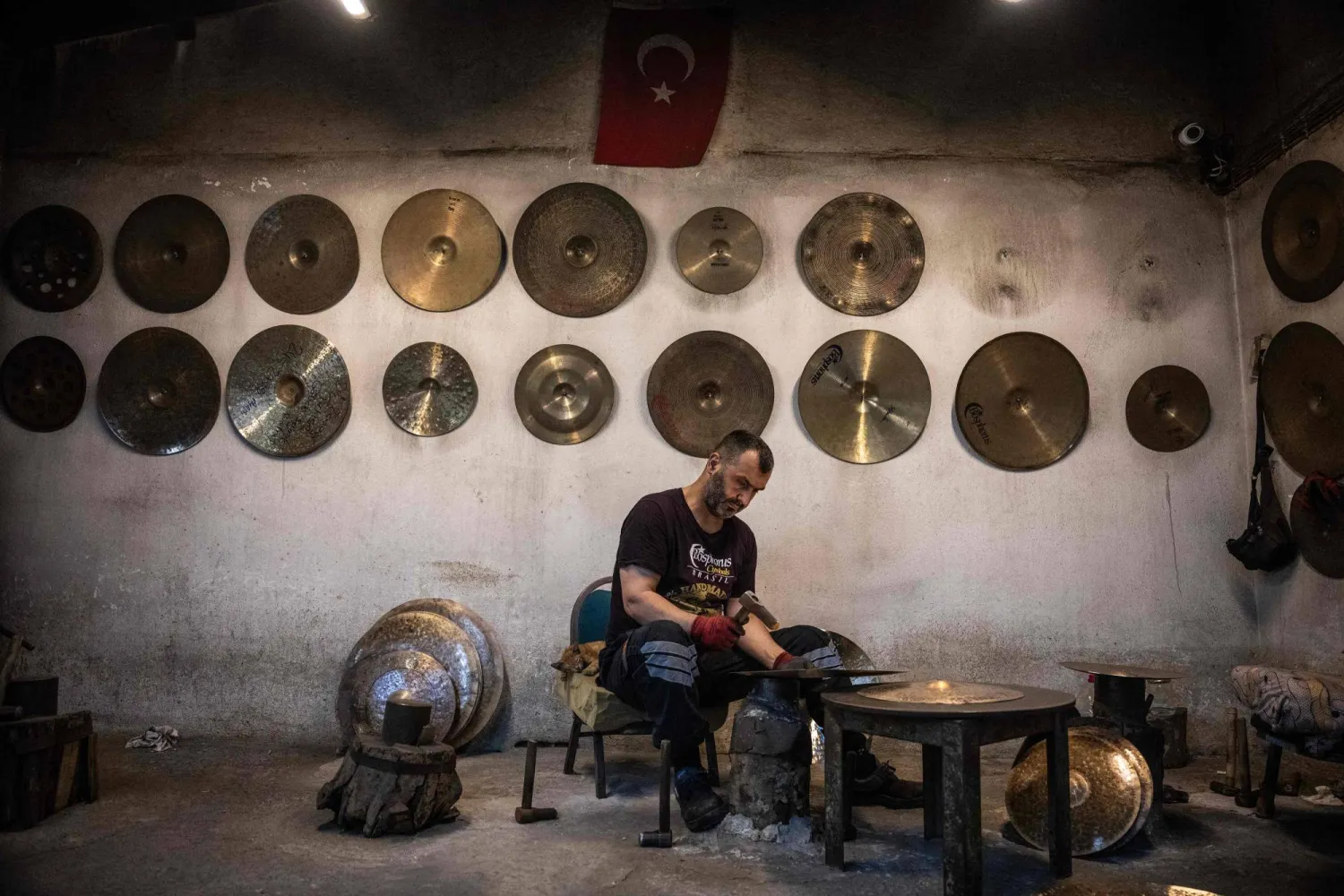
Istanbul Cymbals: From Ottoman Weapon of War to Pulse of Global Music

A worker hammers a cymbal at a workshop in Istanbul on July 30, 2026. (AFP)
TT

Istanbul Cymbals: From Ottoman Weapon of War to Pulse of Global Music

A worker hammers a cymbal at a workshop in Istanbul on July 30, 2026. (AFP)

The rhythmic clanging of hammers on bronze echoes through the Istanbul workshop where three craftsmen are landing blows with astonishing precision to transform featureless metal discs into highly prized handcrafted cymbals.

First used by Ottoman military "mehter" bands to frighten and demoralize the enemy, cymbals were a useful tool for an empire on the warpath.

But it would take the skill of a 17th-century Armenian alchemist called Avedis Zildjian to transform them into a percussion instrument whose exotic sound would first captivate Europe's classical composers and then shape the world of jazz.

Although cymbals existed long before Zildjian, he developed a unique alloy and special process for treating the metals that made them less fragile, winning plaudits in 1623 from the Ottoman sultan who let him set up a workshop.

"It's really hard to make good cymbals because they're consistently being crashed, so to make something that wasn't brittle which could withstand continuous use is quite an achievement," said ethnomusicologist Audrey Wozniak, who specializes in Turkish musical traditions.

The secret was passed down through the generations and although the original Zildjian operation left Istanbul for America in the dying days of the Ottoman Empire, others who learned from the Zildjian masters have continued the tradition.

Today, Istanbul remains the center of excellence for cymbals, where a handful of brands still produce hand-hammered bronze using techniques developed more than 400 years ago.

- 'A cymbal's soul' -

"We are producing 100-percent handmade cymbals with traditional methods, without using electricity or gas, only coal and wood," said Mehmet Ozturk, sales rep at Bosphorus Cymbals on Istanbul's northern outskirts, who said casting a cymbal takes up to a week.

First is the casting stage. Most cymbals are made of a copper and tin alloy that is melted into molten bronze which is poured into molds and cooled into disc-shaped blanks.

Moving swiftly, a worker using a long-handled peel places the blanks into the glowing furnace then removes others that are put through a rolling mill in a cycle repeated up to 15 times to compress and spread the metal which is then water tempered.

"Every stage is crucial," said master cymbalsmith Hasan Seker, a burly 56-year-old who co-founded Bosphorus Cymbals in 1996 and was sweating after hauling glowing blanks into and out of the furnace.

"We use copper and tin and one more ingredient which is secret. Even though it's in very small quantities, it gives the cymbal a different character in terms of consistency and sound," he told AFP.

After punching out the raised bell and cutting it to size, what looks like the now recognizable cymbal must undergo the all-important hammering process.

"Not a single blow is random," he said as a trio of craftsmen and their expert struck the cymbals to create the darker, more complex tones so prized by jazz drummers.

This is where a man's emotional state is poured into his work, said Seker, who began working in the trade aged 12 as a summer job.

"When someone is hammering, he might hit softly, then something comes to mind, he gets angry and hits harder. Those variations in the metal's surface, the reservations, the tension patterns diversify the sound. In a way, he gives the cymbal its soul."

Over the years, Seker has met countless grateful musicians, some of whom come on "a pilgrimage" to the workshop whose grubby walls are lined with ageing posters of jazz drummers like Jeff Hamilton, Stanton Moore and Ari Hoenig.

- 'Every one is different' -

Inside Nardis Jazz Club, a dimly lit venue with an intimate feel in the shadow of Istanbul's Galata Tower, a jazz trio is rehearsing ahead of an evening show with a singer.

For drummer Derin Bayhan, he would only ever use Istanbul-made cymbals because they're "100 percent handmade" and each one has a unique sound.

"Even if you bought two from the same series, the same weight and structure, the two cymbals wouldn't perfectly match. Because it's handmade, it's basically an adventure," the 42-year-old told AFP.

"So you search for one and when you find it, no one else will have it: that sound is yours."

As to why the Istanbul tradition remains so popular among jazz musicians despite the Zildjian family's move to America where they set up a factory, jazz historian Berk Ozler said it was the search for uniqueness.

"Mass production started when Zildjian went to the USA whereas the ones that stayed in Istanbul were handcrafted and still are. Jazz musicians chase after that uniqueness so that's why they are very valuable."



Saudi Visual Arts Commission Signs MoU with Cité Internationale des Arts in Paris to Strengthen Collaboration in Visual Arts

Saudi Visual Arts Commission Signs MoU with Cité Internationale des Arts in Paris to Strengthen Collaboration in Visual Arts
TT

Saudi Visual Arts Commission Signs MoU with Cité Internationale des Arts in Paris to Strengthen Collaboration in Visual Arts

Saudi Visual Arts Commission Signs MoU with Cité Internationale des Arts in Paris to Strengthen Collaboration in Visual Arts

The Saudi Visual Arts Commission has signed a memorandum of understanding with Cité Internationale des arts in Paris to strengthen collaboration, exchange expertise in the visual arts, and explore areas of cooperation that support artists and practitioners and broaden their access to artistic, cultural, and professional exchange.

Areas of collaboration include developing visual arts-related initiatives and residency programs, exploring opportunities to involve local and international artists and talent in programs organized by both parties, and supporting Saudi artists and expanding their opportunities to connect with the global art scene, SPA reported.

The two parties will also collaborate on organizing joint initiatives and exhibitions, exchanging expertise and knowledge, and engaging experts and professionals in mentorship, professional guidance, and talent development initiatives.

The MoU forms part of the commission’s efforts to support the visual arts ecosystem in Saudi Arabia, strengthen international cultural exchange and collaboration, and expand opportunities for artists and cultural practitioners to engage and develop professionally, in line with the objectives of Saudi Vision 2030 to support the growth of the cultural sector, empower practitioners, and enhance the Kingdom’s cultural presence internationally.


Pompeii’s Grandest House Gets a $1.6 Million Restoration Funded by Private Sponsor

 In this undated handout photo provided on Tuesday, Oct. 20, 2026, by the Pompeii Archaeological Park, restorers work inside the House of Marcus Fabius Rufus in Pompeii, near Naples, Italy. (Silvia Vacca/ Pompeii Archaeological Park via AP)
In this undated handout photo provided on Tuesday, Oct. 20, 2026, by the Pompeii Archaeological Park, restorers work inside the House of Marcus Fabius Rufus in Pompeii, near Naples, Italy. (Silvia Vacca/ Pompeii Archaeological Park via AP)
TT

Pompeii’s Grandest House Gets a $1.6 Million Restoration Funded by Private Sponsor

 In this undated handout photo provided on Tuesday, Oct. 20, 2026, by the Pompeii Archaeological Park, restorers work inside the House of Marcus Fabius Rufus in Pompeii, near Naples, Italy. (Silvia Vacca/ Pompeii Archaeological Park via AP)
In this undated handout photo provided on Tuesday, Oct. 20, 2026, by the Pompeii Archaeological Park, restorers work inside the House of Marcus Fabius Rufus in Pompeii, near Naples, Italy. (Silvia Vacca/ Pompeii Archaeological Park via AP)

An ancient residence believed to be the grandest in the Pompeii archaeological site is being restored with the entire 1.4 million euros ($1.6 million) cost being covered by a private sponsor, officials announced Tuesday.

The house of Marcus Fabius Rufus, modeled after Rome’s imperial palaces and buried in the eruption of Mt. Vesuvio that destroyed the ancient city in 79 A.D., has been inaccessible to the public since 1980. Originally built on Pompeii’s city walls, it features four floors connected by a maze of corridors and staircases.

Part of it is expected to open to guided groups by Christmas, officials for the Archeological Park of Pompeii said.

The renovation is being paid for by a German entrepreneur, Frank Hoefer, who contacted the archaeological park after reading superintendent Gabriel Zuchtriegel’s 2023 book: “Pompeii: The Enchanted City.”

“Restoring the spectacular residence of Marcus Fabius Rufus ... is a project I find exciting,” Hoefer said in a release. “I also have the impression that Pompeii is very open to innovative approaches to preservation and public access.”

Zuchtriegel said the goal is to expand such sponsorships.

“This does not mean that from tomorrow on if we had 50 such sponsors we would be able to abolish the entrance ticket, putting it at just a symbolic one-euro price, but it is a perspective towards which we have to work to develop the site,” Zuchtriegel said in a video statement.

Structural work was carried out on the house from 2021-2023, and current renovations are focused on the frescoes, including the famous Venus of Pompeii located in a chapel within the residence. The owner was believed to be a magistrate or a freedman of the imperial household.

Zuchtriegel said work was also being done to make the complex more accessible, and digital technology was being developed to help people grasp the “incredible labyrinth” that makes up the house.

“At times, you feel like you are in a 19th-century palace in Naples, yet this is a Roman house from 2,000 years ago,” Zuchtriegel said.


Saudi Arabia Named Guest of Honor at Algiers International Book Fair 2026

Saudi Arabia Named Guest of Honor at Algiers International Book Fair 2026
TT

Saudi Arabia Named Guest of Honor at Algiers International Book Fair 2026

Saudi Arabia Named Guest of Honor at Algiers International Book Fair 2026

Saudi Arabia will be the guest of honor at the Algiers International Book Fair 2026, taking place from October 28 to November 7 at the Palais des Expositions in Pins Maritimes. The Kingdom's participation aims to strengthen cultural exchange with Algeria.

Saudi Arabia's selection as guest of honor reflects the strong fraternal relations between the two countries and the rapid development of the Kingdom's cultural sector, supported by the Saudi leadership. These efforts have helped strengthen the global presence of Saudi culture and raise awareness of the Kingdom's cultural heritage.

The Literature, Publishing and Translation Commission will lead the Kingdom's participation in the fair, organizing a cultural program featuring seminars, panel discussions, and poetry evenings. The events will bring together a distinguished group of intellectuals, writers, and specialists. The program will also highlight Saudi Arabia's literary scene and the creative momentum across various cultural fields.

The Saudi pavilion will feature sections dedicated to handicrafts, traditional Saudi attire, and musical instruments, alongside an exhibition of manuscripts and archaeological replicas.

It will host performances of Saudi performing arts that reflect the depth of the Kingdom's cultural heritage, as well as screenings of Saudi films.

Several government entities, authorities, and cultural organizations will participate, presenting a comprehensive picture of cultural activity across various sectors in Saudi Arabia.

The pavilion is expected to offer an integrated cultural experience that reflects the richness and diversity of Saudi identity. It will showcase cultural achievements made under Saudi Vision 2030, which seeks to establish culture as a component of quality of life and a means of fostering cultural exchange among peoples.