


Britain’s Andy Green Sets Another Speed Record, This Time in a Hydrogen-Powered Car

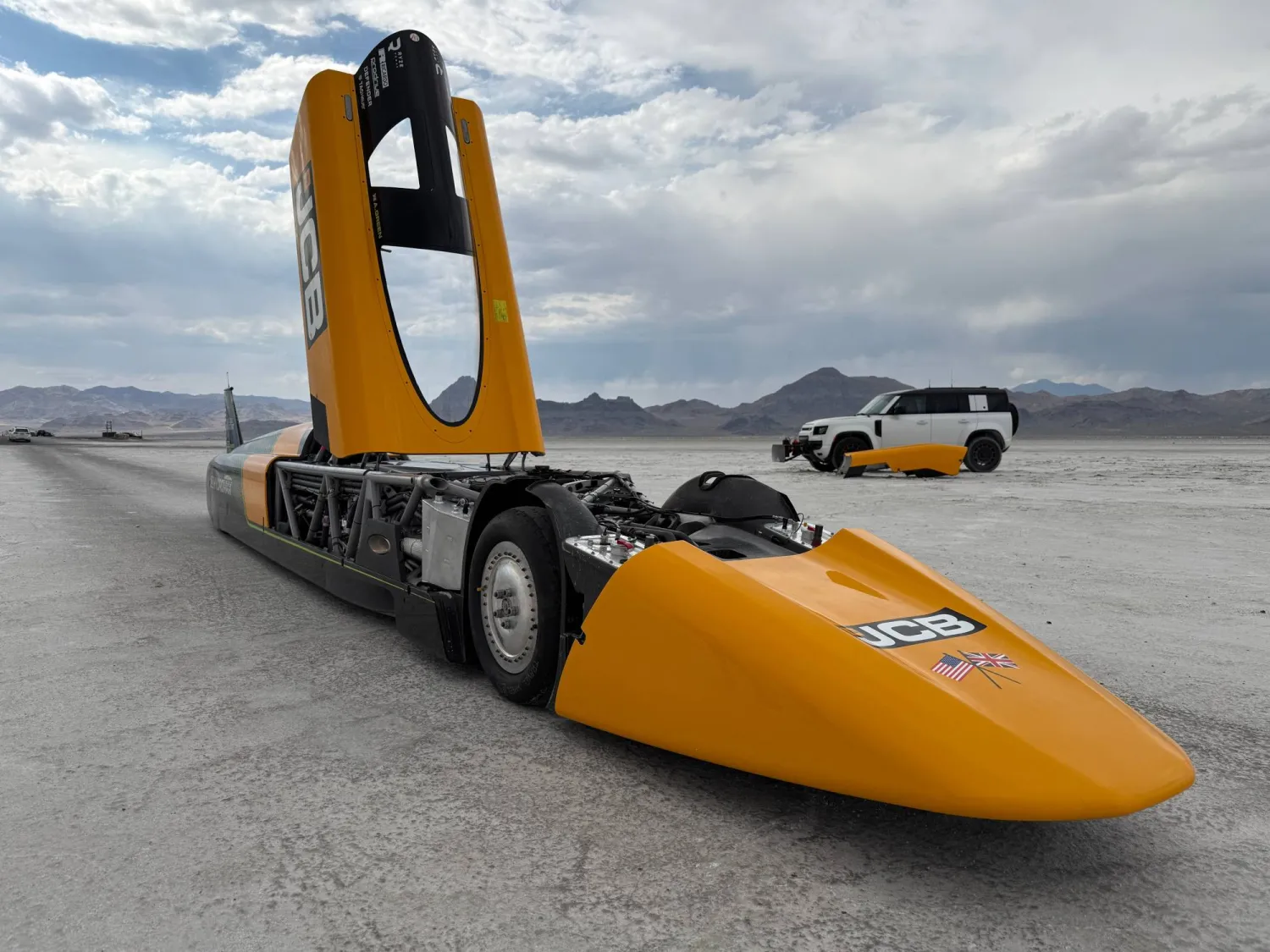
 The JCB Hydromax sits on the Bonneville Salt Flats in Wendover, Utah, where Andy Green aims to drive it to a land speed record for cars powered by hydrogen internal combustion engines, Monday, Aug. 10, 2026. (AP)
The JCB Hydromax sits on the Bonneville Salt Flats in Wendover, Utah, where Andy Green aims to drive it to a land speed record for cars powered by hydrogen internal combustion engines, Monday, Aug. 10, 2026. (AP)
TT

Britain’s Andy Green Sets Another Speed Record, This Time in a Hydrogen-Powered Car

 The JCB Hydromax sits on the Bonneville Salt Flats in Wendover, Utah, where Andy Green aims to drive it to a land speed record for cars powered by hydrogen internal combustion engines, Monday, Aug. 10, 2026. (AP)
The JCB Hydromax sits on the Bonneville Salt Flats in Wendover, Utah, where Andy Green aims to drive it to a land speed record for cars powered by hydrogen internal combustion engines, Monday, Aug. 10, 2026. (AP)

The only person to break the sound barrier in a car earned another world record Tuesday in a show of force for hydrogen power.

British driver Andy Green reached 406.320 mph (653.908 kph) in a car powered by two hydrogen internal combustion engines with a combined 1,600 horsepower, setting the record for that vehicle category, according to the Fédération Internationale de l’Automobile, the international governing body of motor sports.

The 64-year-old retired Royal Air Force pilot rocketed across the crystalline crust at Utah’s famous Bonneville Salt Flats in a 32-foot (9.75-meter) car engineered by British construction equipment manufacturer JCB. The engines, adapted from those used in the company’s heavy machinery, mix pressurized hydrogen gas with air and ignite it to create bursts of power.

“It’s magic to be able to showcase this technology and to showcase how good the engineering is on the best racing surface in the world, Bonneville Salt Flats,” Green told The Associated Press after the run.

To be clear, Tuesday’s feat didn’t come close to approaching the overall land-speed record, which Green set with jet power in 1997. That year, he climbed into the Thrust SSC, a black needle sandwiched between two cartoonishly large jet engines, and hit 763.035 mph (1,227.985 kph), breaking the sound barrier and achieving a feat no one has come close to matching. His runs in Nevada’s Black Rock Desert produced sonic booms that shook the nearby town of Gerlach.

In 2006, Green also set the land-speed record for a diesel-powered car — 350.092 mph (563.4 kph) — at the Bonneville Salt Flats. He returned there Tuesday with the goal of beating that mark using hydrogen power, which he has called the “fuel of the future.”

In targeting his diesel speed, Green easily topped the previous hydrogen combustion world record of 185.5 mph (298.5 kph). He had a 10-mile (16-kilometer) straightaway to build speed. A few dozen JCB staff members and reporters watched from a distance through cameras and binoculars.

Green said the cockpit of the car he used on Tuesday was “probably a little hotter” than in the jet-powered vehicle from 1997, with temperatures routinely above 122 degrees Fahrenheit (50 degrees Celsius).

“But I have been training four months for that, both training in the gym and actually just getting used to it with hot baths,” he said.

A remnant of a prehistoric lake bed, the Bonneville Salt Flats are about 100 miles (160 kilometers) west of Salt Lake City and sit atop a shallow aquifer that cools the tires. The low-friction surface and dry desert air are conducive to speed and have beckoned drivers since the first race there in 1914.

“It looks like snow, and it behaves a bit like packed snow — it is surprisingly slippery,” Green said.

Green was no stranger to speed when he took his first racing job. He had been flying supersonic military jets when he spotted a 1994 British newspaper ad seeking a high-speed driver to break the sound barrier.

Green did not approach supersonic speeds on Tuesday, but JCB engineers hope his feat with hydrogen power will shake up the clean-energy industry.

The company's chairman has argued that hydrogen can better handle the demands of heavy industries than electric power.

Hydrogen is only as clean as its source, and the vast majority is currently produced from fossil fuels. JCB signed a deal to buy green hydrogen, which is created using renewable energy but makes up a tiny fraction of global hydrogen production.

The concept and development of such technology has been around for decades, but has had a resurgence over the past several years, said Greg Keoleian, a professor of sustainable systems at the University of Michigan and co-director of the school’s MI Hydrogen initiative.

Many major automakers have already developed hydrogen internal combustion engines or hydrogen fuel cell technology, but the higher cost of hydrogen production compared with gas and diesel is a barrier to wider usage, Keoleian said.

“It represents an important energy carrier for decarbonizing areas of the economy,” he said. “As far as its deployment, it’s influenced heavily by the cost.”

An emerging focus, he said, is extracting hydrogen from natural deposits instead of separating it from water, a prospect that could significantly reduce costs.



Malaysia Declares Emergency in Serian District in Sarawak State Due to Haze

Kuching riverside in the city center is shrouded in thick haze in Kuching, Sarawak state, Malaysia, Friday, Sept. 4, 2026. (AP)
TT

Malaysia Declares Emergency in Serian District in Sarawak State Due to Haze

Kuching riverside in the city center is shrouded in thick haze in Kuching, Sarawak state, Malaysia, Friday, Sept. 4, 2026. (AP)

Malaysia declared an emergency in the district of Serian, in Sarawak state, after thick haze caused by forest fires in neighboring Indonesia pushed air pollution up to hazardous levels on Friday.

Sarawak, on Borneo, has been heavily affected by fires on the Indonesian side of the island, with haze forcing school closures in some parts of the state.

Malaysian authorities categorize Air Pollution Index (API) readings ‌above 300 as ‌hazardous, with a measurement of ‌500 serving ⁠as the threshold ⁠for declaring an emergency. The API reached 519 in Serian on Friday, government data showed.

The emergency declaration was issued by Malaysia's king, Sultan Ibrahim, after advice from Prime Minister Anwar Ibrahim and Sarawak premier Abang Johari Openg, Anwar's office said in a statement.

"Sultan ⁠Ibrahim has consented to the declaration of ‌a state of emergency throughout ‌the Serian district, Sarawak, following haze conditions that have reached ‌a level of air pollution hazardous to public ‌health and safety," the statement said.

Sarawak disaster management committee chairman Douglas Uggah Embas had earlier told a news conference the state had requested an emergency declaration after API ‌readings breached 500.

The emergency would be confined to the Serian district, covering an area ⁠of ⁠about 20 kilometers (12.4 miles) radius, with essential services such as supermarkets, petrol stations, and banks expected to continue operating, Douglas said.

Cloud-seeding operations were also being carried out, he added.

Malaysia is a constitutional monarchy in which the king has a largely ceremonial role, carrying out his duties with advice from the prime minister and cabinet. But the monarch has the power to decide if an emergency should be declared based on grave threats to national security, the economy, or public order.


US Study Tests Psilocybin to Fight Cancer Side Effects

A health worker from the community health center prepares a cervical cancer and rubella vaccination during the School Children Immunization Month (BIAS) program at a school  in Banda Aceh, Indonesia, 27 August 2026. EPA/HOTLI SIMANJUNTAK
A health worker from the community health center prepares a cervical cancer and rubella vaccination during the School Children Immunization Month (BIAS) program at a school in Banda Aceh, Indonesia, 27 August 2026. EPA/HOTLI SIMANJUNTAK
TT

US Study Tests Psilocybin to Fight Cancer Side Effects

A health worker from the community health center prepares a cervical cancer and rubella vaccination during the School Children Immunization Month (BIAS) program at a school  in Banda Aceh, Indonesia, 27 August 2026. EPA/HOTLI SIMANJUNTAK
A health worker from the community health center prepares a cervical cancer and rubella vaccination during the School Children Immunization Month (BIAS) program at a school in Banda Aceh, Indonesia, 27 August 2026. EPA/HOTLI SIMANJUNTAK

Here's a novel idea for countering the painful side effects of chemotherapy: beforehand, take the hallucinogenic drug found in magic mushrooms.

The study published Thursday in the journal Science involved tests on rats and certain human tissues as researchers looked at using psilocybin to fight a condition called peripheral neuropathy, which affects millions of people around the world.

It is a nerve ailment that hits about three quarters of all people who undergo chemo and commonly causes numbness and tingling, Patrick Dougherty, a co-author of the study, said in a call with reporters.

But a third of that group will develop non-stop, burning pain, said Dougherty, a pain treatment specialist at the University of Texas MD Anderson Cancer Center.

The symptoms can lead to trouble walking and other debilitating complications that can last after a person finishes chemotherapy, and even remain with them for life, AFP reported.

And it is not just a quality-of-life issue. This complication also affects a cancer patient's chances of survival because sometimes the side effects are so bad they force doctors to cut back on chemo or stop it altogether.

It was almost by accident that these researchers found that psilocybin can help cancer patients.

The team was initially studying how the disease manages to hijack nerve cells in order to grow.

And the researchers were surprised to see the mushroom ingredient -- it was being used to study a brain pathway regeneration concept called neuroplasticity -- actually prevented the emergence of peripheral neuropathy.

Later experiments highlighted psilocybin's role in protecting nerve cells and stimulating inside them the transport of mitochondria, often referred to as a cell's powerhouse.

This is key because chemo destroys the microscopic railroads that allow mitochondria to send energy all the way to the tips of people's hands and feet, killing off nerve endings there.

Psilocybin also seems to act on the brain, preserving electrical activity that chemotherapy thwarts.

In rodents, taking two doses of psilocybin before chemo was enough to prevent the appearance of painful hypersensitivity during as many as six rounds of treatment. And it did this without affecting the animal's immune system or hindering the cancer-fighting action.

"This is a highly promising finding," said Kristy Townsend, a professor of neurobiology at The Ohio State University who was not involved in the study.

And psilocybin's nerve-protecting quality does not seem to be linked to its hallucinogenic effects because a non-hallucinogenic analogue had the same effect in a lab test, she added.

Before the treatment can be made standard for people, testing will be needed to see if it is safe and effective, said Townsend.

This will be a long, slow process though it should be eased by a boom in medical research on psychedelic substances and a Trump administration executive order in April to speed up research and regulatory reviews, these scientists say.

The MD Anderson Cancer Center plans to launch clinical tests with psilocybin on cancer patients later this year.

Meanwhile it is important for cancer patients to avoid using magic mushrooms on their own as treatment, the researchers warned.

Psilocybin is legal in a few US states.

The drug has an "amplifier" effect and cancer patients who take it without supervision could feel more stressed and anxious than they already are because of their cancer diagnosis, said Gregory Jones, a psychiatrist who took part in the study released Thursday.

"If you put somebody in adversity under these psychedelic substances, you can get much worse," Jones said.


Tesla Starts Cybercab Rides in Austin, Drawing US Safety Agency Interest

A Tesla's "Cybercab" is displayed in downtown Austin, Texas, on September 3, 2026. (AFP)
TT

Tesla Starts Cybercab Rides in Austin, Drawing US Safety Agency Interest

A Tesla's "Cybercab" is displayed in downtown Austin, Texas, on September 3, 2026. (AFP)

Tesla said on Thursday it was offering rides in "limited areas of Austin, Texas" in its two-seater Cybercab, a vehicle without a steering wheel or pedals, with the US auto safety agency responding that it was evaluating the effort.

CEO Elon Musk has said the Cybercab is key to transforming Tesla into a dominant force in driverless vehicles. Tesla in recent weeks has promoted what it called an exclusive "Cybercab launch event" in Austin on Thursday, drawing interest from investors and fans, some of whom came to Texas to try out the golden, butterfly-door cars.

Musk himself skipped the event, attendees said, and remarks from executives on pricing plans, manufacturing and technology lasted only about a quarter of an hour, according to videos posted after the event.

The electric-vehicle maker has a limited robotaxi ride-hailing service with a network of autonomous Model Ys, some with human safety monitors. Its fleet registered in Texas is less than half that of autonomous rival Waymo, whose autonomous service has cars with human controls – but no human drivers. Over time, Tesla ‌intends to make the ‌no-steering-wheel Cybercab the main driverless vehicle model operating within a larger robotaxi network.

Federal safety norms typically require ‌human ⁠controls, and the safety ⁠regulator, the National Highway Traffic Safety Administration, signaled its interest in Tesla's activity.

"NHTSA is in contact with Tesla and is evaluating the situation," the spokesperson said, without elaborating.

Tesla updated its robotaxi website, saying Cybercab rides were available only in some parts of Austin. Tesla did not specify when it would charge fares, although executives at the event described plans to use dynamic pricing, which would rise with demand, while promising "a first-class experience at coach price".

Tesla AI Chief Ashok Elluswamy, one of the presenters, said that anyone could ride. "It's open to the entire public," he said.

Several Tesla investors and social media personalities in Austin enthused over the look and feel of the Cybercab, posting videos of their rides as well as the event, which included at least one partially manufactured Cybercab.

Musk has promised ⁠for years that driverless Teslas are imminent, including at a Cybercab unveiling in October 2024 at a Los ‌Angeles-area movie studio, but Tesla's robotaxi rollout has fallen short of his targets, and some ‌analysts in recent months have flagged the slower-than-expected growth.

In a Thursday afternoon video, Musk calls it "the first car that is specifically built for unsupervised full self-driving."

MARKET ‌VALUE UNDERPINNED BY ROBOTAXI AMBITIONS

Since launching a pilot in Austin in June 2025, Tesla has expanded its robotaxi service to a handful ‌of other cities in Texas and Florida.

Analysts and investors see driverless vehicles as key to Tesla's future and a central underpinning of its $1.4 trillion market value, far higher than any other automaker. Tesla's core electric-vehicle business faces pressure from global competition, particularly Chinese EV makers.

Musk has said the Cybercab will eventually be Tesla's largest-volume vehicle, supplying a global network of robotaxis and allowing individual owners to add or remove their vehicles from a Tesla-managed driverless ride-hailing fleet when they are not using the cars.

Tesla ‌said production began in April 2026, though Musk cautioned in April that initial production "will be very slow."

REGULATORY HURDLES LIMIT DEPLOYMENT

It is unclear how quickly Tesla will be able to fully deploy the vehicles.

Federal regulations ⁠limit the number of vehicles ⁠any manufacturer can sell without a steering wheel and pedals. Established manufacturers can deploy an unlimited number of such vehicles for testing.

In California, a key market, Tesla does not have permits to operate a robotaxi service or to test driverless vehicles without a safety driver who can take over in the front seat.

In July 2025, Musk said the company's robotaxi network would expand at a "hyper-exponential rate" and be available to half the population of the US by the end of 2025.

Those predictions did not pan out, and Musk and his executives have struck a more cautious tone in recent months, saying the company is taking a careful approach to avoid injuries or fatalities.

REAL-WORLD TESTING REVEALS SERVICE GAPS

Reuters tested out the robotaxi service in the weeks after Dallas and Houston events earlier this year and found long wait times, with sometimes no availability at all.

On three occasions when a reporter managed to get a ride in Dallas, the robotaxi would not drop him at his downtown destination within Tesla's advertised service area. Each time, it left him about a 15-minute walk away. Tesla did not respond to requests for comment about the service issues.

Tesla had 420 autonomous vehicles registered in Texas as of Wednesday evening, according to state records, including 45 Cybercab vehicles. Earlier on Wednesday, state records showed Tesla had registered 314 vehicles. Alphabet's Waymo, the current US leader in driverless taxis, has 988 vehicles registered in the state.