

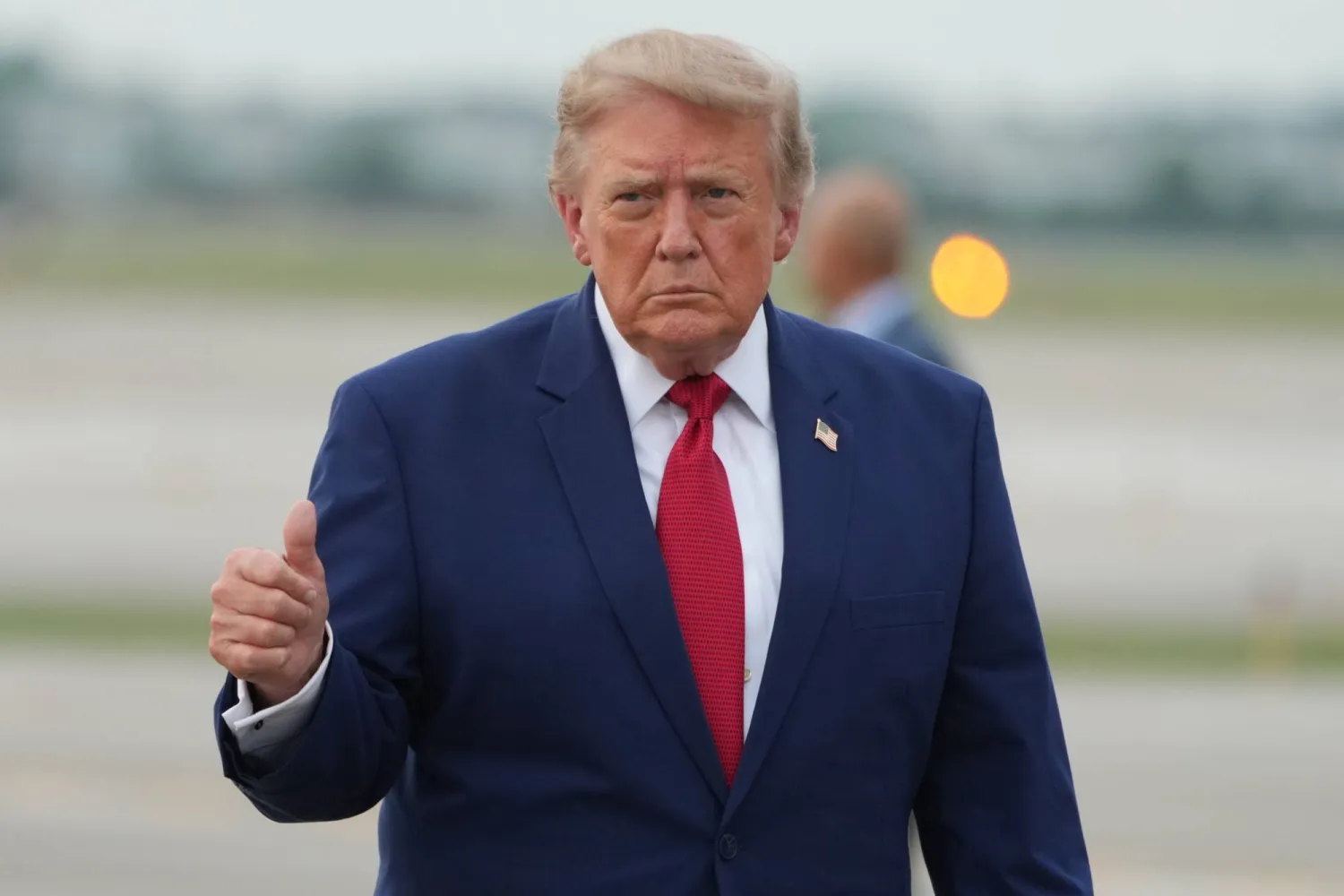

Trump 'Low-key' Bets on Economic Pressure against Iran

President Donald Trump walks from Marine One to board Air Force One at Cleveland Hopkins International Airport in Cleveland, Tuesday, Aug. 11, 2026. (AP Photo/Mark Schiefelbein)
TT

Trump 'Low-key' Bets on Economic Pressure against Iran

President Donald Trump walks from Marine One to board Air Force One at Cleveland Hopkins International Airport in Cleveland, Tuesday, Aug. 11, 2026. (AP Photo/Mark Schiefelbein)

Keeping a low profile doesn't come naturally to Donald Trump.

Yet that is the strategy the American president says he now favors in the war against Iran, and he is betting on economic pressure over diplomacy or new strikes.

"We are low-keying it," Trump told news site Axios by phone Sunday.

"We're only semi-negotiating with them. We are just watching Iran with its huge inflation and the fact they have no money."

The billionaire has since repeated that he is keeping the option of striking Tehran on the table, but prefers to stress the economic damage inflicted on the country through economic sanctions.

"Iran is broke, totally broke and they're not paying their soldiers," Trump said Monday in the Oval Office.

He has repeatedly claimed, most recently in a Truth Social post on Wednesday, that the country is experiencing inflation of over 300 percent.

He also claimed there is no urgency to act because the United States has "total control" of the Strait of Hormuz, a crucial waterway for the oil trade that has become the geopolitical flashpoint of the conflict.

- 'Terrible shape' -

In reality, Tehran is locking down the strategic passage while Washington is imposing its own blockade on Iranian ports.

"Iran is in terrible shape economically. It can't ship oil at any meaningful level. And it still labors under sanctions and still can't access its overseas assets," said Michael O'Hanlon, an expert from the Brookings Institution think tank.

"The question is, do its leaders really care? I think they care some, but not a lot."

The American president has, for the moment, muted both his threats of apocalyptic strikes and promises of imminent diplomatic breakthroughs -- messages that have been in constant rotation since he launched the war with Israel more than five months ago.

At the end of July, Washington announced new measures targeting Iran's Revolutionary Guard Corps (IRGC), the ideological arm of the Iranian military.

The Wall Street Journal reports that Trump's advisors have shown him data on the impact of American sanctions, which he is now reportedly considering tightening while he also mulls imposing new strictures.

That could be a tactical shift for an American president who, until recently, was threatening to unleash the most devastating strikes since World War II against Iran.

- Chess match -

The shift may also indicate the limited military options left available to the United States, where the press has reported that American munitions stockpiles have been heavily depleted.

Iran's foreign ministry spokesman Esmaeil Baqaei called the fresh push for sanctions a "retreat," noting the country has withstood US sanctions for decades.

"Whenever Washington proves itself incapable of pursuing diplomacy it retreats into sanctions; and whenever those sanctions fail to produce results, it simply increases the dose," Baqaei said in an X post this week.

"The real risk is that American politicians, clinging to this habit, will instead strangle their own remaining chances of a less humiliating exit from a crisis of their own making."

What remains to be seen is whether notoriously impatient Trump, who prefers the spectacle of combat sports like MMA and flashy "deals," will be able to stay true to the long-term strategy of economic pressure.

In his interview with Axios, Trump compared the conflict with Iran to a game of chess.

"Iranians have shown they are professional chess players," Baqaei told reporters in response to the comment.



US Floats Prospect of Joint Strikes on Colombian Armed Groups

 US Defense Secretary Pete Hegseth speaks during a forum of the Americas Counter Cartel Coalition in Panama City on August 12, 2026. (AFP)
US Defense Secretary Pete Hegseth speaks during a forum of the Americas Counter Cartel Coalition in Panama City on August 12, 2026. (AFP)
TT

US Floats Prospect of Joint Strikes on Colombian Armed Groups

 US Defense Secretary Pete Hegseth speaks during a forum of the Americas Counter Cartel Coalition in Panama City on August 12, 2026. (AFP)
US Defense Secretary Pete Hegseth speaks during a forum of the Americas Counter Cartel Coalition in Panama City on August 12, 2026. (AFP)

US Defense Secretary Pete Hegseth floated on Wednesday the possibility of joint strikes on Colombian armed groups, as he welcomed the nation into a military-led counter-narcotics coalition after its conservative president took over last week.

Colombia had authorized "joint military operations to destroy terrorists and terror networks," Hegseth told a gathering of the US-led Americas Counter-Cartel Coalition in Panama.

"Yes," he replied when asked if he had discussed with his Colombian counterpart joint strikes against armed groups such as the National Liberation Army (ELN), which the US designates as a terrorist group, and remnants of the Revolutionary Armed Forces of Colombia.

"Designated terrorist organizations, with partnered governments, will be legitimate targets of the United States government," to include Colombia, Hegseth said when asked if such operations were expected.

President Donald Trump's Latin American policy has expanded dramatically beyond its early focus on the Panama ‌Canal.

More than 200 ‌people have been killed since the launch of US military strikes on suspected drug ‌boats ⁠last September, while a ⁠US-led commando raid in January deposed Nicolas Maduro, the president of Venezuela.

Critics say the US strikes amount to war crimes worthy of the International Criminal Court, but Hegseth blasted the organization and encouraged coalition allies attending the meeting in Panama to withdraw from it.

He compared drug traffickers to al-Qaeda or ISIS terrorists.

Speaking at a hotel in Panama City, Hegseth invoked a revamped Monroe Doctrine, the 19th-century policy asserting US primacy across the Americas that critics associate with decades of US intervention.

He has called it the "Donroe Doctrine" — a play on Trump's name.

"We will defend our hemisphere from external threats," including from ⁠narco-traffickers and foreign malign influence, Hegseth said.

COLOMBIAN CRACKDOWN

Colombian President Abelardo De La Espriella's ‌vows of a security crackdown have been embraced by the Trump administration, which ‌announced plans on Friday to provide $1 billion in US security assistance to his government.

During his swearing-in remarks on Friday, De ‌La Espriella vowed to "definitively eradicate the scourge of illicit crops" and committed to also joining the Shield of the ‌Americas program founded by Trump.

De La Espriella has blamed his predecessor, leftist Gustavo Petro, for an expansion of armed groups.

Speaking alongside Hegseth at the event, Colombia's new Defense Minister Jorge Eduardo Mora, a retired major general, said Colombia could take a critical role in combating narco-traffickers on both its Pacific and Caribbean coasts.

"I think the time has arrived for the narco-terrorist cartels to confront ‌the power and the capabilities of the entire hemisphere, led by the United States," Mora said.

One US official, speaking on condition of anonymity, said the new security ⁠partnership was expected to ⁠surpass the level of cooperation under Plan Colombia, a US-Colombia anti-narcotics initiative launched in the early 2000s.

De La Espriella's election was part of a rightward shift rippling across Latin America.

In Argentina, Bolivia, Chile, Ecuador, Panama and Peru, weak economies and rising crime have reshaped voter priorities, allowing once-fringe hard-right candidates to gain traction by promising crackdowns amid a global rise of right-wing nationalism.

In Panama, Trump's administration won a major victory from the country's Supreme Court in January after voicing concerns about encroachment by China. Hong Kong-based CK Hutchison, through local unit Panama Ports Company, lost the port concessions it had held for nearly three decades.

The Panama Canal handles 5% of global maritime trade, making control of its entrance ports a flashpoint for tension between Washington and Beijing.

Addressing the meeting, Panama President Jose Raul Mulino called drug trafficking the biggest threat facing the region and dismissed concerns that the US-led coalition could infringe on members' sovereignty. He made no mention of China.

Instead, he said the transnational crime groups that traffic drugs and people are the real threats to sovereignty.

"There's never going to be a sustainable peace if this enemy (advances)," Mulino said.


Ukraine Military Aid Surged in June Despite Long-Term Shortages, Says Institute

 This photograph shows smoke rising in the distance following a Russian air attack, in Kyiv on August 12, 2026, amid the Russian invasion of Ukraine. (AFP)
This photograph shows smoke rising in the distance following a Russian air attack, in Kyiv on August 12, 2026, amid the Russian invasion of Ukraine. (AFP)
TT

Ukraine Military Aid Surged in June Despite Long-Term Shortages, Says Institute

 This photograph shows smoke rising in the distance following a Russian air attack, in Kyiv on August 12, 2026, amid the Russian invasion of Ukraine. (AFP)
This photograph shows smoke rising in the distance following a Russian air attack, in Kyiv on August 12, 2026, amid the Russian invasion of Ukraine. (AFP)

Boosted by new EU financing, military aid for Ukraine in June hit its highest level since the United States pulled funding, though long-term support is lagging, Kiel Institute data showed Thursday.

Kyiv was allocated 7.2 billion euros ($8.3 billion) in military aid in June, the highest amount since the 9.04 billion euros received in April 2024. US funding dried up in February 2025.

It is the third-biggest monthly military funding boost from donors since Russia's invasion in February 2022, according to the think tank's Ukraine Support Tracker.

The surge was largely driven by the European Union's new Ukraine Support Loan, which helped European institutions allocate 4.3 billion euros of military aid in May and June.

The 90-billion-euro EU loan was introduced to support Ukraine's budgetary and defense needs in 2026 and 2027.

"The rapid launch of the Ukraine Support Loan sends a positive signal to Ukraine," said Taro Nishikawa, project lead of Kiel's Ukraine Support Tracker.

On top of the loan support, Germany allocated 700 million euros, Denmark 600 million euros, and the Netherlands 500 million euros to support Ukraine's military.

But long-term funding levels remain below those seen before US President Donald Trump pulled the plug.

Before February 2025, donors allocated an average of 3.46 billion euros per month in military aid to Kyiv.

Since then, that figure has fallen to 2.94 billion euros.

Although the United States no longer directly contributes to the Ukraine war effort, its weapons still play a key role.

Europe is increasingly procuring weapons from US defense companies and receiving deliveries from existing US military stockpiles.

"The United States remains a key supplier of systems such as Patriot, for which Europe has only limited alternatives at the moment," said Federico Mellace, lead analyst of the Ukraine Support Tracker.

"In the longer term, the key question will be whether Europe can develop and produce reliable substitutes to key US defense systems to gradually reduce this dependence," he added.


Taiwan Holds Naval Drill During War Games as China Steps up Maritime Pressure

 Taiwanese Military Police personnel install road blockades during a drill as part of the annual Han Kuang military exercises in Taipei, Taiwan, August 12, 2026. (Reuters)
Taiwanese Military Police personnel install road blockades during a drill as part of the annual Han Kuang military exercises in Taipei, Taiwan, August 12, 2026. (Reuters)
TT

Taiwan Holds Naval Drill During War Games as China Steps up Maritime Pressure

 Taiwanese Military Police personnel install road blockades during a drill as part of the annual Han Kuang military exercises in Taipei, Taiwan, August 12, 2026. (Reuters)
Taiwanese Military Police personnel install road blockades during a drill as part of the annual Han Kuang military exercises in Taipei, Taiwan, August 12, 2026. (Reuters)

Taiwan's armed forces carried out an anti-blockade drill during annual war games, using the navy and coast guard to simulate escorting a merchant ship, the defense ministry said on Thursday, as China steps up its maritime pressure.

Taiwan, which China views as its own territory, has long been concerned that Beijing could try to choke off the island with a blockade or quarantine to force it into surrender.

In June, China began holding what it ‌calls "law enforcement" patrols off ‌Taiwan's east coast, to the anger of Taipei and prompting ‌concern ⁠in Washington and ⁠some other Western capitals.

The navy worked with coast guard vessels to complete the escort and security protection duties, while a minesweeper cleared a safe navigation channel and guided the simulated merchant vessel to port, Taiwan's defense ministry said in a statement.

Taiwan's coast guard, which would have an auxiliary role helping the navy in time of war, said the drill took place on Wednesday and the ports the ship was taken to were ⁠both on the east coast.

It said it was the first time ‌they had worked with the navy to hold ‌an anti-blockade drill.

The 10-day Han Kuang exercise kicked off last week, rehearsing various scenarios should ‌China ever make good on threats to try to seize the island by ‌force. Taiwan's democratically elected government rejects Beijing's sovereignty claims.

Taiwan President Lai Ching-te on Thursday visited an underground car park at a hospital in Taipei's neighboring city of New Taipei that had been turned into an emergency ward, and a supermarket to see how provisions would be distributed in ‌an emergency.

Lai was accompanied by senior foreign diplomats based in Taiwan, including the de facto US, Israeli and Canadian ambassadors. Taiwan has ⁠been keen to ⁠learn from Israel about its civil defense operations.

"We are not facing regional geopolitical changes alone, but together with the shared concern and joint efforts of the international community," Lai said at the supermarket, of the presence of the diplomats.

During a separate part of the exercise on Wednesday night, soldiers erected metal barricades, barbed-wire obstacles and concrete barriers on roads leading to a key Taipei bridge that could expect to be assaulted in any Chinese attack on the capital.

"I believe the military's plans would also include demolishing these bridges, if necessary, ensuring that the People's Liberation Army would not be able to use them to cross the river quickly and continue its advance," said Chieh Chung, a researcher from Taiwan's Institute for National Defense and Security Research who was watching the bridge drill.