


‘Makkah Agreement’ Moves Toward Establishing Strategic, Political and Military Mechanisms

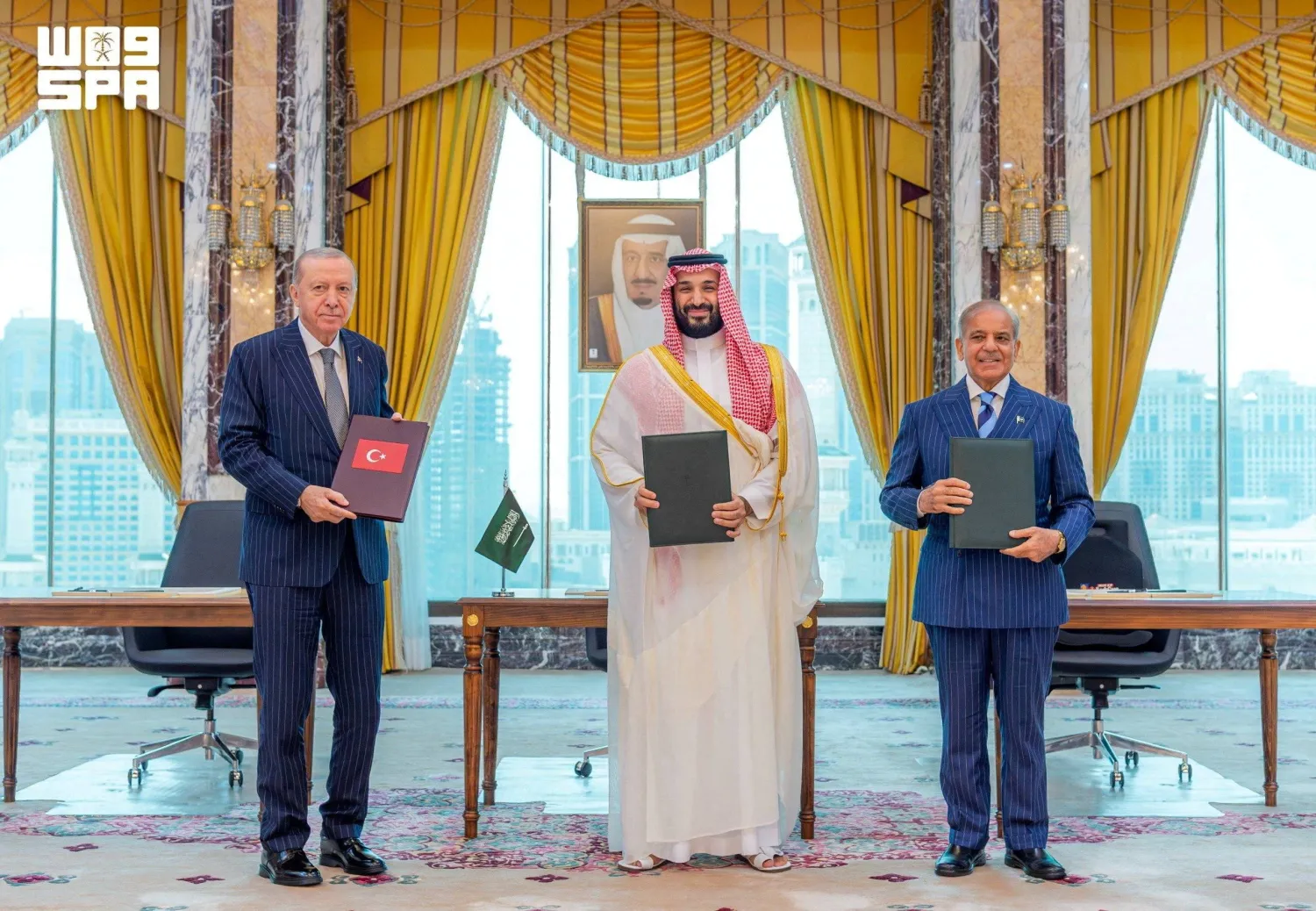
Turkish President Recep Tayyip Erdogan, Prince Mohammed bin Salman, Saudi Crown Prince and Prime Minister, and Pakistani Prime Minister Shehbaz Sharif pose after signing the joint defense agreement in Makkah, Saudi Arabia, August 7, 2026. (SPA)
TT

‘Makkah Agreement’ Moves Toward Establishing Strategic, Political and Military Mechanisms

Turkish President Recep Tayyip Erdogan, Prince Mohammed bin Salman, Saudi Crown Prince and Prime Minister, and Pakistani Prime Minister Shehbaz Sharif pose after signing the joint defense agreement in Makkah, Saudi Arabia, August 7, 2026. (SPA)

Türkiye, Saudi Arabia and Pakistan will group senior ministers, hold joint exercises and deepen defense industry cooperation under a military pact signed between the regional powers last week, Türkiye’s defense ministry said on Thursday.

At a weekly briefing in Ankara, the defense ministry said the pact's fundamental goal was to ensure defense and military ties were put on a "more institutional ⁠and sustainable" footing.

"Under the accord, strategic political ‌and military mechanisms plan to be ‌established involving the Defense Ministers, Foreign Ministers, and Chiefs of ‌General Staff/Armed Forces Commanders, and that coordination among the three countries ‌will be conducted at the highest level," it said.

The Turkish statements open the door for the Makkah Agreement to move from a political commitment toward establishing practical structures and mechanisms for defense coordination, including military, industrial and technological cooperation, while keeping the agreement open to the accession of other countries.

An agreement for deterrence and coordination

On August 7, Saudi Arabia, Türkiye and Pakistan signed the Makkah Agreement for Joint Defense in Makkah during a summit attended by Saudi Crown Prince and Prime Minister Mohammed bin Salman, Turkish President Recep Tayyip Erdogan and Pakistani Prime Minister Shehbaz Sharif.

The agreement is aimed at strengthening joint deterrence, as well as defense coordination and integration among the three countries. It stipulates that an armed attack against any one of the parties will be considered an attack against all three, reinforcing the principle of collective defense against threats to their security.

The agreement was signed under the umbrella of the Makkah Summit for Joint Defense, with the aim of strengthening the security of the three countries and contributing to regional and international security, peace and stability.

Saudi Defense Minister Prince Khalid bin Salman said after the agreement was signed that it establishes a framework for a long-term defense partnership and strengthens deterrence, coordination and integration, contributing to regional and global security and stability.

An open-ended defense partnership

Since the agreement was announced, the three parties have signaled that it is not intended to form a closed alliance. Turkish President Recep Tayyip Erdogan said the agreement is open to the participation of all brotherly countries seeking to achieve peace, prosperity and stability in our region.

Türkiye signaled that expanding the agreement to other countries would depend on first establishing the necessary institutional and regulatory mechanisms. A Saudi official stressed that the pact is not intended as a military or sectarian bloc, nor is it tied to nuclear ambitions or an arms race, but to building sustainable defense capabilities.

The official stressed that the agreement does not come at the expense of Saudi Arabia’s strategic ties with Gulf and Arab states or international partners, and is not directed against any country or intended to escalate tensions in the region.

Joint drills and defense production

The agreement could expand beyond military coordination to include joint exercises, defense production, technology transfer and the development of local capabilities. The three countries aim to build a shared defense-industrial base, with Saudi Arabia seeking greater localization and Türkiye and Pakistan bringing growing expertise in drones and other military systems.

The Makkah Agreement unites three regional powers with shared security interests. Türkiye’s plans to establish strategic, political and military mechanisms could institutionalize the pact and potentially turn it into a broader regional defense framework, depending on its structure and future membership.



Saudi Defense Minister Discusses Defense Cooperation with Malaysian Counterpart

Saudi Defense Minister Prince Khalid bin Salman bin Abdulaziz. (Asharq Al-Awsat)
TT

Saudi Defense Minister Discusses Defense Cooperation with Malaysian Counterpart

Saudi Defense Minister Prince Khalid bin Salman bin Abdulaziz. (Asharq Al-Awsat)

Saudi Defense Minister Prince Khalid bin Salman bin Abdulaziz reviewed with his Malaysian counterpart Mohamed Khaled bin Nordin on Sunday prospects of bilateral cooperation in the defense field between their countries.

During a telephone call, the officials discussed efforts made regarding current regional developments and a number of issues of mutual interest.


Saudi Arabia Participates in G20 Foreign Ministers' Meeting on Ebola Response

G20 Foreign Ministers’ Meeting on accelerating collective action to defeat Ebola. (SPA)
TT

Saudi Arabia Participates in G20 Foreign Ministers' Meeting on Ebola Response

G20 Foreign Ministers’ Meeting on accelerating collective action to defeat Ebola. (SPA)

Dr. Nouf Alnumair, deputy minister for international cooperation at Saudi Arabia’s Ministry of Health, represented Foreign Minister Prince Faisal bin Farhan bin Abdullah at the G20 Foreign Ministers’ Meeting on accelerating collective action to defeat Ebola, held on the sidelines of the 81st session of the United Nations General Assembly in New York, the Saudi Press Agency reported Sunday.

The meeting brought together representatives of G20 countries, invited nations and international organizations, as well as senior officials from affected countries, to discuss strengthening international coordination, accelerating joint efforts to contain the Ebola outbreak, supporting response efforts in affected countries, and bolstering health systems to curb transmission and prevent cross-border spread.

Discussions highlighted the need to unify international efforts to address cross-border health threats, strengthen coordination among governments, international institutions, and health bodies, and accelerate support to affected areas, including surveillance, diagnosis, field response, and capacity building, while enhancing regional and international health preparedness.


Bin Farhan Discusses Regional and International Developments with Guterres

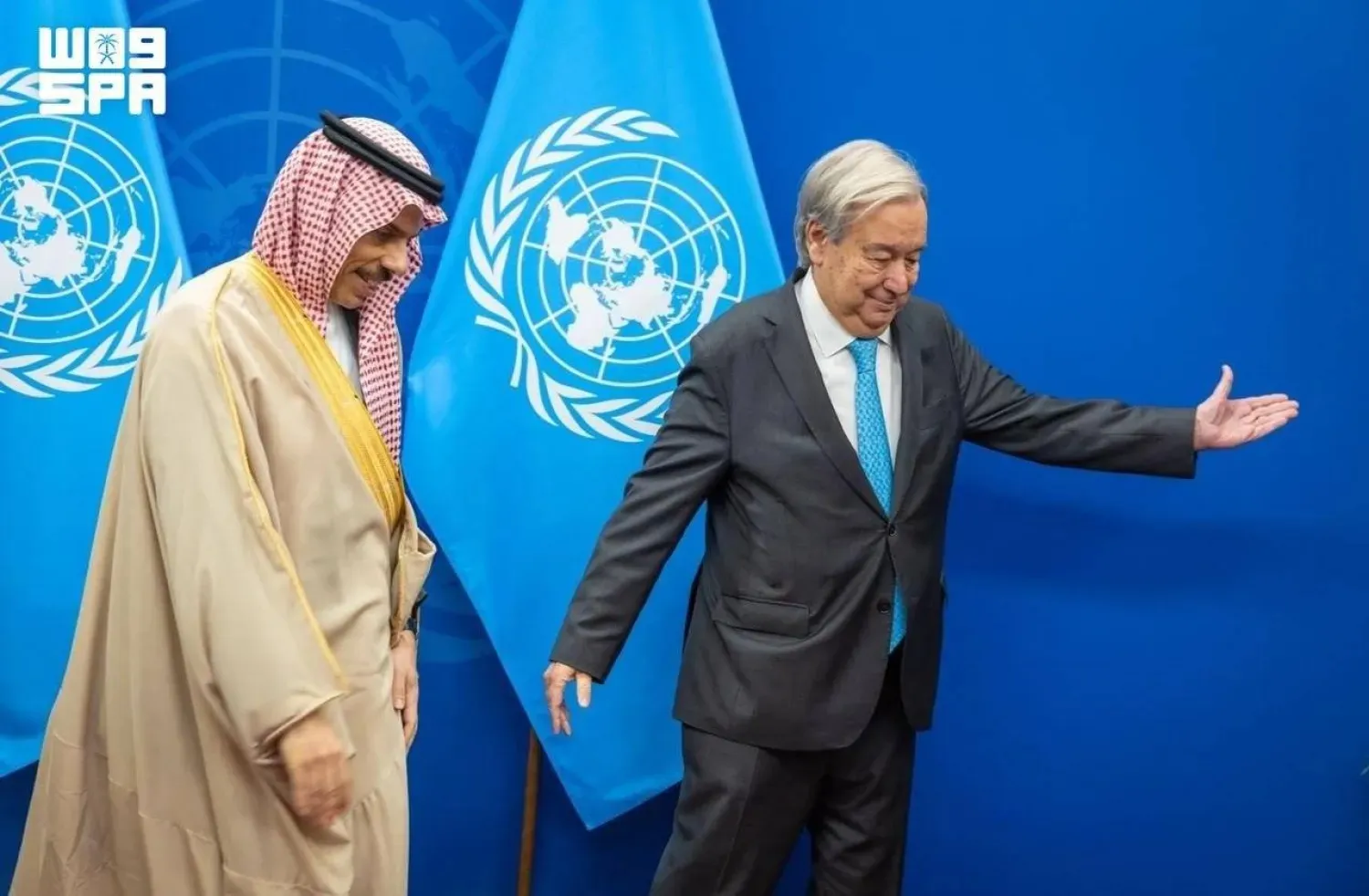
Saudi Foreign Minister Prince Faisal bin Farhan and UN Secretary-General Antonio Guterres (SPA)
TT

Bin Farhan Discusses Regional and International Developments with Guterres

Saudi Foreign Minister Prince Faisal bin Farhan and UN Secretary-General Antonio Guterres (SPA)

Saudi Foreign Minister Prince Faisal bin Farhan met with UN Secretary-General Antonio Guterres in New York on the sidelines of the high-level week of the 81st UN General Assembly session. 

The two officials discussed areas of cooperation and regional and international developments of mutual interest. 

During the meeting, Prince Faisal expressed his appreciation to Guterres as he nears the end of his term, commending the efforts he made during his tenure. 

The Saudi Minister also held separate meetings with Algerian Foreign Minister Ahmed Attaf, Mexican Foreign Minister Roberto Velasco Alvarez, and Ghanian Minister of Foreign Affairs Samuel Okudzeto Ablakwa. 

The meetings focused on key regional and international issues, with the officials exchanging views on current developments and international efforts to address them.