
Yemeni Forces Repel Houthi Attacks on Multiple Fronts

Yemeni Forces repel Houthi attacks on several fronts - Military Media
TT

Yemeni Forces Repel Houthi Attacks on Multiple Fronts

Yemeni Forces repel Houthi attacks on several fronts - Military Media

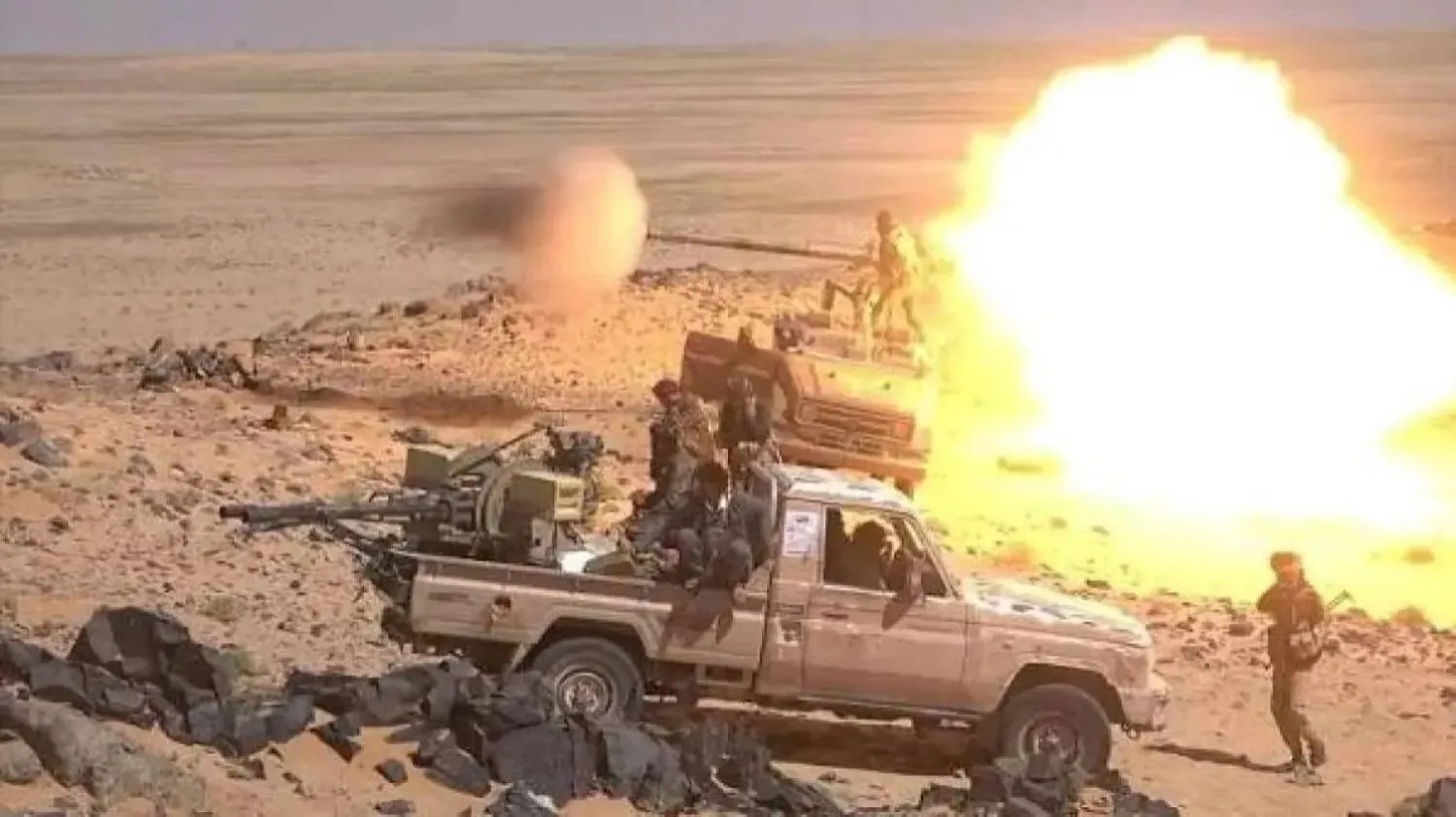
The Iran-backed Houthi group has intensified attacks across several fronts in Yemen, striking civilian areas and facilities in Taiz as government forces said they had repelled assaults and infiltration attempts in Taiz, Shabwa and Dhale and inflicted losses on the group.

Military and local sources said the Houthis had attacked military positions and civilian areas in several locations in recent hours, pointing to a widening of fighting across multiple fronts.

In the southwestern province of Taiz, Houthi mortar fire struck a mosque and a school in Maqsab village in the al-Atqa area of Mawza district, damaging both buildings but causing no casualties, local sources said.

The attack on the mosque came hours after the Houthis shelled al-Jeel al-Jadeed school in the same area.

The sources said the strikes were part of continuing Houthi attacks on places of worship, schools, civilian facilities and residential neighborhoods in the province.

On the northeastern front of Taiz city, the Houthis shelled government positions at Tabbat al-Wakeel and Tabbat al-Mawshki with medium weapons and projectiles, causing no casualties among the troops, a military source was quoted by Yemen’s Saba news agency as saying.

Government forces returned fire on Houthi positions near the Sofitel and International Hospital sites, silencing the sources of fire as clashes continued.

Fighting spreads across fronts

Clashes also spread to the Hayfan front southeast of Taiz, where the two sides fought in Ayrim, al-Mafalis, Tabbat Saeed Taha, al-Abliya and al-Manzara with light, medium and heavy weapons.

Local and military sources said government forces repelled a Houthi attack and forced the fighters to retreat, while continuing to target their firing positions. The forces said they remained ready for further attacks.

In Shabwa province, government troops thwarted Houthi attacks and infiltration attempts on fronts in Harib, Ain, Bayhan and Upper Markha districts.

A military source said forces deployed in the province foiled the infiltration attempts and inflicted losses in personnel and equipment. Government drones then struck Houthi positions and reinforcements in response, the source said.

In Dhale province, artillery fire hit Houthi gatherings and reinforcements near al-Fakher market west of Qataba as the fighters prepared to attack government positions, killing or wounding a number of them. Drone strikes also targeted the reinforcements.

Houthi media report 84 dead in a week

Houthi media acknowledged the deaths of 84 fighters over roughly a week, including 28 field commanders, in an indication of the scale of the group’s reported losses.

The toll included 47 fighters whose funerals were held over two days, among them 14 officers.

Forty of those reported killed were from Sanaa province, while others came from Dhamar, Amran, Hajjah, Saada, Mahwit and Ibb.

The figures announced by Houthi media suggest the losses extended into the group’s field command and were spread across several areas under its control.

The escalation comes as Rashad al-Alimi, Chairman of Yemen’s Presidential Leadership Council, said the state’s position toward the Houthis had changed and that any attack by the group would face a coordinated response and deterrence.

Al-Alimi said the armed forces were now operating through a single operations room and were better prepared to protect civilians, facilities and national institutions.

He said the state’s strategic goal was to restore its institutions and end the coup.

Al-Alimi said the government’s experience over recent years had shown that the Houthis used truces to rebuild their military capabilities and prepare for renewed fighting.

The government, he said, did not want another truce that repeated previous experiences, but a lasting peace based on a state that held sole authority over arms and sovereignty.

He said Houthi attacks on oil facilities and international shipping, along with threats to regional security, had helped shift international perceptions of the group.

The international question, in his view, was increasingly how to protect the Yemeni state, waterways and international peace and security rather than merely how to accommodate the Houthis.

Al-Alimi said the most significant military development was the growing unity and coordination among the fronts, citing simultaneous activity in Marib, Taiz, Shabwa, Dhale, Lahj, Hajjah, Saada and elsewhere.

He urged Yemen’s armed forces to protect civilians and respect the law, saying the strength of the state rested not only on weapons but also on the values and institutions it sought to restore.

Addressing the Houthis, Al-Alimi said the group still had an opportunity to lay down its weapons, enter political life and compete through the ballot box.

Yemen, he said, had room for everyone under the authority of the state and the law.


Lebanon Dismantles Security Network Linked to Hezbollah, Assad Remnants

Syrian army patrols the Lebanese border near Qusayr and searches tunnels used by Hezbollah in April 2026 (AFP)
TT

Lebanon Dismantles Security Network Linked to Hezbollah, Assad Remnants

Syrian army patrols the Lebanese border near Qusayr and searches tunnels used by Hezbollah in April 2026 (AFP)

Lebanese authorities have foiled a plot threatening security in Lebanon and Syria, dismantling a dangerous cross-border network linked to Hezbollah and remnants of the former Syrian regime.

Judicial and security sources told Asharq Al-Awsat that five network members, three Syrians and two Lebanese, had been arrested.

The group brought fighters from Syria into Lebanon across the northern border, moved them to Beirut’s southern suburbs and then sent them to a training camp in the Baalbek-Hermel region.

The detainees held both Lebanese and Syrian citizenships, the sources said. The most prominent was Syrian Colonel Manaf Ali Safi, who had been in charge of a security branch under the former Syrian regime.

Authorities seized weapons and ammunition from the network, including hand grenades, machine guns, and sniper rifles. The arsenal raised fears about what the group was preparing to do, particularly as investigators examine whether its objectives went beyond military training.

Possible attack on the Bekaa

Preliminary investigations showed that the detainees admitted receiving training from Hezbollah fighters and operatives led by a man known as “Hajj Alaa,” according to the sources.

The network was run by Major General Mohammed Jaber, the former commander of the Desert Brigade in the Syrian army, the sources revealed.

Jaber is now in Moscow and is known to have been close to ousted Syrian President Bashar al-Assad.

The case poses a major security challenge for Lebanon, given the network’s ability to move across the Lebanese-Syrian border at a highly sensitive time in relations between Beirut and Damascus.

The detainees claimed the stated purpose of the training was to prepare for a possible attack by Syria’s current forces on Lebanon’s Bekaa region, the judicial and security sources said.

Initial findings also pointed to a broader network inside Syria involving more than 50 remnants of the former regime. They arranged the transfer of fighters from Syria into Lebanon and monitored Syrian forces’ movements inside Syria.

Sowing unrest and security chaos

Initial information also implicated three Hezbollah-linked individuals in bringing in and training the fighters. Several other names remain under scrutiny as investigators seek to establish their roles.

The sources said the network’s mission likely went beyond preparing to repel a possible Syrian incursion. They said it may have sought to sow unrest and security chaos in Lebanon, carry out assassinations and, most importantly, conduct operations in Syria’s coastal region.

That assessment was based on the weapons seized, including explosives, military-grade machine guns, sniper rifles and hand grenades.

Bodyguard to Christian bloc leader arrested

In a significant development, the sources said a member of Lebanon’s State Security agency who was part of the group had been arrested at dawn on Wednesday after more than a week in hiding. The man worked as a bodyguard for the head of a Christian parliamentary bloc.

He is the brother of one of the detainees and helped another person move and conceal a cache of weapons hidden in Talbira, an Akkar town near the Syrian border, the sources said.

The town served as an assembly point for fighters arriving from Syria before they were moved to Beirut’s southern suburbs. That adds a more sensitive dimension to the case, pointing to organized routes for moving people and weapons across the border.

Lebanese security agencies are working to uncover the network’s full structure and identify everyone involved, particularly those suspected of handling financing, recruitment, transportation and training.

Investigators are also seeking to determine what operations the group was preparing and whether it has other cells in Lebanon or Syria.


Lebanon Central Bank Says New Audit to Scrutinize Transactions for Graft

A view shows Lebanon's Central Bank building in Beirut, Lebanon August 25, 2023. (Reuters)
TT

Lebanon Central Bank Says New Audit to Scrutinize Transactions for Graft

A view shows Lebanon's Central Bank building in Beirut, Lebanon August 25, 2023. (Reuters)

Lebanon's central bank said Wednesday that an outside firm had begun a forensic audit into past transactions linked to its foreign assets, scrutinizing them for evidence of graft in the wake of the country's economic collapse.

The move is part of measures the institution has taken to improve oversight, steps that have also resulted in the arrest of the body's former governor, Riad Salameh.

A forensic audit has also been a key demand of the international community and the International Monetary Fund as Lebanon seeks bailout funds after the economic crash, which began in 2019.

The central bank said Wednesday that on August 17, the New York-based Alvarez & Marsal began the forensic audit of "selected transactions", covering the period from October 2019 to the end of 2023.

The audit includes "transactions related to the central bank's foreign assets, including subsidy programs for essential goods and materials" as well as other transfers, it said.

In May, the central bank had said that the audit aimed to verify that payments and transfers "were executed pursuant to proper authorizations and approvals", and that funds "were used for their intended purposes, without any violation, misuse, or misappropriation".

In 2020, Alvarez & Marsal had launched an audit of the central bank but later halted work after the body failed to hand over necessary data.

The firm resumed that audit the following year, and its preliminary report in 2023 painted a damning picture of the institution under long-serving former governor Salameh.

Salameh, who headed the bank from 1993 to July 2023, is widely viewed as a key culprit in the country's dramatic economic crash and is accused of having amassed a fortune during his time in the job.

He has faced numerous accusations including embezzlement and tax evasion in probes in Lebanon and abroad but has consistently denied any wrongdoing, insisting he is being made a "scapegoat" for the economic collapse.

He was arrested in September 2024 and charged with offenses including the alleged embezzlement of $44 million from the central bank, but was released a year later after posting record bail of more than $14 million.

He was placed in custody again in July over accusations including embezzlement and illegal enrichment after a complaint lodged by the new central bank authorities.


Israel Ready to Remove Gaza Population if US Gives Approval, Says Minister

An Israeli military vehicle maneuvers in Gaza, as seen from the Israeli side of the border, September 1, 2026. (Reuters)
TT

Israel Ready to Remove Gaza Population if US Gives Approval, Says Minister

An Israeli military vehicle maneuvers in Gaza, as seen from the Israeli side of the border, September 1, 2026. (Reuters)

Israel has plans ready to remove Palestinians from the Gaza Strip but is waiting for the United States to figure out where to take them, the defense minister said Wednesday.

"There is no real solution for Gaza in the end without this migration," Defense Minister Israel Katz told a conference hosted by Israeli news site Ynet and newspaper Yedioth Ahronoth.

The Israeli government "is organized and prepared to get them out -- by sea, by air, by every way possible", he said.

The US embassy referred requests for comment to the State Department in Washington.

US President Donald Trump, at the start of his second term, stunned much of the world by calling for all two million Palestinians to leave the Gaza Strip.

Trump spoke of developing the Mediterranean territory, devastated by Israeli bombardment since the October 7, 2023 attack by Hamas, into a luxury resort destination.

Trump walked back the idea following strong pushback including from Egypt, the only country other than Israel to border Gaza.

The proposal was also condemned by Palestinians themselves, for whom any effort to force them off their land would recall the "Nakba", or catastrophe -- their mass displacement during Israel's creation in 1948.

Announcing a Gaza war ceasefire in October, Trump laid out 20 points for the territory that included no forced displacement.

Katz, known for his outspoken remarks, said that Trump had only "frozen" the idea as he looks for countries to take in Palestinians.

"The plan hasn't been cancelled; it is being discussed all the time, even now, and I think there is no other solution for everyone's good," he said.

"But for it to happen, we need the US. When will we get their approval? Whenever it becomes clear that Hamas is not meeting its obligations" under the ceasefire, he said.

Katz, without citing his source, said 80 percent of people in Gaza wanted to leave but that Hamas was preventing them.

Forced displacement of civilians in occupied territory is considered a war crime under the Geneva Conventions.

The International Criminal Court has issued arrest warrants for Prime Minister Benjamin Netanyahu and Katz's predecessor Yoav Gallant over alleged war crimes, which both Israel and the United States deny.

Israeli attacks have already internally displaced the vast majority of Gaza's people following the unprecedented Hamas attack, which killed 1,221 people, according to official Israeli figures.

Israel's offensive has since claimed 73,470 lives in Gaza, with more than 1,330 since the ceasefire, according to the Gaza health ministry, which operates under Hamas.