


Oil Rises after US Threatens Indefinite Blockade of Iran

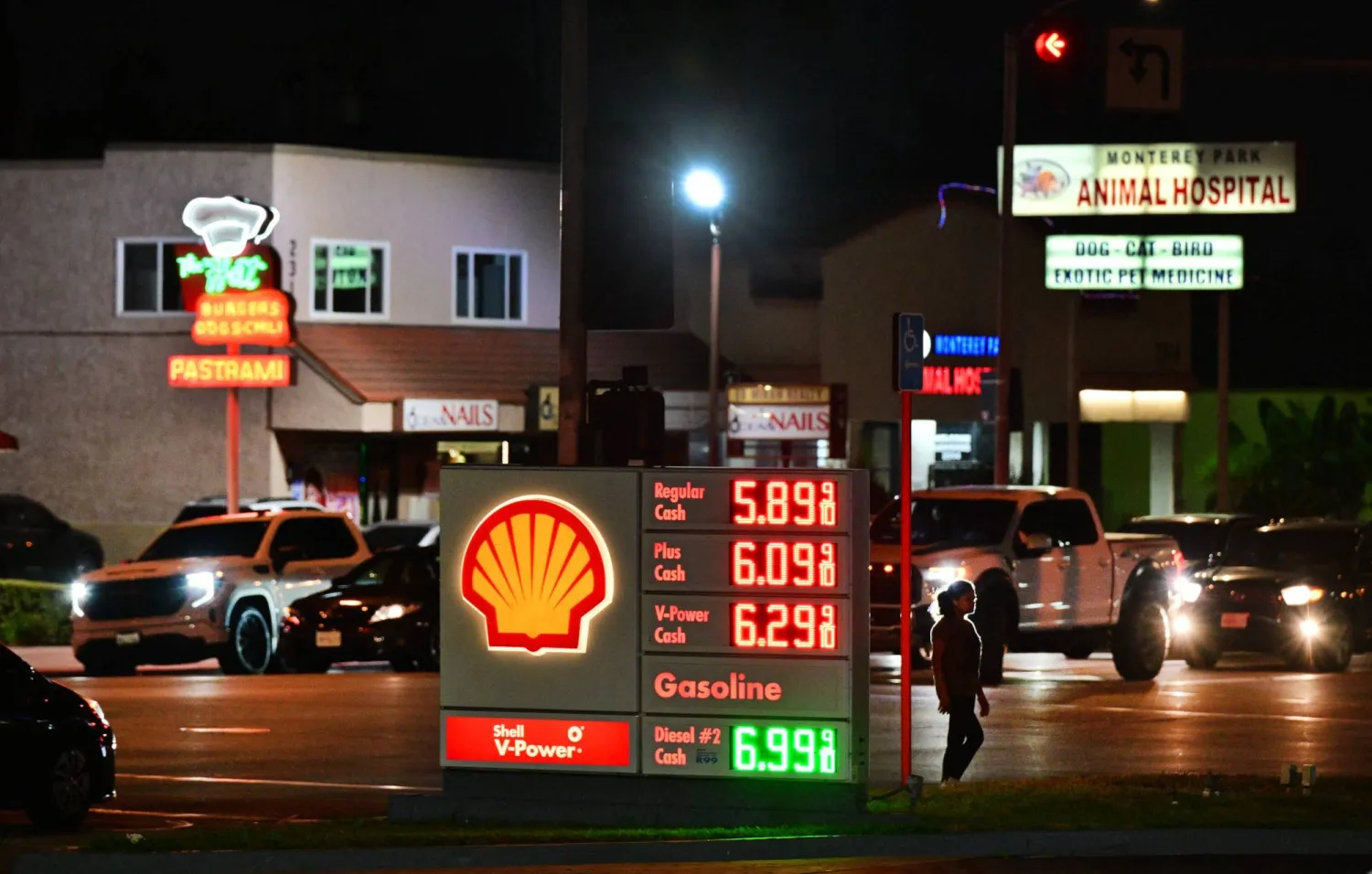
Gas prices are seen listed as motorists make their way durig the evening commute in Monterey Park, California, on August 13, 2026. (Photo by Frederic J. BROWN / AFP)
TT

Oil Rises after US Threatens Indefinite Blockade of Iran

Gas prices are seen listed as motorists make their way durig the evening commute in Monterey Park, California, on August 13, 2026. (Photo by Frederic J. BROWN / AFP)

Oil prices gained on Friday after the United States threatened an indefinite naval blockade of Iran, reviving concerns about supply of crude after the previous session's fall on a weaker outlook for demand and a large build in US stocks.

Brent futures rose 90 cents, or 1.03%, to $87.97 a barrel by 0653 GMT, while US West Texas Intermediate (WTI) crude futures rose 91 cents to $82.16 a barrel, Reuters reported.

The benchmarks were on track for weekly rises of about 4% after the prior session's fall of more than 2%, paring gains following Brent's six-session rally and a five-session rise for WTI.

"Despite the bearish crude stock data, the ⁠broader geopolitical backdrop is ⁠preventing a sharper price decline," Susan Bell, senior vice president for oil commodity markets at Rystad Energy said in a note.

On Thursday, the United States warned that it could maintain a naval blockade of Iran indefinitely and ramp up economic pressure on Tehran as ceasefire talks have stalled.

"Watch this space for more announcements coming next week because we are going to apply ⁠measures like have never been seen in the history of economic isolation of a country," Treasury Secretary Scott Bessent told Newsmax's "Rob Schmitt Tonight" program in an interview.

The latest US threats come as Iran curbs flows through the Strait of Hormuz, which carried 20% of the world’s oil before the conflict, driving up fuel prices and putting pressure on President Donald Trump to end a war that is unpopular at home.

The strait is "under the management and control of the Islamic Republic", however, the recently appointed head of Iran's Basj paramilitary unit, Hossein Taeb, has said, according to the semi-official Fars ⁠news.

The prospect ⁠of a longer war hitting supply was offset this week by forecasts from OPEC and the International Energy Agency lowering outlooks for demand growth, while data showed the largest weekly gain in US crude stocks for more than 3-1/2-years.

Two vessels from the state-owned Abu Dhabi National Oil Company were attacked transiting the Strait of Hormuz on Thursday, said UAE state news agency WAM, an incident the United Arab Emirates government condemned as an Iranian attack.

Elsewhere, Russian authorities quickly cleared up damage on Friday after a fire at the Baltic Sea port of Ust-Luga, a major hub for oil exports, was triggered by a Ukrainian drone attack, regional governor Alexander Drozdenko said.



Fitch Keeps US at 'AA+', Cites Economic Resilience amid Fiscal Risks

The American flag flies in the National Mall near the Capitol building in Washington (Reuters)
TT

Fitch Keeps US at 'AA+', Cites Economic Resilience amid Fiscal Risks

The American flag flies in the National Mall near the Capitol building in Washington (Reuters)

Fitch on Thursday affirmed the sovereign credit rating for the United States at "AA+" with a stable outlook, citing its large economy, high per-capita income and the US dollar's status as the world's leading reserve currency.

The US economy remained resilient despite higher tariffs, government spending cuts, tighter border controls and heightened policy uncertainty, reflecting its ability to absorb shocks and economic flexibility, Reuters quoted the credit ratings agency ⁠as saying.

Fitch, however, estimated ⁠economic growth of 1.9% in 2026-2027, lower than the 2.8% in 2025, and noted weakening labor demand and a significant slowdown in job creation this year.

Inflation remains a concern, with the agency expecting it to average 3.4% in ⁠2026, above the Federal Reserve's 2% target. Tariffs have added to core goods inflation, though their impact has been less severe than expected.

Fitch expects the general government deficit to widen to 7.4% of GDP in 2026 and remain at that level in 2027, the highest among "AA"-rated sovereigns.

Higher military and interest costs, along with rising Medicare and Social Security spending, would limit ⁠efforts ⁠to reduce the deficit.

Peer S&P Global also maintained its "AA+" rating on the US in June, citing the economy's resilience and strong institutions.

Fitch had downgraded the US sovereign rating by one notch from the top-tier triple-A rating in 2023, pointing to expected fiscal deterioration and repeated down-to-the-wire debt ceiling negotiations.

Moody's downgraded the US by one notch last year, citing rising debt levels and stripping the country of its last remaining triple-A rating.


Gold Heads for Weekly Loss as Investors Unwind Inflation-fueled Rally

An employee displays gold bars at the Korea Gold Exchange in Seoul (Reuters)
TT

Gold Heads for Weekly Loss as Investors Unwind Inflation-fueled Rally

An employee displays gold bars at the Korea Gold Exchange in Seoul (Reuters)

Gold prices slipped on Friday and were headed for a weekly loss as investors locked in profits a day after bullion was propelled to its highest level in more than two months on mild US inflation data that weakened the case for a near-term Federal Reserve rate hike.

Spot gold was down 0.5% at $4,330.70 per ounce, as of 0714 ‌GMT. US gold futures ‌for December delivery slid 0.7% to $4,387.40, said Reuters.

Bullion climbed to ‌its ⁠highest point since ⁠June 5 on Thursday, before settling lower, setting it on track for a weekly loss.

"There is some episodic and more speculative capital that's maybe taking a bit of profit in gold, because there's not a near-term catalyst quite so potent immediately in front of us," said Ilya Spivak, head of global macro at finance content network Tastylive.

"Gold ⁠may be setting up, with some choppy trading ‌along the way, for a meaningful ‌rally now. And if we can take out $4,400, I don't think $5,000 by year-end ‌is any kind of a sketch."

The non-yielding metal got ‌a boost after an unexpected drop in US July nonfarm payrolls last week, followed by softer inflation data this week, sharply reducing expectations of a rate hike next month.

US producer prices were unchanged in July, following a revised ‌0.1% drop in June, while US consumer prices barely increased in July as the cost of ⁠gasoline declined ⁠for a second consecutive month.

Traders are now pricing only a 33% chance of a rate hike in September, down from about 55% last week, according to the CME FedWatch Tool.

Lower interest rates make gold more attractive relative to yield-bearing assets.

On the geopolitical front, Washington on Thursday threatened to maintain a naval blockade of Iran indefinitely, ratcheting up economic pressure on Tehran as ceasefire talks have floundered.

In other metals, spot silver slipped 0.3% to $64.25 per ounce.

Platinum was steady at $1,717.40, while palladium inched 0.3% lower at $1,303.50, both touching their lowest levels since August 4 earlier in the session. Both metals were headed for a weekly drop.


Saudi Petrochemical Companies Cut Losses by More than 50% in First-Half

A SABIC manufacturing site in Jubail (SABIC Media Center) 
TT

Saudi Petrochemical Companies Cut Losses by More than 50% in First-Half

A SABIC manufacturing site in Jubail (SABIC Media Center) 

Net losses at nine petrochemical companies listed on the Saudi Exchange fell by more than 50% in the first half of 2026 to SAR 1.7 billion ($452.8 million), from about SAR 3.4 billion ($908.5 million) a year earlier.

The improvement reflected stronger operating efficiency, better results from some associates and joint ventures, and lower losses from discontinued operations and asset impairments. Companies also faced pressure from weaker equity investments, higher average costs for some production inputs and lower sales volumes due to supply-chain disruptions.

Four companies posted net profits — SABIC Agri-Nutrients, Yansab, Saudi Industrial Investment Group and Alujain — while Advanced Petrochemical, Sipchem, SABIC, Tasnee and Saudi Kayan reported losses.

SABIC Agri-Nutrients posted the sector’s highest profit at about SAR 1.6 billion, down 21.4% from SAR 2.04 billion a year earlier. The company attributed the decline to lower sales volumes caused by supply-chain challenges and weaker results from an associate and a joint venture, partly offset by higher average selling prices for most products.

Yansab ranked second, with profit surging 363% to SAR 270 million from SAR 58.2 million, supported by higher selling prices and strong plant reliability. Saudi Industrial Investment Group’s profit rose 410% to SAR 194 million.

Saudi Kayan recorded the largest loss at SAR 1.29 billion, compared with SAR 1.27 billion a year earlier. Tasnee lost SAR 889.1 million and SABIC SAR 820 million.

Combined second-quarter losses for the nine companies fell 42.17% to SAR 2.07 billion from SAR 3.58 billion a year earlier.

G. World CEO Mohamed Hamdy Omar told Asharq Al-Awsat that performance varied according to product mix, petrochemical feedstock costs, production and sales volumes, operating efficiency and exposure to global markets and supply-chain disruptions.

He noted that SABIC’s losses narrowed sharply from SAR 4.07 billion to SAR 833 million, but said much of the improvement reflected the non-recurrence of provisions and impairment charges rather than an equivalent recovery in underlying operations.

SABIC Agri-Nutrients, meanwhile, remained among the sector’s most profitable companies, although second-quarter profit fell 64.2% to SAR 379 million because of lower sales volumes, supply-chain disruptions and weaker contributions from an associate and joint venture.

Omar expects a gradual but uneven recovery in the second half, with global demand, feedstock and energy costs, excess capacity, shipping disruptions and geopolitical tensions remaining key factors. He said sustainable improvements in operating margins, sales volumes and cash flow would provide the clearest evidence of a genuine sector recovery.