


France and England Battle Multiple Wildfires as Record Heat Grips Europe

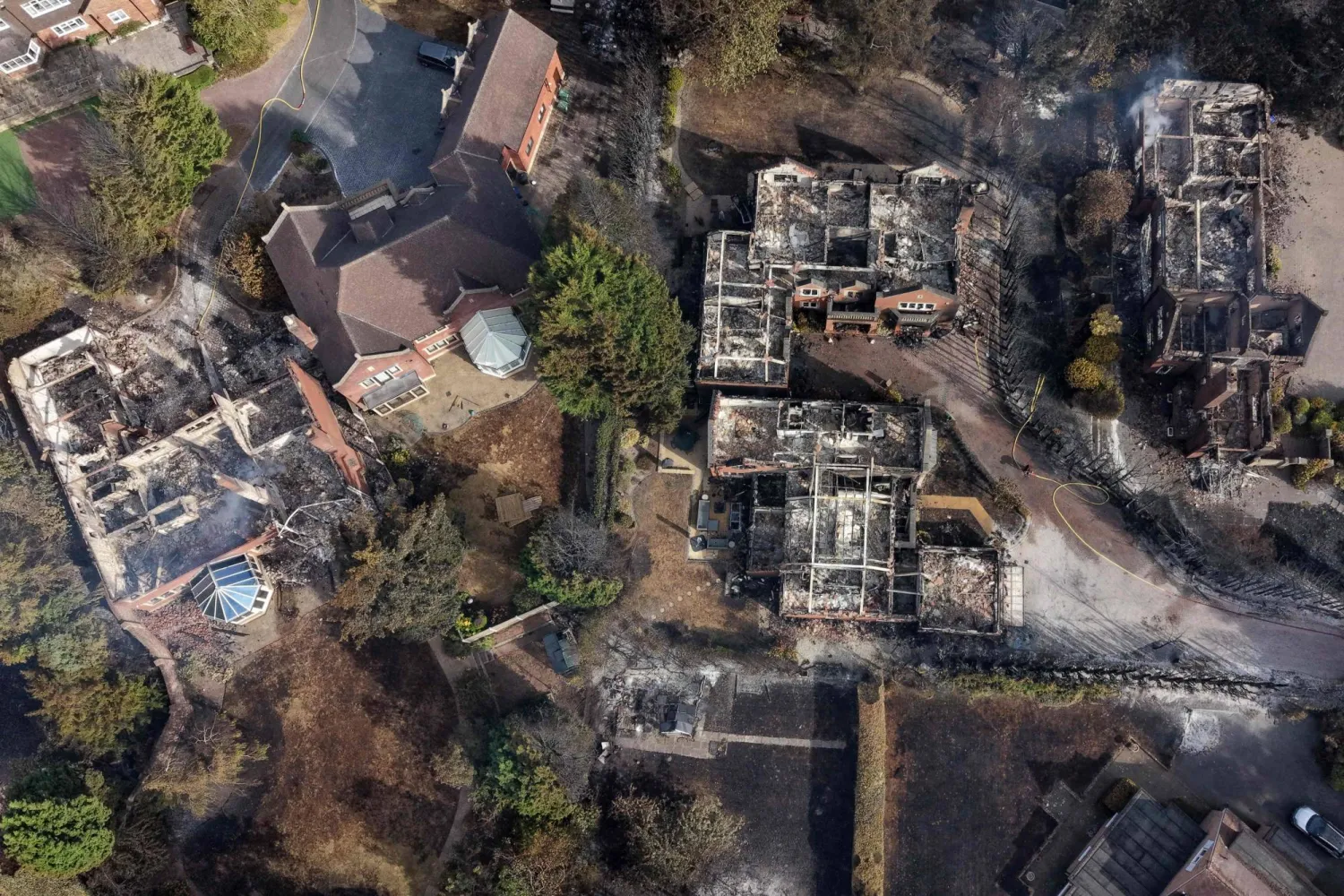
An aerial view shows smoke rising from fire-damaged houses, south of Stourbridge town center in central England on August 14, 2026. (Photo by Darren Staples / AFP)
TT

France and England Battle Multiple Wildfires as Record Heat Grips Europe

An aerial view shows smoke rising from fire-damaged houses, south of Stourbridge town center in central England on August 14, 2026. (Photo by Darren Staples / AFP)

Firefighters across France and in central England struggled against multiple fires Friday as a new wave of record-breaking heat baked a swath of Europe, their task further complicated by exceptionally parched landscapes.

With France experiencing its driest year ever, a new fire raced through woodlands overnight in the Landes region on the southwest coast. The blaze forced more than 500 people to evacuate their homes in the town of Luglon as hundreds of firefighters deployed to the area, the regional administration said Friday.

It’s one of several fires scorching forests around France this week, including in normally cooler and wetter regions in the north and Brittany. A historic fire devoured forests near Bordeaux last month and pushed a quarter of a million people from their homes.

Meanwhile, efforts to contain a wildfire in Germany were complicated by unexploded World War II munitions, and shifting winds in Croatia spread flames deeper into a coastal suburb and forced more than 1,000 people to flee.

After the UK recorded its hottest day of the year on Thursday, wildfires raced across the West Midlands and saw several houses burned to the ground. They have been “one of the most significant” incidents the region’s fire service has ever dealt with, chief fire officer Simon Tuhill said.

Some 1,017 wildfires have been recorded in England and Wales this year, according to data from the National Fire Chiefs Council.

The fires came on the hottest day of the year, when temperatures reached 38.1 degrees Celsius (100.6 degrees Fahrenheit) in west London.

In France, temperatures Thursday approached 41 C (106 F) in several areas, from Aquitaine in the southwest to the Rhone River valley in the east, according to the national weather service. They were forecast to reach similar levels Friday before dropping over the weekend.
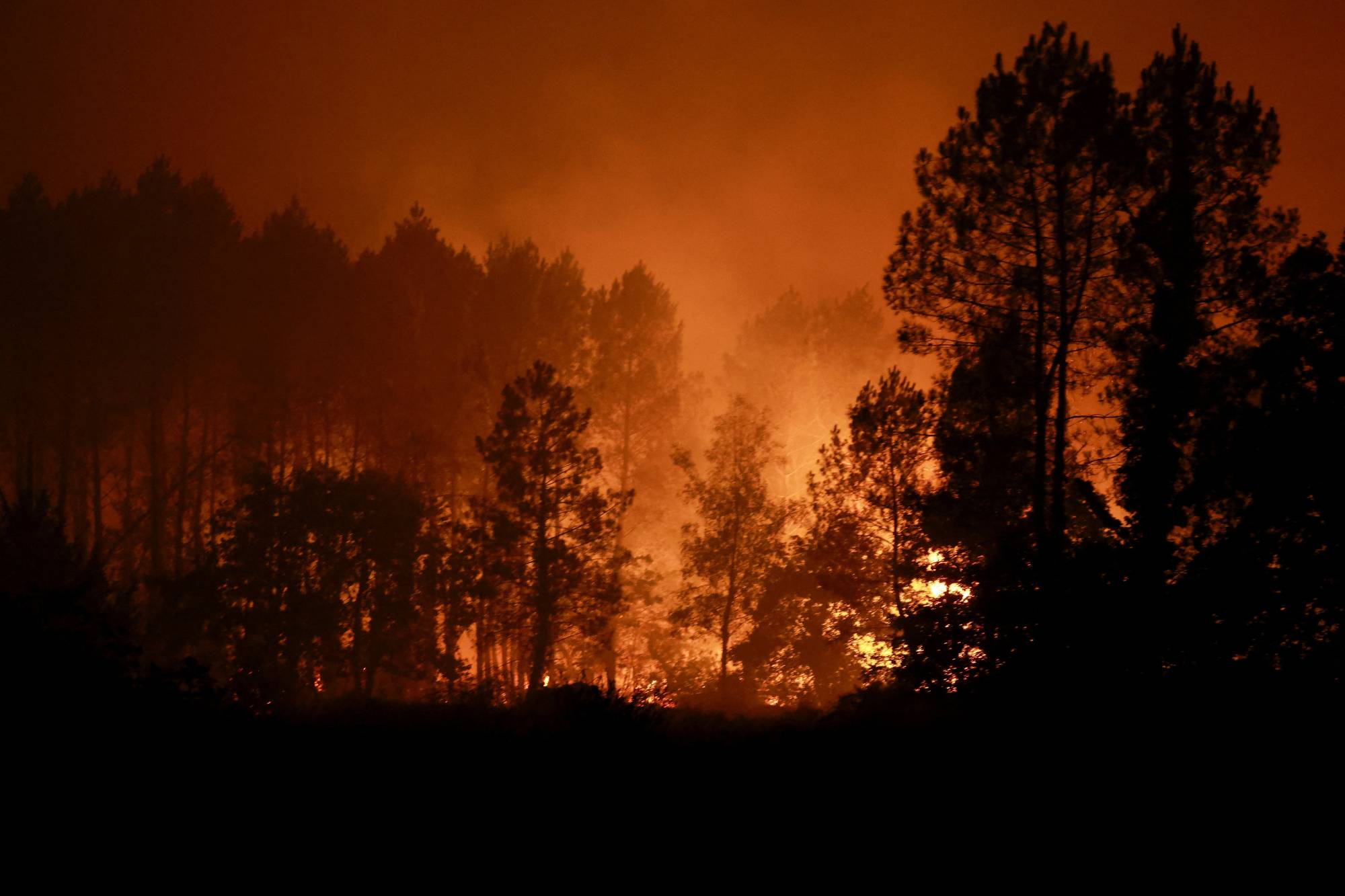
 

Flames engulf trees as a wildfire burns in Luglon, France, August 14, 2026. REUTERS/Stephanie Lecocq

The historic temperatures are linked to human-caused climate change, and are hitting countries more designed for long cold seasons and ill-equipped for this sort of heat, with limited air conditioning.

Firefighters battle forest fire in Germany All 1,800 residents of the village of Gey in Germany’s North Rhine-Westphalia state were evacuated after a wildfire in the nearby Hürtgen forest threatened to reach their homes. Nearly 300 hectares (1.16 square miles) of forest were ablaze on Friday morning, The Associated Press quoted local authorities as saying.

Unexploded ordnance from World War II in the forest hampered firefighting efforts, German news agency dpa reported. Explosions could be heard as the munitions detonated during the fire, forcing firefighters to stay out of the area for safety.

The fire advanced to within 300 meters (1,000 feet) of Gey, which sits on the edge of the forest near the Belgian border. Overnight a shift in wind direction raised the risk that the flames could reach Gey by morning, prompting officials to order the initial evacuation.

The cause of the blaze remains unknown, and authorities have not ruled out further evacuations in the area.

Hundreds of personnel have been deployed to battle the fire, with the German army sending tanks and firefighting helicopters providing air support.

In Croatia, 14 people were hospitalized, of whom seven remained in life-threatening condition early Friday from a fire that raged overnight by the coastal town of Omis and forced more than 1,000 people to evacuate their homes.

The fire erupted late Thursday in an Omis suburb and quickly spread because of strong wind. Public broadcaster HRT said the blaze came close to the town’s center, and parts of Omis were left without electricity while many cars were burned.

Croatian media published photos from a crowded sports hall in Omis where people crammed on beds and on the floor. Witnesses told HRT that people were jumping into the sea after boats also caught fire.

Firefighters put out the blaze by Friday morning as other crews in planes headed further south toward the Peljesac peninsula where another wildfire broke out overnight.

Meanwhile, in northern Greece, more than 300 vacationers and residents were evacuated by sea Thursday after a wildfire swept through a pine forest and threatened seaside homes, authorities said.



Food Giants in India Call for Reconsidering Red Color of Warning Labels

A man walks near a grocery shop in Bhubaneswar, Odisha, India, September 18, 2026. REUTERS/Priyanshu Singh
TT

Food Giants in India Call for Reconsidering Red Color of Warning Labels

A man walks near a grocery shop in Bhubaneswar, Odisha, India, September 18, 2026. REUTERS/Priyanshu Singh

India should reconsider the red color of its proposed food warning labels as it can confuse consumers who associate the color with non-vegetarian ingredient markings, food companies in India have told the Supreme Court.

India is in the midst of an unprecedented food safety crackdown, including nationwide raids against eateries, amid concern over poor hygiene and standards. The government's plan for front-of-pack red warning labels came after heated public debate on the lack of ⁠such measures.

The warning ⁠labels proposal has coincided with India's push to ban junk food sales to children in schools and within 50 meters (164 feet) of schools, measures that will take India close to stricter food regulation approaches adopted in Chile and Mexico.

In India, the food regulator has proposed a red hexagon warning label system to mark high salt, sugar or fat in packaged items, despite the more than $100 billion industry's multi-year campaign to ⁠oppose the labels.

In a court filing dated September 24, All India Food Processors Association, which represents dozens of Indian and foreign food giants, said the color and symbol used for the warnings "require careful consideration in the Indian context.”

"The average Indian consumer is habituated to associating the color red with the mandatory non-vegetarian identification mark," the industry group said in the filing, which was reviewed by Reuters.

The group said it had told the food regulator that "introducing another prominent red warning symbol may create confusion among consumers," the filing said.

A modified label pasted over the original nutrition facts information on a packet of Maggi, during a raid by the Maharashtra Food and Drug Administration (FDA) at a warehouse in Turbhe, India, August 25, 2026. REUTERS/Francis Mascarenhas

India is a top growth market for global consumer giants like PepsiCo, Coca-Cola, Mondelez and Nestle, and also ⁠thousands of small Indian ⁠companies which sell traditional savories and sweets.

The lobby group told the Supreme Court it was not against front-of-pack warning labels, but the thresholds must be decided in a scientific manner. It said it objected to the "indiscriminate application of the thresholds presently proposed.”

India is proposing a red warning if added sugar is in excess of 3% of solid products by weight, and fat in excess of 4.2% - stricter than many foreign markets.

The industry also reiterated its concerns that warnings should be decided on consumption of a single serving of a product, and not 100 grams as currently proposed.

"Indian foods are eaten in widely varying quantities, including approximately 10g of pickle, 15-20g of spread of condiments, 30g of bread," the industry group said.

The Supreme Court is set to review the government's proposal on Monday.


Scientists Find New Clues to Reversal of Alzheimer's Brain Damage

Elderly women sit at a park in downtown Shanghai March 16, 2012. REUTERS/Carlos Barria/File Photo
TT

Scientists Find New Clues to Reversal of Alzheimer's Brain Damage

Elderly women sit at a park in downtown Shanghai March 16, 2012. REUTERS/Carlos Barria/File Photo

Scientists studying the strongest genetic risk factor for Alzheimer's disease say they have new clues to how it works and how its damaging effects on the brain could potentially be reversed.

Researchers have found a noninvasive way to identify and study cells in the body that contribute to age-related disorders ⁠such as cancer, tissue degeneration, and inflammatory diseases.

These so-called senescent cells have stopped dividing and growing but for some reason have not died, as would be expected of old cells. Instead, they undergo significant changes to their shape, metabolic processes, and gene activity, according to Reuters.

Earlier methods of studying these cells would destroy them, the researchers noted in a report of the study in Nature Aging.

Using an analytical technique known as Raman microscopy, which reveals the biochemical composition of cells without harming them, and analyzing individual cells’ ⁠genetic activity, the researchers were able to identify unique “barcodes” of senescent cells.

The study was done in mouse cells. The researchers are now working on adapting it for use with human tissue.

“You can imagine that one day we may develop an endoscope that can look inside your body and identify cellular senescence,” Jeon Woong Kang of MIT, one of the senior authors of the study, said in a statement.

Study leader Peter So of MIT noted that senescence “is ⁠not just a pathological condition.”

While it can also contribute to sagging skin and muscle weakness in aging individuals, cellular senescence plays critical beneficial roles in embryonic development and tissue regeneration, the researchers noted.

The research is part of a National Institutes of Health initiative called the Cellular Senescence Network.

“The idea behind the NIH Cellular Senescence Network is to take a very comprehensive approach to understand senescence and identify senescent cells, because it plays a role in so many normal physiological conditions and many pathological conditions,” So said.


Growing Privacy Fears in London over Smart Glasses

A pair of smart glasses (Meta)
TT

Growing Privacy Fears in London over Smart Glasses

A pair of smart glasses (Meta)

The rise of smart glasses equipped with high-definition cameras raised concerns in London surrounding privacy and consumer technology in public spaces.

According to CNN, videos posted on social media without the knowledge of the concerned person have brought questions about consent and whether existing privacy laws can keep pace with technology that allows people to record almost invisibly.

The glasses — which can capture video, photos and audio from the wearer’s perspective — are growing in popularity. They allow users to listen to music, take calls and snap photos hands-free, and some tech companies believe they could one day be the preferred way to communicate with AI assistants.

Recently, London bars, restaurants, theaters, and public institutions have started to restrict or ban camera-equipped smart glasses while some anti-smart glasses advertisements have appeared at bus stops.

Eyewear giant EssilorLuxottica, which Meta partners with for its glasses, said 7 million pairs of AI glasses were sold in 2025.

Meta is holding its Connect conference this week, where it’s expected to announce new smart glasses without cameras, according to The Information Samsung and Google are expected to debut new jointly developed smart glasses this fall.

But as the technology becomes more widespread, so too has the backlash. Videos posted on social media showing men who appear to film women without their knowledge have raised questions about consent — and whether existing privacy laws can keep pace with technology that allows people to record almost invisibly.

“It makes it harder and harder to protect yourself by just looking around and screening for things,” Irina Raicu, director of the internet ethics program at Santa Clara University’s Markkula Center for Applied Ethics, previously told CNN. “So, the whole notion of consent is kind of disintegrating.”

London A Bellwether for How People Respond to Growing Tech

London, along with New York and Australia, is emerging as a bellwether for how people and businesses are responding to the growing tech.

Some hospitality and entertainment venues have introduced restrictions or bans, and anti-smart glasses advertisements have begun appearing at some bus stations throughout London.

One skewers Kylie Jenner’s ad campaign for Meta glasses, transforming her into a skeletal X-Ray with the tagline: “We’re Always Watching.”

The sentiment echoes a broader ban across the United Kingdom from August that prohibits smart glasses in the courtroom.

Some Londoners told CNN that smart glasses make them feel uneasy in places where people expect a degree of privacy, like bars, restaurants and other social settings.

‘Turn the cameras off’

Popular pub chain Wetherspoons has prohibited customers from recording using the glasses.
“I don’t really want to be filmed when I’m just out having a couple of pints,” Zak, a student at a Wetherspoons pub in central London, told CNN.

He said he had seen videos on TikTok in which people appeared unaware they were being filmed, adding that covering the glasses’ recording light was “ridiculous.”

Serena, another Wetherspoons customer, said she was particularly concerned about the possibility of being filmed without knowing where the footage might end up.

A Wetherspoons spokesperson told CNN, “With regard to Meta glasses, our instinct was to say, ‘turn the cameras off.’”

And while tech companies continue to develop smart glasses, integrating photography and artificial intelligence, Londoners mainly ask how to protect individual privacy when cameras become virtually invisible and integrated into everyday eyewear.