


US Deportees Face Escalating Police Violence, Intimidation in Eq.Guinea

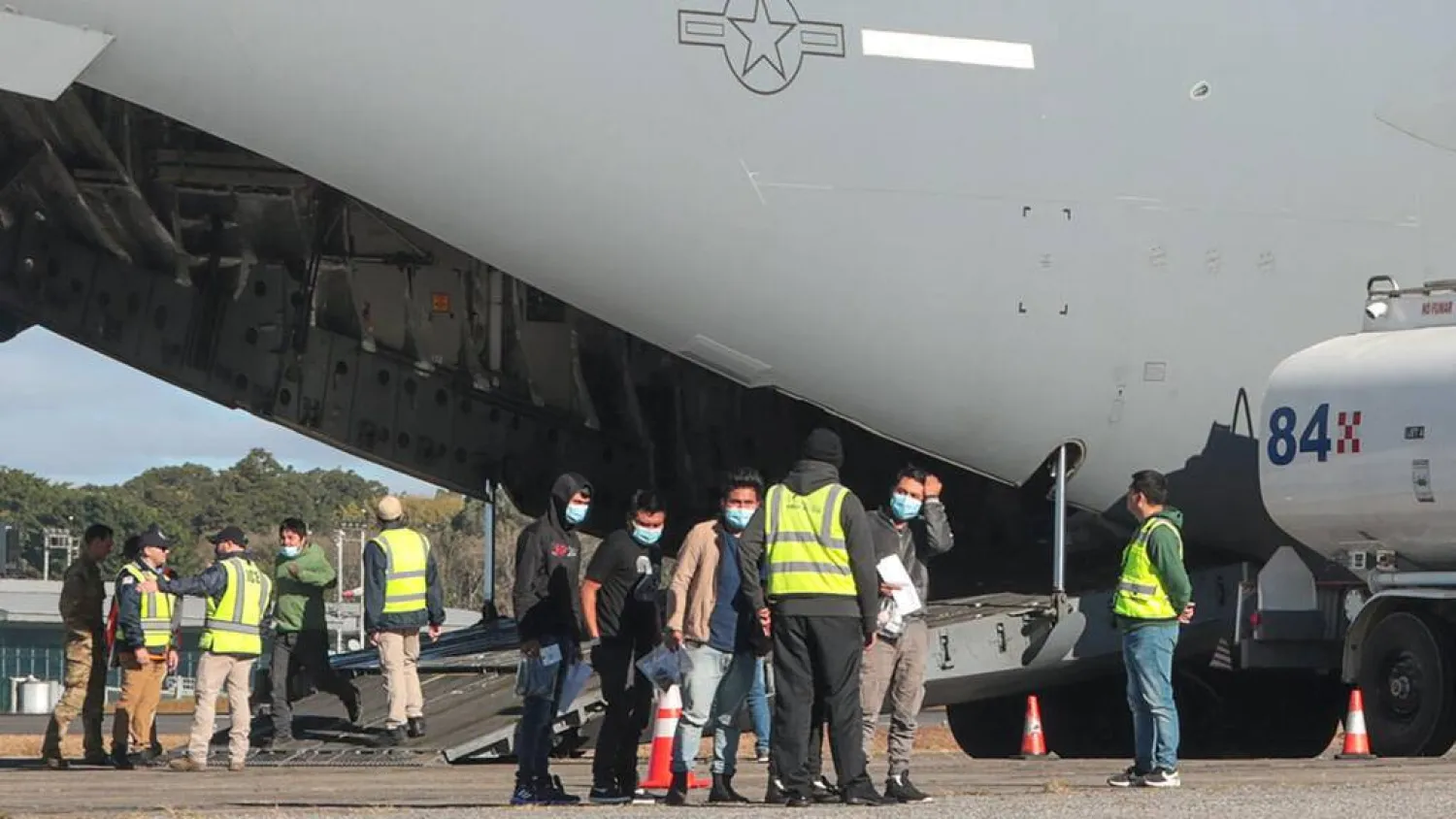
Handout picture released by Guatemalan Migration Institute shows Guatemalan migrants descending from an US military plane after being deported from US at the Guatemalan Air Force Base in Guatemala City on January 24, 2025. Guatemalan Migration Institute via AFP
TT

US Deportees Face Escalating Police Violence, Intimidation in Eq.Guinea

Handout picture released by Guatemalan Migration Institute shows Guatemalan migrants descending from an US military plane after being deported from US at the Guatemalan Air Force Base in Guatemala City on January 24, 2025. Guatemalan Migration Institute via AFP

The masked police officers burst into Ahmed Soliman's hotel room in Equatorial Guinea and dragged him and two dozen other US deportees outside, guns drawn, to deliver a message: go home.

"I have police officers yanking on my neck, trying to throw me on the ground, I have officers elbowing me in my back," Soliman, 30, told AFP of the incident, which occurred two weeks ago.

"Machine guns pointed at our faces, all this just so that they can tell us they're tired of us here in this country," he recalled, saying he and four others were handcuffed and hit by police, in an incident confirmed by two other deportees.

Authorities are ratcheting up pressure on deportees held at the hotel, which has become a dumping ground for expelled US immigrants, including Soliman, who arrived in April, said AFP.

The deportees say they're facing verbal and physical abuse from police, meagre rations and constantly being pushed to return home.

The authoritarian petro-state in central Africa has become a key transit point in President Donald Trump's immigration crackdown, which involves shipping people that the United States can't legally send home to "third countries" like Equatorial Guinea instead.

As their stay at the hotel, under watch from armed guards, drags on for months, authorities are getting impatient, deportees told AFP. A local lawyer also confirmed that deportees are facing pressure to return to their home countries.

"Anytime a problem happens, anytime we're asking for our rights for something, they say, 'Hey, if you don't like it, go back to your country,'" Soliman, who had lived in the United States since he was three and fears returning to his native Egypt because he is gay, told AFP.

The deportees cannot claim asylum in Equatorial Guinea.

But they say they can't leave, because they fear for their lives in their home countries -- and because they were deported without passports.

Soliman said authorities are pressuring him to accept a government-issued travel document instead.

Washington has expelled at least 50 people, mostly Africans, to Equatorial Guinea since November.

Twenty-seven remain in the hotel as Equatorial Guinea has deported people to their home countries, or onward to "fourth" countries.

- 'They're trying to intimidate you' -

At the hotel, the deportees are held on the premises by armed guards.

"They threaten you each and every day," said another deportee, who gave her first name, Petagaye, and has been held in the hotel since June.

"They tell you, 'oh, you need to go back to your country'. Or they tell you, 'oh, just kill yourself, because America don't care'," the 35-year-old said.

Deportees used to be able to walk around the hotel grounds, and sometimes get a police escort to a nearby corner store -- often in exchange for a few dollars -- but that too has seen a crackdown, a deportee who gave the name Him, a pseudonym, told AFP.

"They're trying to intimidate you," said Him, who fled what is now Eritrea during that country's war for independence from Ethiopia, and arrived in the United States as a refugee when he was 13.

"Even though you know you could go back and get killed, even though you ran away from a country and proved it in a federal court of law that we can't go back," said Him, 47.

Neither the US State Department nor Equatorial Guinea's national security minister responded to a request for comment.

- Ebola scare -

In July, deportees were sent into a panic when a guard told them an Ebola patient was being housed in the hotel.

Videos shared with AFP showed men in hazmat suits walking through the building.

Authorities have not commented on the incident and Equatorial Guinea has not reported any Ebola cases.

The three deportees interviewed by AFP had been in the United States since they were children, and spoke with American accents.

All three had won deportation protections preventing them from being sent to their home countries after judges found their lives would be in danger.

Under previous administrations, people with such protections, though legally weaker than asylum, have been allowed to legally work and live in the United States.

The Trump administration has argued that it can still deport people with such protections, as long as it doesn't send them to their home country.

A lawsuit was filed in June at the African Commission on Human and Peoples' Rights, the continent's top human rights body, to try to halt US deportations to Equatorial Guinea.

For now, the deportations continue: 10 more people arrived on July 30, US and local lawyers said.



Iran, US Trade Blows as Hormuz Impasse Deepens

A screenshot from a video released by US Central Command shows a drone boat attack on an anchorage in southern Iran last July 12 (CENTCOM)
TT

Iran, US Trade Blows as Hormuz Impasse Deepens

A screenshot from a video released by US Central Command shows a drone boat attack on an anchorage in southern Iran last July 12 (CENTCOM)

Iran launched fresh attacks against US targets in the Middle East on Wednesday in retaliation for American strikes on Iranian oil tankers, dragging the foes deeper into war.

Tehran's powerful Revolutionary Guards said Wednesday they attacked 20 US vessels trying to pass through the Strait of Hormuz, a vital waterway for the world's oil and gas that Iran has largely controlled since the war erupted, said AFP.

The United States and Iran are locked in a stalemate six months into the war, with Iran maintaining a stranglehold on the Strait of Hormuz and Washington pushing a campaign to choke Iran's ports and economy.

The Guards said Wednesday they pummeled a US military base in Jordan in response to US forces destroying five Iranian oil tankers the day before.

The US military said it acted after Iran targeted an American warship, the second such attack in less than a week.

Oil prices climbed to near $100 a barrel in Asian morning trade, as the flare-up threatened to further choke supply from the crude-rich Middle East.

The price of Brent crude, the benchmark international contract, rose to $99.46 per barrel, while the main US contract West Texas Intermediate was at $94.45 per barrel.

The Iranian republic also said it would target oil tankers off US-allied Kuwait and Bahrain in retaliation for the US strikes on its tankers.

Minutes later, Iran's Revolutionary Guards -- the most powerful arm of the Iranian military -- said they had struck the US air base of Al-Azraq in Jordan with missiles, state media reported.

The "punitive operation" damaged maintenance and repair facilities, deployment locations and shelters for fighter jets, according to IRNA.

Jordan's army said it shot down 18 missiles from Iran targeting the kingdom.

The strikes came after Tehran urged crews on oil tankers off Kuwait and Bahrain to leave their vessels, warning they "will be targeted", the Guards said in a statement posted on IRNA.

- US warning -

The latest round of fighting was triggered after US forces destroyed five Iranian oil tankers, with the US military saying it "directed the crews to abandon ship" before hitting the vessels.

"Iran continues to try to hit US naval ships, and for every time they do that or try to do that, they're going to lose tankers, and I think you'll see that again today," US Secretary of State Marco Rubio told reporters on Tuesday on a visit to Colombia.

Iranian media reported Tuesday that a US missile struck a tanker off the coast of Kharg Island, adding that there were no casualties.

The chief of staff of Iran's army Ali Abdollahi had warned the Iranian republic would hit US bases in the region if Iranian oil tankers were hit.

Iran has asserted control of the Strait of Hormuz -- which normally carries around a fifth of the world's oil and liquefied natural gas -- since the start of the war in February, with traffic through the waterway virtually paralyzed.

Tehran requires vessels to obtain permission and pay transit fees before using the strait.

Iran's Guards also said on Tuesday they seized "one of the most modern, unmanned" American submarine drone in the Strait of Hormuz.

The US military said that the drone had "malfunctioned", insisting it was an "older model" that did not carry any sensitive data.

Iranian state TV also said the Guards had attacked two US destroyers with ballistic missiles.

The US military did not immediately comment on the report.


US Hits Remaining Parts of Iran’s Aviation Sector with Sanctions in Latest Move to Isolate Tehran

 US Treasury Secretary Scott Bessent speaks during a press conference, as finance ministers and central bank governors from G20 countries meet in Asheville, North Carolina, US, September 1, 2026. (Reuters)
US Treasury Secretary Scott Bessent speaks during a press conference, as finance ministers and central bank governors from G20 countries meet in Asheville, North Carolina, US, September 1, 2026. (Reuters)
TT

US Hits Remaining Parts of Iran’s Aviation Sector with Sanctions in Latest Move to Isolate Tehran

 US Treasury Secretary Scott Bessent speaks during a press conference, as finance ministers and central bank governors from G20 countries meet in Asheville, North Carolina, US, September 1, 2026. (Reuters)
US Treasury Secretary Scott Bessent speaks during a press conference, as finance ministers and central bank governors from G20 countries meet in Asheville, North Carolina, US, September 1, 2026. (Reuters)

The Trump administration on Tuesday imposed sanctions on additional aspects of Iran's aviation industry, targeting more than two dozen commercial and private airlines as well as foreign cargo service providers in its new push to isolate Tehran from its remaining trading partners.

The latest actions are part of the Trump administration’s Operation Economic Outcast campaign that is aimed at severing “critical financial lifelines” for the already heavily sanctioned Iranian government.

The new penalties are focused on the remaining facets of Tehran's already beleaguered aviation ecosystem, which has been under countless sanctions from Washington for years.

“Let this be a warning to anyone doing business with Iran’s remaining airlines, all of which we sanctioned today: You are at risk of being cut off from the global financial system,” Treasury Secretary Scott Bessent said in a press release.

The Trump administration accused the 36 entities targeted this week of supporting Tehran’s efforts to use its aviation sector to move weapons, personnel, and illicit cargo.

It also claimed that private entities based in Türkiye, the United Arab Emirates, Kazakhstan and Malaysia have provided parts and logistics services to Iran’s Mahan Air.

The airline has been subject to US counterterrorism sanctions since 2019 for its support for Iran’s paramilitary Revolutionary Guard, which the State Department has designated a foreign terrorist organization.


Russia Says Putin, Trump Had ‘Frank’ Call After US Envoys Visit

Russian President Vladimir Putin listens to acting governor of Tver region Vitaly Korolyov during their meeting at the Kremlin in Moscow, Tuesday, Sept. 8, 2026. (Mikhail Metzel, Sputnik, Kremlin Pool Photo via AP)
TT

Russia Says Putin, Trump Had ‘Frank’ Call After US Envoys Visit

Russian President Vladimir Putin listens to acting governor of Tver region Vitaly Korolyov during their meeting at the Kremlin in Moscow, Tuesday, Sept. 8, 2026. (Mikhail Metzel, Sputnik, Kremlin Pool Photo via AP)

Russian President Vladimir Putin and US counterpart Donald Trump had an "extremely frank" phone call on Tuesday, after US negotiators visited Moscow over the weekend, Kremlin aide Yuri Ushakov told reporters, including AFP.

Steve Witkoff, who is Trump's business ally, and Jared Kushner, the president's son-in-law, visited the Russian and Ukrainian capitals at the weekend for talks with both Putin and Ukrainian President Volodymyr Zelensky.

In a one-hour call on Tuesday, Putin and Trump "exchanged views on the outcome of the visits", Ushakov said.

The talks brought no immediate breakthrough in the four-and-a-half-year war that is Europe's bloodiest conflict since World War II.

Ushakov said Putin presented to Trump an "objective and detailed analysis" of the frontline situation.

The Kremlin leader routinely says his troops are advancing across the entire front, with the capture of the entire eastern Donbas a matter of time.

He also "pointed out what the Americans could realistically do to bring the hostilities to a swift conclusion," Ushakov said, without elaborating.

Moscow has shown no signs of dropping its maximalist conditions to end the war, including a demand that Ukraine cede territory in the east that Russia's troops have not captured.

Putin also told Trump that Russia had "no aggressive plans" towards Europe, Ushakov said.

The Kremlin has over the summer been accused of ratcheting up a sabotage campaign against Ukraine's European backers -- accusations it has denied.

"In view of the speculation regarding Russia's alleged hostile intentions towards European states, it was emphasized that we have absolutely no aggressive plans whatsoever towards Europe," Ushakov said.

"The myths being spread about the Russian threat serve as a pretext for Europeans to ramp up support for Ukraine and their own military spending," he added.

Fueling the concerns over Russia's intentions, CIA chief John Ratcliffe paid a surprise visit to Moscow in late August, with US media reporting he warned Russia against attacking any NATO country.