France's Top Court Blocks Social Media Ban for under-15s

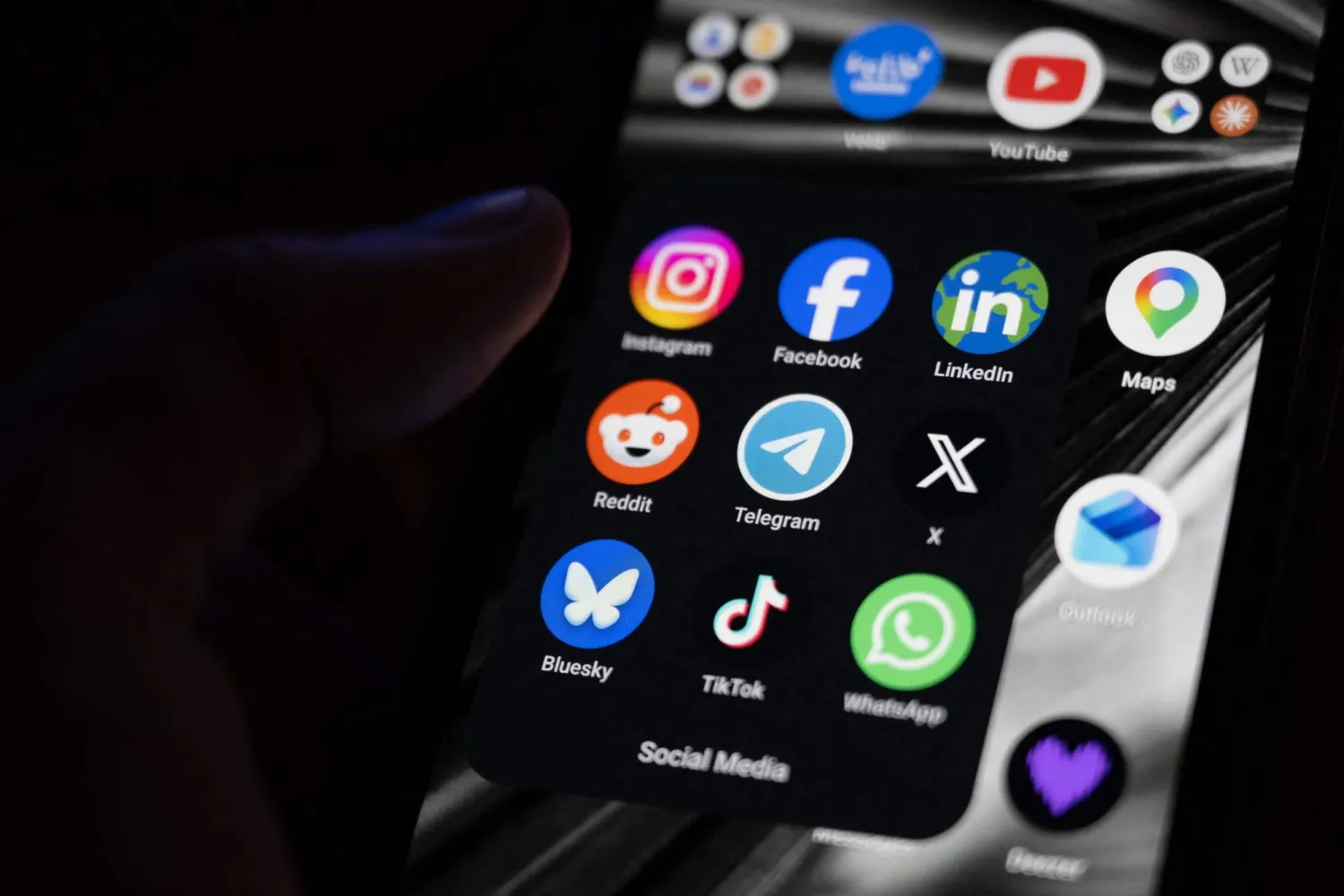
(FILES) This photograph shows a set up smart-phone screen displaying the logo of main social media platforms including Instagram, Facebook, LinkedIn, Reddit, Telegram, X, Bluesky, Tiktok and Whatsapp in Saint-Mande, east of Paris, on April 29, 2026. On August 14, 2026, the French Constitutional Council struck down the ban on social media for under-15s, ruling that this measure constitutes "a disproportionate infringement" of their freedom of expression. (Photo by Martin LELIEVRE / AFP)
TT

France's Top Court Blocks Social Media Ban for under-15s

(FILES) This photograph shows a set up smart-phone screen displaying the logo of main social media platforms including Instagram, Facebook, LinkedIn, Reddit, Telegram, X, Bluesky, Tiktok and Whatsapp in Saint-Mande, east of Paris, on April 29, 2026. On August 14, 2026, the French Constitutional Council struck down the ban on social media for under-15s, ruling that this measure constitutes "a disproportionate infringement" of their freedom of expression. (Photo by Martin LELIEVRE / AFP)

France's top court on Friday blocked a bill banning social media access for under-15s, saying it infringed upon freedom of expression, a setback for President Emmanuel Macron who asked his government to rewrite the legislation.

"By prohibiting minors under the age of fifteen from accessing certain online services, the law inherently requires every person, even an adult, to prove their age before accessing them," the Constitutional Council said in its decision.

"However, by failing to specify the conditions and limits under which such proof must be provided, the legislature has not established the legal safeguards necessary to ensure compliance with these requirements," it added. French lawmakers had approved a ban on social media access for children under age 15, becoming the first in Europe to follow Australia, whose world-first ban barred access to platforms including Facebook, TikTok and YouTube for under-16s in December.

Macron has ordered Prime Minister Sebastien Lecornu to re-work the draft legislation to take the Constitutional Council's concerns into account, the Elysee said in a statement.

The Elysee said Macron was determined the reform take effect before spring 2027, when France holds a presidential election. Macron cannot run for a third term.


New ‘Scentronic’ Technology Can Detect and Transmit Aromas Remotely

Ohio State University researcher Chunyu Yang wears a prototype odor generator device which is part of a technology called Scentronic that can detect scents and transmit them remotely, at Columbus, Ohio, on June 13, 2025, in this image released October 21, 2026. (Shaoru Cheng/Handout via Reuters)
TT

New ‘Scentronic’ Technology Can Detect and Transmit Aromas Remotely

Ohio State University researcher Chunyu Yang wears a prototype odor generator device which is part of a technology called Scentronic that can detect scents and transmit them remotely, at Columbus, Ohio, on June 13, 2025, in this image released October 21, 2026. (Shaoru Cheng/Handout via Reuters)

People can readily share images and sounds digitally, as evidenced by the billions of smartphones in use globally that often overload the human senses of sight and hearing. But smell generally remains missing from remote communication. That could soon change.

Researchers have developed technology that features an electronic nose that recognizes certain smells, like the distinctive aroma of coffee, and then instructs a small and wearable remote device to release scent molecules matching it. The digital communication can take place at any distance, from across the room to around the world.

"In simple terms, it connects 'smelling something here' with 'recreating the corresponding smell somewhere else,'" said Chunyu Yang, an Ohio State University doctoral student in materials science and engineering and lead author of a study describing the technology published in the journal Science Advances.

"The idea is to add smell to the visual and audio information we already share remotely, making those experiences more engaging," Yang said.

The researchers call this latest development in the field of digital scent technology "Scentronic."

"What makes Scentronic ‌different is that ‌it brings odor sensing and generation together for remote sharing. To the best of our knowledge, ‌our ⁠study is the ⁠first to explore this integration in a compact platform for remote odor sharing," Yang said.

The researchers created an e-nose, a device that uses an array of gas sensors to detect chemical compounds associated with different odors. A machine-learning model then classifies odors that the e-nose has been trained to recognize — cake, coffee and oranges.

The technology uses an online platform to transmit the odor information to a scent generator, which then releases fragrances to recreate the aroma at the receiving end. The scent molecules themselves are not transmitted over the internet.

The e-nose device is roughly 6 inches (15 cm) in diameter and is portable, though not designed to be worn. The researchers developed several versions of ⁠the odor generator, including wristband, necklace and handheld designs.

'EVERYDAY ODORS'

At this point, the e-nose recognizes ‌just the five scents.

"We chose these because they are familiar everyday odors with ‌different scent profiles, making them useful examples for demonstrating the system. We have not yet expanded beyond those categories," Yang said.

"A broader scent library ‌is possible in principle, but an unlimited repertoire is far beyond what we have demonstrated. Recognizing an odor and accurately reproducing ‌it are separate challenges. Covering a useful range of everyday scents is a more realistic goal, although that would still require substantial development," Yang said.

The receiving device cannot recreate every smell Scentronic encounters.

"To support additional odors, we would need to train the electronic nose to recognize them and provide corresponding scented liquids in the odor generator," Yang said.

The researchers see various potential applications for the technology.

"For example, someone could share the scent of ‌a meal with family or friends who live far away. Other potential applications include more immersive virtual and augmented reality experiences and online shopping that allows customers to sample selected scents remotely," ⁠Yang said.

'A RESEARCH PROTOTYPE'

The research ⁠was conducted and the devices developed without the involvement of a company, Yang said.

"At present, this is a research prototype. Moving toward commercialization would require a larger, more diverse training dataset and reliable odor recognition under real-world conditions, where smells often occur in mixtures," Yang said.

"The odor generator would also need further development to support more scents while remaining compact and convenient to use. Other considerations include scent fidelity, refillability, durability, manufacturing costs and the safety of repeated exposure to the scented mist," Yang said.

Smartphones are becoming increasingly capable. Could they in the future incorporate scent technology so that, for instance, a person at a tailgate party before an Ohio State football game could call a friend and share video, audio and the aroma of hot dogs on the grill?

"In principle, a smartphone could connect to a scent-generating accessory. Integrating everything into the phone itself would be more challenging because the scent reservoirs, electronics and atomizers all take up space and add weight. Miniaturization and convenient refilling would be important considerations," Yang said.

"The tailgate example illustrates the idea well. A future system could potentially combine video and audio with a corresponding scent, provided it could recognize the relevant odor and the receiver had a suitable scent formulation available. Our current system has not demonstrated the transmission of a grilling-hot-dog scent or the exact mixture of smells at a tailgate party," Yang said.


Websites Go Dark as AI Exposes Critical Security Flaws

Computer code is displayed on multiple screens in this illustration taken on October 22, 2026. (Reuters)
TT

Websites Go Dark as AI Exposes Critical Security Flaws

Computer code is displayed on multiple screens in this illustration taken on October 22, 2026. (Reuters)

Governments and companies around the world shut down websites Thursday as they raced to protect themselves from hacks after artificial intelligence uncovered critical flaws in a widely used programming language called PHP.

PHP helps run about 70 percent of the world's websites -- from online stores and news outlets to government services -- according to Wiz Research, one of the cybersecurity firms that found the two flaws.

Created in the early 1990s, PHP originally stood for "personal home page" but now means "hypertext preprocessor" and sits underneath popular web design platforms.

"These findings rank among the most severe vulnerabilities discovered in PHP, and arguably in software history," a Wiz blog post said.

Increasingly powerful AI models can spot weak points in back-end computer code that have gone unnoticed by humans for years.

That has heightened cybersecurity fears, with the number of software vulnerabilities discovered worldwide in 2026 on track to roughly double last year's record total.

- 'Quite devastating' -

PHP programmers released a fix Wednesday, and the US National Security Agency told organizations to patch their sites immediately or pull vulnerable systems offline -- a call echoed by authorities from China to the European Union.

Amazon Threat Intelligence said it had identified a hacking attempt carried out before the PHP security flaws were made public.

"It remains unclear how the actor acquired exploit information," it said, describing the incident as the "targeting of a honeypot" from an anonymized internet connection.

But Ryan Austin, who has worked on PHP issues for cybersecurity firm Calif, told the BBC: "At the moment, it doesn't look like exploitation has taken off or been widespread."

Only sites that run PHP on their own servers are exposed. Many large platforms are built on other programming languages or use operators that could install the fix quickly and were able to stay online.

Rahat Masood, senior lecturer in cybersecurity at the University of New South Wales, Sydney, described the discovery as "quite devastating".

It could allow "attackers to get into your servers without any authorization, without any username or password", she told AFP.

"Once they are in the servers, they can do anything they want" -- from stealing sensitive information to modifying website content -- she added, urging institutions to "take it seriously."

- 'New phase' -

Government agency sites in countries from Australia to Finland, the Netherlands and the United Kingdom were among those that went dark. Services from insurance firms, transport operators and media outlets were down for emergency maintenance.

Popular apps, including a Pokemon sleep tracker, were also temporarily taken offline while the fix was implemented, while the foundation that runs Wikipedia warned users they could see outages while it addressed the flaws.

"If you run PHP, it is imperative that you update now," the PHP Foundation, which funds developers working on the language, said in a blog post.

Volker Dusch, a security engineer at the foundation, told the Wall Street Journal it was the most serious problem PHP had faced in more than a decade, comparing it to Heartbleed, a 2014 flaw that set off a worldwide rush to patch.

Security firm Calif found the flaws in August using OpenAI's GPT-5.6 Sol model, as part of an OpenAI-funded audit of PHP's code.

OpenAI said the discovery "marks a new phase, where AI can find security bugs with internet-scale impact."

Wiz, which is owned by Google, said it found them independently weeks later with help from AI models including Google's Gemini 4 Argon and GPT-5.6 Sol.

The flaws had been reported privately to PHP's developers and kept confidential while a fix was prepared.

- AI fuels urgency -

Details leaked online Tuesday, a day before the planned release of the fix -- prompting the rush to take sites offline before hackers could exploit them.

Steve Kerrison, senior lecturer in cybersecurity at the Singapore campus of James Cook University, told AFP that the fear of hackers using AI to quickly and easily exploit the PHP vulnerabilities had fueled urgency to react.

Larger institutions, from government agencies to news outlets, should be able to fix their websites relatively fast, Kerrison said -- but others may be left vulnerable.

"There are sites, systems and people out there who will have no idea about this and still won't for days, weeks and months," Kerrison warned.

That may include user-run blogs that could be weaponized to spread computer viruses, spam people or distribute malicious content, he said.


Apple Launches into Foldable Market as iPhone Duo Sales Begin

 23 October 2026, China, Hong Kong: The iPhone Duo, Apple's first foldable smartphone, is displayed at an Apple Store. (dpa)
23 October 2026, China, Hong Kong: The iPhone Duo, Apple's first foldable smartphone, is displayed at an Apple Store. (dpa)
TT

Apple Launches into Foldable Market as iPhone Duo Sales Begin

 23 October 2026, China, Hong Kong: The iPhone Duo, Apple's first foldable smartphone, is displayed at an Apple Store. (dpa)
23 October 2026, China, Hong Kong: The iPhone Duo, Apple's first foldable smartphone, is displayed at an Apple Store. (dpa)

Sales of Apple's first folding phone, the iPhone Duo, began on Friday, with market watchers betting on whether the device can reinvent the small foldables market in the same way the iPhone did for smartphones.

The Duo's reception could prove an early test for new CEO John Ternus, the former hardware chief who unveiled the phone barely a week after taking charge in September.

It could also have large implications for a niche category in which rivals such as Samsung Electronics and Huawei Technologies have sold premium offerings for several years.

Within minutes of pre-orders opening last Friday, Apple's estimated delivery dates for the Duo had slipped to late January as demand outpaced supply. The US company called the response from customers "nothing short of extraordinary."

In Sydney, the first Apple store to sell the phones on Friday, a queue of customers formed outside before opening at 8 a.m. local time (2100 GMT).

Simon Krishnan, a 48-year-old engineer, paid A$3,899 ($2,734) for a Duo with 512GB memory.

"This is a bit of a luxury item ‌for me, because ‌it's so expensive, but I just think, you know what? Life's too short," he said.

In China, a soft ‌consumer ⁠market combined with ⁠memory costs pushing prices higher has led to six straight quarters of declines in smartphone shipments. Apple's market share, however, has rebounded as some phone buyers trade up to premium devices while others seek value at the lower end of the market, putting pressure on mid-range brands.

Liu Wei, a 26-year-old healthcare professional, already has a foldable phone from Xiaomi, but still queued outside a central Shanghai Apple store from 6 a.m. to get his hands on Apple's first foldable.

"I've used Apple products for many years and I have more trust (in the brand), so I bought one on launch day to try it out," he said.

In Hong Kong, May, 38, who declined to give his full name for privacy reasons, secured a 256GB iPhone Duo, which retails for HK$17,499 ($2,231.73), ⁠during an online pre-sale and aimed to resell the handset for a profit of around HK$4,000: “A few meals' ‌worth of money,” he joked.

MIXED REVIEWS

Early reviews have praised the Duo's design as ‌well as its sturdy and barely visible hinge, a major feat for phones whose prominent creased screen has long been a drawback and potential deterrent for buyers.

But ‌reviewers have said camera compromises, including the absence of a telephoto lens and third-party apps that still need to be reworked for the ‌new display size could disappoint some buyers.

They have also said the Duo in its smaller, folded state is less handy for the litany of quick tasks that most users carry out each day on standard iPhones, with several prominent reviewers recommending against the Duo for many Apple customers.

"It's been a lot of fun trying the Duo out for a week, but it feels like I've gotten to use an extraordinarily polished prototype — not a finished product that I'd ‌want to buy and carry," longtime Apple commentator John Gruber, author of the blog Daring Fireball, wrote in a review.

Tech commentator Marques Brownlee, popularly known as MKBHD, said in a YouTube review that "if you're ⁠just a regular person who doesn't ⁠do much more than texting, social media and browsing here and there, then it is probably a no. But if the $2,000 doesn't mean much to you, and you like the idea, after the learning curve and getting used to not having facial identification, it is a really fun phone."

TOUGH TO FIND

The limited supplies could disappoint Apple fans lining up in front of stores to buy the Duo. Apple told Reuters that walk-in availability would vary by country, with limited stocks in the US, Australia, Canada, Mexico and much of Britain and Europe. In China, France, Hong Kong, India and Japan, units would be available only for customers who had ordered online.

"Foldables have been an established category for years, but adoption has remained relatively limited compared with conventional smartphones. Apple's entry could bring the format to a much broader audience," said Francisco Jeronimo, vice president at market researcher IDC.

IDC expects Apple will take 44% of the foldable value in 2026 on 31% of foldable units. By 2027, it will become the market leader in the category both in value and units shipped, IDC forecast.

"Apple has made a convincing case for this form factor," Jeronimo said after spending a week with the passport-shaped Duo.

"Now comes the next test: turning excitement into availability, adoption and a lasting new chapter for the smartphone market," Jeronimo said.