


Japan's Takaichi Skips Controversial Yasukuni Shrine Visit on Anniversary of WWII Surrender

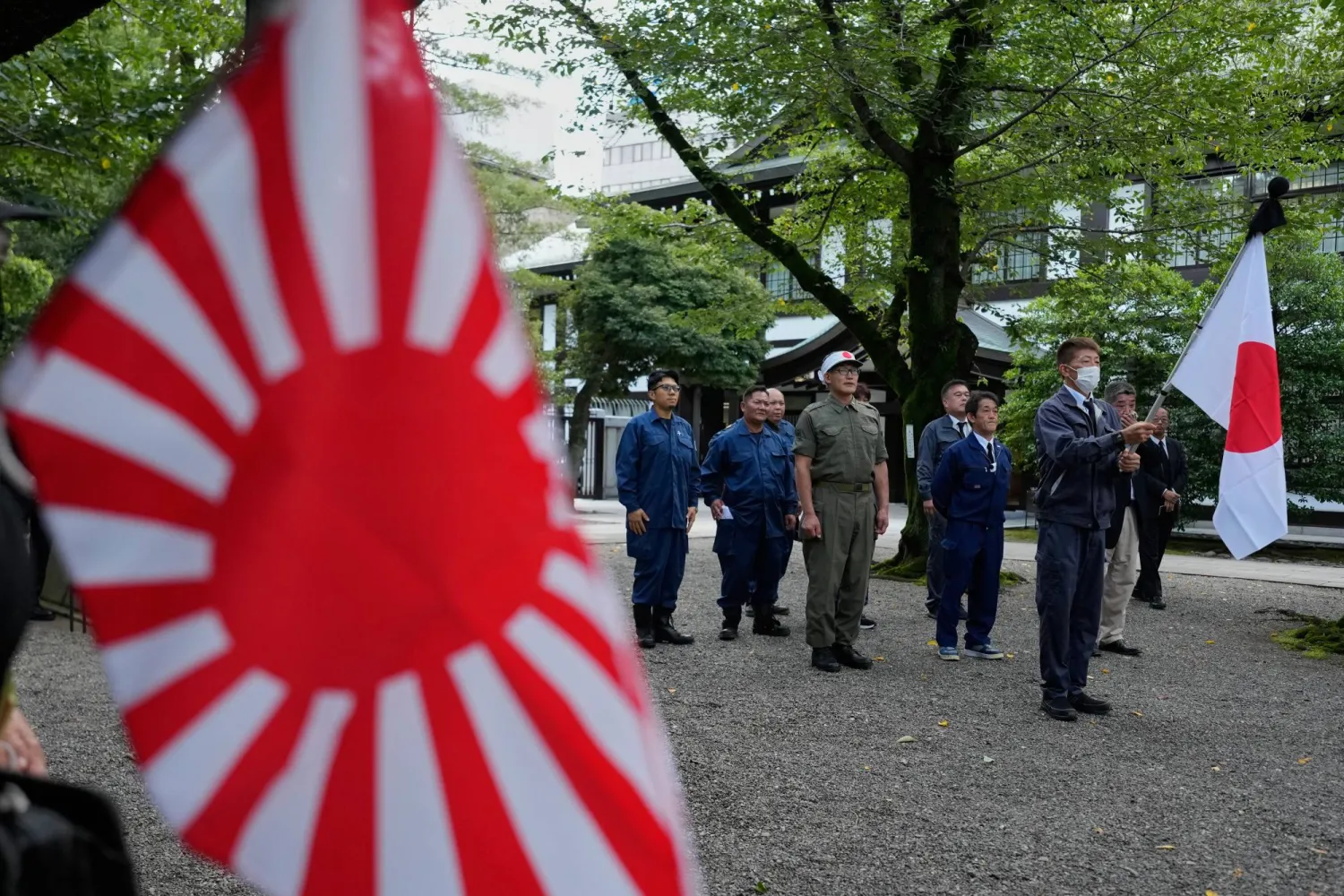
Visitors carry Japanese flags and a rising sun flag at Yasukuni Shrine, which honors Japan's war dead, including convicted war criminals, as the country marks the 81st anniversary of the end of World War II Saturday, Aug. 15, 2026, in Tokyo. (AP Photo/Eugene Hoshiko)
TT

Japan's Takaichi Skips Controversial Yasukuni Shrine Visit on Anniversary of WWII Surrender

Visitors carry Japanese flags and a rising sun flag at Yasukuni Shrine, which honors Japan's war dead, including convicted war criminals, as the country marks the 81st anniversary of the end of World War II Saturday, Aug. 15, 2026, in Tokyo. (AP Photo/Eugene Hoshiko)

Japanese Prime Minister Sanae Takaichi stayed away from Tokyo's controversial Yasukuni Shrine, apparently to prioritize diplomatic relations with China and South Korea, but did not mention her country’s wartime past in Asia or remorse over it in an address Saturday as Japan marked the 81st anniversary of its surrender in World War II.

Takaichi mourned the victims of major devastation in Hiroshima Nagasaki and Okinawa, as well as those who perished in overseas battlefronts, and thanked them for their sacrifice as the “foundation of Japan's peace and prosperity today.” She did not mention Japanese atrocities in Asia or apologize.

“Japan, since the end of the war, has consistently contributed to global peace and prosperity. We will never let the tragedy of the war be repeated," she said, adding that Japan can play a key role in addressing global challenges as “a dependable nation" in the region.

Visits by Japanese politicians to the Yasukuni Shrine, which also commemorates World War II war criminals, have been criticized by China and South Korea. They see it as showing a lack of remorse over Japan’s wartime atrocities.

Japanese Defense Minister Shinjiro Koizumi, another Cabinet minister and three executives from Takaichi's governing party showed up at the shrine earlier Saturday, The Associated Press reported.

Koizumi has regularly visited the controversial shrine to mark Japan's anniversary of the end of the war on Aug. 15 and other occasions. But as a defense minister pushing to increase Japan’s military capability and weapons sales under Takaichi’s hawkish government, his visit Saturday is seen as more contentious.

The previous shrine visit by a defense minister was in 2024 by Minoru Kihara, the current chief secretary and top government spokesperson for Takaichi’s government.

Japan’s Defense Ministry prohibits group visits by service members of the Self-Defense Forces, on grounds of constitutional separation of religion and state. Koizumi said in October it is natural for anyone in any country to pay respect for those who sacrificed their lives for their nation.

Koizumi did not comment on the visit Saturday and walked past journalists at the shrine.

He is the son of popular former Prime Minister Junichiro Koizumi, who outraged China when he visited Yasukuni as a serving leader in 2006.

Three executives from Takaichi’s governing Liberal Democratic Party also prayed together Saturday at the shrine and brought offerings in a rare joint visit on the prime minister's behalf that is seen as a move to make up for Takaichi’s absence and appeal to her right-wing supporters.

Party secretary-general Shunichi Suzuki told reporters he prayed while keeping in mind the prime minister's thoughts for “the spirits of the war dead” and that he brought Takaichi’s cash offerings in her capacity as party leader.

For Takaichi, appealing to right-wing voters is key at a time when her support is seen as rapidly falling, presumably over delayed economic measures addressing rising prices as well as scandals that include alleged negative election campaign videos and unpopular revisions to Japan's imperial family succession rules.

Takaichi has not visited the shrine since taking office but has sent offerings twice for the shrine’s biannual festivals.

Tensions between Japan and China escalated in November when the Japanese leader said a Chinese attack on Taiwan could constitute “a survival-threatening situation” for Japan requiring the use of force. The comments enraged Beijing.

Attention this week was on whether Takaichi, who has repeatedly said she would pray at the shrine on Aug. 15 despite the controversy, would keep her pledge and show up at Yasukuni on Saturday.

Earlier this week, Kihara said Takaichi would make an appropriate decision, followed by Japanese media saying she would not visit the shrine to keep Japan’s already difficult ties with Beijing from worsening and maintain good ties with Seoul.

Takaichi has repeatedly resisted acknowledging Japan's wartime aggression and atrocities, and denied that coercion was used against Korean laborers and women held as sex slaves for Japanese troops. She was previously part of a campaign to remove references to wartime sexual slavery, euphemistically known as “comfort women,” from school textbooks.

She has said she is from the postwar generation who has no responsibility for Japan's past actions and that she has no intention to apologize.

The country has faced revisionist pushbacks since the 2010s under nationalistic former Prime Minister Shinzo Abe, who pushed to correct a “self-deprecating view” of Japan’s wartime history and regain national pride. Takaichi considers Abe a mentor.

Since 2013, Japanese prime ministers have stopped apologizing to Asian victims for wartime atrocities, under a precedent set by Abe. Last year, however, former Prime Minister Shigeru Ishiba expressed “remorse” over the war and called it a mistake, though he fell short of mentioning Japan's aggression across Asia or apologizing.



Zelenskyy Visits Canada to Seek Further Military Support for Ukraine

Ukrainian President Volodymyr Zelenskyy (archive)
TT

Zelenskyy Visits Canada to Seek Further Military Support for Ukraine

Ukrainian President Volodymyr Zelenskyy (archive)

Ukrainian President Volodymyr Zelenskyy was in Canada on Thursday for talks with Prime Minister Mark Carney, his latest international trip aimed at locking in future support for Ukraine’s fight against Russia’s invasion.

Ukraine is under pressure from Russia’s air war, which is using ballistic missiles and jet-powered drones to pierce defenses. Moscow’s attacks have targeted Ukraine’s power grid ahead of the upcoming winter as part of its campaign to demoralize civilians, Ukrainian officials say.

“The main focus will be on supporting Ukraine in protecting our skies and preparing for the winter,” Zelenskyy said of his Canada trip in a social media post. “We will discuss how to strengthen our resilience, support our people, and ensure that Ukraine has the capabilities it needs to defend itself.”

Canada and European countries are sending their own weaponry to Ukraine and are also buying American weapons for Kyiv under the so-called Prioritized Ukraine Requirements List, or PURL. The United States under President Donald Trump has stopped donating weapons to Ukraine, The Associated Press said.

Recent US efforts to stop the more than four years of fighting have delivered no significant breakthrough, although Washington-brokered talks between delegations from Moscow and Kyiv are expected to continue.

Zelenskyy’s arrival on Wednesday night in Calgary, Alberta, came the day after his flight from Moldova to Norway was delayed when authorities closed Moldova’s airspace because of a drone incursion.

The aerial drone battle between Russia and Ukraine has grown in scale since Russia’s all-out invasion in February 2022. Ukraine’s neighbors Romania and Moldova, and other European countries, have reported repeated drone incursions.

Ukraine's drones now reach targets in Siberia, officials say

A Ukrainian sea drone wounded 28 people, including two children, on the waterfront in the Russian city of Sochi, local officials said. They said that beach infrastructure had been damaged but did not provide further details.

Russia’s Ministry of Defense said Thursday that its forces shot down 448 Ukrainian drones overnight. The drones were destroyed over 13 Russian regions, as well as the annexed Ukrainian peninsula of Crimea and the Black and Caspian seas, the ministry said.

Falling debris from a Ukrainian drone set fire to a home in Russia’s southwestern Voronezh region, killing one woman and wounding two other people, local Gov. Alexander Gusev said Thursday.

Ukrainian forces struck eight Russian infrastructure targets supporting the war effort over the past 24 hours, including a refinery in the Yamalo-Nenets region and a port in Dagestan, Zelenskyy said Thursday.

Targets in the Moscow, Voronezh, Astrakhan and Bryansk regions were also hit, he said.

Those targets were hundreds of kilometers (miles) apart, underlining the scope and scale of Ukraine's domestically developed long-range drone technology that has unsettled Russia.

The previous day, Ukrainian forces struck an oil refinery more than 3,000 kilometers (1,800 miles) from Ukraine in Siberia, Ukraine’s General Staff said, confirming earlier reports.

Meantime, Russian forces launched 149 drones, many of them jet-propelled, at Ukraine overnight, Ukraine’s air force said Thursday.

One person was killed and two others wounded in a Russian drone attack on the Kyiv region on Thursday morning, regional head Tymur Tkachenko said.

At least 16 other civilians were wounded in other Ukrainian regions, according to local authorities.


'Heavy Casualties' in Fire on Foreign-flagged Ship at China Port

Representation photo: China Fire and Rescue personnel arrive at Trishuli camp after inspecting the tunnel site in Rasuwa, in the aftermath of flash floods in Nepal's Nuwakot district on August 31, 2026. (Photo by Arun SANKAR / AFP)
TT

'Heavy Casualties' in Fire on Foreign-flagged Ship at China Port

Representation photo: China Fire and Rescue personnel arrive at Trishuli camp after inspecting the tunnel site in Rasuwa, in the aftermath of flash floods in Nepal's Nuwakot district on August 31, 2026. (Photo by Arun SANKAR / AFP)

A fire on a foreign-flagged cargo ship docked in an eastern Chinese port caused "heavy casualties" on Thursday, state media said, with President Xi Jinping calling for urgent search and rescue operations.

"A foreign cargo ship of Beihai Shipbuilding Co., Ltd. in Qingdao, Shandong Province, caught fire during its port call for maintenance, causing heavy casualties," state news agency Xinhua said.

Xinhua did not specify the number of casualties or the cause of the fire, said AFP.

Xi "stressed the need to urgently search for missing persons... and strictly hold those responsible to account", it added.

State media said that the fire broke out at around 11:15 am (0315 GMT). It was not clear whether it had already been extinguished.

Premier Li Qiang also urged the search and rescue of "trapped" people, and for those injured to receive medical treatment, "and strictly prevent secondary disasters".

Qingdao Beihai Shipbuilding is a major shipyard that operates as a subsidiary of the China State Shipbuilding Corporation.

Xi warned that "all regions and relevant departments must draw profound lessons from this incident, thoroughly investigate and rectify all types of fire hazards".


US Military Says It Struck Vessel in Caribbean, Killing Three

This screen grab from a video posted by US Defense Secretary Pete Hegseth on his X account on October 24, 2025, shows what Hegseth says is US military forces conducting a strike on a vessel being operated by Tren de Aragua trafficking narcotics in the Caribbean Sea in on October 23, 2025. (Photo by HANDOUT / US Secretary of Defense Pete Hegseth's X Account / AFP)
TT

US Military Says It Struck Vessel in Caribbean, Killing Three

This screen grab from a video posted by US Defense Secretary Pete Hegseth on his X account on October 24, 2025, shows what Hegseth says is US military forces conducting a strike on a vessel being operated by Tren de Aragua trafficking narcotics in the Caribbean Sea in on October 23, 2025. (Photo by HANDOUT / US Secretary of Defense Pete Hegseth's X Account / AFP)

The US military said on Wednesday three people were killed in a strike on a vessel in the Caribbean Sea, the latest in a series of attacks that Washington says target "narco-terrorists" but human rights groups condemn as extrajudicial ‌killings, Reuters said.

DETAILS:

* US Southern ‌Command said on ‌X ⁠it "executed a lethal kinetic strike ⁠on a go-fast vessel operating along established narco-trafficking routes in the Caribbean."

* It cited "confirmed intelligence" to allege the vessel's active involvement in narco-trafficking, without providing more details.

* The US military said three people, ‌whom it ‌called "narco-terrorists," were killed.

* President Donald Trump's ‌administration has said the vessels it ‌has struck since September 2025 were transporting narcotics.

* The US military's strikes on such vessels in the Caribbean and Eastern ‌Pacific have killed more than 220 people.

* Experts and rights ⁠advocates, ⁠both in the US and globally, have questioned the legality of the strikes.

* Human Rights Watch, Amnesty International and independent UN experts have called the strikes unlawful extrajudicial killings.

* The American Civil Liberties Union has cast the assertions by the Trump administration against those it targets as "unsubstantiated, fear-mongering claims."