


Athens Is Cleaning Its All-Marble Olympic Stadium for the First Time in More Than a Century

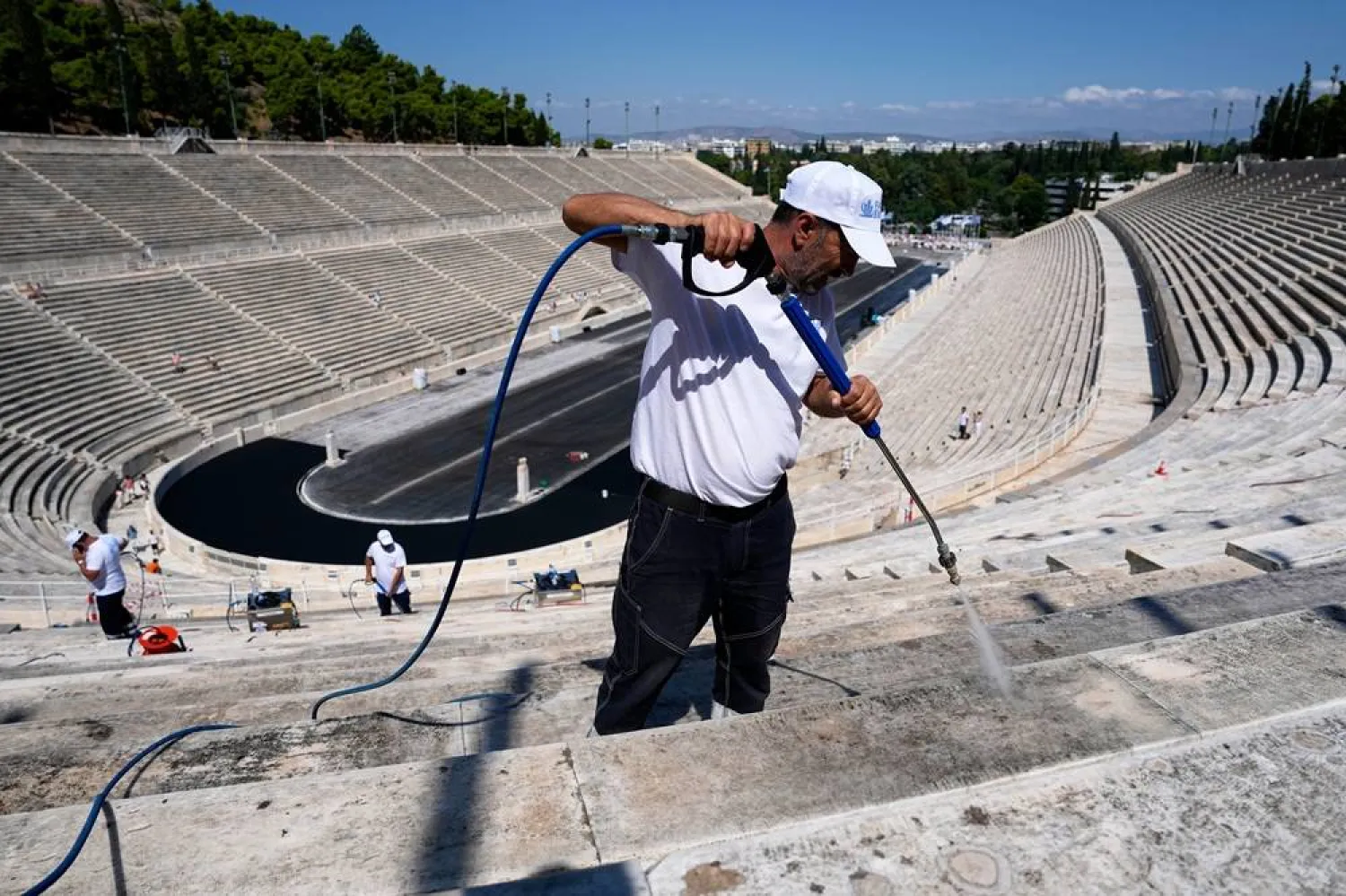
A worker cleans the marble surfaces of the Panathenaic Stadium, also known as "Kallimarmaro," or beautiful marble, which hosted the first modern Olympic Games in 1896, using a high-pressure water hose during renovation work in Athens, Greece, Thursday, Aug. 13, 2026. (AP Photo/Thanassis Stavrakis)
TT

Athens Is Cleaning Its All-Marble Olympic Stadium for the First Time in More Than a Century

A worker cleans the marble surfaces of the Panathenaic Stadium, also known as "Kallimarmaro," or beautiful marble, which hosted the first modern Olympic Games in 1896, using a high-pressure water hose during renovation work in Athens, Greece, Thursday, Aug. 13, 2026. (AP Photo/Thanassis Stavrakis)

It has welcomed marathon runners, rock stars and the first modern Olympic athletes. Now it’s time for a monumental scrub.

Athens’ U-shaped Panathenaic Stadium — made entirely of white marble — is getting its first systematic cleaning in more than a century.

Rebuilt for the first modern Olympics in 1896, the site is the ceremonial send-off point for the Olympic flame, including for Los Angeles 2028.

A fresh look in Athens ahead of LA 2028 The stadium is made of the same glittering marble used on the Acropolis, making the cleanup job delicate.

The work is revealing a monument changed by time, weather and millions of visitors. Cleaners in white and blue overalls move across the stadium’s 47 steep tiers with thin spray lances, using clean water at carefully controlled, low pressure. Machines vacuum up the runoff as they go.

“The goal of cleaning is not to make everything white. It’s to remove the dirt and the first layers of organic material that are deposited on the surface,” said Dimitris Selemis, a senior conservator at the site.

“The idea is to clean all the material that (contains) dirt from the surface, so we have a better understanding of the monument,” he said, noting that there is more weed growth and dirt in areas that receive less direct sunlight.

Crews are also using steam to remove blotches of chewing gum, which have turned black over time. Stadium officials say chewing gum, high heels and soft-drink stains are among the main culprits that stain the marble.

Now slowly being revealed, the original gleaming look of the venue earned it the widely used Greek nickname “Kallimarmaro,” or beautiful marble.

“We call it Kallimarmaro because it is made of the finest marble, the best that was ever produced ... We are very proud of it,” Isidoros Kouvelos, president of the Hellenic Olympic Committee, told The Associated Press in an interview.

“It needed to be cleaned of everything that has accumulated over all these years," he said. "This way the Panathenaic Stadium will show all its brilliance and will once again be the foremost monument of humanity for the Olympic Movement.”

Built into a natural ravine, the stadium’s site was used for ancient Greek athletic contests and later Roman spectacles before falling into centuries of disuse.

An African celebration planned in Athens Since its 1896 revival, it has staged fashion shows, rock concerts, boxing matches and national celebrations — as well as lavish patriotic ceremonies ordered by a military dictatorship in the 1960s.

Today, it’s a popular draw for tourists. Apart from the cleanup, the Kallimarmaro is also getting a new track, upgraded lighting and fresh support facilities. The project is privately funded by a shipping company and overseen by the Hellenic Olympic Committee with guidance from Culture Ministry experts.

The work will continue through 2026 but is currently concentrated on the stadium’s “sling,” or curved end, in time for the next torch-passing ceremony on Sept. 10.

That will be for the Dakar Youth Olympics, scheduled for Oct. 31-Nov. 13 in Senegal, which will be the first Olympic competition ever hosted in Africa.

IOC President Kirsty Coventry, a swimming gold medal winner from Zimbabwe, is due to attend the Sept. 10 ceremony, Kouvelos said.



Italian Police Recover Stolen Renoir, Cezanne and Matisse Worth 9 mn Euros

Carabinieri officers pose with three paintings by Paul Cezanne, Henri Matisse and Pierre-Auguste Renoir recovered after they were stolen from the Magnani Rocca Foundation in Mamiano, Italy, in this handout image released on August 14, 2026. Carabinieri/Handout via REUTERS
TT

Italian Police Recover Stolen Renoir, Cezanne and Matisse Worth 9 mn Euros

Carabinieri officers pose with three paintings by Paul Cezanne, Henri Matisse and Pierre-Auguste Renoir recovered after they were stolen from the Magnani Rocca Foundation in Mamiano, Italy, in this handout image released on August 14, 2026. Carabinieri/Handout via REUTERS

Paintings by Renoir, Cezanne and Matisse worth over nine million euros which were stolen from a museum in Italy in March have been recovered, Italian police said Friday.

The paintings were taken by masked thieves from the villa of the Magnani Rocca Foundation, near Parma in northern Italy, in a heist that lasted under three minutes.

Video footage released by the police showed two thieves wearing headlamps and with their faces covered entering the villa by breaking through a window, Reuters reported.

They headed straight into the room where the three paintings hung and took them off the wall, before heading back to the window and passing them through to an accomplice waiting outside.

They made off with "Fish" by Auguste Renoir, "Still Life with Cherries" by Paul Cezanne, and "Odalisque on the Terrace" by Henri Matisse.

The Renoir is worth six million euros, the Cezanne three million and the Matisse some 20,000 euros, police said.

The Magnani Rocca Foundation -- 20 kilometres (12 miles) from Parma -- houses the collection of art historian Luigi Magnani, which also includes works by Durer, Rubens, Van Dyck, Goya and Monet.

The theft is the latest in a series of robberies targeting major museums in Europe.

Last October, thieves broke into the Louvre in Paris -- the most visited museum in the world -- in broad daylight, escaping in less than eight minutes with jewellery worth $102 million.


Brazilian Police Recover Matisse Works Stolen in 2025

This handout picture released on August 13, 2026, by the Sao Paulo police press office shows eight recovered works by French artist Henri Matisse that had been stolen in December 2025 in Sao Paulo. (Photo by Handout / SAO PAULO'S POLICE PRESS OFFICE / AFP)
TT

Brazilian Police Recover Matisse Works Stolen in 2025

This handout picture released on August 13, 2026, by the Sao Paulo police press office shows eight recovered works by French artist Henri Matisse that had been stolen in December 2025 in Sao Paulo. (Photo by Handout / SAO PAULO'S POLICE PRESS OFFICE / AFP)

Police in Brazil have recovered eight engravings by French artist Henri Matisse that were stolen from a Sao Paulo library last year by an organized gang of thieves, officials said on Thursday.

Vividly colored artwork from Matisse's limited-edition art book "Jazz" were laid out on a table alongside a handgun, in an image released by police.

The works, estimated to be worth $200,000, were found at a home in the town of Sao Bernardo do Campo, near Sao Paulo.

Officers arrested a man who was keeping the works for the mastermind of the heist, police said, adding that he will face charges of receiving stolen goods and illegal weapon possession.

The alleged mastermind was apprehended in April and a woman has also been arrested in the case.

According to AFP, police said the gang behind the robbery was highly organized and structured, with specific tasks assigned to members as it stole artworks in Brazil and sold them on the black market.

In the Matisse robbery last year, police say thieves overpowered a security guard and an elderly couple visiting the Mario de Andrade Library, grabbed the engravings and other items from a glass dome where they were kept, and fled.

They also stole five works by the Brazilian artist Candido Portinari, but these have not been recovered and may have already been sold.

One of the suspects was arrested the day after the theft via the use of the city's facial recognition system.

As part of the investigation, police conducted operations targeting "establishments related to the auction market and the sale of artworks" in municipalities such as Sao Paulo and Rio de Janeiro.

The Matisse engravings were part of a modern art exhibition highlighting a collaboration between the library and the Museum of Modern Art of Sao Paulo.

"Jazz" was published in France in 1947 and there are 250 copies signed by the artist, according to auction house Christie's.


Spain Removes Remains of 11th Century Kings from Monastery as Wildfire Rages

This screen grab of a handout video taken and released by Spain's Military Emergencies Unit (UME) shows firefighters taking away a painting amid a wildfire threatening San Juan de la Pena Monastery in Penas de Riglos in the Spanish southwestern province of Aragon, on August 13, 2026. (Photo by Handout / UME / AFP)
TT

Spain Removes Remains of 11th Century Kings from Monastery as Wildfire Rages

This screen grab of a handout video taken and released by Spain's Military Emergencies Unit (UME) shows firefighters taking away a painting amid a wildfire threatening San Juan de la Pena Monastery in Penas de Riglos in the Spanish southwestern province of Aragon, on August 13, 2026. (Photo by Handout / UME / AFP)

Spanish authorities on Thursday removed the remains of three kings who ruled the Aragón region in the 11th century from a monastery threatened by a wildfire.

Their remains were taken to the provincial museum of Huesca, located 80 km (50 miles) south of the monastery, for their protection until conditions improve, said the northeastern region's vice-president Mar Vaquero.

After the wildfire that had been raging since Monday began moving toward the 10th century San Juan ⁠de la Peña ⁠monastery late on Thursday, concern that it could be engulfed by flames prompted authorities to launch a rescue operation, Vaquero told reporters.

An emergency military unit team managed to enter the monastery, located in a mountain range, and ⁠take ceremonial clothing belonging to an 18th century count buried there, before the proximity of the flames forced them to flee.

A Spanish firefighter and local officials carry boxes containing remains of the first kings of Aragon after their removal from a monastery that is being threatened by a wildfire in San Juan de la Pena, Spain, August 13, 2026. Spanish Military Emergency Unit/Handout via REUTERS

The team returned a second time, accompanied by police officers and heritage officials, and removed the remains of the first three kings of Aragón — who ruled between 1035 and 1104 — from a pantheon within the monastery, as well as some historical paintings.

Vaquero praised ⁠the bravery ⁠of the rescue team, Reuters reported.

The wildfire had intensified earlier on Thursday, fueled by higher temperatures and strong winds. It has burned more than 9,000 hectares and forced the evacuation of 16 towns, although the monastery remained unharmed on Friday morning.

In southern Spain, a much larger wildfire also worsened on Thursday. It has so far burned 31,000 hectares in the province of Huelva and forced the evacuation of around 700 people.