Egypt’s Sisi Discusses Gaza with Trump Envoy Kushner

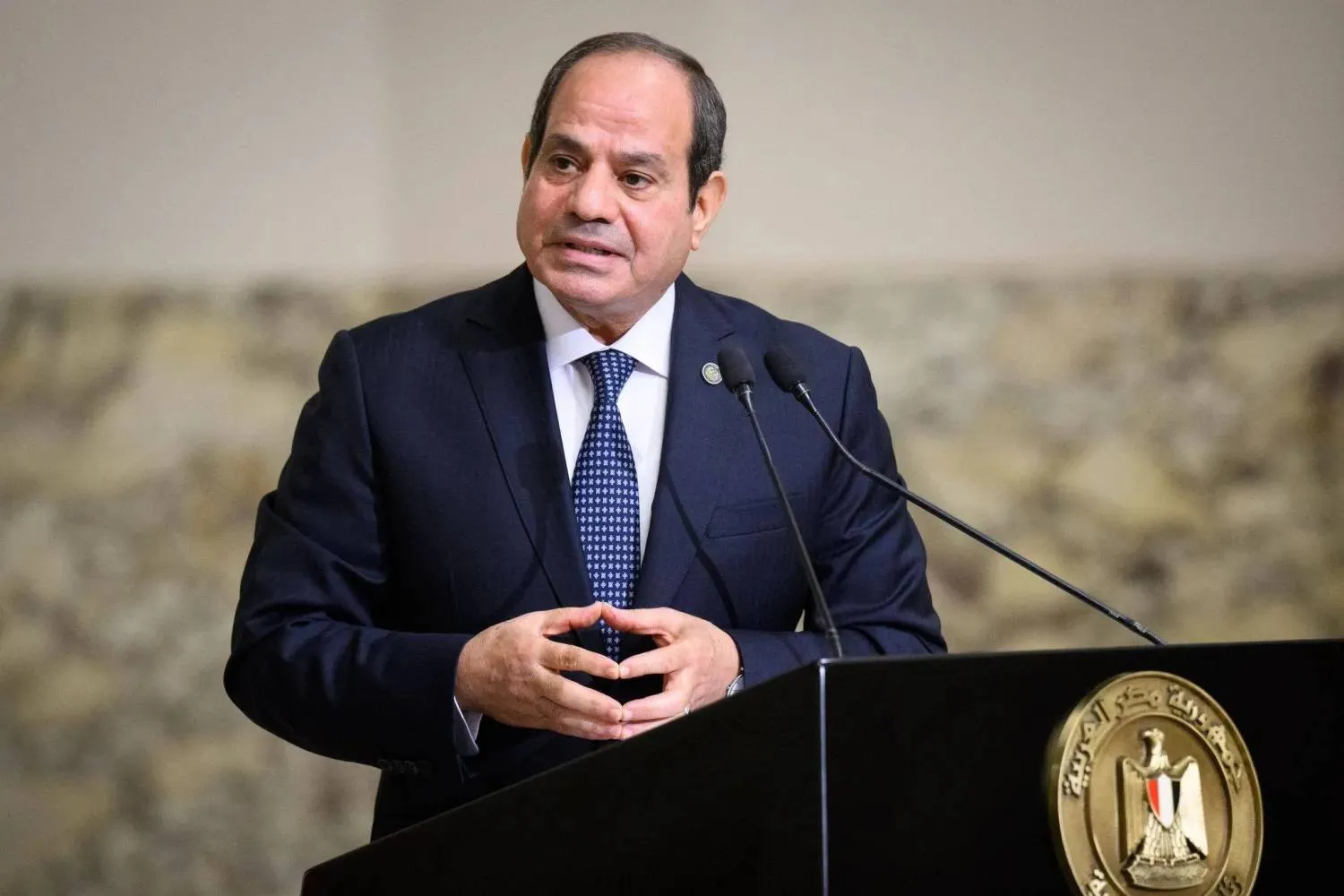
Egyptian President Abdel Fattah al-Sisi. (dpa file)
TT

Egypt’s Sisi Discusses Gaza with Trump Envoy Kushner

Egyptian President Abdel Fattah al-Sisi. (dpa file)

US President Donald Trump's envoy and son-in-law Jared Kushner talked with Egyptian President Abdel Fattah al-Sisi on Sunday about the implementation of the Gaza ceasefire, Sisi's spokesperson said.

The meeting in the Mediterranean city of El-Alamein "stressedthe need for all parties to fulfill their obligations under the Gaza Strip ceasefire agreement", spokesperson Mohamed El-Shennawy said in a statement.


Sanaa's GPC Faces Test of Military Loyalty to Houthis

A scene from an event organized by the Houthi-aligned wing of the General People's Congress in Sanaa (Facebook)
TT

Sanaa's GPC Faces Test of Military Loyalty to Houthis

A scene from an event organized by the Houthi-aligned wing of the General People's Congress in Sanaa (Facebook)

The Houthis have intensified pressure on their political allies in Sanaa, demanding that the local wing of the General People's Congress (GPC) supply hundreds of party members for military training and pay to arm and equip them for deployment to the front lines.

The move is aimed at replenishing the group's depleted ranks amid mounting manpower losses while forcing its political partners to shoulder part of the war's costs.

GPC sources in Sanaa told Asharq Al-Awsat that officials from the Houthis' so-called political bureau visited Sadeq Abu Ras, head of the party's Sanaa wing, at his home several days ago.

Senior party figures, including Abdulaziz bin Habtoor, Yahya al-Rai and Khaled al-Sharif, attended the meeting, during which the Houthi officials demanded concrete action in response to the military escalation, rather than political statements and symbolic activities.

The demands come amid growing tensions between the Houthis and the GPC leadership over what the group considers a failure to participate in military mobilization and recruitment drives, a refusal to send party members to the front lines and a reluctance to provide financial and material support for what it calls the "war effort."

According to the sources, the Houthis ordered GPC leaders to draw up lists of hundreds of members and party officials from Sanaa, its surrounding countryside and other Houthi-controlled provinces for immediate enrollment in open-ended combat training courses.

The recruits would undergo military training and receive weapons before being dispatched to the front lines.

But the Houthis want more than fighters. They have also demanded that GPC leaders finance recruitment, training, weapons and supplies, while Houthi supervisors would control the training programs and decide where the recruits would be deployed.

Houthi leader steps up pressure

Party sources said the Houthis justified their demands by citing leader Abdul Malik al-Houthi's continued dissatisfaction with the GPC leadership's response to battlefield developments and the group's mounting losses.

The message, according to the sources, was that political backing alone was no longer enough. The Houthis wanted direct participation in combat and a commitment to sharing the financial burden of the war.

The demands came with stern warnings and accusations that GPC leaders and members were loyal to Yemen's internationally recognized government and the coalition supporting it.

They were also accused of evading demands to send party members to the front lines and withholding financial and material contributions to the war.

The mounting pressure reflects the scale of the Houthis' manpower and military losses on the fronts in Taiz, Lahj, Marib, al-Dhalea and al-Jawf, the sources said.

Those losses have driven the group to seek fresh recruits and funding, even from political parties and forces under its own control.

Fears of forced recruitment

The demands have alarmed members of the GPC's Sanaa wing, who fear the recruitment lists could be used to single out party members and force them into military training before sending them to fight battles in which they have no stake.

Some party members oppose joining Houthi mobilization programs, describing them as another attempt to subjugate the remaining political parties in areas under the group's control.

They say the Houthis are seeking to curb the parties' political role and turn their activities into platforms for promoting the group's military and sectarian agenda.

Mahmoud, a GPC activist, told Asharq Al-Awsat that the latest recruitment drive followed a wave of media attacks and accusations of disloyalty against party leaders and members in Sanaa.

He said Houthi-aligned activists and media outlets carried out the attacks at the behest of senior Houthi figures to pave the way for further pressure on the party.

The campaign, he added, was part of a broader policy aimed at bringing political parties to heel, stripping them of their independence and turning their members into instruments of the Houthis' military project.

The GPC's Sanaa leadership has faced years of pressure and harassment aimed at forcing it to comply with Houthi decisions and initiatives and provide political cover for the group's actions.

The party's room for independent political action has steadily narrowed as its leadership has become increasingly subject to Houthi dictates.

The Houthis previously pressured GPC leaders in Sanaa to reverse a decision to suspend their participation in the group's internationally unrecognized government and withdraw objections to the so-called "Code of Professional Conduct."

They also forced decisions to remove Ahmed Ali Abdullah Saleh, son of Yemen's late president, from his position as GPC deputy chairman, and imposed restrictions on national holiday celebrations and events marking the anniversary of the party's founding.


US Reaffirms Support for Libya’s Unity, Promotion of ‘Transparency and Accountability’

Massad Boulos, advisor to the US President on African and Middle Eastern Affairs, meets a high-level economic delegation from Libya’s Government of National Unity (GNU) in Washington, DC (Boulos’ account on X)
TT

US Reaffirms Support for Libya’s Unity, Promotion of ‘Transparency and Accountability’

Massad Boulos, advisor to the US President on African and Middle Eastern Affairs, meets a high-level economic delegation from Libya’s Government of National Unity (GNU) in Washington, DC (Boulos’ account on X)

Washington has defended its political initiative in Libya, stating that it aims to accelerate the process of reunifying the divided country, while reaffirming its “commitment to working with Libyan partners to promote economic stability, support transparent and accountable institutions, and ensure that Libya’s resources bring lasting benefits to the Libyan people.”

On Thursday, Massad Boulos, advisor to the US President on African and Middle Eastern Affairs, met with a high-level economic delegation from Libya’s Government of National Unity (GNU) in Washington, DC, to launch a bilateral strategic partnership and discuss Libya's economic and political stabilization.

Boulos said he discussed with the delegation strengthening US-Libya economic cooperation, supporting the development of Libya’s energy sector, and building on recent progress toward greater economic and institutional integration.

In a post on X, he said the United States remains committed to working with Libyan partners to strengthen economic stability, support transparent and accountable institutions, and ensure Libya’s resources deliver lasting benefits for the Libyan people.

“Under President Trump’s leadership, our unification initiative and efforts offer a path towards a unified Libya, open for business, and finally realizing its extraordinary potential,” he wrote.

Later, the State Department said in a statement that Boulos participated in a roundtable discussion hosted at the US Department of Energy to explore opportunities for cooperation between Washington and Tripoli in the energy and trade sectors.

Boulos commended the efforts of the Libyan-US Trade and Investment Council, the host organization, as well as US Department of Energy Undersecretary Kyle Haustveit and the Libyan delegation, for the “fruitful discussion.”

“We are opening doors for American businesses, driving investment and job creation, and creating opportunities for our countries,” he said.

Boulos added that “building a strong and integrated Libyan economy is a fundamental pillar for achieving the broader goal of establishing stability, unity, and prosperity in the country.”

The US initiative rests on unifying the government and the sovereign institutions, so as to stabilize the oil sector and encourage foreign investment, while opening channels of cooperation between the military and security leaderships of eastern and western Libya.

It proposes a power-sharing arrangement that retains Tripoli-based Prime Minister Abdul Hamid Dbeibeh as head of government alongside Saddam Haftar as head of a reformed Presidential Council.


Tunisia: Five-Year Prison Sentence for Prominent Activist Sihem Bensedrine

Tunisian rights activist Sihem Bensedrine
TT

Tunisia: Five-Year Prison Sentence for Prominent Activist Sihem Bensedrine

Tunisian rights activist Sihem Bensedrine

The Court of First Instance of Tunis has sentenced rights activist Sihem Bensedrine to five years in prison on charges of administrative corruption during her tenure as head of a transitional justice commission, according to local agencies and AFP.

Bensedrine was charged under two articles of Tunisia’s Penal Code, relating to the “abuse of office by a public official to cause material harm to the administration” during her tenure as head of the Truth and Dignity Commission (2014–2018), according to Fathi Rebii, Bensedrine's defense team.

Tunisia's Truth and Dignity Commission is an independent body established in 2013 to investigate state-sponsored human rights abuses and financial corruption committed under the mandates of presidents Habib Bourguiba (1957-1987) and Zine El Abidine Ben Ali (1987-2011).

The commission also acted as an arbitrator in cases it heard, and the ruling issued relates to a settlement agreement reached with a businessman.

In the same case, former commission member Khaled Krichi was also sentenced to four years in prison, while ex-minister Mabrouk Korchid received six years, according to Rebii.

Bensedrine was arrested in August 2024 and detained for over six months but has since remained free pending appeals in the cases against her.

Last June, the criminal chamber specialized in financial corruption cases at the Tunis Court of First Instance sentenced Bensedrine to 25 years in prison in cases involving “abuses and violations” in the work of the Truth and Dignity Commission, as well as a settlement agreement reached with businessman Slim Chiboub.

Bensedrine and Khaled Krichi, who had been sentenced to 10 years in prison, appealed the rulings.

In a statement issued on Friday, the organization Lawyers Without Borders in Tunisia condemned the ruling, stating that “instead of combating impunity for perpetrators of gross human rights violations, the judiciary is being exploited to target the body tasked with exposing these violations.”